
Glass Wool Sandwich Panel Production Line
Sinowa is a glass wool sandwich panel production line supplier from china, customized high-quality & high efficiency glass wool sandwich panel production line at low price, the adoption of system integration technology and bus control technology accomplishes the full automatization of integrated and coordinated control of the glass wool sandwich panel production line with accessible remote interactive communication. Ranking the first-class level in the world, it is currently the glass wool sandwich panel production line in the market taking a comprehensive lead in high performance.
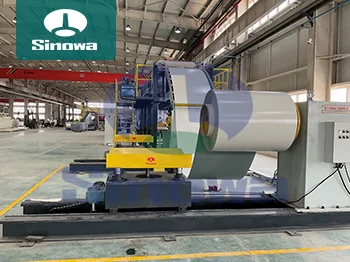
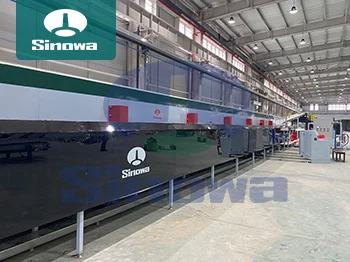
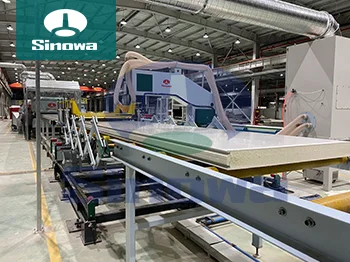
The high-tech glass wool sandwich panel production line can meet a variety of production needs of customers, the whole glass wool sandwich panel production line design concept of modularization enables all our components to be integrated and combined at will. Our high efficiency glass wool sandwich panel production line can easily automate the production of roof sandwich panel, wall sandwich panel, cold storage sandwich panel and other products by different combination and configuration selection and siple switching. The inner core layer can be polyrethane or rock wool, glass wool, an so on.


The high precision glass wool sandwich panel production line has high adaptability, which may produce various sandwich panel of the PU, PIR and rock wool systems. We may design various products according to the customer’s requirements, including various configurations, so as to meet their demands with flexible price system. Highly integrated and linked control system centralizes all control points at the main central center, achieving parameter linkage, fault self-diagnosis controlled by the whole line and shipping distance control. High-level automatic control system also saves the manpower and reduces the manpower loss for customers.


The precision servo hoisting mechanism employed by the main engine without hydraulic system makes the board thickness control flexible and the customer may conveniently change or adjust the board thickness. There will be not such troubles as hydraulic system adjustment, leakage, maintenance, etc.


High-level energy saving and protection design makes the whole glass wool sandwich panel production line possible to produce around the clock throughout the year and the customer will save huge budget. In addition, the isolated heat preservation room is constructed for warming the environment. The energy saving and protection design of our manufacturing line may guarantee that the customer’s production line may be freely heated and produce in the main time to save more costs for customers.


The high-power low-consumption design quickens the reaction of the cheap glass wool sandwich panel production line while energy consumption is kept low. With the brand-new, fully sealed inner insulation design, the energy consumption is controlled at the minimum level to achieve the design objective of less than an hour for the insulation system to be activated from the room temperature above 5℃ to the production process temperature. The energy consumption is only 40% that of those similar products.
A glass wool sandwich panel production line is an integrated automated system designed to manufacture high-performance building panels with excellent thermal insulation and sound absorption properties. It combines glass wool as the core material with outer metal sheets through a series of streamlined processes, ensuring consistent quality and efficient production. The entire line operates continuously, from raw material preparation to final product packaging, minimizing manual intervention and reducing material waste. First, the outer metal sheets are uncoiled and leveled, then cleaned to remove surface impurities that might affect bonding. Meanwhile, glass wool core material is cut to the required thickness and density by automatic cutting equipment, ensuring uniform structure and stable performance. Next, a high-performance adhesive is evenly applied to the metal sheets, and the glass wool core is precisely positioned between the two layers before being pressed and bonded by a double-belt pressing system. The pressing process uses precise temperature control to enhance adhesion, preventing peeling and ensuring the panel’s overall mechanical strength. After compounding, the panels are cut into customized lengths by a CNC cutting system, which maintains high precision without damaging the structure. Finally, the finished panels are automatically stacked and packaged for transportation. This production line is widely applied in manufacturing panels for industrial plants, warehouses, cold storage, and other buildings, meeting the growing demand for energy-saving and fire-resistant building materials. Its automated design improves production efficiency while ensuring the panels’ excellent insulation, soundproofing, and fire-resistant performance, making it an essential equipment in modern building material manufacturing.
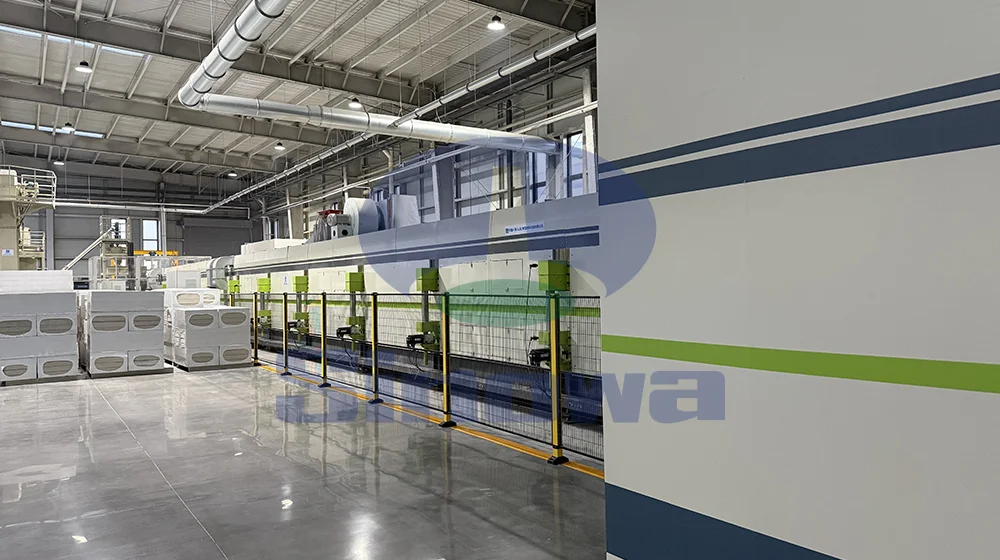
Glass wool sandwich panel production lines are specialized industrial systems designed to manufacture composite panels with a glass wool core and outer facing materials, integrating advanced mechanical technology, automatic control, and material science to ensure consistent quality and efficient production. These production lines play a crucial role in modern construction, industrial insulation, and other fields, as the panels they produce combine excellent thermal insulation, fire resistance, and structural stability, meeting the diverse needs of different application scenarios.
The structure of a glass wool sandwich panel production line is a sophisticated integration of multiple functional units, each responsible for a specific link in the manufacturing process, and the coordinated operation of these units ensures the smooth production of high-quality panels. The basic structural components can be divided into feeding systems, forming systems, bonding systems, cutting systems, cooling and solidifying systems, and conveying systems, each with unique functions and operational principles. The feeding system is the starting point of the production line, responsible for supplying raw materials stably and accurately to subsequent processes. This system usually includes separate feeding units for the upper and lower facing materials and the glass wool core. For the facing materials, which are often metal coils such as galvanized steel or color-coated steel, the feeding unit is equipped with uncoilers that can handle coils of different widths and thicknesses, along with automatic strip connection machines that allow coil changes without stopping the production line, ensuring continuous operation. The glass wool core feeding unit, on the other hand, is designed to transport glass wool slabs, which are first cut into filler strips of appropriate width, rotated 90 degrees to make the fibers perpendicular to the facing materials, and then accurately fed between the upper and lower facing layers. This rotation and cutting process enhances the bonding strength between the core and the facings, as well as the overall structural stability of the final panel.
Following the feeding system is the forming system, which shapes the facing materials into the required profiles to meet different application needs. The forming system mainly consists of roll forming machines, which use a series of precision rollers to gradually bend the flat metal sheets into specific shapes, such as trapezoidal, corrugated, or flat profiles. The roll forming process is carried out continuously and with high precision, ensuring that the facing materials maintain consistent dimensions and shape throughout the production process. For roof panels, the forming system can produce profiles with ribs to enhance load-bearing capacity, while for wall panels, flat or slightly corrugated profiles are often used to ensure a smooth and aesthetically pleasing surface. The forming system also includes adjustment mechanisms that allow operators to quickly switch between different profiles, enabling the production line to adapt to diverse customer requirements without major modifications.
The bonding system is a core component of the production line, as it determines the bonding strength and durability of the sandwich panels. This system typically uses two or multi-component high-pressure metering machines to accurately dose adhesive components, which are then uniformly mixed and applied to the facing materials. The adhesive is usually a high-performance thermal curing adhesive, such as water-based polyurethane, which is environmentally friendly and has strong bonding properties. The even distribution of the adhesive is achieved through an oscillating coating gantry, which ensures that the adhesive covers the entire surface of the facing materials without gaps or unevenness. After the adhesive is applied, the upper and lower facing materials, along with the glass wool core, are fed into a double belt press, which acts as a continuously moving mold. The double belt press applies uniform pressure and temperature to the composite structure, promoting the curing of the adhesive and ensuring a tight bond between the core and the facings. Some advanced production lines also add polyurethane edge sealing to the two sides of the panels during this process, blocking the water absorption path of the glass wool core and extending the service life of the panels.
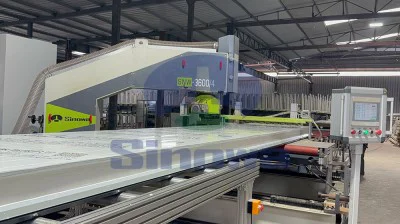
After the bonding process, the continuous composite panel ribbon enters the cutting system, which cuts the ribbon into panels of the required length. The cutting system is equipped with a high-precision cross cutter, which can make straight and smooth cuts without damaging the panel structure. The cutting process is controlled by an automatic system, which can adjust the cutting length according to pre-set parameters, ensuring high accuracy and consistency. To prevent dust and debris from affecting the production environment and the quality of the panels, the cutting system is often equipped with dust collection devices that suck away the debris generated during cutting.
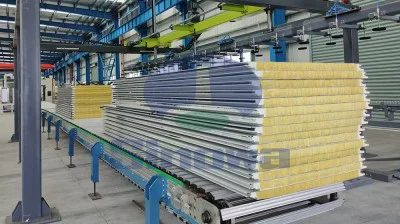
The cooling and solidifying system follows the cutting system, responsible for cooling the newly cut panels to ensure that the adhesive is fully cured and the panels maintain their shape. The cooling system usually consists of a cooling conveyor, which uses air cooling or water cooling to lower the temperature of the panels gradually. The cooling process is carried out in a controlled environment to avoid thermal stress, which could cause deformation or cracking of the panels. After cooling, the panels are conveyed to the stacking system, which automatically stacks the panels onto pallets in an orderly manner. The stacking system is equipped with lifting and positioning mechanisms that ensure the panels are stacked neatly and stably, facilitating subsequent storage and transportation.
In addition to these core functional units, modern glass wool sandwich panel production lines are also equipped with control systems that integrate advanced automation technology to ensure the efficient and stable operation of the entire line. The control system usually adopts a centralized control mode, with a main control console that centralizes all control points, enabling parameter linkage, fault self-diagnosis, and remote interactive communication. Operators can set and adjust production parameters, monitor the operation status of each unit, and handle faults in a timely manner through the control console. The automatic control system not only reduces the need for manual intervention, saving labor costs and reducing human errors, but also improves production efficiency and product quality consistency. Some advanced production lines also adopt system integration and bus control technology, realizing the automatic integrated linkage control of the entire line, which further enhances the level of automation and operational stability.
The performance of a glass wool sandwich panel production line is reflected in its production efficiency, product quality stability, adaptability, energy conservation, and environmental protection, which are the key factors determining the competitiveness and application scope of the production line. Production efficiency is an important performance indicator, usually measured by the annual production capacity and line speed. Modern continuous production lines can achieve an annual production capacity of up to 2,000,000 square meters, with a line speed of up to 15 meters per minute, enabling large-scale mass production to meet the high demand of the market. The high efficiency of these production lines is mainly due to their continuous operation design, automatic feeding and cutting systems, and coordinated operation of all functional units, which minimize downtime and improve production continuity.
Product quality stability is another core performance characteristic of glass wool sandwich panel production lines. High-quality production lines can ensure that the produced panels have consistent dimensions, uniform bonding, and stable performance. The precision of the roll forming machines ensures that the facing materials have accurate dimensions and shape, while the high-precision metering and coating systems ensure uniform adhesive application, avoiding problems such as insufficient bonding or delamination. The double belt press provides uniform pressure and temperature, ensuring full curing of the adhesive and strong bonding between the core and the facings. In addition, the cutting system with high precision ensures that the length of the panels is accurate, with smooth edges and no burrs. The stability of product quality is also guaranteed by the advanced control system, which can monitor and adjust production parameters in real time, correcting any deviations to ensure that the panels meet the required standards.
Adaptability is an important performance indicator that reflects the flexibility of the production line. A good glass wool sandwich panel production line should be able to produce different types, specifications, and profiles of panels to meet the diverse needs of different customers and application scenarios. Through modular design, the production line can easily switch between different production configurations by adjusting the forming rollers, cutting parameters, and feeding methods. For example, it can produce roof panels, wall panels, and cold storage panels by changing the profile of the facing materials and the thickness of the glass wool core. The production line can also adapt to different raw materials, such as different types of metal facings and glass wool cores with different densities and thicknesses. This strong adaptability enables the production line to respond quickly to market changes, expanding its application scope and improving its market competitiveness.
Energy conservation and environmental protection are increasingly important performance requirements for modern industrial production lines, and glass wool sandwich panel production lines are no exception. Advanced production lines adopt a series of energy-saving designs to reduce energy consumption, such as high-power low-consumption motors, fully sealed inner insulation designs, and heat recovery systems. The fully sealed inner insulation design reduces heat loss during the production process, controlling energy consumption at a minimum level. The heat recovery system can recover the heat generated during the curing process and reuse it for preheating the facing materials or the production environment, further saving energy. In terms of environmental protection, the production lines use environmentally friendly adhesives with low VOC emissions, replacing traditional solvent-based adhesives, which reduces air pollution. The dust collection devices in the cutting system prevent dust from being released into the air, protecting the health of operators and the surrounding environment. In addition, the production process of glass wool sandwich panels generates little waste, and the waste materials can be recycled and reused, achieving resource conservation and environmental protection.
The types of glass wool sandwich panel production lines are diverse, and they can be classified according to different standards, such as production mode, automation level, and product type, each with its own characteristics and application scenarios. According to the production mode, the production lines can be divided into continuous production lines and batch production lines. Continuous production lines are large-scale industrial equipment designed for mass production, operating continuously without interruption, ensuring high efficiency and consistent product quality. These production lines are suitable for large manufacturers with high production demand, as they can achieve large-scale production at low cost. The continuous production line is equipped with advanced automatic control systems, requiring minimal manual intervention, and can produce panels of various lengths and profiles by adjusting parameters.
Batch production lines, on the other hand, are designed for small-scale production or customized applications. The production process involves batch processing, where raw materials are melted and processed in discrete batches. Compared with continuous production lines, batch production lines have lower automation levels and may require more manual intervention in operation and maintenance. However, they have the advantage of flexibility, as they can easily adjust production parameters to produce small batches of customized panels, meeting the specific needs of individual customers. Batch production lines are suitable for small and medium-sized manufacturers or enterprises that focus on customized products, as they can avoid the high cost of large-scale continuous production lines while maintaining the ability to produce diverse products.
According to the automation level, glass wool sandwich panel production lines can be divided into fully automatic production lines, semi-automatic production lines, and manual production lines. Fully automatic production lines integrate advanced automatic control technology, with all processes from feeding, forming, bonding, cutting, cooling to stacking being completed automatically, requiring only a small number of operators to monitor and maintain the equipment. These production lines have high production efficiency, stable product quality, and low labor costs, and are widely used in large-scale industrial production. Semi-automatic production lines combine automatic and manual operations, with some key processes such as feeding and forming being completed automatically, while other processes such as stacking and quality inspection are completed manually. These production lines have a lower investment cost than fully automatic production lines and are suitable for small and medium-sized manufacturers with moderate production demand.
Manual production lines rely mainly on manual operation, with simple equipment and low automation levels. These production lines are suitable for small-scale production or start-up enterprises with limited investment capacity, as they have low equipment costs but high labor costs and low production efficiency. However, with the development of industrial automation, manual production lines are gradually being replaced by semi-automatic and fully automatic production lines, as they cannot meet the requirements of large-scale production and high-quality standards.
According to the type of products produced, glass wool sandwich panel production lines can be divided into roof panel production lines, wall panel production lines, cold storage panel production lines, and purification panel production lines. Roof panel production lines are designed to produce panels suitable for roof applications, which usually have trapezoidal or corrugated profiles with strong load-bearing capacity and water resistance. The glass wool core of roof panels is often thicker to ensure good thermal insulation performance, and the edge sealing process is used to prevent water penetration. Wall panel production lines produce panels used for building exterior and interior walls, which can be flat or slightly corrugated, with good thermal insulation, sound insulation, and fire resistance. Cold storage panel production lines are specialized in producing panels for cold storage facilities, which have excellent thermal insulation performance, low thermal conductivity, and good airtightness. The glass wool core of cold storage panels has a higher density, and the adhesive used has good low-temperature resistance to ensure that the panels maintain their performance in low-temperature environments. Purification panel production lines produce panels used for clean rooms, such as those in pharmaceutical, food, and electronics factories, which have good airtightness, dustproof performance, and easy cleaning.
The applications of glass wool sandwich panel production lines are wide-ranging, covering the construction industry, industrial sector, agricultural sector, and other fields, driven by the excellent performance of the glass wool sandwich panels they produce. In the construction industry, glass wool sandwich panels are widely used in industrial plants, warehouses, commercial buildings, residential buildings, and public facilities, serving as wall and roof materials. Industrial plants and warehouses have high requirements for thermal insulation, fire resistance, and structural stability, and glass wool sandwich panels meet these requirements perfectly. The panels are lightweight, reducing the load on the building structure, and have good thermal insulation performance, reducing energy consumption for heating and cooling. In addition, the panels can be installed quickly using modular design and dry construction methods, shortening the construction period and reducing construction costs. For commercial buildings and public facilities, such as shopping malls, hospitals, and schools, glass wool sandwich panels are used for interior and exterior walls, as they have good sound insulation and fire resistance, creating a safe and comfortable environment for users.
In the industrial sector, glass wool sandwich panel production lines play an important role in the manufacturing of insulation materials for industrial equipment and pipelines. Glass wool sandwich panels have excellent thermal insulation and sound absorption performance, making them suitable for use as insulation layers for boilers, furnaces, and pipelines in power plants, chemical plants, and other industrial enterprises. The panels can effectively reduce heat loss, improve energy efficiency, and reduce noise pollution, protecting the environment and improving the working conditions of operators. In addition, glass wool sandwich panels are also used in the manufacturing of cold storage facilities and refrigerated vehicles, as they have good low-temperature resistance and thermal insulation performance, ensuring that the internal temperature of the cold storage or refrigerated vehicle remains stable, preserving the quality of the stored goods.
The agricultural sector is another important application field for glass wool sandwich panel production lines. The panels produced by these lines are used in the construction of greenhouses, livestock houses, and agricultural warehouses. Greenhouses require good thermal insulation and light transmission performance to create a suitable growth environment for crops, and glass wool sandwich panels with transparent or translucent facings can meet these requirements. The panels can maintain a stable temperature inside the greenhouse, extending the growing season of crops and improving crop yields. Livestock houses require good thermal insulation, ventilation, and fire resistance, and glass wool sandwich panels can provide a comfortable living environment for livestock, reducing the incidence of diseases and improving the quality of livestock products. Agricultural warehouses use glass wool sandwich panels for thermal insulation and moisture-proof, protecting agricultural products from moisture and mildew during storage.
In addition to these major fields, glass wool sandwich panel production lines also have applications in other areas, such as the construction of temporary buildings, prefabricated houses, and military facilities. Temporary buildings and prefabricated houses require quick installation and disassembly, and glass wool sandwich panels are lightweight and easy to install, making them an ideal material for such buildings. Military facilities require high structural stability, fire resistance, and thermal insulation, and glass wool sandwich panels meet these strict requirements, providing a safe and reliable protection for military personnel and equipment.
The widespread application of glass wool sandwich panel production lines is also driven by the increasing emphasis on energy conservation and environmental protection worldwide. With the growing awareness of energy conservation and environmental protection, governments and enterprises are actively promoting the use of energy-saving and environmentally friendly building materials. Glass wool sandwich panels are made of inorganic materials, which are non-toxic, harmless, and recyclable, meeting the requirements of environmental protection. The thermal insulation performance of the panels can effectively reduce energy consumption for heating and cooling, contributing to energy conservation and emission reduction. As a result, the demand for glass wool sandwich panels is increasing, driving the development and popularization of glass wool sandwich panel production lines.
In conclusion, glass wool sandwich panel production lines are sophisticated industrial systems with a reasonable structural composition, excellent performance, diverse types, and wide-ranging applications. Their structural design integrates multiple functional units, ensuring the efficient and stable production of high-quality glass wool sandwich panels. The core performance characteristics, such as high production efficiency, stable product quality, strong adaptability, energy conservation, and environmental protection, make them an important part of modern industrial production. The diverse types of production lines can meet the needs of different production scales and product requirements, while their wide-ranging applications cover the construction, industrial, agricultural, and other sectors, contributing significantly to economic development and social progress. With the continuous advancement of technology, glass wool sandwich panel production lines will continue to be upgraded and improved, becoming more efficient, intelligent, and environmentally friendly, and playing an even more important role in the future industrial and construction fields.
« Glass Wool Sandwich Panel Production Line » Update Date: 2026/4/16
URL: https://www.sinowamachine.com/tags/glass-wool-sandwich-panel-production-line.html
![Cheap Glass Wool Sandwich Panel Production Line]()
Cheap Glass Wool Sandwich Panel Production Line
2026-09-03The cheap glass wool sandwich panel production line is a cost-effective, automated manufacturing system designed for mass production of lightweight, thermal-insulating, and soundproof composite panels tailored for construction and industrial enclosure applications. Engineered to balance stable produc…![Glass Wool Sandwich Panel Production Line Supplier]()
Glass Wool Sandwich Panel Production Line Supplier
2026-08-12Glass wool sandwich panel production lines have become core automated manufacturing systems supporting the modern lightweight construction industry, specializing in the integrated production of high-performance composite building panels with glass wool as the core insulation layer. These automated pr…
- Links:
- Sandwich Panel Continuous Production Line
- Automatic and Continuous Sandwich Panel Production Line
- Cheap and Low Price Sandwich Panel Production Line
- China Sandwich Panel Production Line Factory
- Color Steel Sandwich Panel Production Line For Cold Storage
- Continuous Composite Foam Sandwich Panel Production Line
- Continuous Production Line For Rockwool and Mineral Wool Sandwich Panels
- Continuous PU Phenolic Insulation Panel Production Line
- Continuous PU PIR Sandwich Panel Production Line
- Continuous PUF PUR Sandwich Panel Production Line
- Continuous Sandwich Panel Production Line For Roof and Wall
- Customized and Design Sandwich Panel Production Line
- Decorative Sandwich Panel Production Line For Glass Wool Boards
- High Quality Sandwich Panel Production Line For Sale
- Polyurethane(PU) Sandwich Panel Production Line
- Sandwich Panel Production Line Manufacturer and Supplier
- Sandwich Panel Production Machinery and Equipment