
PUR Sandwich Panel Machine
Sinowa is a pur sandwich panel machine supplier from china, customized high-quality & high efficiency pur sandwich panel machine at low price, the adoption of system integration technology and bus control technology accomplishes the full automatization of integrated and coordinated control of the pur sandwich panel machine with accessible remote interactive communication. Ranking the first-class level in the world, it is currently the pur sandwich panel machine in the market taking a comprehensive lead in high performance.
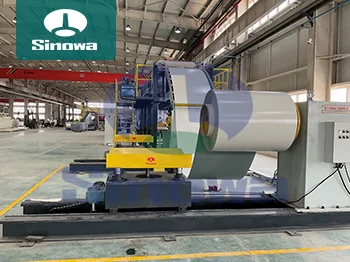
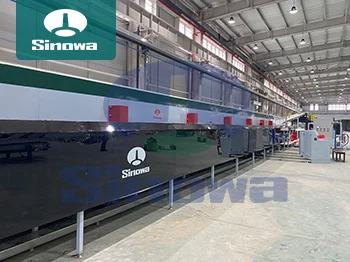
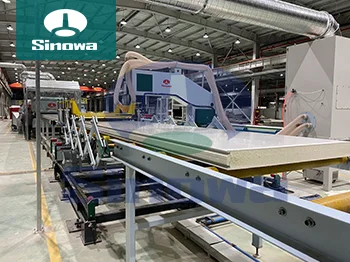
The high-tech pur sandwich panel machine can meet a variety of production needs of customers, the whole pur sandwich panel machine design concept of modularization enables all our components to be integrated and combined at will. Our high efficiency pur sandwich panel machine can easily automate the production of roof sandwich panel, wall sandwich panel, cold storage sandwich panel and other products by different combination and configuration selection and siple switching. The inner core layer can be polyrethane or rock wool, glass wool, an so on.


The high precision pur sandwich panel machine has high adaptability, which may produce various sandwich panel of the PU, PIR and rock wool systems. We may design various products according to the customer’s requirements, including various configurations, so as to meet their demands with flexible price system. Highly integrated and linked control system centralizes all control points at the main central center, achieving parameter linkage, fault self-diagnosis controlled by the whole line and shipping distance control. High-level automatic control system also saves the manpower and reduces the manpower loss for customers.


The precision servo hoisting mechanism employed by the main engine without hydraulic system makes the board thickness control flexible and the customer may conveniently change or adjust the board thickness. There will be not such troubles as hydraulic system adjustment, leakage, maintenance, etc.


High-level energy saving and protection design makes the whole pur sandwich panel machine possible to produce around the clock throughout the year and the customer will save huge budget. In addition, the isolated heat preservation room is constructed for warming the environment. The energy saving and protection design of our manufacturing line may guarantee that the customer’s production line may be freely heated and produce in the main time to save more costs for customers.


The high-power low-consumption design quickens the reaction of the cheap pur sandwich panel machine while energy consumption is kept low. With the brand-new, fully sealed inner insulation design, the energy consumption is controlled at the minimum level to achieve the design objective of less than an hour for the insulation system to be activated from the room temperature above 5℃ to the production process temperature. The energy consumption is only 40% that of those similar products.
The PUR sandwich panel machine is a sophisticated piece of equipment designed specifically for the continuous or discontinuous production of sandwich panels with a polyurethane (PUR) foam core bonded between two facing materials. These machines integrate multiple technological processes, including material uncoiling, forming, foaming, laminating, cutting, and handling, to produce high-quality composite panels that are widely used in various industries due to their excellent insulation, structural strength, and durability. Unlike traditional panel production equipment, PUR sandwich panel machines are engineered to automate the entire manufacturing process, reducing manual intervention, ensuring consistent product quality, and improving production efficiency. The core components and working principles of these machines are tailored to the unique properties of PUR foam, which requires precise control of temperature, pressure, and mixing ratios to achieve optimal bonding and foam formation.
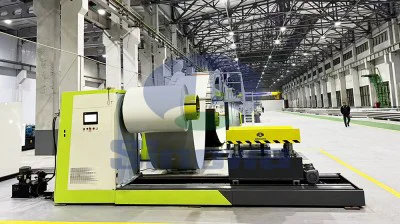
The structure of a PUR sandwich panel machine is a modular system composed of several key functional units that work together seamlessly to complete the panel production process. Each unit is designed to perform a specific task, and the integration of these units ensures a smooth and continuous workflow. The basic structure typically starts with the uncoiling system, which is responsible for feeding the facing materials into the machine. Facing materials commonly used include metal sheets such as steel or aluminum, and the uncoiling system usually consists of two or more uncoilers—one for the top facing and one for the bottom facing—equipped with hydraulic or pneumatic mechanisms to hold and unroll the material coils steadily. To prevent material deviation during uncoiling, the system is often fitted with automatic edge alignment devices that adjust the position of the coils in real time, ensuring that the facing materials remain parallel and properly aligned throughout the production process. Additionally, some uncoiling systems feature coil joining units, which allow for the seamless connection of two coils without interrupting the production line, thereby increasing overall efficiency and reducing downtime.
Following the uncoiling system is the forming unit, which shapes the facing materials into the desired profile. This unit is particularly important for producing panels with specific surface textures or structural designs, such as trapezoidal roof panels, corrugated wall panels, or flat panels with hidden fixings. The forming process is typically carried out by a series of roll forming rollers that gradually bend the flat facing materials into the required shape. The rollers are precision-engineered to ensure consistent profile dimensions and smooth surface finishes, and they can be adjusted or replaced to accommodate different panel designs and thicknesses. In some cases, the forming unit may also include pre-heating devices that warm the facing materials to an optimal temperature before forming, which helps to improve the flexibility of the material and ensure better shaping results. For applications requiring special surface treatments, such as corona treatment or protective film application, additional modules may be integrated into the forming unit to enhance the adhesion of the PUR foam to the facing materials or to protect the panel surfaces from damage during production and transportation.
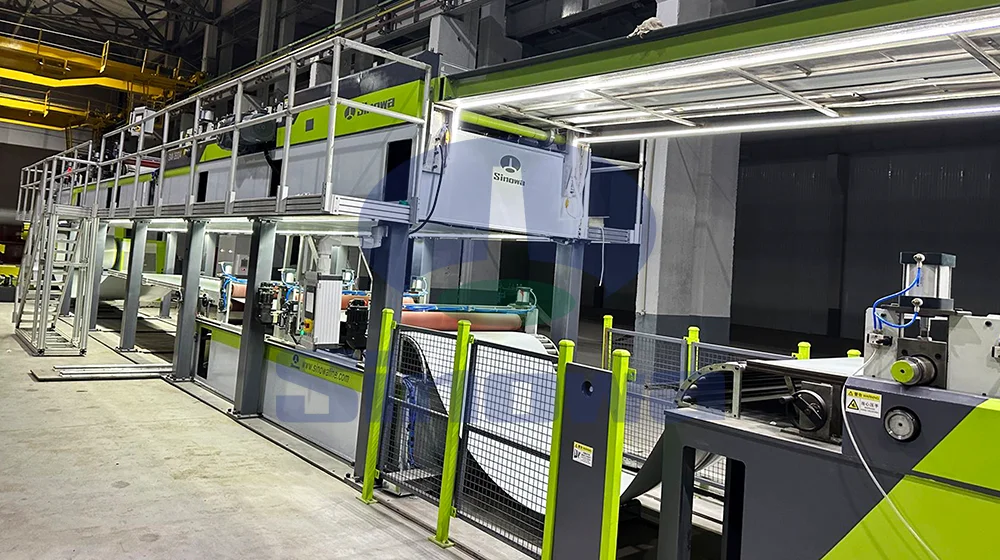
The foaming unit is the heart of the PUR sandwich panel machine, as it is responsible for mixing and applying the PUR foam core that bonds the two facing materials together. PUR foam is produced by mixing two main components—polyol and isocyanate—along with additives such as foaming agents, catalysts, and flame retardants, in precise proportions. The foaming unit consists of a high-pressure or low-pressure mixing system, which ensures thorough and uniform mixing of the components. High-pressure mixing systems are commonly used for large-scale production, as they provide faster mixing speeds and better foam quality, while low-pressure systems are more suitable for small-scale or customized production. The mixing head of the foaming unit is designed to atomize and combine the components efficiently, and it is equipped with a dosing system that controls the flow rate of each component to maintain the correct mixing ratio. The foaming agent, which is often a low-boiling-point liquid such as pentane, causes the mixture to expand rapidly after application, filling the gap between the two facing materials and forming a dense, uniform foam core. To ensure optimal foam expansion and curing, the foaming unit is integrated with temperature control systems that regulate the temperature of the mixing components and the foam during application.
After the foam is applied, the facing materials and foam core move into the laminating and curing unit, which is designed to press the components together and facilitate the curing of the PUR foam. The core of this unit is a double belt press, which consists of two parallel, endless belts that run continuously and apply uniform pressure to the sandwich panel as it passes through. The belts are made of high-strength materials that can withstand high temperatures and pressures, and they are heated to a specific temperature to accelerate the curing process of the PUR foam. The pressure applied by the double belt press ensures that the facing materials are tightly bonded to the foam core, eliminating any gaps or air bubbles that could reduce the panel's structural strength and insulation performance. The length of the double belt press is determined by the production speed and the curing time of the foam, with longer presses being used for high-speed production lines. Additionally, the laminating unit may include side guiding devices and edge trimming systems that ensure the panel edges are straight and uniform, and that any excess foam or material is removed before the panel exits the unit.
The final key component of the PUR sandwich panel machine is the cutting and handling unit. Once the sandwich panel has been cured and laminated, it needs to be cut into the desired lengths for packaging and transportation. The cutting unit is equipped with a flying saw or a circular saw that can cut the panel while it is moving continuously, ensuring precise length control and clean, smooth cuts. Flying saws are particularly suitable for high-speed production lines, as they can adjust their speed to match the speed of the panel, allowing for uninterrupted cutting. The cutting unit is also equipped with a positioning system that uses sensors to detect the panel's position and control the saw's operation, ensuring that each cut is accurate and consistent. After cutting, the handling unit moves the finished panels to a stacking or packaging area. This unit may include conveyor belts, robotic arms, or stacking machines that lift and arrange the panels neatly, reducing manual handling and minimizing the risk of damage to the panels. Some advanced handling systems also include cooling stations that allow the panels to cool completely before stacking, ensuring that the foam core is fully cured and the panel maintains its shape.
The performance of a PUR sandwich panel machine is determined by several key factors, including production efficiency, product quality, energy efficiency, and operational stability. Production efficiency is typically measured by the machine's output rate, which varies depending on the type of machine, the panel thickness, and the production speed. Continuous production machines can achieve output rates of up to 16 meters per minute, making them suitable for large-scale manufacturing, while discontinuous machines have lower output rates but offer greater flexibility for customized production. Product quality is another critical performance indicator, and it is influenced by the precision of the machine's components, the accuracy of the mixing and dosing systems, and the control of temperature and pressure during the foaming and curing processes. High-quality PUR sandwich panel machines can produce panels with consistent foam density, uniform thickness, and strong bonding between the facing materials and foam core, ensuring that the panels meet the required structural and insulation standards. The foam density, which typically ranges from 30 to 100 kg/m³, can be adjusted by the machine to meet different application requirements, with higher density foams offering better structural strength and lower thermal conductivity.
Energy efficiency is an increasingly important performance factor for PUR sandwich panel machines, as manufacturers seek to reduce their energy consumption and environmental impact. Modern machines are equipped with energy-saving technologies such as variable frequency drives (VFDs) that adjust the speed of the motors based on the production load, reducing energy waste during periods of low demand. Additionally, the heating systems of the double belt press and foaming unit are designed to be energy-efficient, with insulation materials that minimize heat loss and temperature control systems that maintain the optimal temperature without excessive energy consumption. Operational stability is also crucial, as downtime can significantly reduce production efficiency and increase costs. PUR sandwich panel machines are built with high-quality components that are resistant to wear and tear, and they are equipped with advanced monitoring and control systems that detect potential faults early and alert operators. These monitoring systems track parameters such as temperature, pressure, mixing ratio, and production speed, allowing operators to make adjustments in real time to prevent breakdowns and ensure consistent performance.
Another important performance characteristic of PUR sandwich panel machines is their flexibility and adaptability. Modern machines are designed to handle a wide range of facing materials, including different types of metal sheets, fiber-reinforced plastics, and even wood-based materials, allowing manufacturers to produce panels for various applications. They can also be adjusted to produce panels of different thicknesses, widths, and lengths, with thicknesses ranging from 20 mm to 300 mm and widths up to 1250 mm or more. Additionally, the machines can be customized to incorporate additional features such as embossing rollers for decorative surfaces, punching equipment for mounting holes, or additional insulation layers for enhanced performance. This flexibility makes PUR sandwich panel machines suitable for both standard and customized production, allowing manufacturers to meet the diverse needs of their customers.
PUR sandwich panel machines can be classified into several types based on their production method, structure, and application. The most common classification is based on the production method, which divides the machines into continuous production lines and discontinuous production lines. Continuous production lines are designed for large-scale, high-volume production of standard sandwich panels. These machines operate continuously, with the uncoiling, forming, foaming, laminating, curing, cutting, and handling processes all integrated into a single, seamless line. Continuous machines offer high production efficiency, consistent product quality, and low labor costs, making them ideal for manufacturers who need to produce large quantities of panels for mass-market applications such as industrial warehouses, commercial buildings, and cold storage facilities. The length of a continuous production line can vary from 24 meters to over 85 meters, depending on the production speed and curing requirements, and the total power consumption typically ranges from 200 kW to 300 kW.
Discontinuous production lines, on the other hand, are designed for small-scale, customized production of sandwich panels. These machines operate in batches, with each production step completed separately before moving on to the next. Discontinuous machines are more flexible than continuous machines, as they can easily be adjusted to produce panels of different sizes, shapes, and configurations, and they are suitable for applications that require specialized panels with unique properties, such as panels with special fixings, custom shapes, or variable thicknesses. The core component of a discontinuous machine is a press, which can be manual, semi-automatic, or fully automatic, and which applies pressure to the sandwich panel during the curing process. Multi-daylight presses are often used in discontinuous production lines to process multiple panels simultaneously, increasing production capacity while maintaining flexibility. Discontinuous machines are commonly used for small-scale manufacturing, prototype production, or applications where the demand for panels is low or variable.
Another classification of PUR sandwich panel machines is based on the type of facing material they process. Metal-faced PUR sandwich panel machines are the most common type, as metal-faced panels are widely used in construction and industrial applications. These machines are designed to handle metal sheets such as steel, aluminum, and galvanized steel, and they are equipped with roll forming units that shape the metal sheets into the desired profiles. Non-metal-faced PUR sandwich panel machines, on the other hand, are designed to process facing materials such as wood-based panels, fiberboard, or plastic sheets. These machines are less common but are used in specialized applications such as interior decoration, furniture manufacturing, and packaging. Additionally, some machines are designed to produce hybrid sandwich panels, which combine different types of facing materials or foam cores, such as PUR and mineral wool, to achieve specific performance characteristics such as enhanced fire resistance or sound insulation.
PUR sandwich panel machines can also be classified based on their automation level. Fully automated machines are equipped with advanced control systems such as PLC (Programmable Logic Controller) and HMI (Human Machine Interface) that allow for full control of the production process, from material feeding to panel cutting and stacking. These machines require minimal manual intervention, with operators only needing to monitor the system and make adjustments when necessary. Fully automated machines are ideal for large-scale production, as they offer high efficiency, consistent quality, and reduced labor costs. Semi-automated machines, on the other hand, require some manual intervention, such as loading the material coils, adjusting the forming rollers, or removing the finished panels from the machine. These machines are suitable for small to medium-scale production, where the cost of a fully automated machine may be prohibitive, and where operators have the skills to perform the required manual tasks. Manual machines are the simplest and most cost-effective type, but they require significant manual labor and are only suitable for very small-scale production or prototype manufacturing.
The applications of PUR sandwich panel machines are closely linked to the applications of the PUR sandwich panels they produce, which are used in a wide range of industries due to their excellent properties. The construction industry is the largest user of PUR sandwich panels, and thus of PUR sandwich panel machines. In construction, PUR sandwich panels are used for exterior walls, roofs, floors, and partitions in residential, commercial, and industrial buildings. The panels' excellent thermal insulation properties help to reduce energy consumption for heating and cooling, making buildings more energy-efficient and environmentally friendly. Their lightweight nature reduces the overall weight of the building, which can lower construction costs by reducing the need for heavy structural supports. Additionally, PUR sandwich panels are easy to install, which speeds up the construction process and reduces labor costs. For example, in high-rise buildings and office complexes, PUR sandwich panels are used as exterior wall cladding to provide insulation and aesthetic appeal, while in industrial warehouses and factories, they are used for roofing and walling due to their durability and resistance to harsh environmental conditions.
The cold storage and refrigeration industry is another major application area for PUR sandwich panel machines. PUR foam has extremely low thermal conductivity, making it an ideal insulation material for cold storage facilities, refrigerated warehouses, cold rooms, and refrigerated transport vehicles such as trucks and containers. The panels produced by PUR sandwich panel machines are used to construct the walls, floors, and ceilings of these facilities, ensuring that the internal temperature is maintained at the required level with minimal energy consumption. The panels' airtight and moisture-resistant properties prevent the formation of condensation, which can damage the stored goods and reduce the efficiency of the refrigeration system. Additionally, PUR sandwich panels are resistant to mold and mildew, which is important for maintaining the quality of perishable goods such as food, pharmaceuticals, and chemicals.
The industrial manufacturing industry also uses a significant number of PUR sandwich panels produced by these machines. In manufacturing facilities, PUR sandwich panels are used for partitioning, clean rooms, and equipment enclosures. Clean rooms, which are required in industries such as electronics, pharmaceuticals, and food processing, require panels that are easy to clean, dust-free, and resistant to contamination. PUR sandwich panels meet these requirements, making them an ideal choice for constructing clean room walls and ceilings. Equipment enclosures made from PUR sandwich panels provide insulation and protection for industrial machinery, reducing noise pollution and preventing heat loss from equipment such as boilers and furnaces. Additionally, PUR sandwich panels are used in the automotive industry for the production of vehicle components such as door panels, roof liners, and floor panels, due to their lightweight nature and sound insulation properties.
The agricultural industry is another growing application area for PUR sandwich panel machines. In agriculture, PUR sandwich panels are used for constructing greenhouses, livestock barns, and storage facilities. Greenhouses require panels that provide good thermal insulation to maintain a stable internal temperature for plant growth, while also allowing sunlight to pass through. PUR sandwich panels with transparent or translucent facing materials are ideal for this application, as they provide insulation while transmitting light. Livestock barns constructed with PUR sandwich panels offer a comfortable environment for animals, with good insulation to regulate temperature and sound insulation to reduce noise stress. Storage facilities for agricultural products such as grains, fruits, and vegetables use PUR sandwich panels to maintain the required storage conditions, preventing spoilage and ensuring product quality.
Other applications of PUR sandwich panel machines include the production of panels for modular buildings, portable cabins, and temporary structures. Modular buildings, which are prefabricated off-site and assembled on-site, are becoming increasingly popular due to their speed of construction and cost-effectiveness. PUR sandwich panels are a key component of modular buildings, as they are lightweight, easy to transport, and can be quickly assembled. Portable cabins, such as construction site offices, temporary housing, and disaster relief shelters, also use PUR sandwich panels produced by these machines, as they are durable, easy to install, and provide good insulation. Additionally, PUR sandwich panels are used in the packaging industry for producing high-strength, lightweight packaging materials for fragile or high-value goods, and in the marine industry for constructing ship interiors and insulation systems.
In conclusion, the PUR sandwich panel machine is a versatile and efficient piece of equipment that plays a critical role in the production of high-quality PUR sandwich panels. Its modular structure, which includes uncoiling, forming, foaming, laminating, cutting, and handling units, ensures a smooth and continuous production process, while its performance characteristics such as production efficiency, product quality, energy efficiency, and flexibility make it suitable for a wide range of production needs. The different types of PUR sandwich panel machines, including continuous, discontinuous, metal-faced, non-metal-faced, fully automated, semi-automated, and manual machines, allow manufacturers to choose the equipment that best fits their production scale, customization requirements, and budget. The applications of these machines span across multiple industries, including construction, cold storage, industrial manufacturing, agriculture, and modular building, reflecting the growing demand for PUR sandwich panels due to their excellent insulation, structural strength, durability, and lightweight nature. As industries continue to focus on energy efficiency, environmental protection, and cost reduction, the demand for PUR sandwich panel machines is expected to grow, driving further technological advancements in machine design and performance.
« PUR Sandwich Panel Machine » Update Date: 2026/2/24
URL: https://www.sinowamachine.com/tags/pur-sandwich-panel-machine.html
![PUR Sandwich Panel Machine Design]()
PUR Sandwich Panel Machine Design
2026-08-12PUR sandwich panel machine design focuses on integrated, automated, and precision-driven manufacturing solutions for producing high-performance polyurethane composite panels widely used in modern construction, cold storage, and industrial enclosure industries. The core design philosophy balances stru…
- Links:
- Sandwich Panel Continuous Production Line
- Automatic and Continuous Sandwich Panel Production Line
- Cheap and Low Price Sandwich Panel Production Line
- China Sandwich Panel Production Line Factory
- Color Steel Sandwich Panel Production Line For Cold Storage
- Continuous Composite Foam Sandwich Panel Production Line
- Continuous Production Line For Rockwool and Mineral Wool Sandwich Panels
- Continuous PU Phenolic Insulation Panel Production Line
- Continuous PU PIR Sandwich Panel Production Line
- Continuous PUF PUR Sandwich Panel Production Line
- Continuous Sandwich Panel Production Line For Roof and Wall
- Customized and Design Sandwich Panel Production Line
- Decorative Sandwich Panel Production Line For Glass Wool Boards
- High Quality Sandwich Panel Production Line For Sale
- Polyurethane(PU) Sandwich Panel Production Line
- Sandwich Panel Production Line Manufacturer and Supplier
- Sandwich Panel Production Machinery and Equipment