
Corrugated Sandwich Panel Production Line
Sinowa is a corrugated sandwich panel production line supplier from china, customized high-quality & high efficiency corrugated sandwich panel production line at low price, the adoption of system integration technology and bus control technology accomplishes the full automatization of integrated and coordinated control of the corrugated sandwich panel production line with accessible remote interactive communication. Ranking the first-class level in the world, it is currently the corrugated sandwich panel production line in the market taking a comprehensive lead in high performance.
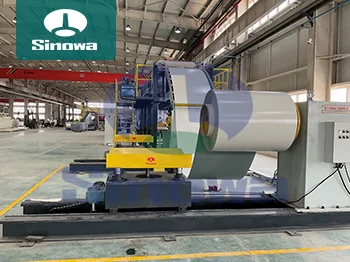
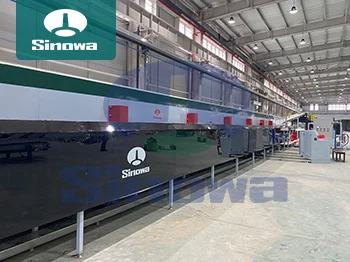
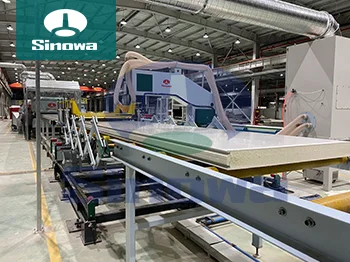
The high-tech corrugated sandwich panel production line can meet a variety of production needs of customers, the whole corrugated sandwich panel production line design concept of modularization enables all our components to be integrated and combined at will. Our high efficiency corrugated sandwich panel production line can easily automate the production of roof sandwich panel, wall sandwich panel, cold storage sandwich panel and other products by different combination and configuration selection and siple switching. The inner core layer can be polyrethane or rock wool, glass wool, an so on.


The high precision corrugated sandwich panel production line has high adaptability, which may produce various sandwich panel of the PU, PIR and rock wool systems. We may design various products according to the customer’s requirements, including various configurations, so as to meet their demands with flexible price system. Highly integrated and linked control system centralizes all control points at the main central center, achieving parameter linkage, fault self-diagnosis controlled by the whole line and shipping distance control. High-level automatic control system also saves the manpower and reduces the manpower loss for customers.


The precision servo hoisting mechanism employed by the main engine without hydraulic system makes the board thickness control flexible and the customer may conveniently change or adjust the board thickness. There will be not such troubles as hydraulic system adjustment, leakage, maintenance, etc.


High-level energy saving and protection design makes the whole corrugated sandwich panel production line possible to produce around the clock throughout the year and the customer will save huge budget. In addition, the isolated heat preservation room is constructed for warming the environment. The energy saving and protection design of our manufacturing line may guarantee that the customer’s production line may be freely heated and produce in the main time to save more costs for customers.


The high-power low-consumption design quickens the reaction of the cheap corrugated sandwich panel production line while energy consumption is kept low. With the brand-new, fully sealed inner insulation design, the energy consumption is controlled at the minimum level to achieve the design objective of less than an hour for the insulation system to be activated from the room temperature above 5℃ to the production process temperature. The energy consumption is only 40% that of those similar products.
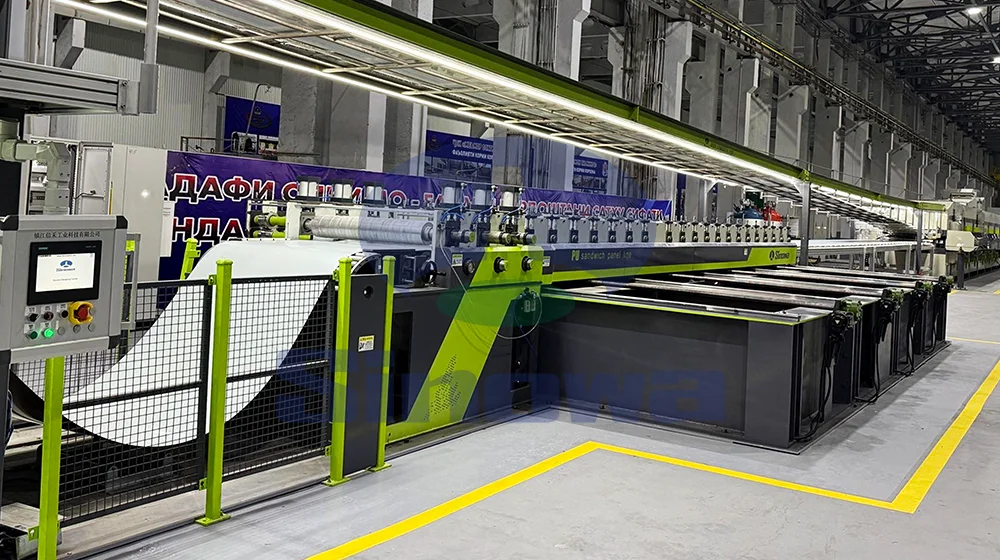
The corrugated sandwich panel production line stands as a highly integrated manufacturing system designed to produce composite structural panels that combine exceptional mechanical strength, lightweight properties and multi-functional performance, reshaping modern construction, industrial manufacturing, transportation and other key sectors with its efficient and standardized production process. Unlike single-layer solid panels, corrugated sandwich panels follow a classic three-layer composite structure, consisting of two parallel outer face sheets and a corrugated core layer firmly bonded between them, a structural design that is precisely engineered and consistently replicated through automated production lines to ensure uniform quality and dimensional accuracy across every finished panel. The production line itself integrates multiple sequential processes, starting with raw material uncoiling and leveling, followed by core layer forming and profiling, adhesive coating and bonding, high-pressure pressing and curing, precise cutting, edge trimming and final packaging, with each stage calibrated to maintain the integrity of the panel’s core structural features. This automated workflow eliminates manual inconsistencies, allowing for mass production of panels with consistent thickness, stable bonding strength and standardized corrugation patterns, which directly determines the overall performance and application adaptability of the final product. The core structural advantage of corrugated sandwich panels lies in the synergistic effect between the outer face sheets and the corrugated core: the face sheets, typically made of rigid and durable materials, bear the majority of tensile and bending stresses, while the corrugated core acts as a vertical and lateral support system, distributing external loads evenly across the entire panel surface and preventing local deformation or collapse. This unique load distribution mechanism sets corrugated sandwich panels apart from other composite panels, as the corrugated core’s periodic, repeating geometric structure creates a rigid framework without excessive material weight, achieving an outstanding strength-to-weight ratio that is hard to match with solid metal or plastic panels of the same thickness.
In terms of structural performance, corrugated sandwich panels deliver a comprehensive set of advantages that make them suitable for demanding operational environments, with each performance attribute directly derived from their layered structure and optimized core design. First and foremost is exceptional mechanical performance, including high compressive strength, superior bending resistance, good shear stability and effective impact absorption. The corrugated core, whether designed in triangular, trapezoidal, rectangular or curved profiles, enhances the panel’s overall rigidity; trapezoidal and rectangular corrugated cores, for instance, offer higher vertical compressive strength, making them ideal for applications with heavy vertical loads, while triangular and curved corrugated cores excel in bending resistance and impact energy dissipation, effectively cushioning external shocks and reducing the risk of sudden structural failure. Unlike foam core sandwich panels that may crush under sustained pressure, corrugated cores maintain their structural integrity under moderate to heavy loads, providing long-term structural stability without significant deformation over time. Beyond mechanical strength, these panels offer excellent thermal insulation performance, a critical feature for temperature-controlled applications; the hollow channels within the corrugated core trap static air, a natural thermal insulator, and when combined with insulating core fillers or insulated face sheet materials, the panels effectively block heat transfer through conduction, convection and radiation, maintaining stable internal temperatures and reducing energy consumption for heating or cooling. Acoustic insulation is another notable performance trait, as the corrugated structure and trapped air layers dampen sound wave transmission, reducing noise penetration from external environments and minimizing internal sound reflection, making them suitable for noise-sensitive spaces. Additionally, corrugated sandwich panels exhibit good moisture resistance, weatherability and dimensional stability; they do not easily absorb water, preventing warping, mold growth or material degradation caused by humidity, and can withstand extreme temperature fluctuations, UV exposure and mild chemical exposure without losing their structural or functional properties. They are also lightweight compared to traditional building materials like concrete, brick or solid steel, reducing the overall dead load of structures, lowering transportation and installation costs, and enabling faster construction and assembly, which is particularly valuable for large-scale projects and modular structures.
Corrugated sandwich panels are classified into distinct varieties based on three key criteria: raw material composition of face sheets and core layers, corrugated core geometry and profile, and functional customization, with each variety tailored to specific performance needs and application scenarios, all efficiently produced on adaptable corrugated sandwich panel production lines. The most common classification is based on face sheet materials, with metal-faced panels being the most widely used category; these typically feature steel or aluminum face sheets, with steel-faced panels offering higher structural strength and durability for heavy-duty applications, and aluminum-faced panels prioritizing lightweight performance, corrosion resistance and ease of handling, ideal for weight-sensitive projects. Non-metal face sheet options include fiber-reinforced composite materials, high-density plastic and coated paperboard, which are used for lightweight, low-load applications that prioritize cost efficiency and corrosion resistance. Core layer materials further divide the panels into pure corrugated core panels and filled corrugated core panels; pure corrugated core panels use only corrugated metal or plastic as the core, focusing on maximum structural rigidity and minimal weight, while filled corrugated core panels integrate insulating materials such as foam, mineral wool or fiber blankets into the corrugated channels, combining structural strength with enhanced thermal and acoustic insulation. Core geometry is another critical classification factor: trapezoidal corrugated panels are the most prevalent, offering a balanced mix of compressive strength, production efficiency and versatility, suitable for most general-purpose applications; rectangular corrugated panels provide maximum vertical load-bearing capacity, perfect for floor panels or heavy-duty wall cladding; triangular and curved corrugated panels offer enhanced flexibility and impact resistance, ideal for curved surfaces, protective enclosures and vibration-damping applications. Additionally, panels can be categorized by production specifications, including thickness, corrugation height, panel width and length, with the production line easily adjustable to accommodate these variations to meet diverse project requirements. There are also specialized varieties designed for specific functional needs, such as moisture-resistant panels for humid environments, fire-retardant panels for high-safety areas, and anti-static panels for industrial workshops with sensitive equipment, each developed by adjusting raw material formulations and production processes without compromising core structural performance.
The versatility of corrugated sandwich panels, enabled by their robust structure and diverse varieties, has led to their extensive adoption across a wide range of industries, with applications spanning residential, commercial, industrial, transportation and even special engineering fields, all supported by the scalable and flexible corrugated sandwich panel production line. In the construction industry, they are one of the most widely used materials for modern prefabricated and modular buildings, serving as wall panels, roof panels, partition walls and ceiling panels for industrial warehouses, logistics centers, factory workshops, commercial exhibition halls and temporary construction sites. Their lightweight nature reduces the need for heavy structural foundations, while their excellent insulation and weatherability create comfortable and durable interior spaces, and their quick-installation design significantly shortens construction cycles compared to traditional building materials. For cold storage and temperature-controlled facilities, corrugated sandwich panels with insulated core fillers are the preferred choice, as their superior thermal insulation performance maintains consistent low or constant temperatures, minimizing energy loss and ensuring the stability of temperature-sensitive goods such as food, pharmaceuticals and agricultural products. In the transportation sector, these panels are used to fabricate body parts for trucks, trailers, shipping containers and railway carriages, where their high strength-to-weight ratio reduces vehicle weight, improves fuel efficiency and increases payload capacity, while their impact resistance protects cargo during transit. They are also used in marine and offshore applications for ship interior partitions, decking and protective cladding, leveraging their corrosion resistance and lightweight properties to withstand harsh marine environments. In industrial manufacturing, they serve as protective barriers, machine enclosures, soundproofing shields and workshop partitions, effectively isolating work areas, reducing noise pollution and enhancing workplace safety. For civil and infrastructure projects, corrugated sandwich panels are used for temporary housing, emergency shelters, road noise barriers and stadium cladding, offering quick deployment, durability and reusability. Even in the aerospace and automotive prototype manufacturing, specialized lightweight corrugated sandwich panels are utilized for their high structural efficiency and customizable performance, where weight reduction and structural reliability are critical. Beyond these traditional applications, the scope of use continues to expand as production technology advances, with modified varieties finding roles in renewable energy facilities, agricultural greenhouses, data center enclosures and other emerging sectors, thanks to their adaptable performance and cost-effective production. The continuous innovation of the corrugated sandwich panel production line further drives this expansion, allowing for the development of new panel varieties with enhanced performance features to meet evolving industry demands, solidifying the status of corrugated sandwich panels as a core composite material in modern engineering and construction.
As a cornerstone of modern composite material manufacturing, the corrugated sandwich panel production line not only ensures the consistent production of high-quality panels but also enables the optimization of structural design and performance to match specific application needs, bridging the gap between manufacturing efficiency and material functionality. The inherent structural advantages of corrugated sandwich panels—lightweight, high strength, excellent insulation and long-lasting durability—address key pain points in traditional materials, such as excessive weight, poor insulation and slow installation, making them a sustainable and practical choice for global infrastructure development and industrial upgrading. Each variety of corrugated sandwich panel is a product of targeted design and precise manufacturing, with the production line’s flexibility allowing for seamless adjustments to material combinations, core profiles and dimensional specifications without sacrificing performance uniformity. This adaptability ensures that corrugated sandwich panels can meet the unique requirements of every application, from heavy-duty industrial structures to lightweight decorative panels, from extreme temperature environments to high-noise industrial zones. As the demand for efficient, sustainable and high-performance building and industrial materials continues to grow, corrugated sandwich panels will remain a dominant solution, with ongoing advancements in production line technology and material science further enhancing their structural performance, expanding their application boundaries and reinforcing their position as an indispensable material in modern engineering and manufacturing sectors worldwide.
« Corrugated Sandwich Panel Production Line » Update Date: 2026/3/24
URL: https://www.sinowamachine.com/tags/corrugated-sandwich-panel-production-line.html