
Rock Wool Production Line
Sinowa is a rock wool production line supplier from china, customized high-quality & high efficiency rock wool production line at low price, the adoption of system integration technology and bus control technology accomplishes the full automatization of integrated and coordinated control of the rock wool production line with accessible remote interactive communication. Ranking the first-class level in the world, it is currently the rock wool production line in the market taking a comprehensive lead in high performance.
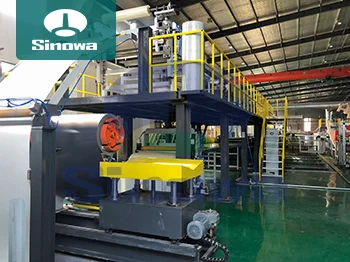
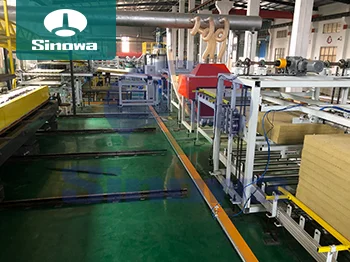
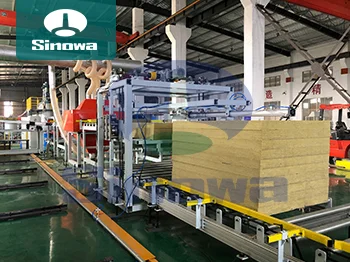
The high-tech rock wool production line can meet a variety of production needs of customers, the whole rock wool production line design concept of modularization enables all our components to be integrated and combined at will. Our high efficiency rock wool production line can easily automate the production of roof sandwich panel, wall sandwich panel, cold storage sandwich panel and other products by different combination and configuration selection and siple switching. The inner core layer can be polyrethane or rock wool, glass wool, an so on. The precision servo hoisting mechanism employed by the main engine without hydraulic system makes the board thickness control flexible and the customer may conveniently change or adjust the board thickness. There will be not such troubles as hydraulic system adjustment, leakage, maintenance, etc.
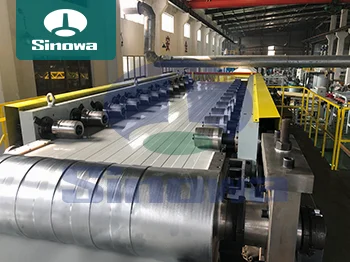
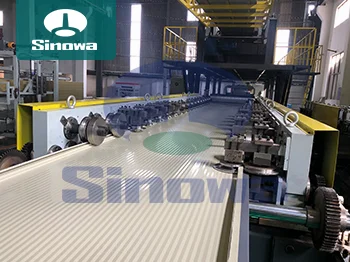
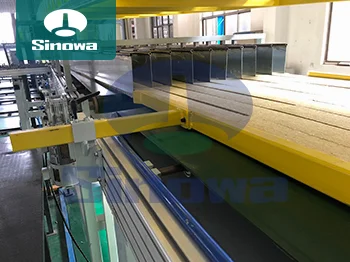
The high precision rock wool production line has high adaptability, which may produce various sandwich panel of the PU, PIR and rock wool systems. We may design various products according to the customer’s requirements, including various configurations, so as to meet their demands with flexible price system. Highly integrated and linked control system centralizes all control points at the main central center, achieving parameter linkage, fault self-diagnosis controlled by the whole line and shipping distance control. High-level automatic control system also saves the manpower and reduces the manpower loss for customers. High-level energy saving and protection design makes the whole rock wool production line possible to produce around the clock throughout the year and the customer will save huge budget. In addition, the isolated heat preservation room is constructed for warming the environment. The energy saving and protection design of our manufacturing line may guarantee that the customer’s production line may be freely heated and produce in the main time to save more costs for customers.
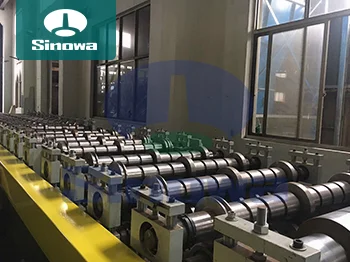
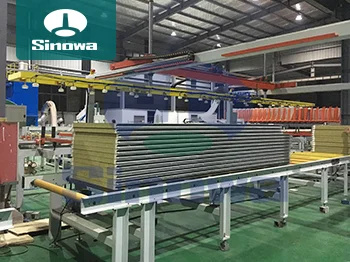
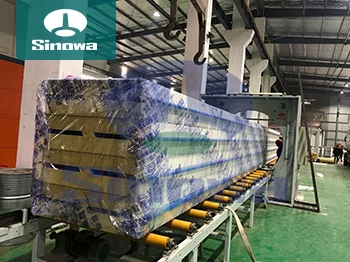
The high-power low-consumption design quickens the reaction of the cheap rock wool production line while energy consumption is kept low. With the brand-new, fully sealed inner insulation design, the energy consumption is controlled at the minimum level to achieve the design objective of less than an hour for the insulation system to be activated from the room temperature above 5℃ to the production process temperature. The energy consumption is only 40% that of those similar products.
The rock wool sandwich panel production line is a fully integrated, automated manufacturing system dedicated to the mass production of high-performance composite building panels widely used in modern construction, industrial workshops, clean rooms, and public infrastructure projects. This advanced production system integrates multiple automated processing units to complete the whole manufacturing process from raw material pretreatment, core material processing, adhesive coating, composite pressing, and curing to precision cutting and finished product stacking. Different from traditional panel manufacturing equipment, this production line features continuous operation, high operational stability, and intelligent parameter adjustment, which effectively unifies the appearance quality and structural performance of finished panels. The core advantage of the production line lies in its precise control over rock wool core forming and metal surface bonding, endowing the final products with excellent fire resistance, thermal insulation, and sound absorption properties. With flexible production configurations, it can adapt to diverse panel specifications and meet the customized production demands of different construction scenarios while maintaining stable and efficient long-term operation.
Raw material preparation and pretreatment constitute the foundational stage of the entire rock wool sandwich panel production process, directly determining the surface quality and structural stability of finished products. The main raw materials involved include coiled metal sheets for panel surface layers and bulk rock wool materials for the insulating core. Metal coils are loaded onto automatic unwinding units equipped with hydraulic tension control systems, which sustain uniform tension during material release to prevent sheet wrinkling, stretching, or uneven flatness that may affect subsequent composite processing. After unwinding, the metal sheets go through leveling, trimming, and deburring devices to eliminate edge defects and subtle structural deviations generated during coil manufacturing, ensuring the surface materials meet precise dimensional and flatness standards. In parallel, bulk rock wool raw materials undergo specialized pretreatment procedures, including impurity removal, fiber loosening, and density homogenization. This process eliminates agglomerated rock wool blocks and uneven fiber distribution, laying a solid foundation for consistent thermal and mechanical performance of the panel core. All pretreatment procedures operate synchronously through linked mechanical systems, realizing seamless material supply for subsequent production links and avoiding production stagnation caused by unqualified raw material processing.
Core material forming and shaping is a pivotal process that defines the functional performance of rock wool sandwich panels, focusing on optimizing the internal fiber structure and overall compactness of rock wool cores. After pretreatment, loose rock wool fibers are transported to the core forming unit through automated conveying systems, where professional equipment conducts uniform fiber spreading and directional arrangement. Unlike ordinary wool processing methods, this production line adopts targeted fiber carding technology to arrange rock wool fibers in a regular orientation, which significantly enhances the overall structural strength and pressure resistance of the core material. During the forming process, the system precisely controls the laying thickness and density of rock wool according to preset production parameters, ensuring consistent core specifications of each panel. Meanwhile, auxiliary dust removal and shaping devices clean up floating fibers on the surface of formed rock wool blankets and trim irregular edges to form complete, neat core slabs with uniform thickness. This refined forming process effectively avoids local hollowing, uneven density, and structural defects in the rock wool core, ensuring that each finished panel maintains stable thermal insulation, sound insulation, and fireproof performance in actual application scenarios.
Adhesive coating and composite assembly are key links to realize the integrated structure of metal surface layers and rock wool cores, determining the bonding firmness and overall durability of sandwich panels. The production line is equipped with an automatic precision gluing system that evenly sprays high-performance adhesive on the inner surfaces of upper and lower metal sheets. The gluing system features adjustable glue amount and spraying range, which can adapt to different panel widths and production speeds, ensuring full coverage of the bonding surface without excess glue accumulation or missing coating. After gluing, the pretreated rock wool core slabs are automatically positioned and laid between the two metal sheets through a core feeding and positioning device, achieving accurate alignment of the core material and surface layers to avoid offset and dislocation. Subsequently, the initially assembled semi-finished panels enter the composite positioning unit for preliminary shaping, where fine position correction is carried out to ensure the overall dimensional accuracy of the composite structure. The entire composite assembly process is completed by automated mechanical linkage, which replaces traditional manual operation, effectively improving assembly accuracy and efficiency while eliminating unstable bonding quality caused by human errors.
High-pressure lamination and constant-temperature curing are critical processes to solidify the composite structure and enhance the overall performance of rock wool sandwich panels. After composite assembly, semi-finished panels are sent to a double-belt pressing machine, the core equipment for lamination molding. The double-belt press maintains stable and uniform mechanical pressure throughout the entire panel surface, enabling the adhesive to fully infiltrate the tiny gaps between metal sheets and rock wool fibers, thus forming a tight integrated bonding structure. The pressure value and pressing speed are intelligently adjusted according to panel thickness and material characteristics to ensure moderate bonding compactness without crushing the internal rock wool fiber structure. Following lamination, panels enter the constant-temperature curing channel for staged heat treatment. The curing system adopts gradient temperature control to accelerate the curing reaction of the adhesive, gradually enhancing bonding strength and structural stability. Staged curing avoids quality problems such as incomplete adhesive curing or material deformation caused by excessive instantaneous temperature. After full curing, the bonding interface achieves excellent tightness and durability, enabling the panels to resist external temperature changes and mechanical extrusion in long-term use.
Precision sizing cutting and edge finishing ensure the dimensional standardization and appearance refinement of finished rock wool sandwich panels. After curing and shaping, continuous integrated panel strips are transported to the automatic cross-cutting unit, which executes fixed-length cutting according to customized production parameters. The cutting device adopts high-precision servo control technology to realize smooth and neat cutting sections without burrs, cracks, or fiber shedding, effectively guaranteeing the dimensional consistency of each finished panel. After cutting, the panels enter the edge finishing process, where professional trimming equipment polishes and shapes the four edges of the panels to eliminate residual fibers and tiny irregularities generated during cutting. For panels requiring special edge structures, the production line can complete groove processing and edge sealing treatment through supporting auxiliary devices to optimize the panel assembly effect in subsequent construction. All cutting and finishing procedures operate synchronously with the front-end production process, realizing continuous and uninterrupted production. The refined post-processing technology not only improves the appearance grade of finished products but also avoids assembly gaps and performance attenuation caused by dimensional deviations in practical engineering applications.
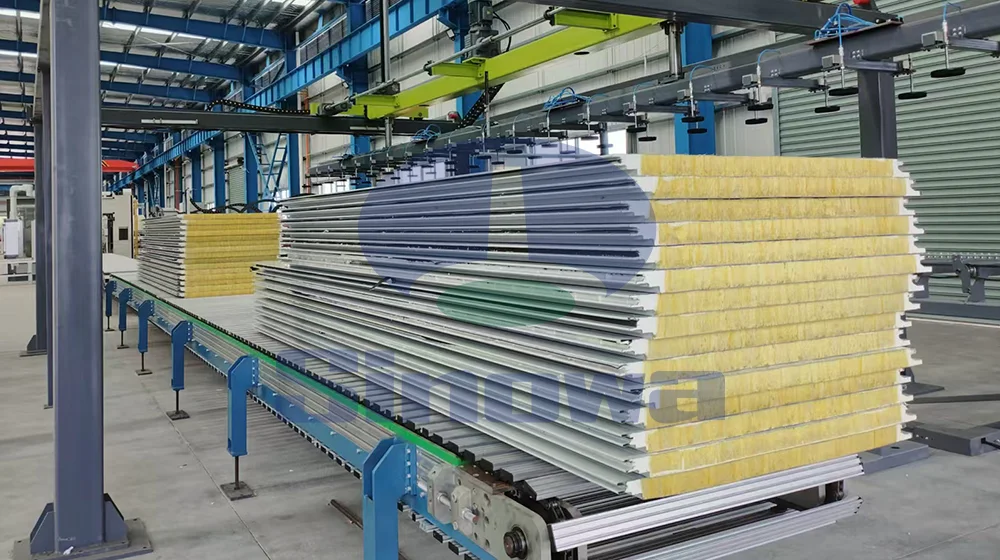
Automatic stacking and finished product output constitute the final link of the production line, realizing efficient collection and standardized storage of qualified rock wool sandwich panels. After finishing treatment, qualified panels are automatically conveyed to the stacking platform through a roller conveying system. The intelligent stacking device adopts programmable control to complete orderly stacking of panels according to specified layers and spacing, with precise positioning to avoid panel collision, friction, and surface scratch damage during stacking. The system can adjust stacking specifications according to panel sizes and production batches, realizing standardized packaging preparation for different product types. After stacking is completed, the finished panel stacks are automatically transported out of the production line through the discharge device, facilitating subsequent packaging, storage, and transportation. The fully automated output and stacking mode greatly reduces manual intervention, lowers labor costs and manual operation errors, and effectively improves the overall production efficiency of the line. Meanwhile, the orderly finished product output mode ensures the continuity of production operations, avoiding production line shutdowns caused by untimely material collection.
Intelligent control system and overall operational advantages make the modern rock wool sandwich panel line highly adaptable and competitive in the building material manufacturing industry. The entire production process is centrally controlled by an integrated intelligent system, which monitors and adjusts key production parameters such as material feeding speed, gluing volume, pressing pressure, and curing temperature in real time. The visual operation interface enables operators to intuitively grasp the production status of each link and conduct timely parameter optimization and fault adjustment, realizing refined production management. Compared with traditional semi-automatic production equipment, this fully continuous production line significantly improves production efficiency through synchronous linkage of all units, with stable and continuous production rhythm greatly increasing hourly output. In terms of product quality, unified mechanical and parametric control eliminates quality differences caused by manual operation, ensuring consistent performance of each batch of panels. In addition, the production line is designed with environmental protection and energy-saving structures, which reduce material waste and dust generation during processing, realizing green and efficient production while lowering comprehensive production and operation costs.
« Rock Wool Production Line » Update Date: 2026/8/27
URL: https://www.sinowamachine.com/tags/rock-wool-production-line.html
![Sandwich Panel Rock Wool Production Line]()
Sandwich Panel Rock Wool Production Line
2026-08-12The rock wool sandwich panel production line is a sophisticated integrated manufacturing system designed for the automated and continuous production of high-performance composite building panels. It integrates multiple functional units to complete the entire production process from raw material pretr…![Automatic Rock Wool Production Line]()
Automatic Rock Wool Production Line
2026-02-24Automatic rock wool production lines are integrated systems designed to realize the continuous, efficient and standardized production of rock wool products, which are widely used in various fields due to their excellent thermal insulation, fire resistance and sound absorption properties. Unlike tradi…
- Links:
- Sandwich Panel Continuous Production Line
- Automatic and Continuous Sandwich Panel Production Line
- Cheap and Low Price Sandwich Panel Production Line
- China Sandwich Panel Production Line Factory
- Color Steel Sandwich Panel Production Line For Cold Storage
- Continuous Composite Foam Sandwich Panel Production Line
- Continuous Production Line For Rockwool and Mineral Wool Sandwich Panels
- Continuous PU Phenolic Insulation Panel Production Line
- Continuous PU PIR Sandwich Panel Production Line
- Continuous PUF PUR Sandwich Panel Production Line
- Continuous Sandwich Panel Production Line For Roof and Wall
- Customized and Design Sandwich Panel Production Line
- Decorative Sandwich Panel Production Line For Glass Wool Boards
- High Quality Sandwich Panel Production Line For Sale
- Polyurethane(PU) Sandwich Panel Production Line
- Sandwich Panel Production Line Manufacturer and Supplier
- Sandwich Panel Production Machinery and Equipment