
Rockwool Sandwich Panel Production Line
Sinowa is a rockwool sandwich panel production line supplier from china, customized high-quality & high efficiency rockwool sandwich panel production line at low price, the adoption of system integration technology and bus control technology accomplishes the full automatization of integrated and coordinated control of the rockwool sandwich panel production line with accessible remote interactive communication. Ranking the first-class level in the world, it is currently the rockwool sandwich panel production line in the market taking a comprehensive lead in high performance.
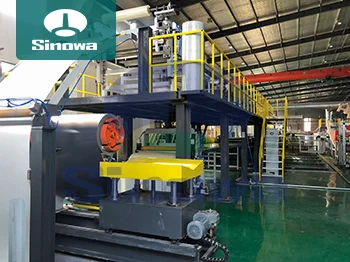
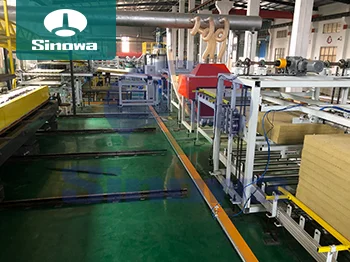
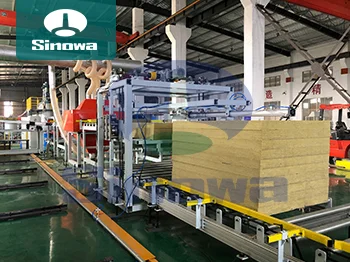
The high-tech rockwool sandwich panel production line can meet a variety of production needs of customers, the whole rockwool sandwich panel production line design concept of modularization enables all our components to be integrated and combined at will. Our high efficiency rockwool sandwich panel production line can easily automate the production of roof sandwich panel, wall sandwich panel, cold storage sandwich panel and other products by different combination and configuration selection and siple switching. The inner core layer can be polyrethane or rock wool, glass wool, an so on. The precision servo hoisting mechanism employed by the main engine without hydraulic system makes the board thickness control flexible and the customer may conveniently change or adjust the board thickness. There will be not such troubles as hydraulic system adjustment, leakage, maintenance, etc.
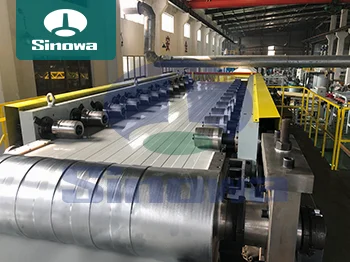
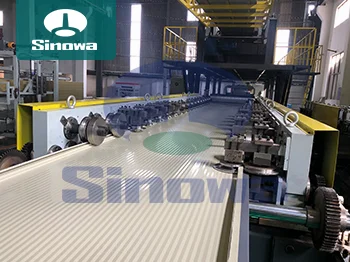
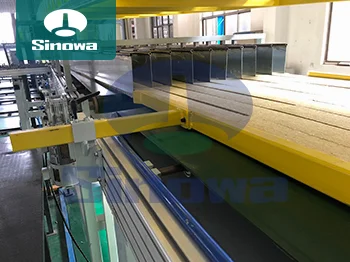
The high precision rockwool sandwich panel production line has high adaptability, which may produce various sandwich panel of the PU, PIR and rock wool systems. We may design various products according to the customer’s requirements, including various configurations, so as to meet their demands with flexible price system. Highly integrated and linked control system centralizes all control points at the main central center, achieving parameter linkage, fault self-diagnosis controlled by the whole line and shipping distance control. High-level automatic control system also saves the manpower and reduces the manpower loss for customers. High-level energy saving and protection design makes the whole rockwool sandwich panel production line possible to produce around the clock throughout the year and the customer will save huge budget. In addition, the isolated heat preservation room is constructed for warming the environment. The energy saving and protection design of our manufacturing line may guarantee that the customer’s production line may be freely heated and produce in the main time to save more costs for customers.
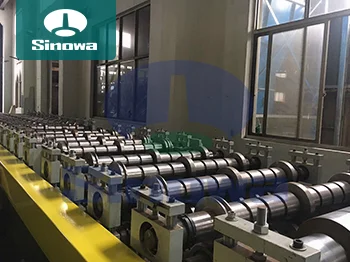
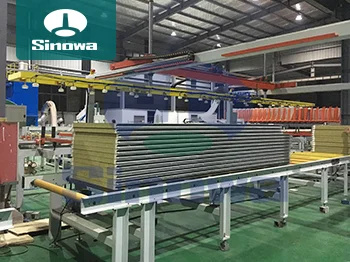
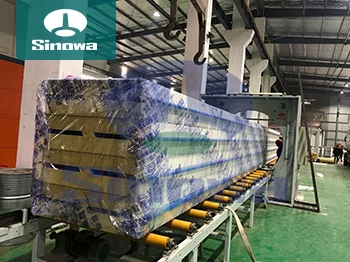
The high-power low-consumption design quickens the reaction of the cheap rockwool sandwich panel production line while energy consumption is kept low. With the brand-new, fully sealed inner insulation design, the energy consumption is controlled at the minimum level to achieve the design objective of less than an hour for the insulation system to be activated from the room temperature above 5℃ to the production process temperature. The energy consumption is only 40% that of those similar products.
The rockwool sandwich panel production line is a sophisticated integration of mechanical, electrical, and material processing technologies, designed to realize efficient and continuous manufacturing of high-performance sandwich panels. It streamlines the entire production process from raw material input to finished product stacking, minimizing human intervention and ensuring consistent product quality. The production process typically starts with the uncoiling of surface materials, usually metal coils, which are fed into a roll forming unit to be shaped into desired profiles through a series of precisely designed rollers. Meanwhile, the rockwool core material is processed, cut to appropriate thickness, and evenly laid between the two surface layers. An adhesive application system ensures strong bonding between the core and surface layers, followed by a composite pressing process that enhances the panel’s structural stability and density. The final step involves cutting the continuous panel into preset lengths and stacking them neatly for subsequent transportation. This production line boasts high automation, allowing for flexible adjustment of parameters to produce panels of different specifications, adapting to diverse needs in industrial warehouses, commercial buildings, and prefabricated residences. Its efficient design not only improves production capacity but also ensures the panels retain excellent properties such as fire resistance, thermal insulation, and sound absorption, making it an essential equipment in the modern construction material industry.
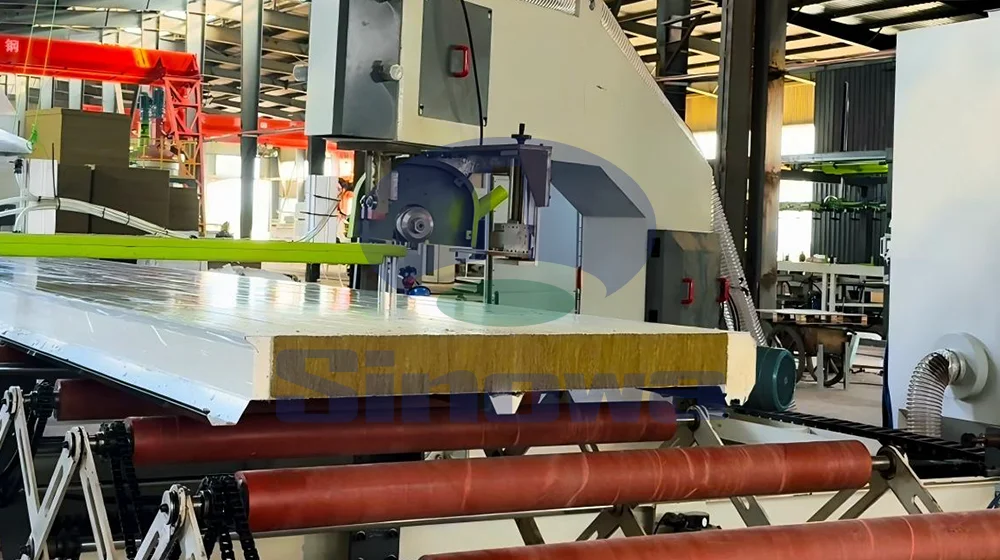
The rockwool sandwich panel production line is a sophisticated integrated system that combines mechanical engineering, electrical control, hydraulic technology, and material processing science to transform raw materials into high-performance composite panels through a series of continuous, automated operations. Unlike traditional production methods that rely heavily on manual intervention, this advanced line streamlines the entire manufacturing process from raw material feeding to final product stacking, ensuring consistent quality while reducing operational complexity. Its structural design is characterized by modular components that work in harmony, each contributing to the overall functionality and reliability of the system, making it an indispensable core equipment in the modern construction and industrial material manufacturing industry. The rationality of its structure directly determines the production efficiency, product quality, and long-term operational stability, while its performance characteristics determine the adaptability to different raw materials and production requirements, and its diverse types and wide range of applications enable it to meet the needs of various industries and scenarios.
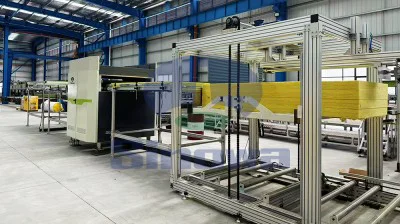
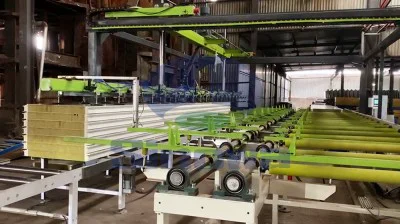
The structure of the rockwool sandwich panel production line is a modular combination designed to accommodate the unique properties of rockwool and ensure optimal processing conditions, consisting of several core functional units that cooperate seamlessly to complete the entire production process. At the beginning of the production line is the feeding system, which typically includes chain plate conveyors and lifting devices equipped with frequency conversion control technology. This design minimizes vibration and prevents damage to the rock wool slabs during transportation, ensuring the integrity of the raw materials. The raw rock wool slabs, usually with dimensions ranging from 1200 mm to 2400 mm in length, 1200 mm in width, and up to 105mm in thickness, are gently transferred by the conveyors to the next processing station. Connected to the feeding system is the automatic slitting system, which is a core component of the production line. It comprises a set of precision rolling blades driven by an AC asynchronous motor, with a tool spacing adjuster that allows for flexible adjustment of strip widths according to production requirements. Common strip thicknesses range from 50 mm to 250 mm, with a slitting gap controlled to approximately 3.3 mm to ensure clean, smooth cuts and reduce material waste. After slitting, the rock wool strips are transferred to a 90-degree flipping device, which uses a continuous rotary motion to reorient the strips so that their fiber direction is vertical, a key step that significantly enhances the structural strength and load-bearing capacity of the final sandwich panels by distributing stress more evenly.
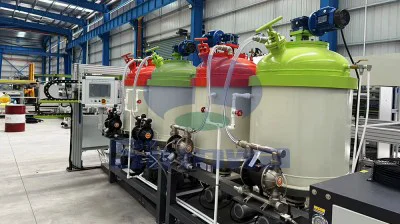
Following the slitting and flipping process is the adhesive application unit, which is responsible for applying a uniform layer of adhesive to the surface of the rock wool core and the facing materials. The adhesive application system adopts precise quantitative control technology to ensure that the adhesive amount is consistent across the entire surface, avoiding problems such as insufficient adhesion or excessive adhesive waste. The facing materials, which can be color steel plates, galvanized sheets, aluminum sheets, or other metal materials, are fed into the production line through a separate uncoiling system. The uncoiling system, often equipped with hydraulic decoilers, includes feeding trolleys and hydraulic stations to ensure stable and smooth uncoiling of the metal coils, which typically have a thickness of 0.2 to 0.8 mm and a maximum width of 1250 mm. After uncoiling, the facing materials undergo preliminary processing such as surface cleaning and preheating to remove impurities and rust, which is crucial for enhancing the adhesion of the adhesive and ensuring the durability of the finished panels. The preheating process is usually completed in a preheating room or through hot air circulation heating, which controls the temperature within a suitable range to optimize the bonding effect between the facing materials and the rock wool core.
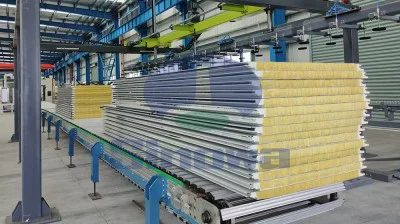
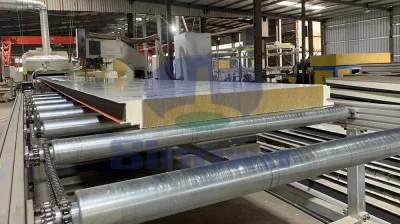
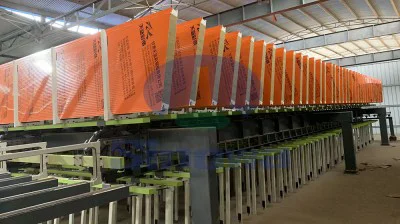
The lamination station is another key part of the production line, where the rock wool core and the upper and lower facing materials are pressed together to form a composite structure. The lamination process is carried out by a double belt conveyor system, which uses two parallel conveyor belts to apply uniform pressure to the composite panel, ensuring that the three layers are closely bonded without gaps. The double belt conveyor is often equipped with a heating device that maintains a constant temperature to promote the curing of the adhesive, further improving the bonding strength. The length of the double belt conveyor typically ranges from 16000 mm to 36000 mm, providing sufficient time for the adhesive to cure and the composite panel to form a stable structure. After lamination, the composite panel is transferred to the cutting-to-length component, which uses an automatic tracking band saw to cut the continuous panel into specified lengths according to production requirements. The cutting system is equipped with precise positioning technology to ensure that the cutting length is accurate and the cut surface is flat, avoiding burrs or uneven edges. Finally, the cut panels are transferred to the stacking and packaging system, where they are automatically stacked in an orderly manner and packaged to prevent damage during transportation and storage. The entire production line is controlled by a central electrical control system, which adopts PLC automatic control and a human-machine interface (HMI) to realize intelligent operation, allowing operators to set production parameters, monitor the production process, and handle faults in real time.
The performance of the rockwool sandwich panel production line is reflected in multiple aspects, including production efficiency, processing precision, stability, adaptability, and environmental friendliness, which are the key indicators to measure the quality and competitiveness of the production line. In terms of production efficiency, the line adopts continuous automated operation, with a production speed ranging from 3 to 10 meters per minute, which can be adjusted according to actual production needs. This high efficiency significantly reduces the production cycle compared with manual or semi-automatic production methods, enabling large-scale mass production to meet the growing market demand. Processing precision is another important performance indicator, which is guaranteed by the advanced design of each component. The automatic slitting system can achieve precise slitting of rock wool slabs with an error of less than 1 mm, ensuring the uniformity of the rock wool core width. The lamination station uses uniform pressure control technology to ensure that the thickness of the composite panel is consistent, with a thickness error within ±0.5 mm. The cutting system can accurately cut the panel to the specified length, with a length error of less than 2 mm, ensuring the dimensional accuracy of the finished product.
Stability is a key factor affecting the long-term operation of the production line. The modular design of the line makes each component independent and easy to maintain, reducing the probability of overall failure. The electrical control system adopts mature and reliable components, which can stably control the operation of each unit, avoiding sudden shutdowns caused by electrical faults. The mechanical components are made of high-strength materials and undergo strict heat treatment and precision processing, ensuring good wear resistance and service life. The bearing capacity of the conveyor system is designed according to the maximum load of the raw materials and finished products, preventing deformation or damage during operation. Adaptability is another important performance of the production line, which can be adjusted according to different raw materials and product specifications. For example, it can process rock wool slabs of different densities (ranging from 85 kg/m³ to 150 kg/m³) and thicknesses, and can produce composite panels with different facing materials, such as color steel plates, galvanized sheets, or aluminum sheets. The production line can also be customized according to customer needs to produce panels of different widths (usually 600 mm to 1200 mm) and lengths (2000 mm to 16000 mm), meeting the diverse needs of different projects.
Environmental friendliness is an increasingly important performance requirement in modern production equipment. The rockwool sandwich panel production line adopts a series of environmental protection measures to reduce the impact on the environment. The adhesive used in the production process is usually a low-volatile, environmentally friendly type, which reduces the emission of harmful gases. The production line is equipped with a dust collecting device to collect the dust generated during the slitting and processing of rock wool, protecting the health of workers and reducing air pollution. In addition, the production process uses cyclopentane or other environmentally friendly blowing agents instead of harmful substances such as CFC, making the production process more environmentally friendly. The rock wool core material itself is an inorganic non-combustible material that can be recycled and reused, further improving the environmental friendliness of the entire production process. The energy consumption of the production line is also optimized through frequency conversion control technology, which adjusts the power output according to the production load, reducing energy waste and lowering production costs.
The types of rockwool sandwich panel production lines can be divided into different categories according to various classification standards, each with its own characteristics and applicable scenarios. According to the production process, the production lines can be divided into continuous production lines and intermittent production lines. Continuous production lines are suitable for large-scale mass production, with high production efficiency and stable product quality. They realize the continuous flow of raw materials from feeding to finished product stacking, reducing manual intervention and improving production efficiency. Intermittent production lines, on the other hand, are suitable for small-batch, multi-variety production. They can be flexibly adjusted according to the production needs, and are suitable for enterprises with small production scale or diverse product types. According to the type of facing materials, the production lines can be divided into color steel rockwool sandwich panel production lines, galvanized sheet rockwool sandwich panel production lines, aluminum sheet rockwool sandwich panel production lines, etc. Each type of production line is equipped with corresponding processing equipment according to the characteristics of the facing materials to ensure the bonding effect and product quality.
Another classification standard is based on the function of the finished panels, which can be divided into thermal insulation rockwool sandwich panel production lines, fireproof rockwool sandwich panel production lines, sound insulation rockwool sandwich panel production lines, and comprehensive performance rockwool sandwich panel production lines. Thermal insulation rockwool sandwich panel production lines focus on optimizing the thermal insulation performance of the panels, usually by adjusting the density and thickness of the rock wool core to improve the thermal conductivity. The thermal conductivity of the rock wool core is usually between 0.041 W/(m·K) and 0.045 W/(m·K), ensuring excellent thermal insulation effect. Fireproof rockwool sandwich panel production lines are designed to produce panels with high fire resistance, which are classified as non-combustible according to relevant standards. The fire resistance level of the panels can reach EI 30 to EI 240, depending on the thickness of the rock wool core (usually 60 mm to 150 mm or more). Sound insulation rockwool sandwich panel production lines focus on improving the sound insulation performance of the panels, with a noise reduction coefficient (NRC) ranging from 0.80 to 0.90, which can effectively block noise transmission. Comprehensive performance rockwool sandwich panel production lines integrate thermal insulation, fireproof, sound insulation, and other functions, meeting the multi-functional requirements of modern construction projects.
In addition, according to the degree of automation, the production lines can be divided into fully automatic production lines and semi-automatic production lines. Fully automatic production lines realize the entire production process from raw material feeding to finished product packaging through intelligent control, requiring only a small number of operators to monitor and maintain the equipment, which greatly reduces labor costs and improves production efficiency. Semi-automatic production lines require manual intervention in some links, such as raw material feeding or finished product stacking, which are suitable for enterprises with limited investment or small production scale. Each type of production line has its own advantages and applicable scenarios, and enterprises can choose the appropriate type according to their own production needs, investment budget, and market positioning.
The applications of rockwool sandwich panel production lines are widely distributed in various fields, mainly focusing on the construction industry, industrial production, and other related fields, driven by the excellent performance of the rockwool sandwich panels produced. In the construction industry, rockwool sandwich panels are widely used in the exterior walls, interior partitions, roofs, and ceilings of various buildings, including industrial workshops, warehouses, commercial buildings, residential buildings, prefabricated houses, and public buildings. As exterior wall materials, rockwool sandwich panels have excellent thermal insulation and fireproof performance, which can reduce the energy consumption of buildings and improve the safety of buildings. The panels can effectively block the transfer of heat between the inside and outside of the building, reducing the energy consumption of air conditioning and heating, and meeting the requirements of energy-saving buildings. As interior partitions, the panels have good sound insulation performance, which can improve the privacy and comfort of the indoor environment. For roofs, the panels are lightweight and have good load-bearing capacity, which can reduce the weight of the building structure and improve the service life of the roof.
In the industrial field, rockwool sandwich panel production lines play an important role in the construction of industrial workshops, warehouses, and equipment rooms. Industrial workshops, especially those in the chemical, electric power, and metallurgical industries, have high requirements for fireproof and thermal insulation performance. Rockwool sandwich panels produced by the production line can meet these requirements, providing a safe and stable production environment. Warehouses used to store flammable and explosive materials require high fire resistance, and rockwool sandwich panels with excellent fireproof performance can effectively prevent the spread of fire, protecting the safety of materials and equipment. Equipment rooms, such as power distribution rooms and control rooms, require good thermal insulation and sound insulation performance to ensure the normal operation of the equipment. Rockwool sandwich panels can effectively isolate external heat and noise, creating a suitable working environment for the equipment.
In addition to the construction and industrial fields, rockwool sandwich panel production lines also have applications in other fields, such as the construction of cold storage, clean rooms, and temporary buildings. Cold storage requires materials with excellent thermal insulation performance to maintain a low temperature environment, and rockwool sandwich panels have low thermal conductivity, which can effectively reduce cold loss and save energy consumption. Clean rooms, such as those in the pharmaceutical, food, and electronics industries, require materials with good airtightness and corrosion resistance. Rockwool sandwich panels with appropriate facing materials can meet these requirements, ensuring the cleanliness of the indoor environment. Temporary buildings, such as construction site offices, worker camps, and emergency shelters, require materials that are lightweight, easy to install, and durable. Rockwool sandwich panels produced by the production line are lightweight and can be quickly installed, making them an ideal choice for temporary buildings.
With the continuous development of the construction industry and the increasing emphasis on energy conservation, environmental protection, and safety, the demand for rockwool sandwich panels is constantly rising, which also promotes the continuous upgrading and development of rockwool sandwich panel production lines. In the future, the production lines will tend to be more intelligent, efficient, and environmentally friendly. The integration of intelligent technologies such as Internet of Things (IoT) and artificial intelligence (AI) will enable real-time monitoring and intelligent adjustment of the production process, further improving production efficiency and product quality. The optimization of the production process and the development of new environmentally friendly materials will further reduce the environmental impact of the production line, meeting the requirements of green production. At the same time, the production lines will be more flexible, able to adapt to the production of more types and specifications of rockwool sandwich panels, meeting the increasingly diverse market needs.
In conclusion, the rockwool sandwich panel production line is a complex and advanced integrated production system, whose structure, performance, types, and applications are closely related to the quality and application effect of rockwool sandwich panels. Its reasonable modular structure ensures the stability and efficiency of the production process, its excellent performance guarantees the precision and quality of the products, its diverse types meet the needs of different production scenarios, and its wide range of applications promotes the development of various industries. With the continuous progress of technology and the continuous expansion of market demand, the rockwool sandwich panel production line will play an increasingly important role in the future, making greater contributions to the development of the construction industry and the realization of energy conservation and environmental protection goals.
« Rockwool Sandwich Panel Production Line » Update Date: 2026/4/16
URL: https://www.sinowamachine.com/tags/rockwool-sandwich-panel-production-line.html
![High Precision Rockwool Sandwich Panel Production Line]()
High Precision Rockwool Sandwich Panel Production Line
2026-09-01High precision rockwool sandwich panel production line represents an advanced automated manufacturing system tailored for the streamlined and high-quality production of composite building panels. Integrating precision mechanical transmission, intelligent parameter control, and continuous composite mo…![Rockwool Sandwich Panel Production Line For Cold Room]()
Rockwool Sandwich Panel Production Line For Cold Room
2026-08-31Rockwool sandwich panel production lines tailored for cold room applications are specialized automated manufacturing systems designed to produce high-performance insulation panels that meet the unique operational demands of refrigerated storage environments. Unlike standard building sandwich panel pr…![Rockwool Sandwich Panel Production Line For Construction]()
Rockwool Sandwich Panel Production Line For Construction
2026-08-28The rockwool sandwich panel production line is a specialized automated manufacturing system tailored for the mass production of high-performance building insulation panels widely used in modern construction projects. Integrating multiple interconnected functional modules, this production line complet…![Rockwool Sandwich Panel Production Line For Roof]()
Rockwool Sandwich Panel Production Line For Roof
2026-08-26The rockwool sandwich panel production line for roof is a specialized, integrated manufacturing system designed to produce high-performance composite panels tailored exclusively for building roof structures. This automated production setup seamlessly combines metal surface finishing, rockwool core ma…![Rockwool Sandwich Panel Production Line Manufacturer]()
Rockwool Sandwich Panel Production Line Manufacturer
2026-08-13The rockwool sandwich panel production line stands as a sophisticated, fully automated manufacturing system dedicated to the continuous production of high-performance composite building panels widely used in modern construction, industrial facilities, and prefabricated architecture. Integrating mecha…![High Efficiency Rockwool Sandwich Panel Production Line]()
High Efficiency Rockwool Sandwich Panel Production Line
2026-08-12High efficiency rockwool sandwich panel production line represents an advanced integrated manufacturing system tailored for mass production of high-performance building insulation panels, combining automated processing, precise material control, and intelligent operational management to reshape the t…![Rockwool Sandwich Panel Production Line Supplier]()
Rockwool Sandwich Panel Production Line Supplier
2026-08-12Rockwool sandwich panel production lines have become core manufacturing equipment in the modern lightweight building material industry, dedicated to the automated and continuous production of high-performance composite panels integrating thermal insulation, fire resistance and structural stability. A…![Rockwool Sandwich Panel Production Line For Sale]()
Rockwool Sandwich Panel Production Line For Sale
2026-05-08The global construction industry continues to pursue efficient, durable, and energy-saving building materials, driving steady market demand for composite insulation panels. Among various insulation panel products, rockwool sandwich panels stand out for their excellent thermal insulation, sound absorp…![Rockwool Sandwich Panel Production Line In China]()
Rockwool Sandwich Panel Production Line In China
2026-04-16In the rapidly evolving landscape of global construction materials, rockwool sandwich panels have emerged as a pivotal component, valued for their exceptional fire resistance, thermal insulation, sound absorption, and structural stability. These panels, composed of a rockwool core sandwiched between …![Rockwool Sandwich Panel Production Line For Cold Storage]()
Rockwool Sandwich Panel Production Line For Cold Storage
2026-01-09With the rapid development of the cold chain logistics industry, the demand for high-performance cold storage facilities has surged globally. Cold storage structures require materials that can maintain stable low-temperature environments, resist external thermal interference, and ensure operational s…
- Links:
- Sandwich Panel Continuous Production Line
- Automatic and Continuous Sandwich Panel Production Line
- Cheap and Low Price Sandwich Panel Production Line
- China Sandwich Panel Production Line Factory
- Color Steel Sandwich Panel Production Line For Cold Storage
- Continuous Composite Foam Sandwich Panel Production Line
- Continuous Production Line For Rockwool and Mineral Wool Sandwich Panels
- Continuous PU Phenolic Insulation Panel Production Line
- Continuous PU PIR Sandwich Panel Production Line
- Continuous PUF PUR Sandwich Panel Production Line
- Continuous Sandwich Panel Production Line For Roof and Wall
- Customized and Design Sandwich Panel Production Line
- Decorative Sandwich Panel Production Line For Glass Wool Boards
- High Quality Sandwich Panel Production Line For Sale
- Polyurethane(PU) Sandwich Panel Production Line
- Sandwich Panel Production Line Manufacturer and Supplier
- Sandwich Panel Production Machinery and Equipment