
Fully Automatic PU Sandwich Panel Production Line
Sinowa is a fully automatic pu sandwich panel production line supplier from china, customized high-quality & high efficiency fully automatic pu sandwich panel production line at low price, the adoption of system integration technology and bus control technology accomplishes the full automatization of integrated and coordinated control of the fully automatic pu sandwich panel production line with accessible remote interactive communication. Ranking the first-class level in the world, it is currently the fully automatic pu sandwich panel production line in the market taking a comprehensive lead in high performance.
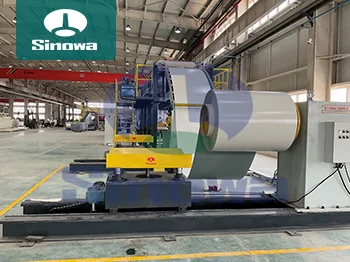
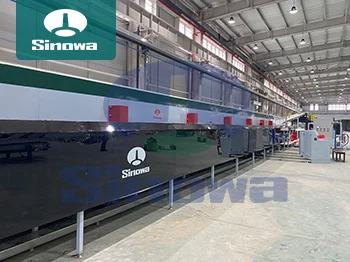
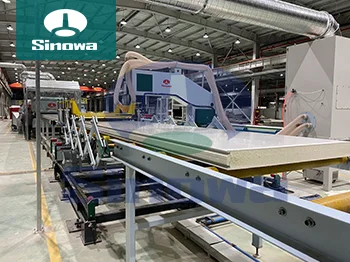
The high-tech fully automatic pu sandwich panel production line can meet a variety of production needs of customers, the whole fully automatic pu sandwich panel production line design concept of modularization enables all our components to be integrated and combined at will. Our high efficiency fully automatic pu sandwich panel production line can easily automate the production of roof sandwich panel, wall sandwich panel, cold storage sandwich panel and other products by different combination and configuration selection and siple switching. The inner core layer can be polyrethane or rock wool, glass wool, an so on.


The high precision fully automatic pu sandwich panel production line has high adaptability, which may produce various sandwich panel of the PU, PIR and rock wool systems. We may design various products according to the customer’s requirements, including various configurations, so as to meet their demands with flexible price system. Highly integrated and linked control system centralizes all control points at the main central center, achieving parameter linkage, fault self-diagnosis controlled by the whole line and shipping distance control. High-level automatic control system also saves the manpower and reduces the manpower loss for customers.


The precision servo hoisting mechanism employed by the main engine without hydraulic system makes the board thickness control flexible and the customer may conveniently change or adjust the board thickness. There will be not such troubles as hydraulic system adjustment, leakage, maintenance, etc.


High-level energy saving and protection design makes the whole fully automatic pu sandwich panel production line possible to produce around the clock throughout the year and the customer will save huge budget. In addition, the isolated heat preservation room is constructed for warming the environment. The energy saving and protection design of our manufacturing line may guarantee that the customer’s production line may be freely heated and produce in the main time to save more costs for customers.


The high-power low-consumption design quickens the reaction of the cheap fully automatic pu sandwich panel production line while energy consumption is kept low. With the brand-new, fully sealed inner insulation design, the energy consumption is controlled at the minimum level to achieve the design objective of less than an hour for the insulation system to be activated from the room temperature above 5℃ to the production process temperature. The energy consumption is only 40% that of those similar products.
A fully automatic PU sandwich panel production line is an integrated intelligent system that combines mechanical, electronic, and chemical technologies to realize continuous and efficient production of polyurethane sandwich panels. It minimizes manual intervention through streamlined workflows, ensuring stable and consistent product quality throughout the entire manufacturing process. The production line consists of several closely coordinated functional modules, including uncoiling, forming, foaming, composite, cutting, and stacking systems, which work together to complete the entire process from raw material input to finished product output. The uncoiling system ensures the smooth unwinding of surface materials, while the forming system processes flat coils into the required shapes with high precision. The foaming system injects and mixes PU raw materials evenly, creating a core with excellent thermal insulation performance, and the composite system tightly bonds the surface materials with the PU core to form a solid structure. Compared with traditional manual production methods, this automatic line offers significant advantages such as higher production efficiency, lower labor intensity, and better raw material utilization. The panels produced are widely used in various fields, including modular buildings, cold storage facilities, agricultural greenhouses, and industrial equipment shells, thanks to their excellent thermal insulation, soundproofing, and waterproof properties. The intelligent control system of the production line allows for flexible adjustment of production parameters, adapting to different specifications and requirements of PU sandwich panels, thus meeting the diverse needs of modern construction and industrial applications.
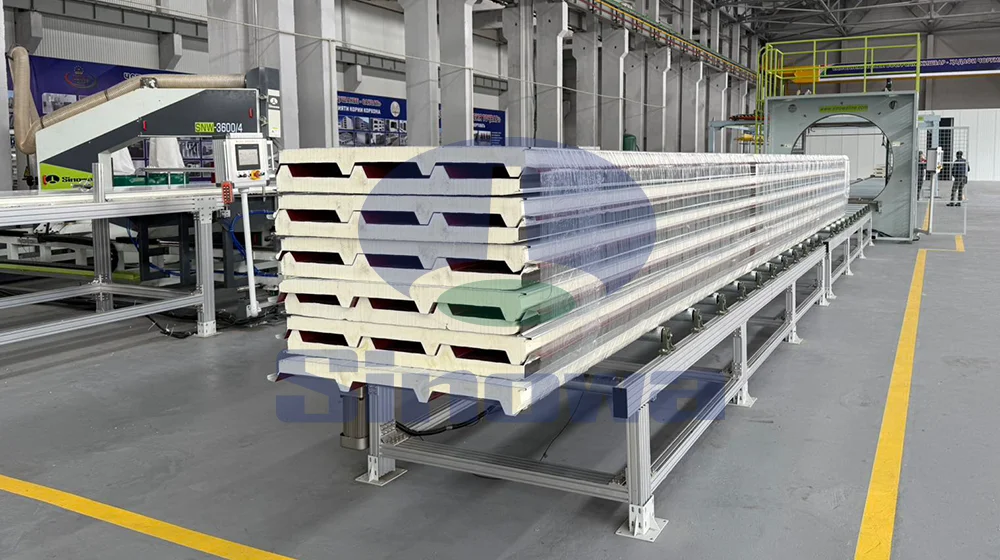
In the modern construction and industrial insulation sectors, fully automatic PU (polyurethane) sandwich panel production lines stand as a cornerstone of advanced manufacturing technology, bridging raw material processing and high-performance finished panel production with seamless, automated workflows. These production systems are engineered to eliminate manual intervention across nearly all production stages, delivering consistent, high-quality sandwich panels that combine structural strength, thermal efficiency, and durability in a single composite product. Unlike semi-automated or manual production setups, fully automatic lines integrate specialized mechanical, electrical, and process control systems into a unified, continuous operation, adapting to diverse production demands while maintaining strict uniformity in panel dimensions, material bonding, and core foam formation.
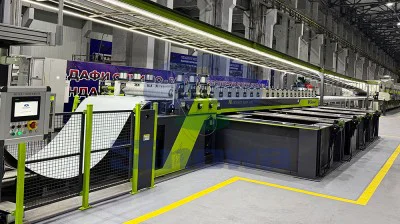
At its core, a fully automatic PU sandwich panel production line features a modular, interconnected structural design, with each functional module performing a dedicated task while operating in precise synchronization to maintain a smooth, uninterrupted production cycle. The entire system is typically arranged in a linear layout to optimize material flow and minimize production downtime, starting from raw material handling and extending through panel forming, foaming, curing, cutting, and finished product stacking. The first critical module is the raw material feeding and uncoiling unit, designed to handle coiled facing materials—most commonly metal sheets, though compatible with other rigid or semi-rigid facing substrates—with automatic uncoiling, leveling, and edge trimming functions. This unit eliminates manual material handling errors, ensuring the facing materials are fed into the production line at a consistent tension and flatness, which is vital for the overall integrity of the final sandwich panel. Following the uncoiling and leveling stage, the profiling unit takes shape, using precision roll-forming machinery to shape the facing materials into predefined profiles, such as flat, trapezoidal, or ribbed designs, based on production requirements. The profiling process is fully automated, with adjustable settings to modify profile dimensions without manual reconfiguration, enhancing the line’s flexibility for custom panel production.
Moving into the core processing section, the heart of the production line lies in the PU foam mixing, pouring, and laminating module, which governs the quality of the sandwich panel’s insulating core. This module consists of a high-precision raw material dosing system, a dynamic mixing chamber, and a controlled pouring mechanism, all regulated by a centralized control system to ensure accurate ratios of polyurethane raw materials—polyol and isocyanate—along with necessary additives for foam curing, density adjustment, and performance enhancement. The automated dosing system eliminates human error in material measurement, guaranteeing uniform foam density and consistent cellular structure throughout the panel length and width. After mixing, the liquid PU mixture is evenly distributed between the two pre-formed facing layers, immediately entering the double-belt laminating system. This system applies controlled, uniform pressure and temperature across the entire panel surface, pressing the facing materials and liquid PU core together while initiating the foaming and curing process. The double-belt unit is engineered with adjustable speed and pressure settings, accommodating different panel thicknesses and foam curing rates, and maintains a stable temperature environment to optimize the polymerization of the PU foam, ensuring a strong, permanent bond between the core and facings without gaps or delamination.
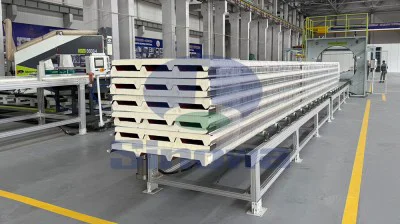
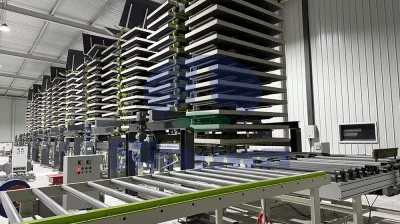
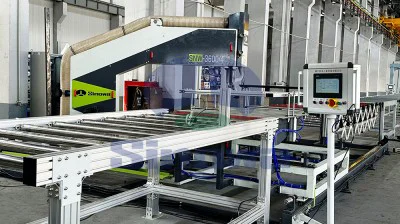
The subsequent structural modules include the curing and cooling section, the precision cutting unit, and the automatic stacking and packaging system. The curing and cooling section is a temperature-controlled tunnel that allows the PU foam to fully cure and harden at a gradual, consistent rate, preventing internal stress, warping, or shrinkage in the finished panels. This section is fully enclosed to maintain a stable ambient condition, independent of external temperature fluctuations, which is critical for maintaining panel dimensional stability. Once cured, the continuous panel strip moves to the precision cutting unit, equipped with high-speed cutting tools that operate automatically based on preset length parameters. The cutting system uses real-time positioning technology to ensure accurate, clean cuts with minimal material waste, and can switch between different cutting lengths seamlessly during production without halting the line. Finally, the automatic stacking system gently lifts and stacks the finished panels in neat, organized batches, preparing them for storage or transportation; this unit also includes protective measures to prevent surface scratches or damage to the panel facings during handling. Complementing these mechanical modules is the centralized electrical control system, the nerve center of the entire production line, which uses advanced programmable logic to synchronize all units, monitor real-time production data, adjust process parameters, and detect minor faults or inconsistencies. The control system features an intuitive interface for operational oversight, allowing technicians to modify settings, track production efficiency, and ensure consistent output without constant manual adjustment.
The performance of a fully automatic PU sandwich panel production line is defined by its efficiency, precision, consistency, and adaptability, setting it apart from lower-level production systems in key technical metrics. One of the most prominent performance advantages is its high degree of automation, which reduces labor dependency to a minimum, with only a small team of operators needed to monitor and oversee the entire process, rather than performing manual tasks at each production stage. This automation translates to continuous, uninterrupted production capacity, with stable line speeds that support large-scale output over extended periods, making it suitable for mass production demands in the construction and insulation industries. Equally important is the production precision offered by the line: all process parameters, from material dosing and profiling to pressure, temperature, and cutting length, are controlled with micrometer-level accuracy, resulting in panels with uniform thickness, consistent density, and precise dimensional tolerances across every batch. This level of precision ensures that finished panels meet strict functional requirements and fit perfectly during on-site installation, reducing installation time and material waste for end users.
Thermal and structural performance consistency is another core attribute of the production line, directly impacting the quality of the final PU sandwich panels. The automated foaming and laminating process ensures that the PU core has a uniform closed-cell structure, which is essential for optimal thermal insulation, sound absorption, and structural rigidity. Unlike manual or semi-automated production, where foam density and bonding can vary across the panel, the fully automatic line eliminates inconsistencies, resulting in panels with stable thermal conductivity values and reliable load-bearing capacity. The line also exhibits strong adaptability to different production requirements, capable of adjusting to various panel thicknesses, widths, profiles, and core densities with minimal setup time. It can process different types of facing materials, from thin metal sheets to other rigid composite materials, and can accommodate modifications to the PU foam formula for enhanced performance, such as improved fire resistance, moisture resistance, or compressive strength, without requiring extensive structural changes to the line itself. Additionally, the production line is designed for energy efficiency and operational stability, with optimized power and material usage to reduce waste, and robust mechanical components that minimize downtime and maintenance needs, ensuring long-term reliable operation with consistent output quality.
Fully automatic PU sandwich panel production lines are capable of manufacturing a diverse range of panel types, classified primarily by panel function, core structure, and application scenario, each tailored to specific operational and environmental needs. The most common distinction is between standard PU sandwich panels and modified PU (PIR) panels, with the latter featuring a modified foam formula that offers enhanced fire resistance and thermal stability, suitable for applications with stricter safety requirements. Structurally, panels are divided into wall panels and roof panels, each with distinct profiling and structural designs: wall panels are typically flat or lightly profiled for vertical installation, focusing on thermal insulation, soundproofing, and exterior aesthetic consistency, while roof panels feature reinforced ribbed or trapezoidal profiles to improve load-bearing capacity, waterproofing, and resistance to environmental stressors such as wind, snow, and temperature extremes. Another key classification is based on core density and thickness, with lightweight, thin panels designed for interior partition walls and temporary structures, and heavy-duty, thick panels engineered for high-insulation applications such as cold storage and industrial facilities.
Panels can also be categorized by their edge joint design, which affects installation efficiency and airtightness: tongue-and-groove edge panels create a tight, seamless fit between adjacent panels, improving thermal efficiency and preventing air or moisture infiltration, while flat-edge panels are designed for simpler, faster installation in general construction projects. Some panels are engineered with additional protective layers or surface treatments for enhanced durability in harsh environments, such as high humidity, chemical exposure, or extreme temperature fluctuations, all of which can be produced seamlessly on the fully automatic line by adjusting facing material treatments and foam additives during the production process. This versatility in panel types means the production line can cater to a wide spectrum of industry needs, from basic commercial construction to specialized industrial applications, without compromising on quality or performance.
The applications of PU sandwich panels produced by fully automatic lines span across multiple industries, driven by the panels’ unique combination of lightweight construction, high thermal insulation, structural strength, and quick installation. In the construction industry, these panels are widely used for the exterior walls and roofs of industrial warehouses, factory buildings, commercial workshops, and prefabricated structures, offering a cost-effective, time-efficient alternative to traditional building materials. The panels’ excellent thermal insulation properties reduce energy consumption for heating and cooling in buildings, supporting sustainable construction practices and long-term operational cost savings. For cold chain and refrigeration applications, PU sandwich panels are the material of choice for cold storage warehouses, refrigerated transport containers, and food processing facilities, as their low thermal conductivity maintains stable low temperatures with minimal energy usage, preserving the quality and safety of perishable goods. The closed-cell PU core also resists moisture absorption, preventing mold growth and maintaining insulation performance in high-humidity cold storage environments.
In the agricultural sector, the panels are used for livestock housing, greenhouse structures, and agricultural storage facilities, providing a controlled internal environment that protects crops and livestock from extreme external temperatures, while also offering sound insulation to reduce stress in livestock. The smooth, easy-to-clean surface of the panel facings also supports hygienic conditions in agricultural and food-related facilities, aligning with industry hygiene standards. For industrial and commercial infrastructure, the panels are used for partition walls in large office buildings, shopping malls, and exhibition centers, creating flexible, customizable interior spaces quickly and efficiently. Their lightweight nature reduces the overall structural load on buildings, making them suitable for both new construction and renovation projects. Additionally, modified PIR panels with enhanced fire resistance are used in public facilities and high-safety industrial sites, where fire performance is a critical consideration, providing reliable fire containment and thermal protection without sacrificing insulation efficiency.
Beyond these core applications, PU sandwich panels are also utilized in specialized sectors such as clean room construction, data center insulation, and temporary emergency buildings, thanks to their quick installation, airtightness, and consistent performance. The ability of fully automatic production lines to produce custom-sized and profiled panels further expands their usability, allowing for tailored solutions in unique construction and insulation projects. As global demand for energy-efficient, sustainable building materials continues to rise, the role of fully automatic PU sandwich panel production lines becomes increasingly significant, as they enable large-scale, high-quality production of these versatile composite panels to meet evolving industry needs. The combination of advanced structural design, reliable performance, and flexible production capabilities makes these lines an indispensable part of modern manufacturing, supporting progress in construction, cold chain, agriculture, and industrial sectors worldwide.
In summary, fully automatic PU sandwich panel production lines represent a pinnacle of automated composite material manufacturing, with a well-engineered modular structure that ensures seamless, efficient production, exceptional performance metrics that guarantee consistent panel quality, a diverse range of producible panel types to suit varied needs, and extensive applications across key global industries. By eliminating manual errors, optimizing production efficiency, and maintaining strict quality control, these lines deliver high-value PU sandwich panels that address critical challenges in energy efficiency, structural durability, and construction speed. As technology continues to advance, these production lines will further evolve to enhance automation, precision, and sustainability, continuing to support the growth of energy-efficient construction and industrial insulation solutions for years to come.
« Fully Automatic PU Sandwich Panel Production Line » Update Date: 2026/4/16
URL: https://www.sinowamachine.com/tags/fully-automatic-pu-sandwich-panel-production-line.html
![Cheap Fully Automatic PU Sandwich Panel Production Line]()
Cheap Fully Automatic PU Sandwich Panel Production Line
2026-09-03The cheap fully automatic PU sandwich panel production line is a cost-effective, integrated industrial manufacturing system tailored for mass production of high-performance polyurethane sandwich panels, catering to the growing demand for economical building and insulation materials across multiple in…![Custom Fully Automatic PU Sandwich Panel Production Line]()
Custom Fully Automatic PU Sandwich Panel Production Line
2026-05-08In the evolving modern construction and industrial manufacturing sectors, the demand for high-performance composite building materials continues to rise steadily, driving the continuous upgrading of production equipment for thermal insulation and structural panels. PU sandwich panels have gradually b…![Fully Automatic PU Sandwich Panel Production Line In China]()
Fully Automatic PU Sandwich Panel Production Line In China
2026-04-20In the global construction and manufacturing landscape, the demand for efficient, energy-saving, and versatile building materials has been on a steady rise in recent years. Polyurethane (PU) sandwich panels, renowned for their exceptional thermal insulation, lightweight structure, high structural str…![Fully Automatic PU Sandwich Panel Production Line Manufacturer]()
Fully Automatic PU Sandwich Panel Production Line Manufacturer
2026-04-20In the modern construction and industrial manufacturing landscape, the demand for high-performance, energy-efficient, and durable building materials has been steadily rising. Among these materials, PU sandwich panels have emerged as a pivotal choice, celebrated for their exceptional thermal insulatio…
- Links:
- Sandwich Panel Continuous Production Line
- Automatic and Continuous Sandwich Panel Production Line
- Cheap and Low Price Sandwich Panel Production Line
- China Sandwich Panel Production Line Factory
- Color Steel Sandwich Panel Production Line For Cold Storage
- Continuous Composite Foam Sandwich Panel Production Line
- Continuous Production Line For Rockwool and Mineral Wool Sandwich Panels
- Continuous PU Phenolic Insulation Panel Production Line
- Continuous PU PIR Sandwich Panel Production Line
- Continuous PUF PUR Sandwich Panel Production Line
- Continuous Sandwich Panel Production Line For Roof and Wall
- Customized and Design Sandwich Panel Production Line
- Decorative Sandwich Panel Production Line For Glass Wool Boards
- High Quality Sandwich Panel Production Line For Sale
- Polyurethane(PU) Sandwich Panel Production Line
- Sandwich Panel Production Line Manufacturer and Supplier
- Sandwich Panel Production Machinery and Equipment