
Fully Automatic PU Sandwich Panel Production Line In China
Sinowa is a well-known manufacturer and technical service provider of high-end fully automatic pu sandwich panel production line, learn more about fully automatic pu sandwich panel production line in china, please contact Sinowa's technical engineer, tell us what you need, we will contact you as soon as possible!
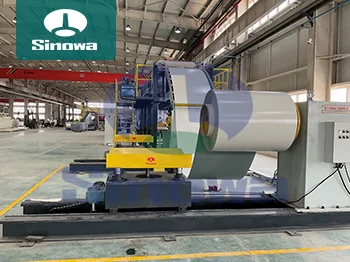
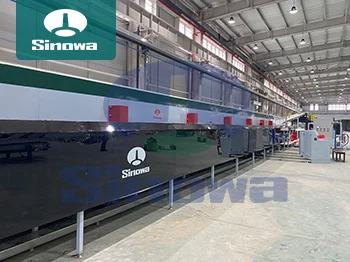
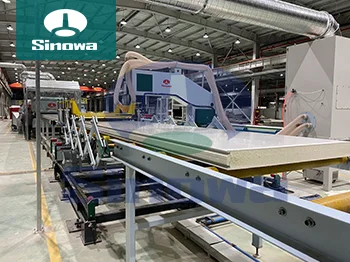
Sinowa is committed to the development and manufacturing of high-end and high-efficiency fully automatic pu sandwich panel production line. Our fully automatic pu sandwich panel production line are leading the way in efficiency, automatic control, human-computer interaction, environmental protection and energy consumption. Using system integration and bus control technology, it realizes the automatic integrated linkage control of the entire fully automatic pu sandwich panel production line, and can achieve remote interactive communication, which has the world-class level and a comprehensive leading high-performance fully automatic pu sandwich panel production line in the market.
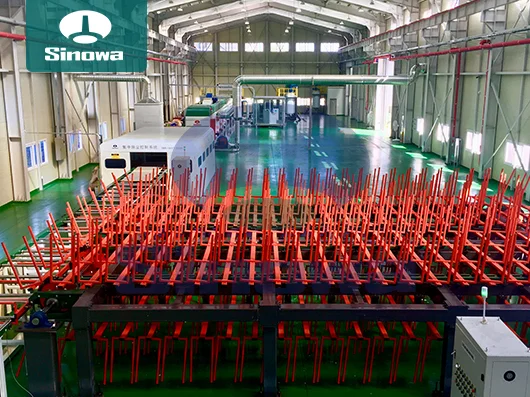
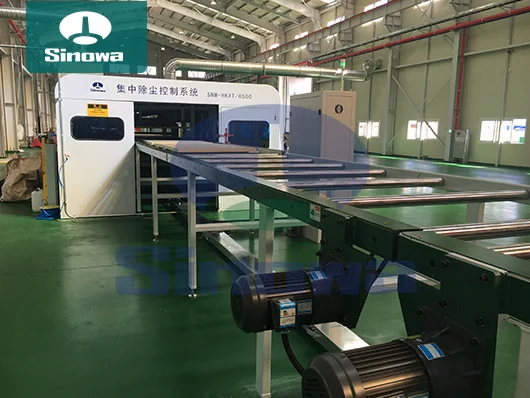
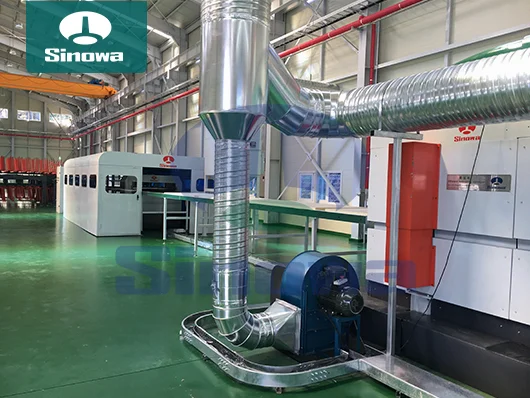
For more than ten years, relying on our innovative manufacturing concept and excellence in quality, reliable and trustworthy service to customers, we cooperate with customers all over the world, exported products to Canada, South Korea, Israel, Australia, the Middle East and other more than 20 countries and regions. contributed to building energy conservation and low-carbon production and have won widespread praise.
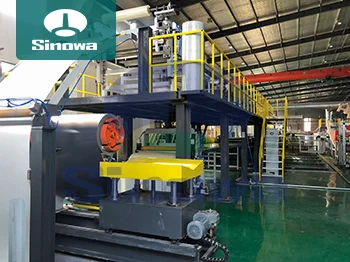
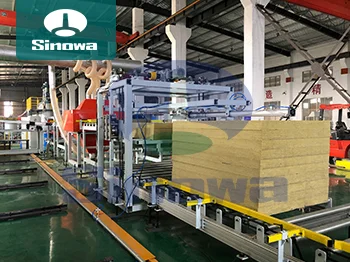
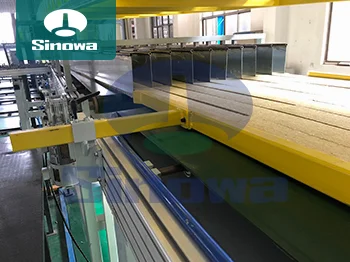
Sinowa has invested outstanding efforts in fully automatic pu sandwich panel production line, this is why our products are more efficiency, quality, automatic control technology, environmental protection, energy consumption indicators and the appearance and safety protection are comprehensively leading, some subversive design changes in many major technical points, these major innovations make our products excellent in price/performance and user experience.
In the global construction and manufacturing landscape, the demand for efficient, energy-saving, and versatile building materials has been on a steady rise in recent years. Polyurethane (PU) sandwich panels, renowned for their exceptional thermal insulation, lightweight structure, high structural strength, and weather resistance, have emerged as a preferred choice across a wide range of applications, from industrial warehouses and cold storage facilities to commercial buildings and modular housing. At the core of the mass production of these high-performance panels lies the fully automatic PU sandwich panel production line, and China has established itself as a key player in the development, innovation, and supply of such advanced manufacturing equipment. Over the past few decades, China’s production lines have evolved from simple imitations of foreign technology to highly customized, intelligent systems that meet the diverse needs of global customers, driven by growing domestic demand, government support for industrial upgrading, and relentless innovation by domestic equipment manufacturers. Today, fully automatic PU sandwich panel production lines in China are characterized by high efficiency, precision, energy conservation, and environmental friendliness, playing a crucial role in promoting the development of the global construction material industry.
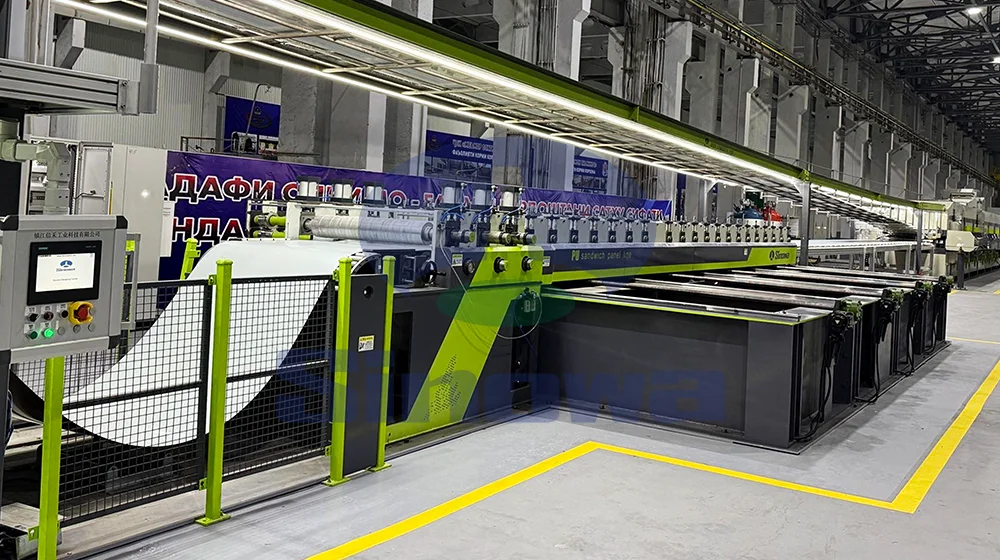
The fully automatic PU sandwich panel production line is a sophisticated integrated system designed to realize a seamless production process from raw material feeding to finished product stacking, minimizing manual intervention and maximizing production continuity. Unlike traditional discontinuous production methods that involve intermittent processing and manual handling, these continuous production lines operate in a streamlined manner, enabling the continuous fabrication of PU sandwich panels with consistent specifications and stable quality. The core working principle revolves around the precise coordination of multiple functional modules, each operating in a synchronized manner under the control of an advanced automated system to ensure that every stage of the production process is carried out with high precision and efficiency. From raw material handling and surface material forming to PU foam mixing and pouring, lamination curing, precision cutting, and automatic stacking, each module plays a vital role in guaranteeing the final product’s performance and reliability.
Raw material handling is the initial and crucial stage of the production process, involving the preparation and supply of both surface materials and core PU foam components. The surface materials commonly used for PU sandwich panels include galvanized steel, galvalume, aluminum, non-woven fabrics, aluminum foil, and kraft paper, among others. Fully automatic production lines in China are equipped with multiple uncoiling machines that can handle different types of surface material coils, ensuring a stable and continuous supply. These uncoiling machines are often equipped with tension control systems to prevent surface material deformation during the uncoiling process, which is essential for maintaining the flatness and quality of the final panels. Before entering the subsequent forming stage, the surface materials undergo pre-processing procedures such as cleaning, passivation, and coating, which enhance their adhesion to the PU foam core and improve their corrosion resistance and durability. This pre-processing step is fully automated, with specialized equipment ensuring uniform treatment and consistent results across all surface materials.
The PU foam mixing and pouring system is the core component of the production line, as the quality of the foam directly determines the thermal insulation, structural strength, and durability of the sandwich panels. Fully automatic production lines in China adopt advanced high-pressure foaming machines that can precisely control the ratio of A/B components (polyol and isocyanate) as well as the addition of catalysts, foaming agents, and other additives. The mixing head of these foaming machines is equipped with temperature control systems that maintain a temperature accuracy of ±0.5℃, ensuring the stability of the foaming reaction. The foaming agents used are environmentally friendly alternatives such as pentane or 141b, replacing traditional chlorofluorocarbons (CFCs) to reduce environmental impact. The foaming process is fully automated, with the system adjusting the pouring amount and speed according to the desired panel thickness and production speed, ensuring uniform foam density and consistent core thickness. The foam density typically ranges from 36 to 45 kg/m³, which can be adjusted based on specific application requirements to balance thermal insulation performance and structural strength.
After the PU foam is poured between the two layers of surface materials, the composite structure enters the lamination curing stage. Fully automatic production lines are equipped with double-track continuous laminating machines with adjustable pressure ranging from 0.1 to 0.5 MPa, which ensure tight bonding between the surface materials and the PU foam core. The laminating machines are also equipped with segmented temperature control systems that can adjust the heating temperature between 20℃ and 80℃, accelerating the curing process of the PU foam while preventing deformation of the surface materials. The continuous curing process ensures that the foam core is fully cured and bonded to the surface materials, forming a cohesive structure with excellent structural integrity. During this stage, the production line also incorporates cooling systems to quickly stabilize the panel structure after curing, reducing the risk of warping or deformation and ensuring the flatness of the finished panels.
Precision cutting is another key stage in the production process, as it determines the dimensional accuracy of the finished PU sandwich panels. Fully automatic production lines in China adopt servo-driven CNC flying saws with visual recognition positioning systems, which can achieve a cutting accuracy of ±0.5 mm. The cutting length can be freely set according to customer requirements, and the system can automatically adjust the cutting speed to match the production line speed, ensuring continuous production without interruption. Additionally, the cutting system is equipped with automatic waste recycling devices that collect and process the cutting waste, reducing material waste and improving resource utilization. This not only reduces production costs but also aligns with the concept of sustainable manufacturing.
The final stage of the production process is automatic stacking and packaging. Fully automatic production lines are equipped with six-axis robotic stackers with a load capacity of no less than 500 kg, which can stack the finished panels to a maximum height of 3.5 meters. The stackers adopt intelligent sorting algorithms and dual-mode grasping systems (vacuum suction cups and mechanical fixtures) to ensure stable and safe stacking, preventing damage to the panels. Integrated weighing sensors with an accuracy of ±0.2 kg are also installed to monitor the weight of each stack, ensuring consistency in product quantity. The stacking system is also equipped with anti-dumping and stabilizing devices to prevent the stacks from collapsing during storage or transportation. After stacking, the panels can be automatically packaged with protective films or packaging materials to prevent scratches, moisture, and other damage during transportation and storage.
One of the most prominent features of fully automatic PU sandwich panel production lines in China is their high level of automation and intelligent control. These production lines integrate PLC control systems and industrial robot technology, realizing full automation from raw material feeding to finished product stacking. The centralized control system unifies all production processes, allowing operators to monitor and adjust parameters such as production speed, foam density, temperature, and pressure in real time through a user-friendly interface. Advanced data acquisition and analysis systems are also incorporated to collect production data, enabling manufacturers to optimize production processes, improve efficiency, and reduce downtime. Some advanced production lines even adopt artificial intelligence (AI) and Internet of Things (IoT) technologies, allowing remote monitoring and control of the production process, predictive maintenance of equipment, and real-time troubleshooting, further enhancing production efficiency and reliability.
In addition to high automation, fully automatic PU sandwich panel production lines in China also excel in energy conservation and environmental protection. The heat recovery utilization rate of these production lines can reach 65%, effectively recycling waste heat generated during the curing process to reduce energy consumption. The use of environmentally friendly foaming agents and water-based adhesives reduces volatile organic compound (VOC) emissions to less than 50 mg/m³, meeting strict environmental standards. The waste recycling rate of the production process exceeds 90%, with cutting waste and other production residues being collected and reused, minimizing environmental impact. These eco-friendly features not only reduce the production costs of manufacturers but also meet the growing global demand for sustainable and green building materials.
Flexibility and customization are also key advantages of fully automatic PU sandwich panel production lines in China. These production lines can be customized according to customer requirements, supporting the production of panels with different widths (600-1200 mm), thicknesses (30-200 mm), and lengths (2000-16000 mm). The production line speed can be adjusted between 3 and 12 meters per minute, allowing manufacturers to adjust production capacity according to market demand. Additionally, these production lines are compatible with different core materials such as rock wool and glass wool, enabling the production of various types of sandwich panels to meet diverse application needs. The quick specification switching function allows manufacturers to switch between different product specifications within 3 minutes, improving production flexibility and responsiveness to market changes. The production lines can also store over 100 formulas, enabling quick adjustment of foam properties to meet different performance requirements.
The wide application of PU sandwich panels has driven the continuous development and upgrading of fully automatic production lines in China. PU sandwich panels are widely used in industrial buildings, such as factories, warehouses, and logistics centers, where their thermal insulation, sound insulation, and structural strength properties are essential. They are also extensively used in cold storage facilities, food cold storage, medical cold storage, and cold chain logistics centers, where their excellent thermal insulation performance helps maintain stable temperatures and reduce energy consumption. In civil buildings, PU sandwich panels are used for roofs, walls, and partitions of residential buildings, villas, and apartments, offering lightweight, energy-saving, and aesthetically pleasing solutions. Additionally, they are used in purification plants, container houses, mobile homes, gymnasiums, exhibition halls, and other structures, demonstrating their versatility and wide applicability. The growing demand for these applications has continuously promoted the innovation and upgrading of fully automatic production lines, making them more efficient, precise, and flexible.
The development of fully automatic PU sandwich panel production lines in China has also been supported by the country’s industrial policies and technological innovation environment. The Chinese government has introduced a series of policies to promote the upgrading of the construction material industry, encouraging the development of energy-saving and environmentally friendly building materials and advanced manufacturing equipment. This has provided strong policy support and financial incentives for domestic equipment manufacturers to invest in research and development, promoting technological breakthroughs and industrial upgrading. Domestic manufacturers have continuously increased their investment in R&D, focusing on improving the automation level, precision, and energy efficiency of production lines, and have gradually mastered core technologies, reducing reliance on imported equipment. Today, Chinese production lines have reached the world’s advanced level in terms of technology and performance, and are exported to many countries and regions around the world, including Poland, Brazil, Jordan, Kuwait, Saudi Arabia, and Tunisia, gaining widespread recognition from international customers.
Looking to the future, fully automatic PU sandwich panel production lines in China will continue to develop in the direction of higher automation, intelligence, energy conservation, and environmental protection. With the continuous advancement of AI, IoT, and big data technologies, production lines will become more intelligent, with functions such as predictive maintenance, intelligent optimization of production processes, and full-process data monitoring. The integration of digital twin technology will allow manufacturers to simulate the production process, optimize parameters, and reduce trial-and-error costs. In terms of energy conservation and environmental protection, more advanced heat recovery systems and environmentally friendly materials will be adopted to further reduce energy consumption and environmental impact. The production lines will also become more flexible and customizable, able to meet the increasingly diverse and personalized needs of global customers. Additionally, the development of modular production lines will enable manufacturers to quickly assemble and adjust production equipment according to production needs, improving production efficiency and reducing investment costs.
In conclusion, fully automatic PU sandwich panel production lines in China have undergone remarkable development over the past few decades, evolving from simple imitations to advanced, intelligent systems that lead the global market. These production lines are characterized by high automation, precision, energy conservation, environmental friendliness, flexibility, and customization, providing efficient and reliable solutions for the mass production of high-quality PU sandwich panels. Supported by favorable industrial policies and continuous technological innovation, Chinese production lines have not only met the growing domestic demand for energy-saving building materials but also gained a strong foothold in the international market. As the global demand for energy-efficient, sustainable, and high-performance building materials continues to grow, fully automatic PU sandwich panel production lines in China will play an increasingly important role in the global construction material industry, driving the development of green and intelligent construction and making greater contributions to the global sustainable development goals.
« Fully Automatic PU Sandwich Panel Production Line In China » Update Date: 2026/4/20
- Continuous PUF Panel Production Line On Sales
- Cheap Insulated Sandwich Panel Line
- External Wall Insulation Panel Production Line
- PU Sandwich Panel Machine Price
- PIR Wall Panel Production Line Factory
- Sandwich Panel Foam Making Machine Design
- Discontinuous PU Sandwich Panel Production Line For Sale
- Continuous Sandwich Panel Manufacturing Line
- PIR Insulation Panel Production Line Manufacturer
- Sandwich Panel Foam Production Line Manufacturer
- Cold Room Sandwich Panel Production Line Design
- Continuous PUF Panel Production Line
- PU Sandwich Panel Machine Supplier
- PU Sandwich Panel Line Factory
- Continuous PU Sandwich Panel Production Line For Building
- Cheap Sandwich Roof Panel Production Line
- High-tech PU Sandwich Panel Production Line
- High-end PU Isolation Panel Production Line
- PU Panel Machine Design
- Tailor-made Sandwich Panel Line