
External Wall Insulation Panel Production Line
Sinowa is a external wall insulation panel production line supplier from china, customized high-quality & high efficiency external wall insulation panel production line at low price, the adoption of system integration technology and bus control technology accomplishes the full automatization of integrated and coordinated control of the external wall insulation panel production line with accessible remote interactive communication. Ranking the first-class level in the world, it is currently the external wall insulation panel production line in the market taking a comprehensive lead in high performance.
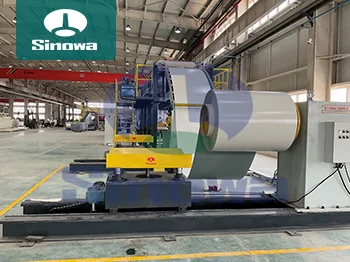
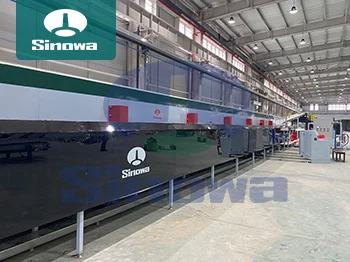
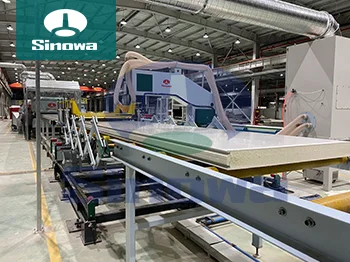
The high-tech external wall insulation panel production line can meet a variety of production needs of customers, the whole external wall insulation panel production line design concept of modularization enables all our components to be integrated and combined at will. Our high efficiency external wall insulation panel production line can easily automate the production of roof sandwich panel, wall sandwich panel, cold storage sandwich panel and other products by different combination and configuration selection and siple switching. The inner core layer can be polyrethane or rock wool, glass wool, an so on.


The high precision external wall insulation panel production line has high adaptability, which may produce various sandwich panel of the PU, PIR and rock wool systems. We may design various products according to the customer’s requirements, including various configurations, so as to meet their demands with flexible price system. Highly integrated and linked control system centralizes all control points at the main central center, achieving parameter linkage, fault self-diagnosis controlled by the whole line and shipping distance control. High-level automatic control system also saves the manpower and reduces the manpower loss for customers.


The precision servo hoisting mechanism employed by the main engine without hydraulic system makes the board thickness control flexible and the customer may conveniently change or adjust the board thickness. There will be not such troubles as hydraulic system adjustment, leakage, maintenance, etc.


High-level energy saving and protection design makes the whole external wall insulation panel production line possible to produce around the clock throughout the year and the customer will save huge budget. In addition, the isolated heat preservation room is constructed for warming the environment. The energy saving and protection design of our manufacturing line may guarantee that the customer’s production line may be freely heated and produce in the main time to save more costs for customers.


The high-power low-consumption design quickens the reaction of the cheap external wall insulation panel production line while energy consumption is kept low. With the brand-new, fully sealed inner insulation design, the energy consumption is controlled at the minimum level to achieve the design objective of less than an hour for the insulation system to be activated from the room temperature above 5℃ to the production process temperature. The energy consumption is only 40% that of those similar products.
In the context of global emphasis on energy conservation, environmental protection and green building development, external wall insulation technology has become an indispensable part of modern architectural engineering. As the core equipment for mass production of high-quality external wall insulation panels, the external wall insulation panel production line plays a decisive role in improving construction efficiency, ensuring product quality and promoting the popularization of energy-saving buildings.
The structure of the external wall insulation panel production line is a systematic and integrated design, composed of multiple functional units that cooperate closely to complete the entire production process of insulation panels from raw material input to finished product output. Each functional unit has a specific role, and the rationality of their connection and coordination directly affects the overall production efficiency and product quality. Generally speaking, the basic structure of the production line includes a raw material processing unit, a mixing and stirring unit, a molding unit, a curing unit, a cutting unit, a conveying unit and a control unit. These units are connected in sequence according to the production process, forming a continuous and automated production flow.
The raw material processing unit is the starting link of the production line, mainly responsible for pretreating various raw materials required for the production of insulation panels to ensure that they meet the production technical requirements. The raw materials used for external wall insulation panels are diverse, including organic insulation materials such as expanded polystyrene particles, extruded polystyrene particles, and polyurethane foam, as well as inorganic materials such as cement, river sand, fly ash, glass fiber, and mineral wool. The raw material processing unit is equipped with equipment for crushing, screening, drying and mixing of raw materials. For example, bulk raw materials such as cement and river sand need to be crushed and screened to remove impurities and ensure uniform particle size; organic insulation materials such as polystyrene particles need to be dried to reduce moisture content, which helps to improve the bonding performance between raw materials and the durability of finished products; short-cut glass fiber or glass fiber cloth needs to be cut into specified lengths to enhance the structural strength of insulation panels. The raw material processing unit also has a batching system, which can accurately measure various raw materials according to the preset formula to ensure the stability of product performance.
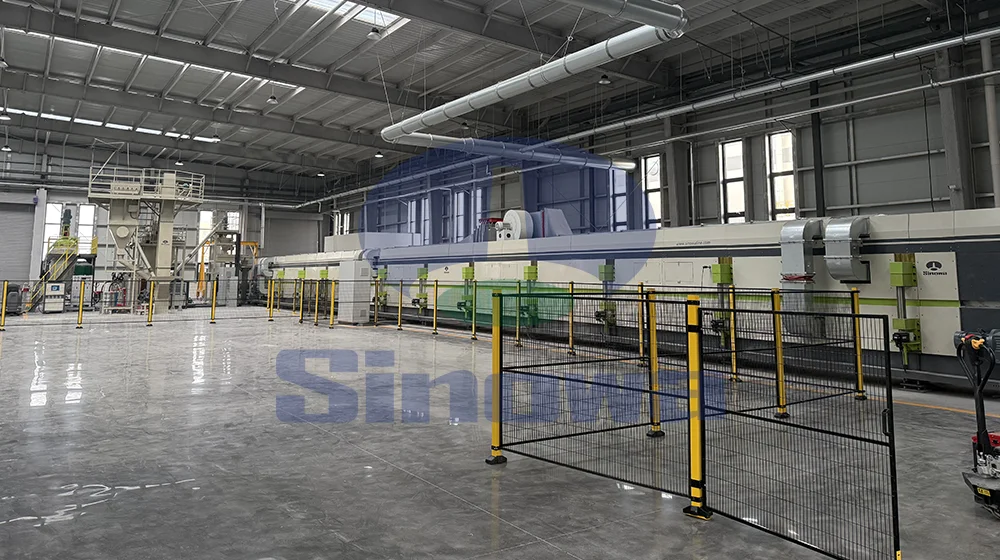
The mixing and stirring unit is connected to the raw material processing unit, and its main function is to fully mix the pretreated various raw materials with an appropriate amount of additives and water to form a uniform and stable mixture. The quality of mixing and stirring directly affects the uniformity of the internal structure of the insulation panel, as well as its insulation, fire resistance and mechanical properties. The mixing and stirring equipment in this unit usually adopts high-efficiency mixing machines with strong stirring capacity and uniform mixing effect. The mixing process is controlled by a program, and parameters such as stirring speed, stirring time and material feeding order are strictly set to avoid problems such as uneven mixing, agglomeration and insufficient bonding. Some advanced mixing and stirring units are also equipped with automatic cleaning functions, which can effectively reduce material waste and equipment maintenance costs. In the production process of composite insulation panels, the mixing and stirring unit can also complete the layered mixing of different materials to meet the functional requirements of different layers of the panel.
The molding unit is the core part of the production line, responsible for pressing or casting the uniformly mixed raw material mixture into insulation panels of specified size and shape. The molding method adopted by the molding unit varies according to the type of insulation panel and production requirements, and common molding methods include roller pressing molding, extrusion molding, pouring molding and mold pressing molding. Roller pressing molding is mainly used for the production of thin insulation panels, which uses multiple groups of pressure rollers with adjustable pressure to press the mixture into panels with smooth surface and uniform thickness; extrusion molding is suitable for the production of insulation panels with complex cross-sections or special shapes, and the mixture is extruded through a die of specified shape under the action of extrusion force to form finished products of the required shape; pouring molding is mostly used for the production of thick insulation panels or composite insulation panels, and the mixture is poured into a pre-installed mold, and then formed through vibration and leveling; mold pressing molding is suitable for small-batch production of special-shaped insulation panels, and the mixture is pressed into shape in a closed mold under high pressure and high temperature. The molding unit is equipped with a mold adjustment system, which can flexibly adjust the size and thickness of the mold according to customer needs, realizing the production of insulation panels of different specifications.
The curing unit is an important link to ensure the performance of insulation panels, which is used to cure the formed insulation panels to improve their strength, durability and stability. The curing method is mainly divided into natural curing and artificial curing, and the specific choice depends on the type of insulation panel, production cycle and environmental conditions. Natural curing is a simple and economical method, which places the formed insulation panels in a clean, ventilated and dry environment, and lets them cure naturally at room temperature. This method has low energy consumption, but the curing cycle is long, which is suitable for small-batch production or areas with suitable environmental conditions. Artificial curing is a method of accelerating the curing process by controlling environmental factors such as temperature, humidity and air circulation, including steam curing, electric heating curing and infrared curing. Steam curing is the most commonly used artificial curing method, which places the insulation panels in a curing chamber, and uses steam to maintain a certain temperature and humidity in the chamber, so that the panels can quickly reach the required strength. The curing unit is equipped with temperature and humidity control equipment, which can accurately control the curing parameters to ensure the consistency and stability of product performance. For some composite insulation panels that require bonding between layers, the curing unit also needs to control the curing time and temperature to ensure the bonding strength between layers.
The cutting unit is connected to the curing unit, and its function is to cut the cured insulation panels into finished products of standard size according to the preset specifications. After curing, the insulation panels are usually in a continuous or large-size state, which needs to be cut to meet the requirements of construction and installation. The cutting unit is equipped with high-precision cutting equipment, such as circular saw cutting machines, band saw cutting machines and CNC cutting machines. These cutting equipment have the characteristics of high cutting precision, smooth cutting surface and high cutting efficiency, which can effectively avoid problems such as uneven cutting, burrs and edge damage. The cutting unit is also equipped with a positioning and clamping system, which can firmly fix the insulation panels during the cutting process to ensure the accuracy of cutting size. Some advanced cutting units also have automatic cutting and blanking functions, which can realize continuous cutting of insulation panels and improve production efficiency. In addition, the cutting unit can also perform special cutting processes such as bevel cutting and slotting according to customer needs to meet the special installation requirements of insulation panels.
The conveying unit runs through the entire production line, responsible for the transportation of raw materials, semi-finished products and finished products between various functional units. The conveying equipment used in the conveying unit includes belt conveyors, roller conveyors, chain conveyors and lifting conveyors, which are selected according to the transportation distance, transportation volume and the characteristics of the transported materials. Belt conveyors are mainly used for the transportation of powdery, granular and sheet materials, with stable transportation and large transportation volume; roller conveyors are suitable for the transportation of large-size insulation panels and molds, with strong bearing capacity and convenient loading and unloading; chain conveyors are used for the transportation of heavy materials or materials that need to be positioned accurately; lifting conveyors are used for the transportation of materials between different heights, such as the transportation of finished products from the cutting unit to the storage area. The conveying unit is equipped with speed control equipment, which can adjust the conveying speed according to the production rhythm to ensure the coordination and consistency of the entire production line. In addition, the conveying unit is also equipped with safety protection devices, such as anti-deviation devices, emergency stop devices and protective covers, to ensure the safe and stable operation of the conveying process.
The control unit is the "brain" of the entire production line, responsible for the centralized control and regulation of all functional units, realizing the automation and intelligence of the production process. The control unit is composed of a control system, a sensor system and an operation interface. The control system adopts a programmable logic controller (PLC) or a distributed control system (DCS), which can preset and store multiple production formulas and production processes, and realize automatic control of the production process by receiving signals from the sensor system. The sensor system is used to detect various parameters in the production process in real time, such as the temperature, humidity, pressure, speed and material level of each unit, and transmit these parameters to the control system. The control system adjusts the operation parameters of each unit according to the detected signals to ensure the stability of the production process and the quality of products. The operation interface is a human-computer interaction platform, which can display the operation status, production parameters and fault information of the entire production line in real time. Operators can set production parameters, start and stop the production line and handle fault problems through the operation interface. Some advanced control units also have remote monitoring and fault diagnosis functions, which can realize remote monitoring of the production line and timely diagnosis and handling of faults, reducing the workload of operators and improving the reliability of the production line.
The performance of the external wall insulation panel production line is an important indicator to measure its quality and applicability, which directly affects the production efficiency, product quality and economic benefits of the production line. The main performance indicators of the production line include production efficiency, product quality stability, automation degree, energy consumption, environmental protection performance and operational reliability.
Production efficiency is one of the core performance indicators of the production line, which refers to the output of insulation panels that the production line can complete per unit time. The production efficiency of the production line is affected by many factors, such as the performance of each functional unit, the coordination between units, the production process and the skill level of operators. A high-efficiency production line can complete a large number of insulation panel production tasks in a short time, which helps to reduce production costs and meet the large demand of the market. The production efficiency of modern external wall insulation panel production lines has been greatly improved, and the output per hour can reach dozens to hundreds of square meters, which can meet the needs of large-scale construction projects.
Product quality stability refers to the ability of the production line to produce insulation panels that meet the technical requirements stably for a long time. The stability of product quality is crucial to the application effect of insulation panels and the safety of buildings. A production line with good quality stability can ensure that the performance indicators of each batch of insulation panels, such as density, thermal conductivity, compressive strength, tensile strength and fire resistance, are within the specified range, avoiding quality fluctuations caused by equipment failure, parameter deviation or operational errors. To ensure product quality stability, the production line needs to have high-precision equipment, scientific production processes and strict quality control systems. The control unit of the production line can monitor the production process in real time, adjust parameters in time when deviations are found, and the quality inspection link can detect unqualified products in time to ensure that only qualified products leave the factory.
The degree of automation is an important symbol of the technical level of the production line, which refers to the ability of the production line to complete the production process automatically without manual intervention. The high degree of automation can not only reduce the labor intensity of operators, reduce the number of operators, but also improve the production efficiency and product quality, and avoid human errors caused by manual operation. Modern external wall insulation panel production lines generally adopt a high degree of automation design, from raw material batching, mixing and stirring, molding, curing to cutting and blanking, which can be completed automatically by the production line. Operators only need to set production parameters through the operation interface, monitor the operation status of the production line and handle occasional faults. Some advanced production lines also have intelligent functions such as automatic formula adjustment, automatic fault diagnosis and automatic maintenance reminder, which further improves the automation level and operational convenience of the production line.
Energy consumption is an important indicator to measure the environmental protection and economic benefits of the production line. With the increasing emphasis on energy conservation and environmental protection, the energy consumption of the production line has become one of the key factors considered by enterprises when purchasing equipment. The energy consumption of the external wall insulation panel production line is mainly concentrated in the mixing and stirring unit, the curing unit and the cutting unit. A high-performance production line adopts energy-saving equipment and technologies, such as energy-saving motors, efficient heat exchangers and heat recovery systems, which can effectively reduce energy consumption. For example, the steam curing unit can recover and reuse the waste heat generated during the curing process, reducing the consumption of steam and energy; the mixing and stirring unit adopts a high-efficiency mixing machine, which can reduce the stirring time and energy consumption on the premise of ensuring the mixing effect. In addition, the production line that adopts room-temperature molding and natural curing can greatly reduce energy consumption compared with the production line that adopts high-temperature and high-pressure molding and artificial curing.
Environmental protection performance is another important indicator of the modern production line, which refers to the impact of the production line on the environment during the production process. The external wall insulation panel production line should avoid generating a large amount of waste gas, waste water, waste residue and noise during the production process, so as to meet the requirements of environmental protection laws and regulations. In terms of waste gas treatment, the production line is equipped with waste gas purification equipment, which can purify the harmful gas generated during the mixing and curing process and then discharge it; in terms of waste water treatment, the waste water generated during the production process is collected and treated to meet the discharge standard before being discharged; in terms of waste residue treatment, the waste residue generated during the raw material processing and cutting process is recycled and reused, such as crushing the waste residue and using it as a raw material additive, reducing the generation of solid waste. In terms of noise control, the production equipment is equipped with noise reduction devices, such as sound insulation covers and shock absorbers, to reduce the noise generated during the operation of the equipment and avoid affecting the surrounding environment and the physical and mental health of operators.
Operational reliability refers to the ability of the production line to operate stably for a long time without failure under normal operating conditions. The operational reliability of the production line is related to the service life of the equipment, production efficiency and production costs. A production line with high operational reliability adopts high-quality equipment components and a reasonable structural design, which can reduce the frequency of equipment failures. At the same time, the production line is equipped with a complete fault diagnosis and protection system, which can detect potential faults in time and take protective measures to avoid equipment damage and production interruption. In addition, the production line has good maintainability, and the equipment components are easy to disassemble, assemble and replace, which can reduce the maintenance time and maintenance costs when faults occur.
According to different classification standards, the external wall insulation panel production line can be divided into many types, each of which has its own characteristics and applicable scope. The common classification methods include classification according to the type of insulation panel produced, classification according to the molding method, classification according to the degree of automation and classification according to the production scale.
According to the type of insulation panel produced, the production line can be divided into organic insulation panel production lines, inorganic insulation panel production lines and composite insulation panel production lines. Organic insulation panel production lines are mainly used to produce insulation panels made of organic materials, such as expanded polystyrene (EPS) insulation panel production lines, extruded polystyrene (XPS) insulation panel production lines and polyurethane (PU) insulation panel production lines. These production lines have the characteristics of simple production process, low energy consumption and good insulation performance of finished products, and are suitable for the production of insulation panels with high insulation requirements. Inorganic insulation panel production lines are used to produce insulation panels made of inorganic materials, such as mineral wool insulation panel production lines, glass wool insulation panel production lines and cement-based insulation panel production lines. These production lines have the characteristics of good fire resistance, high temperature resistance and environmental protection, and are suitable for the production of insulation panels used in high-rise buildings, public buildings and other places with high fire protection requirements. Composite insulation panel production lines are the most widely used type of production line, which can produce composite insulation panels composed of organic and inorganic materials. Composite insulation panels combine the advantages of organic and inorganic insulation materials, such as good insulation performance, high fire resistance, high mechanical strength and durability. Common composite insulation panels include EPS composite cement insulation panels, XPS composite rock wool insulation panels and insulation decoration integrated panels. The composite insulation panel production line has a more complex structure, which needs to complete the processing, mixing, molding and curing of multiple materials, and has higher requirements on the coordination and control accuracy of each functional unit.
According to the molding method, the production line can be divided into roller pressing molding production lines, extrusion molding production lines, pouring molding production lines and mold pressing molding production lines. Roller pressing molding production lines adopt roller pressing molding method, which is mainly used for the production of thin insulation panels with small thickness and large area, such as thin EPS insulation panels and glass wool insulation panels. This type of production line has the characteristics of high production efficiency, smooth product surface and uniform thickness, and is suitable for large-scale continuous production. Extrusion molding production lines use extrusion molding method, which is suitable for the production of insulation panels with complex cross-sections, fixed shapes and high density, such as XPS insulation panels and PVC insulation panels. The production line has the characteristics of high production efficiency, stable product quality and good dimensional accuracy, and can produce insulation panels of different cross-sections by replacing the die. Pouring molding production lines adopt pouring molding method, which is mainly used for the production of thick insulation panels, special-shaped insulation panels and composite insulation panels, such as cement-based composite insulation panels and polyurethane composite insulation panels. This type of production line has strong flexibility, can produce insulation panels of different sizes and shapes according to customer needs, but the production efficiency is relatively low, which is suitable for small-batch and customized production. Mold pressing molding production lines use mold pressing molding method, which is suitable for the production of small-batch, high-precision special-shaped insulation panels, such as insulation panels used in special parts of buildings. The production line has the characteristics of high product precision and good surface quality, but the production cycle is long and the production cost is relatively high.
According to the degree of automation, the production line can be divided into manual production lines, semi-automatic production lines and fully automatic production lines. Manual production lines rely mainly on manual operation to complete each production link, such as manual batching, manual mixing, manual molding and manual cutting. This type of production line has a simple structure, low investment cost, but low production efficiency, poor product quality stability and high labor intensity, which is only suitable for small-batch production or small enterprises with limited funds. Semi-automatic production lines combine manual operation and automatic equipment, some key production links (such as mixing and stirring, molding) are completed by automatic equipment, and some auxiliary links (such as raw material feeding, finished product stacking) are completed by manual operation. This type of production line has moderate investment cost, production efficiency and product quality, and is suitable for medium-sized enterprises with certain production scale. Fully automatic production lines adopt full-automatic control, and all production links from raw material input to finished product output are completed automatically by equipment, without manual intervention. This type of production line has high production efficiency, good product quality stability, low labor intensity, but high investment cost and technical requirements, which is suitable for large-scale enterprises with strong economic strength and high production requirements.
According to the production scale, the production line can be divided into small-scale production lines, medium-scale production lines and large-scale production lines. Small-scale production lines have a small production capacity, usually with an hourly output of less than 50 square meters, which is suitable for small enterprises or workshops with small production demand. This type of production line has a simple structure, small floor area and low investment cost. Medium-scale production lines have a moderate production capacity, with an hourly output of 50 to 150 square meters, which is suitable for medium-sized enterprises with a certain market share. This type of production line has complete functions, stable performance and moderate investment cost. Large-scale production lines have a large production capacity, with an hourly output of more than 150 square meters, which is suitable for large-scale enterprises engaged in mass production of insulation panels. This type of production line has a complex structure, high degree of automation, large floor area and high investment cost, but it has obvious advantages in production efficiency and product cost, and can meet the needs of large-scale construction projects.
The external wall insulation panel production line has a wide range of applications, which is mainly used in the production of external wall insulation panels for various buildings, and plays an important role in the fields of residential buildings, public buildings, industrial buildings and old building renovation. With the continuous development of green building technology and the continuous improvement of energy conservation and environmental protection policies, the application scope of the production line is also constantly expanding.
In the field of residential buildings, the external wall insulation panel production line is widely used in the production of external wall insulation panels for high-rise residential buildings, multi-storey residential buildings, villas and other residential buildings. Residential buildings have high requirements on indoor thermal comfort and energy conservation, and external wall insulation panels produced by the production line can effectively block the heat exchange between indoor and outdoor, reduce the energy consumption of air conditioning and heating, and improve the indoor thermal comfort. For example, in cold areas, the use of insulation panels can reduce indoor heat loss in winter, reduce heating energy consumption; in hot areas, the use of insulation panels can block outdoor heat from entering the room, reduce air conditioning energy consumption. In addition, the insulation panels produced by the production line also have good sound insulation performance, which can reduce the noise interference from the outside, improve the living comfort of residents. For villas and low-rise residential buildings, the production line can also produce insulation decoration integrated panels, which integrate insulation and decoration functions, reducing the construction process and improving the construction efficiency.
In the field of public buildings, the external wall insulation panel production line is used in the production of external wall insulation panels for office buildings, shopping malls, hotels, hospitals, schools and other public buildings. Public buildings usually have a large area, high energy consumption and high requirements on fire resistance and durability of insulation materials. The insulation panels produced by the production line can meet these requirements well. For example, office buildings and shopping malls have high requirements on indoor thermal comfort and energy conservation, and the insulation panels with good insulation performance can reduce the energy consumption of the building; hospitals and schools have high requirements on fire resistance and environmental protection of insulation materials, and the inorganic insulation panels or composite insulation panels produced by the production line have good fire resistance and environmental protection, which can ensure the safety of the building and the health of users. In addition, public buildings have high requirements on the appearance of the external wall, and the production line can produce insulation panels with different colors and textures to meet the decorative needs of public buildings.
In the field of industrial buildings, the external wall insulation panel production line is used in the production of external wall insulation panels for factories, warehouses, workshops and other industrial buildings. Industrial buildings usually have special requirements on insulation, fire resistance, corrosion resistance and other properties of external wall materials due to their production characteristics. For example, some factories need to maintain a certain indoor temperature during the production process, and the insulation panels produced by the production line can effectively maintain the indoor temperature stability and reduce energy consumption; warehouses storing flammable and explosive materials have high requirements on the fire resistance of insulation materials, and the inorganic insulation panels produced by the production line have good fire resistance, which can prevent the spread of fire and ensure the safety of the warehouse; workshops with corrosive gases have high requirements on the corrosion resistance of insulation materials, and the composite insulation panels produced by the production line can be coated with a corrosion-resistant layer to improve the corrosion resistance of the panels. In addition, industrial buildings usually have a large construction area, and the high-efficiency production line can quickly complete the production of insulation panels, ensuring the progress of the construction project.
In the field of old building renovation, the external wall insulation panel production line also plays an important role. A large number of old buildings built in the early stage do not have external wall insulation systems, which have high energy consumption and poor indoor thermal comfort, and need to be renovated with external wall insulation. The insulation panels produced by the production line are light in weight, easy to install, and can be directly installed on the external wall of old buildings without major modification to the original building structure, which reduces the renovation cost and shortens the renovation cycle. For example, in the renovation of old residential buildings, the use of lightweight insulation panels can reduce the load of the building, avoid damage to the original building structure, and at the same time improve the energy-saving effect of the building and the living comfort of residents. In addition, the production line can produce insulation panels of different thicknesses and specifications according to the structure and energy-saving requirements of old buildings, meeting the personalized renovation needs of different old buildings.
In addition to the above main application fields, the external wall insulation panel production line can also be used in the production of insulation panels for other fields, such as the external wall insulation of prefabricated buildings, the insulation of building envelopes and the insulation of special buildings. With the continuous development of prefabricated building technology, the demand for prefabricated external wall insulation panels is increasing, and the production line can produce prefabricated insulation panels that meet the requirements of prefabricated buildings, improving the assembly efficiency of prefabricated buildings. In the field of building envelope insulation, the insulation panels produced by the production line can be used for the insulation of external walls, roofs and floors, forming a complete building insulation system, further improving the energy-saving effect of the building. For special buildings such as cold storage, greenhouses and laboratories, the production line can produce insulation panels with special performance requirements, such as high insulation performance, high humidity resistance and high corrosion resistance, to meet the special use requirements of these buildings.
In conclusion, the external wall insulation panel production line is a key equipment in the green building industry, with a systematic structure, excellent performance, diverse types and a wide range of applications. Its structure is composed of multiple functional units that cooperate closely to complete the entire production process of insulation panels; its performance is reflected in production efficiency, product quality stability, automation degree, energy consumption, environmental protection performance and operational reliability, which determines the production level and economic benefits of insulation panels; its types are diverse, and different types of production lines can meet the production needs of different insulation panels and different production scales; its applications cover various fields of building engineering, making an important contribution to the promotion of energy-saving buildings, environmental protection and green development. With the continuous progress of science and technology and the continuous improvement of energy conservation and environmental protection policies, the external wall insulation panel production line will continue to develop towards higher automation, more energy conservation, more environmental protection and more intelligence, and its application scope will be further expanded, providing stronger support for the sustainable development of the building industry.
« External Wall Insulation Panel Production Line » Update Date: 2026/2/24
URL: https://www.sinowamachine.com/tags/external-wall-insulation-panel-production-line.html
![Mineral Wool External Wall Insulation Panel Production Line]()
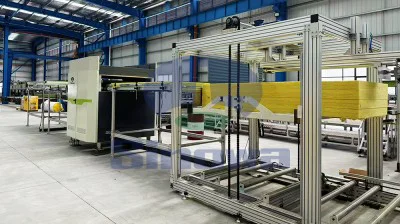
Mineral Wool External Wall Insulation Panel Production Line
2026-05-08The advancement of modern architectural construction has continuously raised demands for building envelope materials, especially for external wall components that undertake thermal regulation, structural protection, and environmental adaptation tasks. Mineral wool external wall insulation panels have…
- Links:
- Sandwich Panel Continuous Production Line
- Automatic and Continuous Sandwich Panel Production Line
- Cheap and Low Price Sandwich Panel Production Line
- China Sandwich Panel Production Line Factory
- Color Steel Sandwich Panel Production Line For Cold Storage
- Continuous Composite Foam Sandwich Panel Production Line
- Continuous Production Line For Rockwool and Mineral Wool Sandwich Panels
- Continuous PU Phenolic Insulation Panel Production Line
- Continuous PU PIR Sandwich Panel Production Line
- Continuous PUF PUR Sandwich Panel Production Line
- Continuous Sandwich Panel Production Line For Roof and Wall
- Customized and Design Sandwich Panel Production Line
- Decorative Sandwich Panel Production Line For Glass Wool Boards
- High Quality Sandwich Panel Production Line For Sale
- Polyurethane(PU) Sandwich Panel Production Line
- Sandwich Panel Production Line Manufacturer and Supplier
- Sandwich Panel Production Machinery and Equipment