
Automatic Sandwich Panel Production Line
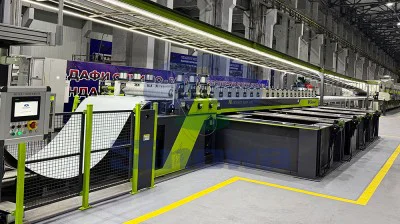
Sinowa is a automatic sandwich panel production line supplier from china, customized high-quality & high efficiency automatic sandwich panel production line at low price, the adoption of system integration technology and bus control technology accomplishes the full automatization of integrated and coordinated control of the automatic sandwich panel production line with accessible remote interactive communication. Ranking the first-class level in the world, it is currently the automatic sandwich panel production line in the market taking a comprehensive lead in high performance.
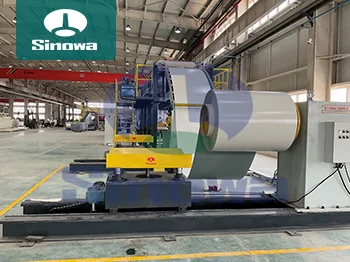
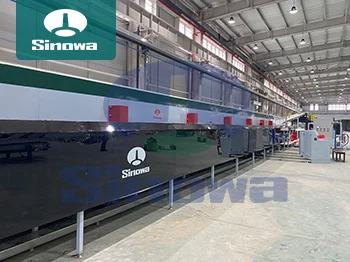
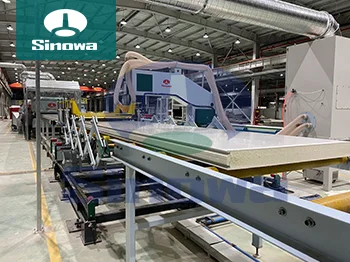
The high-tech automatic sandwich panel production line can meet a variety of production needs of customers, the whole automatic sandwich panel production line design concept of modularization enables all our components to be integrated and combined at will. Our high efficiency automatic sandwich panel production line can easily automate the production of roof sandwich panel, wall sandwich panel, cold storage sandwich panel and other products by different combination and configuration selection and siple switching. The inner core layer can be polyrethane or rock wool, glass wool, an so on.


The high precision automatic sandwich panel production line has high adaptability, which may produce various sandwich panel of the PU, PIR and rock wool systems. We may design various products according to the customer’s requirements, including various configurations, so as to meet their demands with flexible price system. Highly integrated and linked control system centralizes all control points at the main central center, achieving parameter linkage, fault self-diagnosis controlled by the whole line and shipping distance control. High-level automatic control system also saves the manpower and reduces the manpower loss for customers.


The precision servo hoisting mechanism employed by the main engine without hydraulic system makes the board thickness control flexible and the customer may conveniently change or adjust the board thickness. There will be not such troubles as hydraulic system adjustment, leakage, maintenance, etc.


High-level energy saving and protection design makes the whole automatic sandwich panel production line possible to produce around the clock throughout the year and the customer will save huge budget. In addition, the isolated heat preservation room is constructed for warming the environment. The energy saving and protection design of our manufacturing line may guarantee that the customer’s production line may be freely heated and produce in the main time to save more costs for customers.


The high-power low-consumption design quickens the reaction of the cheap automatic sandwich panel production line while energy consumption is kept low. With the brand-new, fully sealed inner insulation design, the energy consumption is controlled at the minimum level to achieve the design objective of less than an hour for the insulation system to be activated from the room temperature above 5℃ to the production process temperature. The energy consumption is only 40% that of those similar products.
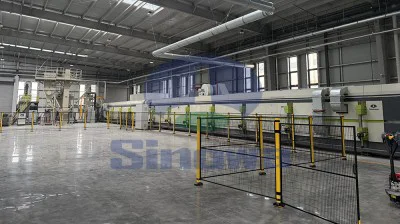
An automatic sandwich panel production line is an advanced integrated system designed to realize continuous and efficient manufacturing of sandwich panels, which are widely used in various fields due to their excellent performance. This production line integrates multiple functional processes into a seamless workflow, from raw material feeding to finished product stacking, eliminating the need for excessive manual intervention and greatly improving production efficiency. The whole production process is controlled by an intelligent system, which ensures stable and consistent product quality, avoiding the errors caused by traditional manual or semi-automatic operation. The line can flexibly adapt to different types of core materials, such as polyurethane, rock wool and glass wool, as well as various surface materials, meeting diverse production needs. It usually consists of automatic feeding devices, pre-processing units, core material filling systems, hot pressing forming equipment, high-precision cutting machines and automatic stacking devices. These components work in coordination to complete each production link efficiently, allowing the line to operate continuously for a long time. The sandwich panels produced by this line have the characteristics of light weight, high strength, thermal insulation and soundproofing, which are widely applied in construction, cold chain logistics, industrial plants and modular buildings. By optimizing the production process and intelligent control, the automatic production line not only reduces labor costs, but also improves production stability and product qualification rate, becoming an indispensable core equipment in the modern sandwich panel manufacturing industry.
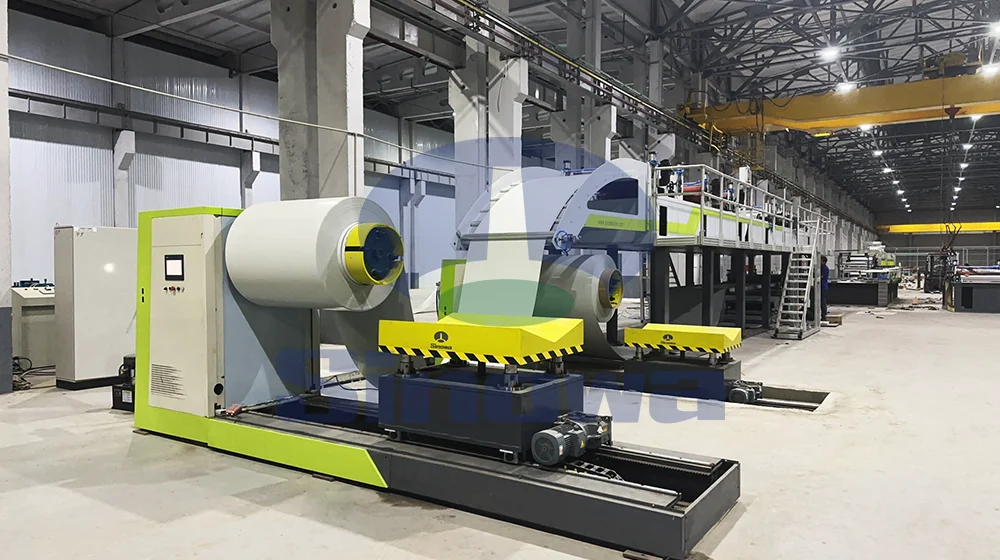
An automatic sandwich panel production line is a highly integrated and continuous equipment system designed for the efficient and high-quality manufacturing of sandwich panels, which are widely used in various industries due to their excellent comprehensive performance. This kind of production line integrates multiple advanced technologies, realizing full-process automation from raw material feeding to finished product stacking, which not only greatly improves production efficiency but also ensures the stability and consistency of product quality. Unlike traditional manual or semi-automatic production methods, the automatic production line reduces human intervention to the greatest extent, minimizes errors caused by manual operation, and adapts to the large-scale and diversified production needs of modern construction and industrial fields. To fully understand the value and application of this equipment, it is necessary to conduct an in-depth analysis of its structure, performance, types and specific applications.
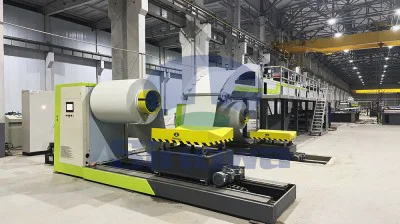
The structure of an automatic sandwich panel production line is designed based on the principle of continuous operation, consisting of multiple functional modules that are closely connected and coordinated with each other to form a complete production chain. Each module undertakes a specific production link, and the seamless connection between modules ensures the smooth progress of the entire production process. The core structure usually includes an uncoiling and pre-processing system, a forming system, a core material processing system, a composite system, a cutting system, a conveying and stacking system, and an intelligent control system. The uncoiling and pre-processing system is the starting point of the production line, mainly responsible for the unfolding and preliminary treatment of surface materials, which are usually metal coils such as color steel plates or aluminum coils. This system is equipped with an uncoiler, a leveling machine, and a shear welding device; the uncoiler unfolds the metal coil smoothly, the leveling machine eliminates the internal stress of the metal plate and makes it flat, and the shear welding device trims the edge of the plate to ensure that the surface material enters the subsequent process without defects. Some advanced production lines are also equipped with a corona treatment system, which increases the surface energy of the metal through high-voltage discharge, thereby enhancing the bonding strength between the surface material and the core material.
The forming system is the key link to determine the shape and structural strength of the sandwich panel. Through a series of precision rolling molds, the flat metal plate is gradually pressed into the desired waveform or flat shape. The forming process usually requires 12 to 16 passes of rolling, and each pass of rolling brings the plate closer to the final shape, ensuring the accuracy and stability of the plate shape. The design of the rolling molds can be adjusted according to the different uses of the sandwich panel; for example, the roof panel needs a specific corrugated shape to enhance drainage performance and wind resistance, while the wall panel may adopt a flat or small rib structure to improve flatness and installation efficiency. The core material processing system varies significantly according to the type of core material, as different core materials have different physical and chemical properties and require different processing methods. For polyurethane core materials, the system includes a high-pressure foaming machine, a temperature control system, and a mixing head; the high-pressure foaming machine mixes the two-component raw materials of polyurethane in a certain proportion and injects them between the upper and lower surface materials, and the temperature control system ensures that the foaming process is carried out at a suitable temperature to form a uniform and dense foam core. For prefabricated core materials such as rock wool and glass wool, the system is equipped with automatic slitting machines, conveyor belts, and positioning devices; the automatic slitting machine cuts the large-scale core material into the required width according to the production specifications, and the conveyor belt and positioning device transport and fix the core material to ensure that it is evenly laid between the surface materials. Some production lines also have an edge sealing device, which injects polyurethane into the edge of the core material to form a sealed edge, improving the waterproof and moisture-proof performance of the sandwich panel.
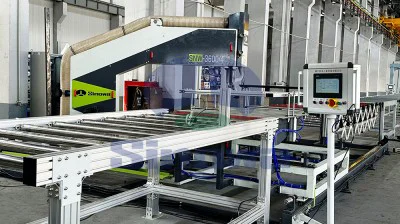
The composite system is the core part of the entire production line, responsible for firmly bonding the upper and lower surface materials with the core material. This system usually adopts a double-track press, which applies a certain temperature and pressure to the combined surface materials and core material under controlled conditions, making the adhesive between them fully cured and bonded. The temperature and pressure parameters of the press are adjustable according to the type of surface material and core material; for example, when using polyurethane core material, a higher temperature is needed to promote the foaming and curing of polyurethane, while for rock wool core material, the pressure needs to be adjusted to ensure that the core material is closely combined with the surface material without gaps. The cutting system is used to cut the continuously produced sandwich panels into the required length according to the customer's needs. It is usually equipped with a high-precision servo-controlled flying saw or laser cutting device, which can achieve high-precision cutting with an error of no more than ±0.5 mm. The cutting process is carried out synchronously with the operation of the production line, without stopping the machine, ensuring the continuity of production. The conveying and stacking system is responsible for transporting the cut finished products to the designated area and stacking them automatically. This system is equipped with conveyor belts, lifting devices, and stacking robots, which can realize automatic conveying and stacking, reduce manual labor intensity, and avoid damage to the finished products during manual stacking.
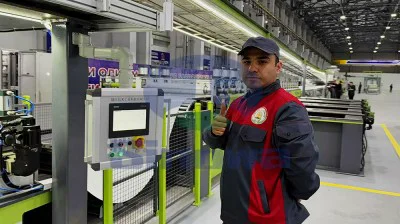
The intelligent control system is the "brain" of the automatic sandwich panel production line, integrating PLC control technology, touch screen operation, and data monitoring functions. The control system can centrally control all modules of the production line, realize the linkage operation of each link, and display the production parameters, equipment operation status, and production progress in real time. Operators can set and adjust production parameters such as production speed, plate thickness, and cutting length through the touch screen, and the system can automatically adjust according to the set parameters to ensure the stability of production. Some advanced control systems also have remote monitoring and fault self-diagnosis functions; operators can monitor the operation status of the production line through mobile phones or computers, and the system can automatically alarm when a fault occurs, and display the fault location and cause, which is convenient for maintenance personnel to quickly handle the fault and reduce production downtime. In addition, the control system can record production data, such as production volume, qualified rate, and raw material consumption, which provides a basis for enterprise production management and optimization.
The performance of an automatic sandwich panel production line directly determines the quality of the sandwich panels and the efficiency of production, and its core performance is mainly reflected in stability, adaptability, efficiency, and energy conservation. Stability is the most basic and important performance indicator of the production line. Through the modular design of components and the use of precision transmission mechanisms, the production line can maintain stable operation for a long time, ensuring the consistency of the specifications, thickness, and bonding strength of the produced sandwich panels, and reducing the defective rate caused by equipment fluctuations. The modular design also makes the maintenance and replacement of components more convenient; when a certain module fails, it can be replaced independently without affecting the operation of other modules, which improves the maintainability of the equipment. Adaptability refers to the ability of the production line to adapt to different raw materials and product specifications. The production line can flexibly switch between different surface materials, such as color steel plates, aluminum plates, and aluminum foil, and different core materials, such as polyurethane, rock wool, glass wool, and phenolic foam, without major modifications to the equipment. At the same time, it can adjust the thickness and width of the sandwich panel within a certain range to meet the diverse needs of different application scenarios. For example, it can produce thin sandwich panels for interior decoration and thick sandwich panels for cold storage insulation, realizing multi-purpose production with one line.
Efficiency is another important performance of the automatic production line. Compared with semi-automatic or manual production, the automatic production line greatly improves production speed. The production speed can usually be adjusted between 3 and 15 meters per minute according to the type of core material and product requirements, and the daily production capacity can reach thousands of square meters. The continuous operation mode of the production line avoids the time waste caused by manual material handling and equipment adjustment, and the automatic feeding, forming, composite, cutting, and stacking processes realize the integration of production, which further improves production efficiency. In addition, the production line only needs a small number of operators to monitor and operate, which reduces the labor cost of the enterprise while improving production efficiency. Energy conservation is an important development trend of modern equipment, and the automatic sandwich panel production line also pays attention to energy conservation and environmental protection in the design. The production line adopts energy-saving motors and optimized heating systems, which reduces energy consumption; some production lines are equipped with heat recovery systems, which can recover and reuse the waste heat generated during the production process, further reducing energy waste. At the same time, the production line adopts closed-loop production, which reduces the emission of waste gas and waste residue, and meets the requirements of environmental protection.
According to the differences in core materials, production processes, and product uses, automatic sandwich panel production lines can be divided into various types, each with its own characteristics and applicable scenarios. According to the type of core material, it can be divided into polyurethane sandwich panel production lines, rock wool sandwich panel production lines, glass wool sandwich panel production lines, and phenolic foam sandwich panel production lines. The polyurethane sandwich panel production line is mainly used to produce sandwich panels with polyurethane as the core material. This type of production line is equipped with a high-pressure foaming system, which can realize on-site foaming and filling of polyurethane, ensuring that the core material is evenly distributed without voids. The polyurethane sandwich panels produced have excellent thermal insulation, sound insulation, and waterproof performance, and are widely used in cold storage, commercial buildings, and other fields. The rock wool sandwich panel production line is designed for rock wool core materials, which are non-combustible and have excellent fire resistance. The production line is equipped with a rock wool feeding system, a slitting device, and a dust collection device; the dust collection device can effectively collect the dust generated during the processing of rock wool, ensuring the cleanliness of the production environment. The rock wool sandwich panels produced are mainly used in buildings with high fire protection requirements, such as industrial plants, public buildings, and high-rise buildings.
The glass wool sandwich panel production line is similar to the rock wool sandwich panel production line, but it is aimed at glass wool core materials, which have the characteristics of light weight, good thermal insulation, and sound absorption. The production line is equipped with a glass wool processing system that can cut and shape the glass wool to meet the production needs of different specifications. The glass wool sandwich panels are widely used in interior decoration, ventilation ducts, and other fields. The phenolic foam sandwich panel production line is used to produce sandwich panels with phenolic foam as the core material. Phenolic foam has excellent fire resistance, thermal insulation, and corrosion resistance, and is suitable for harsh environments. The production line adopts a special foaming process to ensure the quality of the phenolic foam core material, and the produced sandwich panels are mainly used in petrochemical, marine, and other fields. According to the degree of automation, it can be divided into fully automatic and semi-automatic production lines. The fully automatic production line integrates all production links from raw material feeding to finished product stacking, realizing full-process automation without manual intervention, which is suitable for large-scale mass production. The semi-automatic production line needs manual assistance in some links, such as raw material feeding and finished product stacking, which is suitable for small and medium-sized enterprises with small production volume and diverse product types. According to the product use, it can be divided into roof panel production lines, wall panel production lines, cold storage panel production lines, and purification panel production lines. The roof panel production line is optimized for the characteristics of roof panels, emphasizing the anti-wind, waterproof, and drainage performance of the panels, and the forming system is designed to produce corrugated or trapezoidal roof panels. The wall panel production line focuses on the flatness and installation efficiency of the panels, and the produced wall panels are easy to assemble and have good decorative effects. The cold storage panel production line strengthens the control of the thermal insulation performance of the core material, and the produced cold storage panels have low thermal conductivity and good thermal insulation effect, which can meet the insulation needs of cold storage and cold chain transportation. The purification panel production line is used to produce sandwich panels for clean workshops, which have the characteristics of dust-proof, anti-bacterial, and easy to clean, and are widely used in pharmaceutical, food, and electronic fields.
The application of automatic sandwich panel production lines is closely related to the performance of sandwich panels, covering multiple fields such as construction, industry, cold chain logistics, and new energy, and has become an important support for the development of these industries. In the construction industry, sandwich panels produced by automatic production lines are widely used in the roof and wall enclosure of industrial plants, warehouses, commercial complexes, and modular buildings. Due to their light weight, high strength, and convenient installation, they can greatly shorten the construction period and reduce construction costs. For example, in the construction of industrial plants, rock wool sandwich panels are used as wall and roof materials, which not only have good fire resistance but also can achieve thermal insulation and sound insulation effects, creating a comfortable working environment. In high-rise buildings and public buildings, sandwich panels are used as external wall insulation materials, which can improve the energy-saving performance of the building and meet the requirements of green building standards. In addition, sandwich panels are also used in the renovation of old buildings, which can improve the thermal insulation and decorative effect of the building without major changes to the original structure.
In the industrial field, automatic sandwich panel production lines play an important role in the construction of industrial facilities. For example, in the petrochemical industry, phenolic foam sandwich panels produced by special production lines are used to build equipment enclosures and insulation layers, which can resist high temperature, corrosion, and fire, ensuring the safe operation of equipment. In the electronic industry, purification sandwich panels are used to build clean workshops, which can control the dust content in the air and provide a clean production environment for electronic product manufacturing. In the power industry, sandwich panels are used to build power distribution rooms and transformer rooms, which have good thermal insulation and moisture-proof performance, protecting electrical equipment from the influence of the external environment. In the cold chain logistics field, polyurethane and phenolic foam sandwich panels produced by automatic production lines are widely used in the construction of cold storage, cold chain transport vehicles, and refrigerated containers. These sandwich panels have excellent thermal insulation performance, which can maintain a stable low temperature environment, reduce energy consumption, and ensure the quality of low-temperature goods during storage and transportation. For example, in the food and pharmaceutical industries, cold storage built with sandwich panels can keep food and drugs fresh and effective, extending their shelf life. In the new energy field, sandwich panels produced by automatic production lines are used in the construction of photovoltaic power stations and wind power plants. The sandwich panels used in photovoltaic power stations have good weather resistance and load-bearing capacity, which can support photovoltaic modules and adapt to outdoor harsh environments. The sandwich panels used in wind power plants are used to build wind turbine engine rooms and maintenance platforms, which have good anti-wind and corrosion resistance, ensuring the stable operation of wind power equipment.
In addition to the above fields, automatic sandwich panel production lines also have a wide range of applications in other special fields. For example, in the field of transportation, sandwich panels are used in the interior decoration of trains, ships, and aircraft, which have the characteristics of light weight, sound insulation, and fire resistance, improving the comfort and safety of transportation tools. In the field of military engineering, sandwich panels are used to build temporary barracks, command posts, and other facilities, which can be quickly installed and disassembled, adapting to the mobility needs of military operations. With the continuous advancement of building industrialization and the deepening of the concept of energy conservation and environmental protection, the application field of automatic sandwich panel production lines is still expanding, and new application scenarios are constantly emerging.
In summary, the automatic sandwich panel production line is a complex and advanced equipment system, whose structure is composed of multiple functional modules that coordinate with each other, and its performance is reflected in stability, adaptability, efficiency, and energy conservation. According to different classification standards, it can be divided into various types, each suitable for different production needs and application scenarios. Its wide application in construction, industry, cold chain logistics, and other fields has promoted the development of related industries, improved production efficiency, reduced costs, and met the needs of energy conservation, environmental protection, and high-quality development. With the continuous progress of science and technology, the automatic sandwich panel production line will develop towards a more intelligent, efficient, and environmentally friendly direction, integrating more advanced technologies such as artificial intelligence and the Internet of Things to further improve production precision and efficiency, and provide more high-quality and diversified sandwich panel products for various industries. At the same time, with the expansion of application fields, the automatic sandwich panel production line will play a more important role in promoting the upgrading and development of the building materials industry and promoting the realization of green and low-carbon development goals.
« Automatic Sandwich Panel Production Line » Update Date: 2026/4/16
URL: https://www.sinowamachine.com/tags/automatic-sandwich-panel-production-line.html
![Automatic Sandwich Panel Production Line Design]()
Automatic Sandwich Panel Production Line Design
2026-09-03Automatic sandwich panel production line design focuses on creating an integrated, streamlined manufacturing system that enables continuous, automated fabrication of composite sandwich panels for modern construction and industrial applications. This systematic design abandons traditional segmented an…![Automatic Sandwich Panel Production Line For Sale]()
Automatic Sandwich Panel Production Line For Sale
2026-08-31The automatic sandwich panel production line is a highly integrated, intelligent industrial manufacturing system dedicated to the continuous and efficient production of composite sandwich panels widely used in modern construction and industrial fields. Combining mechanical transmission, precise mater…![Automatic Sandwich Panel Production Line Manufacturer]()
Automatic Sandwich Panel Production Line Manufacturer
2026-08-12The automatic sandwich panel production line has emerged as a core intelligent manufacturing solution for the modern composite building material industry, driving the standardized, high-efficiency, and high-quality production of thermal insulation and decorative sandwich panels. As integrated automat…![Automatic Sandwich Panel Production Line From China]()
Automatic Sandwich Panel Production Line From China
2026-05-08In the evolving landscape of global construction and industrial manufacturing, lightweight composite building materials have become indispensable for modern engineering projects, and sandwich panels stand out as one of the most widely applied products due to their unique structural advantages and ver…![Automatic Sandwich Panel Production Line Price]()
Automatic Sandwich Panel Production Line Price
2026-04-20In the modern construction and industrial manufacturing fields, the demand for efficient, high-quality, and multi-functional building materials has been steadily rising, and sandwich panels have emerged as a pivotal component due to their excellent thermal insulation, sound insulation, fire resistanc…![Automatic Sandwich Panel Production Line Supplier]()
Automatic Sandwich Panel Production Line Supplier
2026-01-09In the context of global construction industry's transformation towards greenization and modularization, sandwich panels have emerged as a core building material, favored for their balanced performance of light weight, high strength, thermal insulation, and soundproofing. This growing demand for …
- Links:
- Sandwich Panel Continuous Production Line
- Automatic and Continuous Sandwich Panel Production Line
- Cheap and Low Price Sandwich Panel Production Line
- China Sandwich Panel Production Line Factory
- Color Steel Sandwich Panel Production Line For Cold Storage
- Continuous Composite Foam Sandwich Panel Production Line
- Continuous Production Line For Rockwool and Mineral Wool Sandwich Panels
- Continuous PU Phenolic Insulation Panel Production Line
- Continuous PU PIR Sandwich Panel Production Line
- Continuous PUF PUR Sandwich Panel Production Line
- Continuous Sandwich Panel Production Line For Roof and Wall
- Customized and Design Sandwich Panel Production Line
- Decorative Sandwich Panel Production Line For Glass Wool Boards
- High Quality Sandwich Panel Production Line For Sale
- Polyurethane(PU) Sandwich Panel Production Line
- Sandwich Panel Production Line Manufacturer and Supplier
- Sandwich Panel Production Machinery and Equipment