
Sandwich Panel Foam Production Line
Sinowa is a sandwich panel foam production line supplier from china, customized high-quality & high efficiency sandwich panel foam production line at low price, the adoption of system integration technology and bus control technology accomplishes the full automatization of integrated and coordinated control of the sandwich panel foam production line with accessible remote interactive communication. Ranking the first-class level in the world, it is currently the sandwich panel foam production line in the market taking a comprehensive lead in high performance.
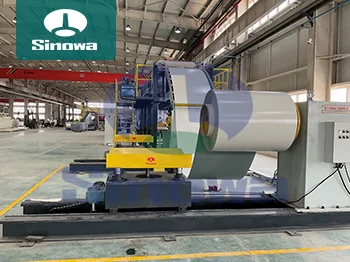
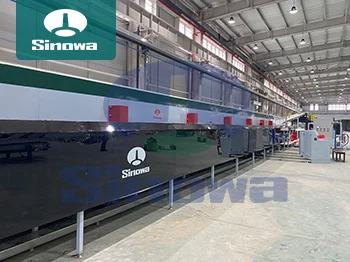
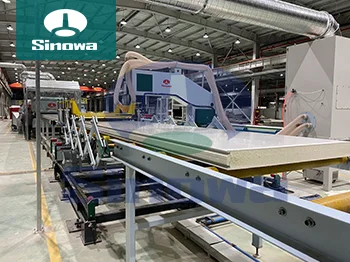
The high-tech sandwich panel foam production line can meet a variety of production needs of customers, the whole sandwich panel foam production line design concept of modularization enables all our components to be integrated and combined at will. Our high efficiency sandwich panel foam production line can easily automate the production of roof sandwich panel, wall sandwich panel, cold storage sandwich panel and other products by different combination and configuration selection and siple switching. The inner core layer can be polyrethane or rock wool, glass wool, an so on.


The high precision sandwich panel foam production line has high adaptability, which may produce various sandwich panel of the PU, PIR and rock wool systems. We may design various products according to the customer’s requirements, including various configurations, so as to meet their demands with flexible price system. Highly integrated and linked control system centralizes all control points at the main central center, achieving parameter linkage, fault self-diagnosis controlled by the whole line and shipping distance control. High-level automatic control system also saves the manpower and reduces the manpower loss for customers.


The precision servo hoisting mechanism employed by the main engine without hydraulic system makes the board thickness control flexible and the customer may conveniently change or adjust the board thickness. There will be not such troubles as hydraulic system adjustment, leakage, maintenance, etc.


High-level energy saving and protection design makes the whole sandwich panel foam production line possible to produce around the clock throughout the year and the customer will save huge budget. In addition, the isolated heat preservation room is constructed for warming the environment. The energy saving and protection design of our manufacturing line may guarantee that the customer’s production line may be freely heated and produce in the main time to save more costs for customers.


The high-power low-consumption design quickens the reaction of the cheap sandwich panel foam production line while energy consumption is kept low. With the brand-new, fully sealed inner insulation design, the energy consumption is controlled at the minimum level to achieve the design objective of less than an hour for the insulation system to be activated from the room temperature above 5℃ to the production process temperature. The energy consumption is only 40% that of those similar products.
The sandwich panel foam production line is an integrated, automated manufacturing system designed for the continuous fabrication of high-performance foam-core sandwich panels widely used in construction, industrial insulation, and modular building projects. This streamlined production system integrates multiple interconnected functional units to complete the entire manufacturing process from raw material pretreatment and foam batching to lamination, curing, trimming, and final product shaping. Featuring a modular and synchronized operational design, it minimizes manual intervention while ensuring consistent product quality and stable production efficiency. The core working principle relies on precise foam material proportioning, uniform pouring, and controlled thermal curing, which endow finished panels with excellent thermal insulation, sound insulation, and structural stability. Modern production lines adopt closed-loop operation and intelligent parameter adjustment mechanisms, effectively avoiding common quality flaws such as uneven foam density, weak layer bonding, and surface irregularities. As a core equipment for lightweight building material production, it adapts to diverse production demands and supports the manufacturing of panels with different thicknesses and performance specifications to meet varied engineering application scenarios.
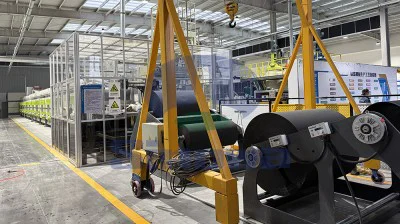
Raw material pretreatment serves as the foundational preliminary stage of the entire sandwich panel foam production process, laying a crucial foundation for subsequent foaming and composite molding. This processing unit mainly targets the surface layer substrates and foam core raw materials to eliminate factors that may affect product bonding quality and structural performance. For surface substrates, the system conducts automatic unwinding, straightening, and surface cleaning to remove dust, oil stains, and surface burrs generated during material storage and transportation. It also implements micro-preheating treatment to stabilize the substrate surface activity, which significantly enhances the adhesion between the surface layer and foam core material. For foam raw materials including polyol, isocyanate, and functional additives, the pretreatment system realizes sealed storage and constant temperature maintenance to prevent raw material deterioration, moisture absorption, and component separation. Professional filtering devices are equipped to remove impurity particles in raw materials, ensuring the purity of foaming components. Every parameter in the pretreatment process is precisely controlled to maintain the stability of raw material properties, avoiding quality fluctuations caused by inconsistent raw material states and guaranteeing the uniformity of subsequent foaming reactions and composite bonding effects.
Precision batching and high-speed mixing constitute the core link that determines the internal quality of foam cores in sandwich panels. This functional module consists of raw material conveying pipelines, precision metering units, and closed high-speed mixing chambers, achieving accurate proportioning and homogeneous blending of all foaming components. The metering system adopts high-sensitivity flow monitoring components to strictly control the feeding ratio, flow rate, and pressure of each raw material, effectively preventing product performance deviations caused by disproportionate component mixing. Different functional additives are quantitatively added according to preset production parameters to optimize the foam’s compactness, toughness, and weather resistance. After entering the mixing chamber, raw materials undergo high-speed cyclic stirring and instantaneous blending to form a uniform reactive liquid mixture without local component aggregation or dilution. The entire mixing process is carried out in a fully sealed environment to isolate external air and dust, avoiding bubble impurities and component oxidation. Reasonable mixing speed and time parameters are set to ensure the mixed liquid maintains optimal activity and fluidity, laying a reliable material foundation for uniform pouring and stable foaming expansion in the subsequent process.
Automatic pouring and uniform material distribution are key processes to ensure the consistent thickness and density of foam core layers. After full mixing, the reactive foam liquid is stably transported to the intelligent pouring device, which adopts a gantry reciprocating oscillation structure to realize linear and uniform pouring on the surface of the lower substrate. The pouring head moves at a constant and adjustable speed, cooperating with the continuous advancing of the substrate conveyor system to make the foam liquid evenly cover the entire gap between upper and lower surface layers. This dynamic pouring mode effectively solves common problems such as local material accumulation, sparse distribution, and uneven core thickness that occur in traditional fixed-point pouring processes. Equipped with auxiliary vibration leveling structures, the system can eliminate tiny voids inside the foam liquid, further improving the compactness and flatness of the initial foam layer. Meanwhile, the intelligent sensing system monitors the pouring dosage and material distribution state in real time, automatically adjusting the operating parameters of the pouring device according to the production speed and preset panel thickness. This real-time adjustment ensures that each section of the foam core maintains uniform structural consistency, avoiding quality differences in different areas of the finished sandwich panel.
Continuous lamination and pressure forming are critical procedures for compounding surface substrates and foam cores into integrated sandwich panel structures. After the foam liquid is poured and initially leveled, the upper and lower surface substrates with foam materials synchronously enter the double-belt pressing and forming unit. The closed space formed by the upper and lower circulating belts creates a stable molding environment, where the foam liquid completes rapid expansion and preliminary curing under constant mechanical pressure and appropriate temperature conditions. The double-belt system maintains uniform pressure distribution in the horizontal and vertical directions, ensuring that the foam core fits closely with the surface substrates without gaps or delamination during the expansion process. The running speed of the circulating belts matches the foaming reaction rate perfectly, coordinating the molding progress to prevent excessive extrusion from causing foam core thinning or insufficient pressure from leading to loose internal structure. In this stage, the initial loose foam liquid gradually forms a dense and stable core structure, and the molecular bonding between the foam core and surface substrates is completed. This integrated molding process greatly improves the overall structural rigidity and integrity of the sandwich panel, enhancing its pressure resistance and structural stability in long-term use.
Thermal insulation curing and parameter stabilization processes determine the final physical performance and service durability of sandwich panels. After preliminary lamination and forming, the semi-finished panels enter the constant-temperature curing channel to complete the final foaming reaction and structural solidification. The curing system adopts multi-stage temperature control technology to form a gradient thermal environment, which adapts to the different reaction rates of foam materials in different curing stages. The real-time temperature and pressure sensing elements inside the curing channel continuously monitor the foaming state, automatically adjusting internal environmental parameters to avoid quality defects such as hollow cavities, crackles, and uneven density caused by excessive or insufficient foaming. The slow and stable curing process enables the foam molecular structure to be fully cross-linked and solidified, significantly improving the core material’s thermal insulation performance, compression resistance, and aging resistance. Meanwhile, the layered bonding structure between the foam core and surface layers is further strengthened in the curing environment, effectively preventing delamination and peeling in subsequent use. Sufficient and stable curing treatment eliminates internal structural stress of the panels, ensuring that the finished products maintain stable performance under different temperature and humidity environments.
Precision trimming and fixed-length cutting are finishing processes to standardize the appearance and size of sandwich panels. After completing curing and cooling, the continuous strip-shaped panel blanks are transported to the trimming and cutting unit through an automatic conveyor system. The edge trimming device accurately cuts off the irregular residual edges on both sides of the panels caused by overflowing foam materials in the molding process, ensuring consistent width and neat edge structures of the panels. The high-precision cutting system adopts servo positioning technology to achieve fixed-length cutting according to customized size requirements, with accurate cutting dimensions and smooth incision surfaces without burrs or deformation. The entire trimming and cutting process operates synchronously with the production line rhythm, realizing uninterrupted continuous processing and effectively improving production efficiency. In addition, the system is equipped with a waste recycling mechanism to collect trimmed leftover materials, realizing resource recycling and reducing production waste. Through standardized finishing processing, all finished panels maintain unified dimensional accuracy and appearance quality, meeting the installation and matching requirements of various engineering scenarios and improving the overall applicability of the products.
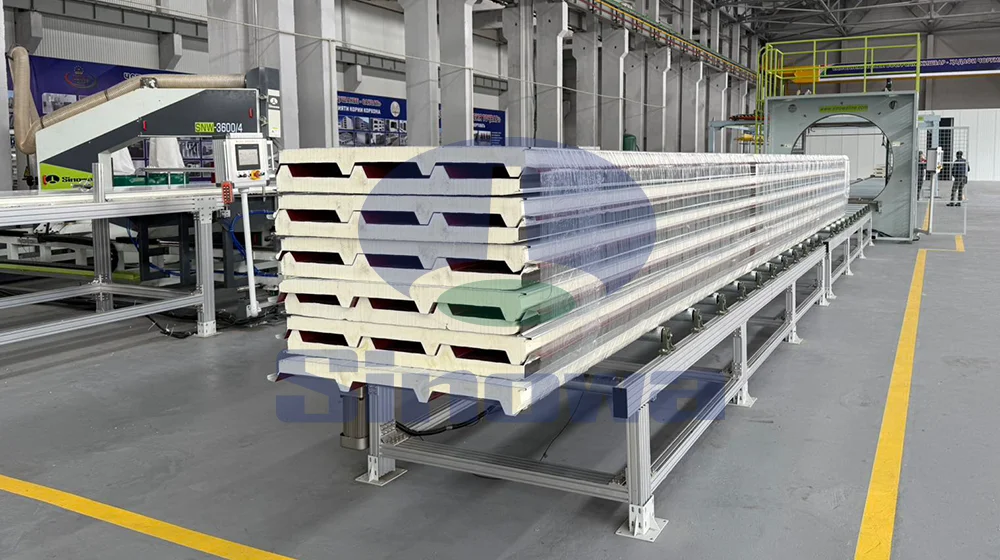
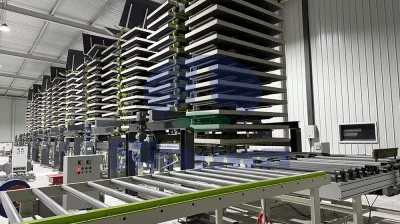
Automatic conveying and intelligent stacking constitute the final link of the entire production line, realizing efficient collection and standardized storage of finished products. After trimming and cutting, the qualified finished panels are automatically transported to the finished product sorting platform through the low-noise conveyor system. The intelligent detection unit conducts real-time inspection on panel surface flatness, dimensional accuracy, and surface integrity, screening out unqualified products to ensure that all delivered products meet production quality standards. Qualified panels are then automatically stacked by the mechanical stacking device in an orderly and standardized manner, with stable stacking posture and uniform arrangement, which facilitates subsequent packaging, transportation, and on-site construction. The entire finished product processing stage requires almost no manual operation, effectively reducing labor costs and avoiding product damage caused by manual handling errors. The highly automated terminal processing system perfectly matches the continuous production rhythm of the front-end process, forming a fully closed and efficient production loop from raw material input to finished product output. This complete production mode not only improves the overall automation level and production capacity of the equipment but also ensures the long-term stability and consistency of finished sandwich panel quality.
« Sandwich Panel Foam Production Line » Update Date: 2026/8/21
URL: https://www.sinowamachine.com/tags/sandwich-panel-foam-production-line.html
![Sandwich Panel Foam Production Line Supplier]()
Sandwich Panel Foam Production Line Supplier
2026-08-31Sandwich panel foam production lines stand as integral automated manufacturing systems tailored for the continuous and efficient production of high-performance composite building panels, which consist of lightweight foam core layers firmly bonded to rigid outer surface layers. These advanced producti…![Sandwich Panel Foam Production Line Manufacturer]()
Sandwich Panel Foam Production Line Manufacturer
2026-08-26The sandwich panel foam production line stands as a core integrated manufacturing system tailored for the automated and continuous production of high-performance foam core sandwich panels, widely applied in the construction, cold storage, industrial plant, and clean room industries. This fully automa…
- Links:
- Sandwich Panel Continuous Production Line
- Automatic and Continuous Sandwich Panel Production Line
- Cheap and Low Price Sandwich Panel Production Line
- China Sandwich Panel Production Line Factory
- Color Steel Sandwich Panel Production Line For Cold Storage
- Continuous Composite Foam Sandwich Panel Production Line
- Continuous Production Line For Rockwool and Mineral Wool Sandwich Panels
- Continuous PU Phenolic Insulation Panel Production Line
- Continuous PU PIR Sandwich Panel Production Line
- Continuous PUF PUR Sandwich Panel Production Line
- Continuous Sandwich Panel Production Line For Roof and Wall
- Customized and Design Sandwich Panel Production Line
- Decorative Sandwich Panel Production Line For Glass Wool Boards
- High Quality Sandwich Panel Production Line For Sale
- Polyurethane(PU) Sandwich Panel Production Line
- Sandwich Panel Production Line Manufacturer and Supplier
- Sandwich Panel Production Machinery and Equipment