
PIR Sandwich Panel Line
Sinowa is a pir sandwich panel line supplier from china, customized high-quality & high efficiency pir sandwich panel line at low price, the adoption of system integration technology and bus control technology accomplishes the full automatization of integrated and coordinated control of the pir sandwich panel line with accessible remote interactive communication. Ranking the first-class level in the world, it is currently the pir sandwich panel line in the market taking a comprehensive lead in high performance.
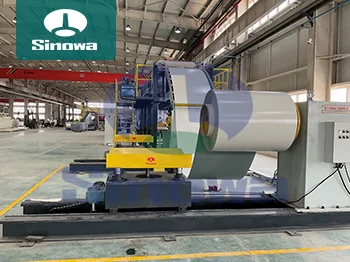
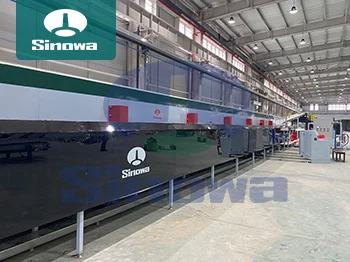
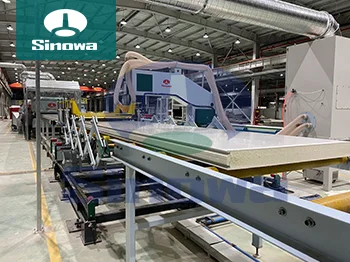
The high-tech pir sandwich panel line can meet a variety of production needs of customers, the whole pir sandwich panel line design concept of modularization enables all our components to be integrated and combined at will. Our high efficiency pir sandwich panel line can easily automate the production of roof sandwich panel, wall sandwich panel, cold storage sandwich panel and other products by different combination and configuration selection and siple switching. The inner core layer can be polyrethane or rock wool, glass wool, an so on.


The high precision pir sandwich panel line has high adaptability, which may produce various sandwich panel of the PU, PIR and rock wool systems. We may design various products according to the customer’s requirements, including various configurations, so as to meet their demands with flexible price system. Highly integrated and linked control system centralizes all control points at the main central center, achieving parameter linkage, fault self-diagnosis controlled by the whole line and shipping distance control. High-level automatic control system also saves the manpower and reduces the manpower loss for customers.


The precision servo hoisting mechanism employed by the main engine without hydraulic system makes the board thickness control flexible and the customer may conveniently change or adjust the board thickness. There will be not such troubles as hydraulic system adjustment, leakage, maintenance, etc.


High-level energy saving and protection design makes the whole pir sandwich panel line possible to produce around the clock throughout the year and the customer will save huge budget. In addition, the isolated heat preservation room is constructed for warming the environment. The energy saving and protection design of our manufacturing line may guarantee that the customer’s production line may be freely heated and produce in the main time to save more costs for customers.


The high-power low-consumption design quickens the reaction of the cheap pir sandwich panel line while energy consumption is kept low. With the brand-new, fully sealed inner insulation design, the energy consumption is controlled at the minimum level to achieve the design objective of less than an hour for the insulation system to be activated from the room temperature above 5℃ to the production process temperature. The energy consumption is only 40% that of those similar products.
A PIR sandwich panel line is a highly integrated and automated industrial system designed to produce composite sandwich panels with polyisocyanurate as the core material. It realizes seamless and continuous production from raw material input to finished product output, integrating multiple functional processes to ensure efficiency and consistency. The production process typically starts with the pretreatment of surface materials, which are smoothed and preheated to enhance adhesion with the core. The PIR foam, mixed with eco-friendly blowing agents and additives, is then injected between two surface layers, where it expands and cures to form a solid, uniform core. This entire process is controlled by an intelligent system that monitors parameters such as foam density and panel thickness, minimizing human intervention and reducing defects. The line features modular design, allowing flexible switching between different panel specifications and thicknesses to meet diverse project needs. It is also energy-efficient, adopting technologies that lower energy consumption compared to traditional production methods. The panels produced by this line have excellent thermal insulation, fire resistance and structural stability, making them widely applicable in various fields such as industrial buildings, cold chain logistics, commercial structures and fire-proof partitions. This advanced production line plays a vital role in promoting the development of energy-saving and high-performance building materials, adapting to the growing demand for sustainable and efficient construction solutions.
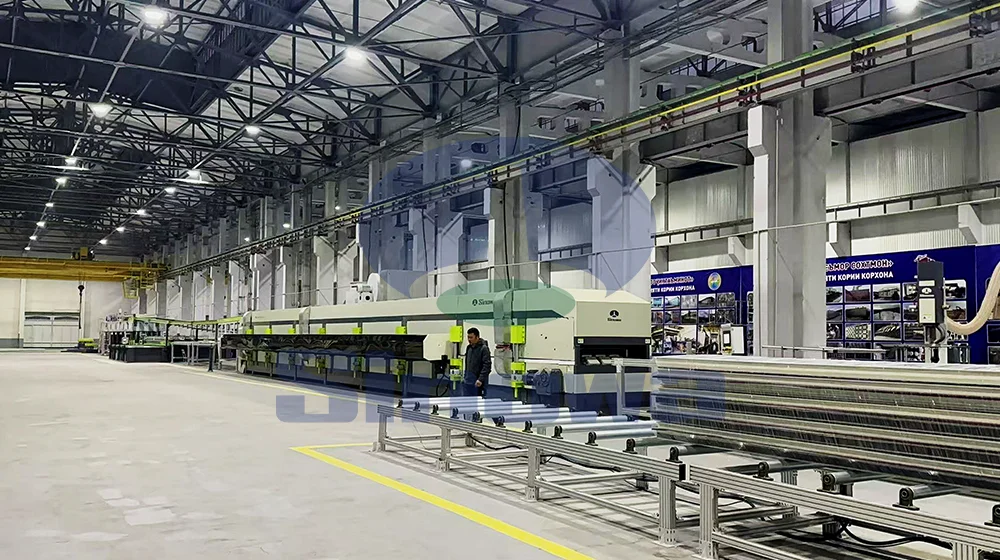
Polyisocyanurate (PIR) sandwich panels have become an indispensable material in modern construction, industrial, and commercial fields due to their excellent fire resistance, thermal insulation, and structural stability. The production of these high-performance panels relies on specialized PIR sandwich panel lines, which are highly integrated and automated industrial manufacturing systems designed to convert raw materials into finished composite panels through a series of precise and continuous processes. These production lines integrate multidisciplinary knowledge, including mechanical engineering, materials science, and automation control, to ensure consistent product quality, efficient manufacturing, and adaptability to diverse application needs.
The structure of a PIR sandwich panel line is a sophisticated combination of functional modules, each designed to perform specific tasks in the production workflow, working together seamlessly to achieve continuous and automated production. At the core of the line are several key components that form the backbone of the manufacturing process. The production process typically starts with unwinding units, which are responsible for the continuous supply of facing materials. These units are equipped with tension control systems to maintain stability and prevent wrinkling or deformation of the facings during processing, ensuring that the surface of the final panel is smooth and free from defects. Common facing materials include thin-gauge metal sheets such as galvanized steel or aluminum, as well as non-metallic substrates like oriented strand board (OSB) or magnesium oxide (MGO) board, depending on the intended application of the panels. The unwinding units can accommodate different widths and thicknesses of facing materials, allowing for flexibility in panel dimensions to meet diverse project requirements.
Following the unwinding stage, the facing materials undergo pre-treatment processes to improve their adhesion with the PIR core. This pre-treatment may involve surface cleaning to remove dust, oil, or other contaminants that could hinder the bonding process, as well as chemical or mechanical activation to create a rough surface texture that promotes stronger bonding between the facing and the core. Some advanced production lines also use coronary discharge to remove static electricity from the metal sheets, further enhancing the adhesion of the PIR foam. After pre-treatment, the facing materials move to the adhesive application unit, where a precise amount of adhesive is evenly distributed on the inner surface of the lower facing. Advanced adhesive application systems, such as roller coaters or spray nozzles with computerized control, ensure uniform coverage and consistent adhesive thickness, which is critical for maintaining the structural integrity of the final panel. In some cases, rotating brushes are used to transfer a portion of the adhesive from the lower facing to the upper facing, optimizing the bonding effect between both facings and the PIR core.
The most critical component of the PIR sandwich panel line is the PIR foam mixing and pouring system, which is responsible for generating the fire-resistant foam core that gives the panels their unique properties. This system consists of storage tanks for raw materials, including isocyanates, polyols, catalysts, blowing agents, and additives, as well as high-pressure mixers and pouring heads. The raw materials are precisely metered and mixed at controlled temperatures and pressures to ensure the formation of a homogeneous foam with consistent density and performance. The blowing agent, often cyclopentane or pentane, which meets environmental standards, is added to create a closed-cell structure in the foam, enhancing its thermal insulation and water resistance. The high-pressure mixing ensures that the components react fully, resulting in a foam core with excellent mechanical strength and fire resistance. The pouring head evenly distributes the foam mixture between the pre-treated upper and lower facings, which are then fed into a composite laminating system.
The composite laminating system, often consisting of a double-track laminating press or crawler press, applies uniform pressure and temperature to the sandwich structure, ensuring that the PIR foam bonds firmly with the facings as it cures. The temperature in this stage is carefully controlled, typically between 50 and 60 degrees Celsius, to optimize the foaming and curing process, with an infrared temperature measurement system monitoring the track temperature in real-time to ensure accuracy within ±1 degree Celsius. This stage is crucial for preventing delamination and ensuring that the final panel has consistent thickness and structural integrity. After laminating, the continuous panel moves to the cutting and sawing system, which uses laser positioning combined with hydraulic cutting blades to achieve high-precision cutting. The cutting system can be adjusted to produce panels of customized lengths, with a length error of no more than 0.5 millimeters per meter, and can handle panel lengths of up to 24 meters depending on configuration. Finally, the finished panels are transferred to a stacking system, which arranges them neatly for storage or transportation, completing the production process.
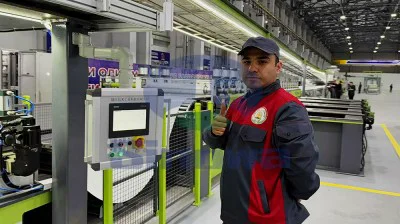
The overall length of a PIR sandwich panel line typically varies between 45 meters and 100 meters, depending on the production capacity requirements and the complexity of the products being manufactured. Longer production lines generally have more process segments, allowing for the production of more complex product types or higher levels of automation. Most modern lines adopt a modular design concept, where each functional unit is relatively independent yet closely coordinated. This modular design not only makes maintenance and upgrades easier but also allows for flexible configuration, enabling manufacturers to adapt the line to produce different types of panels or integrate new technologies as needed. The entire line is controlled by an intelligent automation system, often using PLC (Programmable Logic Controller) technology with a human-machine interface, which enables the linkage of all production parameters, real-time monitoring of the production process, and fault self-diagnosis. This automation reduces the need for manual intervention, lowers labor costs, and ensures consistent product quality by minimizing human error.
The performance of a PIR sandwich panel line is determined by its ability to produce high-quality panels efficiently, reliably, and in line with diverse application requirements. One of the key performance characteristics of these lines is their high efficiency and productivity. Depending on the product specifications and line configuration, PIR sandwich panel lines can achieve production speeds ranging from 3 to 25 meters per minute, with continuous lines capable of producing up to 2.5 million square meters of panels per year. This high productivity makes them suitable for large-scale manufacturing, meeting the demands of large construction projects or industrial applications. The automation of the line also contributes to its efficiency, as it reduces downtime between processes and ensures a continuous flow of production, with only 6 to 8 operators required to run the entire line in most cases.
Another critical performance aspect is the precision and consistency of the production process. Advanced PIR sandwich panel lines are equipped with precise control systems that monitor and adjust key parameters such as raw material proportioning, foaming temperature and pressure, laminating pressure, and cutting length. This precision ensures that the finished panels have consistent thickness, density, and mechanical properties, with the density deviation of the PIR core typically controlled within 3%. The high-precision cutting system also ensures that the panels have clean, flat edges, reducing waste and improving the efficiency of on-site installation. Additionally, the lines are designed to maintain stability even during long-term operation, with durable components and reliable fault detection systems that minimize unplanned downtime.
Environmental protection and energy conservation are also important performance characteristics of modern PIR sandwich panel lines. Many lines are equipped with energy-saving laminated conveyors and use fluorine-free foaming technologies, such as cyclopentane or pentane foaming, which are more environmentally friendly than traditional foaming agents. These technologies reduce the environmental impact of the production process while also lowering energy consumption, with some lines consuming only 40% to 50% of the energy used by similar equipment. The modular design also contributes to energy efficiency, as it allows manufacturers to operate only the necessary modules for a specific product, reducing unnecessary energy use. Furthermore, the production process generates minimal waste, as the precise control of raw materials and cutting reduces scrap, and many components of the line are recyclable, aligning with global sustainability trends.
The adaptability and flexibility of PIR sandwich panel lines are also key performance features. These lines can be configured to produce a wide range of panel types, with adjustable core thicknesses, facing materials, and panel dimensions. They can support the production switching of various core materials, including PIR, PU (polyurethane), and rock wool, allowing manufacturers to meet diverse market demands without investing in multiple production lines. The modular design enables rapid switching between different panel specifications, making it easy to adapt to changes in customer requirements or market trends. Additionally, the lines can accommodate different facing materials, from metal sheets to non-metallic substrates, and can produce panels with different surface profiles, such as trapezoidal roofs or hidden joint walls, further enhancing their adaptability.
PIR sandwich panel lines can be categorized into different types based on their production mode, configuration, and intended product range. The most common classification is between continuous and discontinuous production lines. Continuous PIR sandwich panel lines are designed for mass production of standard panels, offering high productivity and consistent quality. These lines operate continuously, with raw materials fed into one end and finished panels emerging from the other, making them ideal for large-scale manufacturing of wall, roof, and cold storage panels. Continuous lines are typically equipped with advanced automation systems and modular components, allowing for high-speed production and easy customization of panel dimensions.
Discontinuous PIR sandwich panel lines, on the other hand, are more suitable for medium-batch production of diverse panel types, including specialized panels with unique configurations. Unlike continuous lines, discontinuous lines operate in batches, allowing for greater flexibility in product design and material selection. They can produce a wide range of panels, including those with rigid facing materials such as OSB or MGO board, as well as specialized panels like cold storage panels with complete side sealing or clean room panels with internal channels for electrical or thermal wiring. Discontinuous lines are often preferred by manufacturers who need to produce multiple product types or cater to niche markets, as they offer greater versatility and lower investment costs for small to medium-scale production.
Another classification of PIR sandwich panel lines is based on the type of panels they produce. Some lines are specifically designed for fire-proof partition panels, integrating technologies that enhance the fire resistance of the panels, such as PIR edge sealing rock wool composite processes. These lines are equipped with specialized pre-treatment and foaming systems to ensure that the panels meet strict fire safety requirements, making them suitable for use in high-risk environments such as lithium battery factories, hospitals, and data centers. Other lines are designed for cold storage panels, featuring enhanced insulation performance and waterproof structures, such as concealed nail connections and unique waterproof groove designs, which allow the panels to perform effectively in low-temperature environments as low as -40 degrees Celsius.
There are also specialized PIR sandwich panel lines designed for lightweight structural panels, which are used in modular buildings and other applications where weight reduction and structural strength are paramount. These lines produce panels with a lightweight yet strong composite structure, featuring eccentric hook plate designs that enable fast splicing, increasing construction efficiency by up to 40%. Additionally, some lines are designed to produce panels for roof applications, with specialized roll forming systems that create trapezoidal profiles for enhanced water drainage, even with roof slopes as low as 3%.
The applications of PIR sandwich panel lines are closely linked to the applications of the PIR sandwich panels they produce, covering a wide range of industries and project types. In the construction industry, PIR sandwich panels produced by these lines are widely used for external walls, internal walls, and roofs of various buildings, including commercial buildings, office buildings, industrial factories, warehouses, sports halls, and exhibition halls. The panels’ excellent thermal insulation performance helps reduce energy consumption for heating and cooling, making buildings more energy-efficient and environmentally friendly. Their lightweight nature also reduces the overall weight of the building structure, lowering construction costs and shortening construction cycles, especially in modular and prefabricated building projects.
In the cold chain logistics industry, PIR sandwich panels produced by specialized lines are essential for the construction of cold storage facilities, freezers, and refrigerated warehouses. The closed-cell structure of the PIR core provides excellent thermal insulation, ensuring that the internal temperature of the cold storage remains stable even in extreme external temperatures. The panels’ dimensional stability at low temperatures, superior to EPS or XPS materials, makes them ideal for long-term use in cold chain applications, helping to preserve perishable goods such as food, pharmaceuticals, and chemicals. Additionally, the waterproof and moisture-resistant properties of the panels prevent condensation and moisture damage, ensuring the integrity of the cold storage environment.
The industrial sector is another major application area for PIR sandwich panel lines. The panels produced by these lines are used for the construction of industrial factories, workshops, and storage facilities, where they provide thermal insulation, fire resistance, and sound insulation. In industries such as automotive manufacturing, electronics, and chemical processing, the panels are used to create clean rooms and controlled environments, as they can be designed to meet strict cleanliness and airtightness requirements. The fire-resistant properties of PIR panels also make them suitable for use in industrial facilities where fire safety is a critical concern, such as lithium battery factories, where they are used as fire-resistant partitions that can withstand electrolyte corrosion.
Modular and prefabricated buildings have become increasingly popular in recent years, and PIR sandwich panel lines play a key role in their production. The lightweight and easy-to-install nature of PIR panels makes them ideal for modular construction, where panels are prefabricated in the factory and then transported to the construction site for assembly. The fast splicing design of some panels, enabled by specialized production lines, significantly reduces on-site construction time, making modular buildings a cost-effective and efficient solution for residential, commercial, and industrial projects. Additionally, the thermal insulation and sound insulation properties of PIR panels ensure that modular buildings are comfortable and energy-efficient.
Other application areas of PIR sandwich panel lines include public infrastructure projects, such as subway stations, airports, and railway stations, where the panels are used for wall cladding, ceilings, and partitions. The panels’ durability and resistance to environmental factors, such as moisture and corrosion, make them suitable for use in these high-traffic public spaces. They are also used in agricultural buildings, such as greenhouses and livestock barns, where they provide thermal insulation to maintain optimal growing or living conditions for plants and animals. In addition, PIR panels produced by these lines are used in the renovation and retrofitting of existing buildings, helping to improve their energy efficiency and fire safety without the need for extensive structural modifications.
As the demand for energy-efficient, fire-resistant, and sustainable building materials continues to grow, the role of PIR sandwich panel lines becomes increasingly important. These production lines are constantly evolving, with advancements in automation, material science, and environmental technology enhancing their performance, efficiency, and versatility. The integration of digital technologies, such as AI quality inspection systems and digital twin technology, is further improving the quality control and operational efficiency of these lines, reducing waste and optimizing production processes. The modular design of modern lines also allows for easy upgrades and customization, enabling manufacturers to adapt to changing market demands and technological advancements.
In conclusion, PIR sandwich panel lines are sophisticated, automated manufacturing systems that play a critical role in the production of high-performance PIR sandwich panels. Their structure, consisting of interconnected functional modules, ensures continuous and precise production, while their performance characteristics, including high efficiency, precision, environmental friendliness, and adaptability, make them suitable for a wide range of manufacturing needs. The different types of lines, including continuous and discontinuous systems, cater to various production scales and product requirements, enabling manufacturers to produce panels for diverse applications. From construction and cold chain logistics to industrial facilities and modular buildings, PIR sandwich panel lines contribute to the development of sustainable, efficient, and safe built environments. As technology continues to advance, these lines will continue to evolve, further enhancing the quality and versatility of PIR sandwich panels and expanding their applications in new industries and projects.
« PIR Sandwich Panel Line » Update Date: 2026/4/17
URL: https://www.sinowamachine.com/tags/pir-sandwich-panel-line.html
![PIR Sandwich Panel Line For Roof]()
PIR Sandwich Panel Line For Roof
2026-09-03The PIR sandwich panel production line for roof applications is a fully automated, continuous manufacturing system designed to produce high-performance insulated roof panels tailored for modern construction projects. Integrating multiple synchronized processing units, this streamlined production syst…![PIR Sandwich Panel Line For Sale]()
PIR Sandwich Panel Line For Sale
2026-09-01The PIR sandwich panel production line stands as a sophisticated, fully integrated industrial manufacturing system tailored for the continuous mass production of high-performance polyisocyanurate composite sandwich panels. As an upgraded industrial solution compared with traditional polyurethane pane…![PIR Sandwich Panel Line Manufacturer]()
PIR Sandwich Panel Line Manufacturer
2026-08-17PIR sandwich panel production lines represent advanced integrated manufacturing equipment dedicated to the mass production of high-performance composite building panels, which have become indispensable core equipment in the modern energy-saving building material industry. Different from traditional i…![PIR Sandwich Panel Line Price]()
PIR Sandwich Panel Line Price
2026-01-12The global construction and manufacturing industries have witnessed a growing demand for energy-efficient and high-performance building materials, and PIR (Polyisocyanurate) sandwich panels have emerged as a prominent choice in this context. These panels are celebrated for their exceptional thermal i…![High-tech PIR Sandwich Panel Line]()
High-tech PIR Sandwich Panel Line
2026-01-09In the evolving landscape of modern manufacturing, the demand for efficient, versatile, and sustainable production solutions has driven significant innovations in building material production equipment. Among these advancements, the high-tech PIR sandwich panel line stands out as a pivotal developmen…
- Links:
- Sandwich Panel Continuous Production Line
- Automatic and Continuous Sandwich Panel Production Line
- Cheap and Low Price Sandwich Panel Production Line
- China Sandwich Panel Production Line Factory
- Color Steel Sandwich Panel Production Line For Cold Storage
- Continuous Composite Foam Sandwich Panel Production Line
- Continuous Production Line For Rockwool and Mineral Wool Sandwich Panels
- Continuous PU Phenolic Insulation Panel Production Line
- Continuous PU PIR Sandwich Panel Production Line
- Continuous PUF PUR Sandwich Panel Production Line
- Continuous Sandwich Panel Production Line For Roof and Wall
- Customized and Design Sandwich Panel Production Line
- Decorative Sandwich Panel Production Line For Glass Wool Boards
- High Quality Sandwich Panel Production Line For Sale
- Polyurethane(PU) Sandwich Panel Production Line
- Sandwich Panel Production Line Manufacturer and Supplier
- Sandwich Panel Production Machinery and Equipment