
Foam Sandwich Panel Production Line
Sinowa is a foam sandwich panel production line supplier from china, customized high-quality & high efficiency foam sandwich panel production line at low price, the adoption of system integration technology and bus control technology accomplishes the full automatization of integrated and coordinated control of the foam sandwich panel production line with accessible remote interactive communication. Ranking the first-class level in the world, it is currently the foam sandwich panel production line in the market taking a comprehensive lead in high performance.
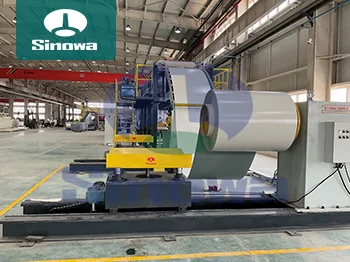
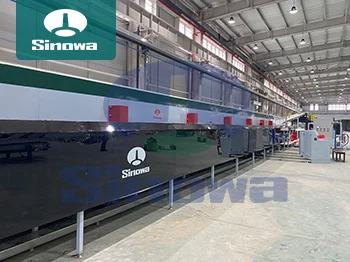
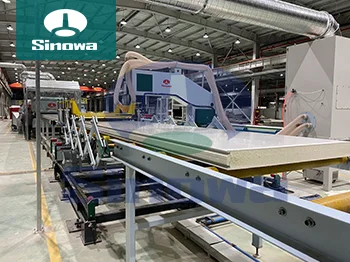
The high-tech foam sandwich panel production line can meet a variety of production needs of customers, the whole foam sandwich panel production line design concept of modularization enables all our components to be integrated and combined at will. Our high efficiency foam sandwich panel production line can easily automate the production of roof sandwich panel, wall sandwich panel, cold storage sandwich panel and other products by different combination and configuration selection and siple switching. The inner core layer can be polyrethane or rock wool, glass wool, an so on.


The high precision foam sandwich panel production line has high adaptability, which may produce various sandwich panel of the PU, PIR and rock wool systems. We may design various products according to the customer’s requirements, including various configurations, so as to meet their demands with flexible price system. Highly integrated and linked control system centralizes all control points at the main central center, achieving parameter linkage, fault self-diagnosis controlled by the whole line and shipping distance control. High-level automatic control system also saves the manpower and reduces the manpower loss for customers.


The precision servo hoisting mechanism employed by the main engine without hydraulic system makes the board thickness control flexible and the customer may conveniently change or adjust the board thickness. There will be not such troubles as hydraulic system adjustment, leakage, maintenance, etc.


High-level energy saving and protection design makes the whole foam sandwich panel production line possible to produce around the clock throughout the year and the customer will save huge budget. In addition, the isolated heat preservation room is constructed for warming the environment. The energy saving and protection design of our manufacturing line may guarantee that the customer’s production line may be freely heated and produce in the main time to save more costs for customers.


The high-power low-consumption design quickens the reaction of the cheap foam sandwich panel production line while energy consumption is kept low. With the brand-new, fully sealed inner insulation design, the energy consumption is controlled at the minimum level to achieve the design objective of less than an hour for the insulation system to be activated from the room temperature above 5℃ to the production process temperature. The energy consumption is only 40% that of those similar products.
The foam sandwich panel production line stands as a highly integrated, automated manufacturing system designed to produce composite building and industrial panels that combine lightweight foam cores with rigid outer facing materials, delivering a unique balance of structural strength, thermal efficiency, and practical versatility. Unlike fragmented manual production processes, this continuous or semi-continuous line streamlines every stage of panel manufacturing into a synchronized workflow, eliminating inconsistencies in product quality and boosting overall production efficiency while adapting to diverse market demands for customized panel specifications. At its core, the line is built around a modular structural framework, where each functional unit works in seamless coordination to transform raw materials—including metal coil facings, foam raw materials, and bonding agents—into finished sandwich panels ready for installation across countless sectors. The overall structure prioritizes stability, adaptability, and operational continuity, with key components engineered to withstand long hours of continuous operation while maintaining precise control over critical production parameters such as temperature, pressure, material feeding speed, and bonding uniformity.
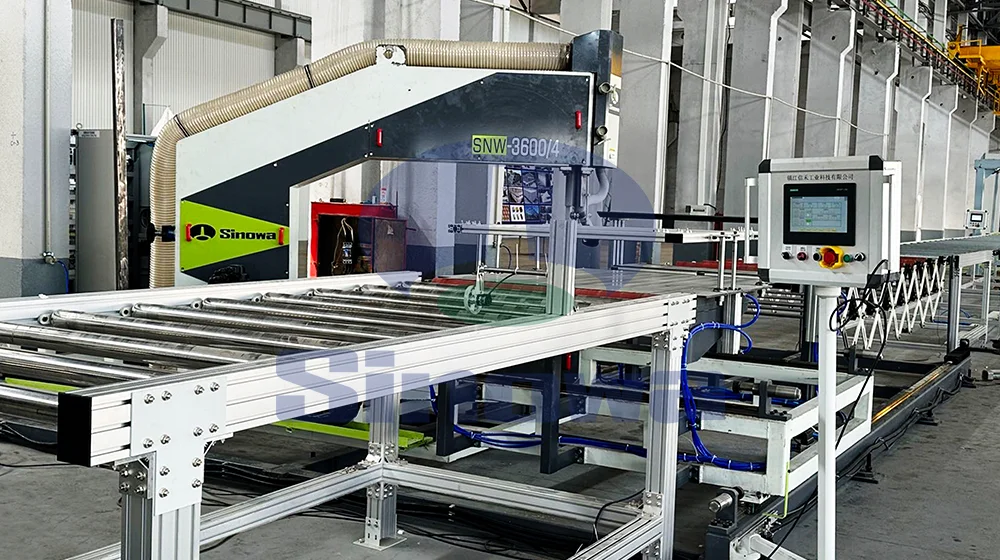
Breaking down the structural composition, the production line begins with a material uncoiling and preparation unit, which handles the outer facing materials, most commonly metal coils such as steel or aluminum, though non-metal facing options like fiberglass-reinforced panels are also accommodated for specialized applications. This unit features precision uncoilers, levelers, and surface treatment stations that remove contaminants, smooth surface irregularities, and prepare the facings for optimal adhesion with the foam core; preheating modules are often integrated here to raise the facing material to a controlled temperature range, enhancing the bonding strength between the outer layers and the foam core and preventing delamination over the panel’s service life. Following the preparation stage, the facing materials move into a roll forming section that shapes the edges and profiles of the panels, creating interlocking grooves, overlapping edges, or custom profiles tailored to specific installation needs, with adjustable tooling to accommodate varying panel widths and thicknesses without full line reconfiguration.
The central and most critical segment of the production line is the foam core formation and lamination system, where the foam material is mixed, expanded, and bonded between the two outer facings to form a unified composite structure. For continuous production lines, this section consists of a high-precision foam mixing and dispensing system, a double-belt conveyor press, and a controlled heating and curing zone. The foam mixing equipment ensures accurate ratio control of liquid foam raw materials, delivering a uniform mixture that expands evenly to fill the gap between the upper and lower facings without voids or density inconsistencies. The double-belt press maintains consistent pressure and panel thickness throughout the curing process, ensuring the final product has a flat surface, uniform density distribution, and tight bonding between all layers; the belt speed is synchronized with the entire line’s pace to prevent material stretching or compression, which could compromise structural integrity. Downstream from the lamination and curing section, a precision cutting and finishing unit trims the continuous panel strip to custom lengths, smooths cut edges, and performs optional surface treatments such as protective film application to prevent damage during transportation and installation. The line concludes with a stacking and material handling system that automatically collects finished panels, sorts them by specification, and prepares them for storage or shipping, reducing manual labor and minimizing the risk of product damage.
In terms of structural performance, the foam sandwich panel production line is engineered to deliver exceptional stability and durability, even under high-volume, continuous production demands. The main frame of the line is constructed with heavy-duty, rigid steel profiles that resist vibration and deformation, ensuring that all moving components maintain precise alignment during operation; this structural rigidity is critical for preserving panel thickness accuracy and uniform bonding across the entire panel surface, regardless of production speed. Key moving parts, such as conveyor belts, rollers, and cutting blades, are designed with wear-resistant materials and smooth operation mechanisms to minimize friction and extend service life, reducing downtime for maintenance and repairs. The line’s performance also extends to operational precision, with advanced control systems regulating every parameter in real time: temperature in the curing zone is maintained within a narrow tolerance range to support optimal foam expansion and cross-linking, material feeding rates are adjusted to match the foam curing speed, and pressure in the lamination zone is calibrated to avoid over-compression of the foam core (which would reduce insulation performance) or under-compression (which would weaken structural bonding).
Another core performance attribute of the production line is its adaptability and flexibility, allowing manufacturers to switch between different panel types, thicknesses, and facing materials with minimal downtime and setup adjustments. This flexibility is supported by modular component design, where individual units can be fine-tuned or replaced to accommodate different foam materials, facing thicknesses, or panel profiles without overhauling the entire line. The line also delivers consistent product performance across all output, ensuring that every panel meets uniform standards for density, thermal conductivity, bonding strength, and dimensional accuracy; this consistency is vital for end-users, as it guarantees predictable performance in real-world applications and simplifies installation and assembly. Additionally, the production line is designed for energy efficiency and operational safety, with optimized heating systems that target only the necessary zones to reduce energy consumption, enclosed material handling to minimize dust and chemical exposure for operators, and safety interlocks that halt operation if irregularities are detected, preventing accidents and material waste.
Foam sandwich panels produced by these lines are categorized primarily by the type of foam core material, each offering distinct performance properties that suit specific application requirements, with no compromise on the structural integrity of the composite panel. The most common foam core type is polyurethane (PU) foam, known for its outstanding thermal insulation efficiency, moderate structural strength, and strong bonding capability with metal and non-metal facings; PU foam panels have a closed-cell structure that resists moisture penetration and heat transfer, making them ideal for temperature-controlled environments. A variation of PU foam is polyisocyanurate (PIR) foam, which offers enhanced fire resistance and thermal stability compared to standard PU foam, with a higher temperature tolerance and lower thermal conductivity, suitable for applications where fire safety and long-term thermal performance are top priorities. Expanded polystyrene (EPS) foam is another widely used core material, valued for its lightweight properties, cost-effective production, and reliable basic insulation performance; EPS foam panels are lighter than PU or PIR panels, reducing the overall load on building structures while providing sufficient thermal resistance for general-purpose applications.
Phenolic foam core panels represent a specialized category designed for high-fire-resistance environments, with exceptional flame retardancy, low smoke emission, and heat insulation properties that exceed many other foam types; phenolic foam maintains its structural integrity at higher temperatures and does not release toxic fumes when exposed to fire, making it suitable for public buildings and high-safety industrial facilities. Extruded polystyrene (XPS) foam cores offer higher density and compressive strength than EPS foam, with superior moisture resistance and dimensional stability, making them ideal for applications that require heavy load-bearing capacity and resistance to water damage, such as cold storage floors and exterior wall panels in humid climates. Additionally, specialized PET foam cores, made from recycled materials, provide a sustainable alternative with good mechanical strength and thermal insulation, catering to the growing demand for eco-friendly building materials. Each foam core type is paired with compatible facing materials—typically galvanized steel, aluminum, or fiberglass-reinforced plastic—to enhance durability, weather resistance, and aesthetic appeal, with the production line capable of adjusting lamination parameters to match the unique bonding requirements of each foam-facing combination.
The performance variations between different foam sandwich panel types translate directly to their diverse range of applications across construction, industrial, transportation, and agricultural sectors, with each type selected for its ability to meet specific functional needs such as thermal insulation, structural support, fire resistance, or lightweight design. In the construction industry, these panels are among the most widely used materials for both residential and commercial building projects, serving as exterior wall cladding, roof panels, partition walls, and ceiling panels. PU and PIR foam panels dominate in residential and commercial construction for their superior thermal efficiency, reducing heating and cooling energy consumption and maintaining consistent indoor temperatures; their lightweight nature also speeds up construction timelines, as they are easier to transport and install than traditional brick, concrete, or masonry materials, requiring less structural support and reducing overall construction time and labor costs. Phenolic foam panels are preferred for public buildings such as schools, hospitals, and shopping centers, where strict fire safety regulations and high occupancy rates demand materials with exceptional fire resistance and low smoke emission.
Industrial applications rely heavily on foam sandwich panels for specialized facilities that require precise environmental control and structural durability, with cold storage warehouses being one of the most prominent use cases. EPS, PU, and XPS foam panels are ideal for cold chain storage facilities, as their high thermal insulation performance maintains stable low temperatures, preventing temperature fluctuations that could spoil perishable goods such as food, pharmaceuticals, and chemical products; these panels also resist moisture buildup and condensation, protecting the integrity of the storage environment and extending the service life of the facility. Manufacturing plants and industrial workshops use heavy-duty foam sandwich panels for wall and roof construction, benefiting from their sound insulation properties to reduce noise pollution, weather resistance to withstand harsh industrial environments, and quick installation to minimize downtime during facility construction or renovation. Cleanroom facilities in industries such as electronics, pharmaceuticals, and food processing also use smooth, non-porous foam sandwich panels, as their seamless surface prevents dust and bacteria accumulation, making them easy to clean and maintain sterile conditions.
The transportation sector utilizes foam sandwich panels for their unique combination of lightweight design and structural strength, which helps improve fuel efficiency and load capacity while maintaining insulation for temperature-sensitive cargo. Refrigerated trucks, shipping containers, and insulated rail cars use PU and PIR foam panels to create temperature-controlled cargo spaces, ensuring that perishable goods remain at a consistent temperature during long-distance transportation; the lightweight properties of the panels reduce the overall vehicle weight, allowing for heavier cargo loads and lower fuel consumption compared to traditional insulated materials. Recreational vehicles (RVs), mobile homes, and modular housing units also rely on foam sandwich panels for wall, roof, and floor construction, as they provide excellent insulation for comfortable indoor living conditions, structural stability for mobile use, and quick assembly for modular manufacturing processes. In addition, marine and aerospace applications use specialized lightweight foam sandwich panels with high-strength facings, leveraging their buoyancy, vibration resistance, and thermal insulation properties for specific components that require both durability and weight reduction.
Agricultural applications of foam sandwich panels have grown significantly in recent years, particularly for controlled agricultural environments such as greenhouses, livestock barns, and aquaculture facilities. Greenhouses use insulated foam sandwich panels for walls and roofs to maintain stable internal temperatures, protect plants from extreme outdoor weather conditions, and reduce energy usage for heating and cooling; the panels also block unwanted UV radiation when paired with specialized facings, creating an optimal growing environment for crops. Livestock barns benefit from the panels’ thermal insulation and soundproofing, keeping animals comfortable in both hot and cold climates and reducing stress from external noise; the smooth, easy-to-clean surface of the panels also supports hygienic livestock housing, preventing the growth of bacteria and parasites. Aquaculture facilities use moisture-resistant XPS or PU foam panels to construct insulated tanks and enclosure walls, maintaining consistent water temperatures for fish and aquatic species and improving survival rates and growth efficiency.
Beyond these core sectors, foam sandwich panels find use in temporary structures such as construction site offices, emergency shelters, and event pavilions, thanks to their portability, quick installation, and reusability. These temporary structures require materials that are lightweight, durable, and weather-resistant, and foam sandwich panels meet all these criteria while providing basic insulation for year-round use. The versatility of the production line further supports these niche applications, as it can produce custom-sized, thin-profile panels for small-scale projects or large-format panels for industrial and commercial construction, with consistent quality regardless of panel size or specification. As sustainable building practices and energy efficiency become increasingly important globally, the demand for high-performance foam sandwich panels and advanced production lines continues to rise, driven by the material’s ability to balance performance, affordability, and environmental benefits. The production line’s ongoing evolution focuses on enhancing automation, reducing material waste, and accommodating more eco-friendly foam materials and recycled facing materials, ensuring that foam sandwich panels remain a leading choice for modern construction and industrial design for years to come.
In summary, the foam sandwich panel production line is a sophisticated, multi-functional manufacturing system defined by its robust modular structure, reliable operational performance, and exceptional adaptability to diverse panel types. Its structural design ensures stable, high-precision production, while its performance capabilities deliver consistent, high-quality panels tailored to a wide spectrum of industry needs. The variety of foam core materials and facing combinations available through the line results in panels with distinct thermal, mechanical, and safety properties, enabling their use in everything from residential buildings and cold storage facilities to transportation vehicles and agricultural structures. This synergy between production line engineering and end-product versatility cements foam sandwich panels as a foundational material in modern manufacturing and construction, offering practical solutions to challenges related to energy efficiency, structural durability, and rapid, cost-effective project implementation across global markets.
« Foam Sandwich Panel Production Line » Update Date: 2026/3/24
URL: https://www.sinowamachine.com/tags/foam-sandwich-panel-production-line.html
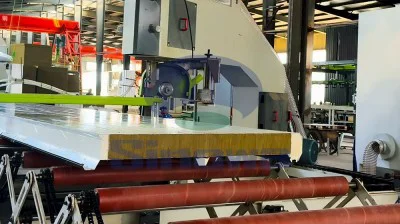
![Continuous Composite Foam Sandwich Panel Production Line]()
Continuous Composite Foam Sandwich Panel Production Line
2026-08-29The continuous composite foam sandwich panel production line is a highly integrated automated manufacturing system designed for streamlined and uninterrupted production of high-performance composite panels. It completes the entire manufacturing workflow in a seamless one-stop process, starting from t…
- Links:
- Sandwich Panel Continuous Production Line
- Automatic and Continuous Sandwich Panel Production Line
- Cheap and Low Price Sandwich Panel Production Line
- China Sandwich Panel Production Line Factory
- Color Steel Sandwich Panel Production Line For Cold Storage
- Continuous Composite Foam Sandwich Panel Production Line
- Continuous Production Line For Rockwool and Mineral Wool Sandwich Panels
- Continuous PU Phenolic Insulation Panel Production Line
- Continuous PU PIR Sandwich Panel Production Line
- Continuous PUF PUR Sandwich Panel Production Line
- Continuous Sandwich Panel Production Line For Roof and Wall
- Customized and Design Sandwich Panel Production Line
- Decorative Sandwich Panel Production Line For Glass Wool Boards
- High Quality Sandwich Panel Production Line For Sale
- Polyurethane(PU) Sandwich Panel Production Line
- Sandwich Panel Production Line Manufacturer and Supplier
- Sandwich Panel Production Machinery and Equipment