
Mineral Wool Sandwich Panel Machine
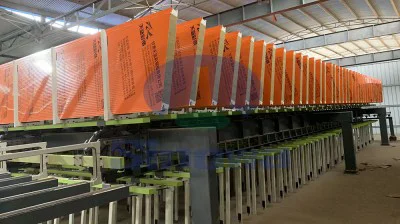
Sinowa is a mineral wool sandwich panel machine supplier from china, customized high-quality & high efficiency mineral wool sandwich panel machine at low price, the adoption of system integration technology and bus control technology accomplishes the full automatization of integrated and coordinated control of the mineral wool sandwich panel machine with accessible remote interactive communication. Ranking the first-class level in the world, it is currently the mineral wool sandwich panel machine in the market taking a comprehensive lead in high performance.
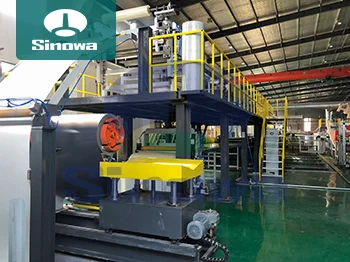
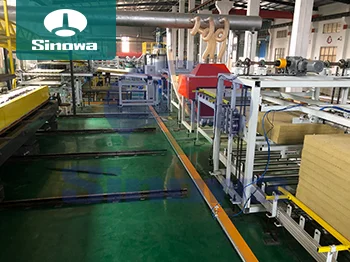
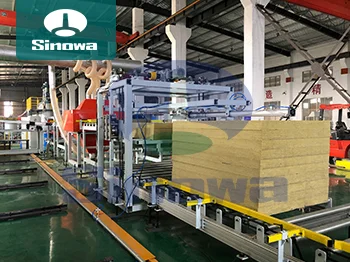
The high-tech mineral wool sandwich panel machine can meet a variety of production needs of customers, the whole mineral wool sandwich panel machine design concept of modularization enables all our components to be integrated and combined at will. Our high efficiency mineral wool sandwich panel machine can easily automate the production of roof sandwich panel, wall sandwich panel, cold storage sandwich panel and other products by different combination and configuration selection and siple switching. The inner core layer can be polyrethane or rock wool, glass wool, an so on. The precision servo hoisting mechanism employed by the main engine without hydraulic system makes the board thickness control flexible and the customer may conveniently change or adjust the board thickness. There will be not such troubles as hydraulic system adjustment, leakage, maintenance, etc.
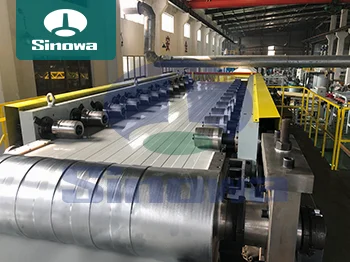
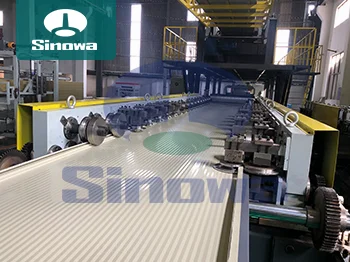
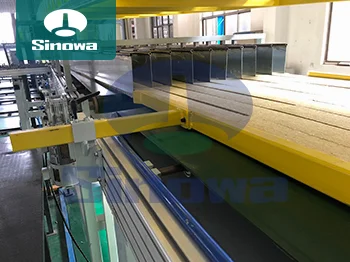
The high precision mineral wool sandwich panel machine has high adaptability, which may produce various sandwich panel of the PU, PIR and rock wool systems. We may design various products according to the customer’s requirements, including various configurations, so as to meet their demands with flexible price system. Highly integrated and linked control system centralizes all control points at the main central center, achieving parameter linkage, fault self-diagnosis controlled by the whole line and shipping distance control. High-level automatic control system also saves the manpower and reduces the manpower loss for customers. High-level energy saving and protection design makes the whole mineral wool sandwich panel machine possible to produce around the clock throughout the year and the customer will save huge budget. In addition, the isolated heat preservation room is constructed for warming the environment. The energy saving and protection design of our manufacturing line may guarantee that the customer’s production line may be freely heated and produce in the main time to save more costs for customers.
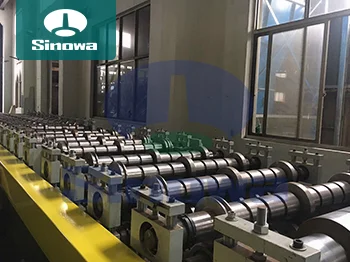
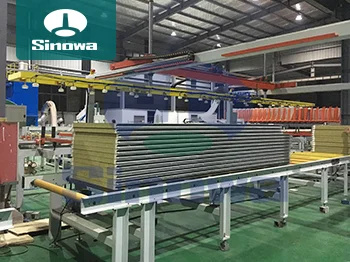
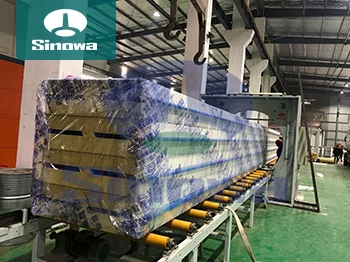
The high-power low-consumption design quickens the reaction of the cheap mineral wool sandwich panel machine while energy consumption is kept low. With the brand-new, fully sealed inner insulation design, the energy consumption is controlled at the minimum level to achieve the design objective of less than an hour for the insulation system to be activated from the room temperature above 5℃ to the production process temperature. The energy consumption is only 40% that of those similar products.
Mineral wool sandwich panel machines stand as core industrial equipment dedicated to the mass manufacturing of mineral wool sandwich panels, a high-performance composite building material widely adopted across modern construction, industrial engineering and infrastructure sectors. Unlike single-layer building boards, mineral wool sandwich panels feature a three-layer composite structure with two rigid outer facings and a dense mineral wool core in between, and the specialized production machines are engineered to integrate multiple mechanical, electrical and hydraulic processes into one continuous, automated workflow, ensuring consistent panel quality, stable production efficiency and compliance with industrial processing standards. These machines eliminate the need for manual assembly of composite panels, streamline the entire production chain from raw material feeding to finished product packaging, and address the growing market demand for fire-resistant, heat-insulating and sound-absorbing building components that balance structural strength and lightweight properties. The design and manufacturing of these machines are rooted in mechanical engineering principles, material processing technology and automated control systems, with every component and functional module tailored to the unique physical and processing characteristics of mineral wool, a non-combustible fibrous material made from natural rock and slag, to avoid damage to the core material during production while achieving firm bonding between the core and outer facings.
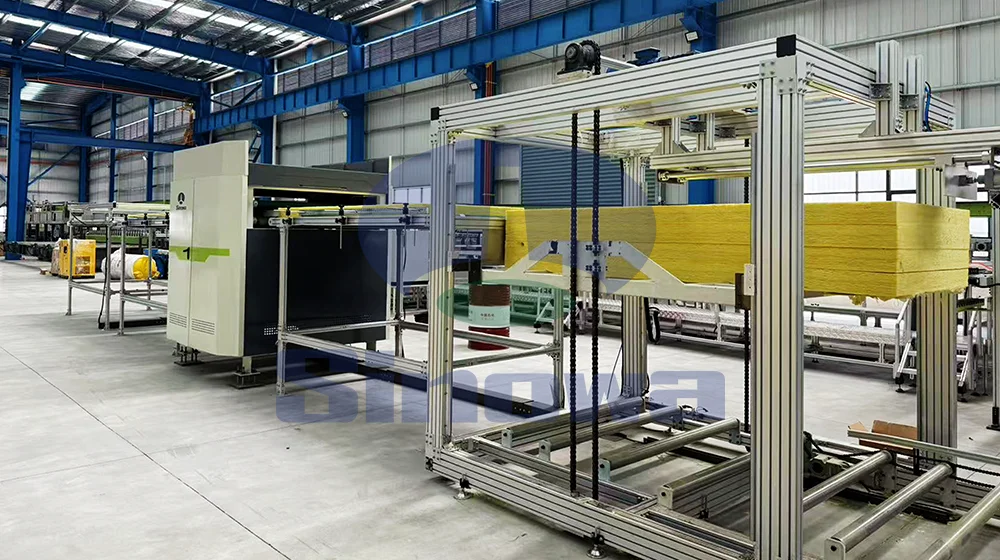
To understand the operational logic and functional superiority of mineral wool sandwich panel machines, it is essential to analyze their complete structural composition, which is divided into several interconnected functional sections that work in seamless coordination throughout the production cycle. The first and foremost section is the raw material handling and uncoiling unit, which is responsible for storing and feeding the outer facing materials, typically metal coils such as steel sheets, the most commonly used facing for mineral wool sandwich panels. This unit consists of heavy-duty uncoilers, coil support frames, tension control devices and leveling rollers, designed to unwind large metal coils smoothly without creases, deformations or surface scratches, and to level the metal sheets to ensure a flat, uniform base for subsequent composite processing. The tension control system is critical here, as it maintains consistent feeding speed and tension to prevent misalignment between the upper and lower facings, a factor that directly impacts the overall flatness and structural integrity of the finished panels. Following the uncoiling and leveling section is the profiling and pre-treatment unit, which shapes the flat metal sheets into specific profiles through roll forming technology; common profiles include trapezoidal, rectangular and tongue-and-groove designs, each optimized for different installation scenarios and structural load-bearing needs. This unit also includes surface pre-treatment components, such as pre-heating devices and primer application mechanisms, which enhance the adhesive force between the metal facings and the mineral wool core, ensuring a long-lasting, durable bond that resists delamination even under extreme temperature changes or mechanical stress.
The central and most complex part of the mineral wool sandwich panel machine is the core composite and laminating section, which serves as the heart of the entire production line and determines the quality of the sandwich panel’s internal structure. This section integrates mineral wool core feeding, adhesive spraying, edge sealing and high-pressure laminating functions, with precise control over material placement, adhesive dosage and laminating pressure. Mineral wool core materials are usually supplied in pre-cut slabs or continuous fibrous rolls, and the machine’s core feeding mechanism is designed to transport these materials steadily to the middle of the two metal facings, with automatic cutting and trimming functions to match the width and length of the facings. The adhesive spraying system adopts a uniform, full-coverage spraying mode, covering both the inner surfaces of the metal facings and the top and bottom surfaces of the mineral wool core, avoiding uneven adhesive distribution that could lead to weak bonding or core damage. For edge sealing, specialized sealing mechanisms are equipped to seal the lateral edges of the composite panel, preventing moisture penetration, dust accumulation and core material displacement over time, which extends the service life of the panels and maintains their insulation and fireproof performance. The laminating unit consists of a double-layer conveyor belt system with adjustable pressure and temperature settings, which applies consistent pressure to the three-layer composite material to compact the structure, accelerate adhesive curing and ensure the core and facings are tightly integrated. The speed and pressure of the laminating belts are fully adjustable to accommodate different thicknesses of mineral wool cores and types of outer facings, making the machine adaptable to a wide range of panel specifications.
Downstream of the laminating section is the post-processing and finished product handling unit, which completes the final shaping, cutting, inspection and packaging of the sandwich panels. This unit includes precision cutting devices, such as flying saws and fixed-length cutters, that can cut the continuous composite panels into custom lengths without stopping the production line, maximizing production efficiency and minimizing material waste. After cutting, the panels are transported to a cooling and shaping area to allow the adhesive to fully cure and the panel structure to stabilize, followed by surface cleaning and quality inspection components that check for defects such as uneven thickness, delamination, surface scratches or profile distortion. Non-conforming panels are automatically separated from the production line to ensure only high-quality products enter the final packaging stage. The packaging unit is equipped with stacking, film wrapping and binding mechanisms, which arrange the finished panels neatly, protect them from damage during transportation and storage, and prepare them for direct delivery to construction sites or warehouses. The entire machine is controlled by a centralized automated control system, usually a PLC-based control cabinet with a human-machine interface, allowing operators to set and adjust production parameters such as feeding speed, laminating pressure, cutting length and adhesive dosage with high precision. The control system also features real-time monitoring and fault alarm functions, tracking the operating status of each module, detecting mechanical jams, parameter deviations or material shortages, and sending timely alerts to operators to reduce downtime and ensure continuous, stable production.
In terms of performance, mineral wool sandwich panel machines exhibit outstanding functional advantages that make them indispensable in the composite building material manufacturing industry, with core performance indicators covering production efficiency, processing precision, stability, energy consumption and adaptability. First, these machines feature high automation and continuous production capacity, with most models supporting uninterrupted 24-hour operation under normal working conditions, and production speeds adjustable within a reasonable range to match different production scales and order requirements. The high degree of automation reduces the need for manual labor significantly, as only a small team of operators is required to monitor the control system, replenish raw materials and conduct routine maintenance, cutting down labor costs and human error in the production process. Second, the processing precision of these machines is exceptionally high, with strict control over panel thickness, width, length and profile consistency; the thickness tolerance of the finished panels is kept within a narrow range, meeting the precise dimensional requirements of modern construction projects, especially for prefabricated buildings and modular construction where standardized components are critical. Third, the machines boast strong operational stability, with robust mechanical structures made of high-strength steel to withstand long-term high-load operation, and wear-resistant components used in key parts such as rollers, cutting blades and conveyor belts to extend service life and reduce maintenance frequency. The hydraulic and electrical systems are designed with heat dissipation and overload protection functions, preventing equipment damage caused by prolonged operation or sudden power fluctuations.
Another key performance feature is the machine’s adaptability to diverse production requirements, as it can process mineral wool cores of varying densities and thicknesses, as well as different types of outer facings, including colored steel sheets, aluminum sheets and other rigid metal materials. This adaptability allows manufacturers to produce a wide range of mineral wool sandwich panels for different applications without replacing the entire production line, only adjusting relevant parameters or replacing individual profiling modules. Additionally, the machines are designed with energy-saving and environmental protection performance, optimizing the power distribution system to reduce unnecessary energy consumption, and equipped with dust collection devices to capture mineral wool fibers and dust generated during the cutting and trimming process, maintaining a clean working environment and preventing air pollution in the production workshop. Unlike traditional panel processing equipment, these machines minimize material waste by optimizing the cutting and trimming processes, utilizing raw materials to the maximum extent and reducing production waste, which aligns with the global trend of sustainable and green manufacturing. The durability of the machine is also a notable performance highlight, with regular maintenance and proper operation enabling the equipment to maintain stable performance for many years, providing long-term production value for manufacturing enterprises and ensuring a steady supply of high-quality mineral wool sandwich panels to the market.
Mineral wool sandwich panel machines are classified into several types based on different classification criteria, including production process, automation level, production scale and panel application, each with unique structural features and applicable scenarios to meet the diverse needs of small, medium and large-scale manufacturing enterprises. The most common classification is based on the production process, dividing the machines into continuous production machines and discontinuous (batch) production machines. Continuous production machines are large-scale, fully automated production lines designed for high-volume, mass production, suitable for large manufacturing plants with high annual output demands. These machines integrate all production processes from raw material feeding to finished product packaging into one uninterrupted workflow, with high production efficiency and consistent product quality, capable of producing long-length, standardized sandwich panels continuously. They feature a more complex structural design, with longer overall length, higher power configuration and more advanced control systems, and are ideal for meeting large-scale government infrastructure projects, industrial park construction and large commercial building demands. Discontinuous production machines, by contrast, are smaller and more compact, with a modular design that occupies less workshop space and is suitable for small and medium-sized manufacturing enterprises or customized panel production. These machines process panels in batches, with each batch completing the composite and cutting process before the next batch starts, offering higher flexibility for producing small orders, customized specifications or special-shaped panels that cannot be mass-produced by continuous lines. They are easier to operate, install and maintain, with lower initial investment costs, making them a practical choice for manufacturers entering the composite panel industry or focusing on customized production.
Based on automation level, mineral wool sandwich panel machines are categorized into fully automatic, semi-automatic and manual-assisted models, though fully automatic models dominate the modern market due to their efficiency and quality advantages. Fully automatic machines require minimal manual intervention, with automatic raw material feeding, profiling, composite laminating, cutting, inspection and packaging, and the control system can store multiple sets of production parameters for quick switching between different panel specifications, greatly reducing production conversion time. Semi-automatic machines require manual assistance in some links, such as manual placement of mineral wool cores or manual adjustment of partial parameters, suitable for enterprises with limited production scale and budget. Manual-assisted machines are basic models with simple structures, mainly used for small-batch, low-precision production, and are gradually being replaced by fully automatic models with the development of industrial automation. Classification by production scale divides the machines into small-scale, medium-scale and large-scale production lines, with small-scale machines featuring compact structure, low power and low output, suitable for small workshops; medium-scale machines balance output and investment, meeting the production needs of medium-sized manufacturing enterprises; large-scale machines are high-power, high-efficiency production lines with advanced technology, designed for large-scale industrial manufacturing bases with ultra-high annual output requirements. Additionally, machines can be classified by the type of sandwich panels produced, including wall panel special machines, roof panel special machines and universal machines that produce both wall and roof panels, with each type optimized for the structural and performance requirements of the corresponding panels.
The wide application of mineral wool sandwich panel machines is directly linked to the extensive use of mineral wool sandwich panels across various industries, as the machines enable large-scale, standardized production of these high-performance panels to meet global market demand. In the construction industry, the primary application field, mineral wool sandwich panels produced by these machines are widely used in external wall insulation, internal partition walls, roof insulation and fireproof partitions of residential buildings, commercial buildings, office buildings and prefabricated houses. The panels’ excellent fire resistance, thermal insulation and sound absorption properties make them ideal for modern energy-saving buildings, reducing building energy consumption for heating and cooling, improving indoor comfort, and meeting strict fire safety standards for public and residential buildings. In industrial engineering, these panels are extensively used in the construction of industrial workshops, warehouses, logistics centers and factory buildings, especially in high-temperature, high-humidity or fire-prone industrial environments, as the mineral wool core is non-combustible, high-temperature resistant and corrosion-resistant, providing reliable structural protection and insulation for industrial facilities. The panels are lightweight and easy to install, significantly shortening the construction cycle of industrial buildings and reducing the overall construction cost compared with traditional brick-concrete or reinforced concrete structures.
In the field of cold chain logistics and low-temperature storage, mineral wool sandwich panels are a preferred material for cold storage, refrigerated warehouses and constant-temperature workshops, and the corresponding production machines are optimized to produce panels with superior thermal insulation performance to maintain stable low-temperature environments and reduce energy loss in cold chain facilities. The panels’ closed structure and good air tightness prevent cold air leakage and external heat penetration, making them essential for the food processing, pharmaceutical storage and agricultural product preservation industries. In infrastructure construction, the machines produce mineral wool sandwich panels used in traffic engineering facilities such as highway sound barriers, railway station buildings and airport terminal insulation layers, leveraging the panels’ excellent sound absorption and noise reduction properties to reduce traffic noise pollution and improve the environmental quality of transportation hubs. Additionally, these panels are used in temporary buildings, emergency shelters and modular construction projects, as they are easy to transport, assemble and disassemble, providing fast and reliable building solutions for emergency relief, field construction and temporary public facilities.
Beyond traditional construction and industrial sectors, the application scope of mineral wool sandwich panel machines and their finished products is continuously expanding with the development of green building and sustainable engineering concepts. The machines are also used to produce special-purpose mineral wool sandwich panels for industrial insulation, shipbuilding building parts and agricultural greenhouse insulation walls, adapting to the special performance requirements of different industries by adjusting production processes and material configurations. The continuous upgrading of mineral wool sandwich panel machines, driven by technological innovation, further enhances their production efficiency, processing precision and product adaptability, promoting the wider application of mineral wool sandwich panels as a green, environmentally friendly and high-performance building material. As global demand for energy-saving, fire-resistant and sustainable building materials continues to rise, mineral wool sandwich panel machines will remain a key piece of equipment in the composite building material manufacturing industry, with ongoing improvements in structural design, performance optimization and intelligent control to meet the evolving needs of the market and contribute to the development of low-carbon, efficient and safe modern construction and industrial engineering.
In summary, mineral wool sandwich panel machines are a perfect integration of mechanical engineering, automated control and material processing technology, with a well-designed structural system that ensures stable and efficient production, outstanding performance that meets industrial production standards, diverse types that adapt to different production scales and needs, and a wide range of applications that support the development of multiple industries. These machines not only solve the technical challenges of large-scale production of high-quality mineral wool sandwich panels but also promote the transformation and upgrading of the building material manufacturing industry towards automation, intelligence and green production. As the global construction industry continues to pursue energy efficiency, safety and sustainability, the technical level and application scope of mineral wool sandwich panel machines will continue to expand, playing an increasingly important role in meeting market demand, improving product quality and promoting the development of the entire composite building material sector.
« Mineral Wool Sandwich Panel Machine » Update Date: 2026/3/24
URL: https://www.sinowamachine.com/tags/mineral-wool-sandwich-panel-machine.html
![High Efficiency Mineral Wool Sandwich Panel Machine]()
High Efficiency Mineral Wool Sandwich Panel Machine
2026-09-01High efficiency mineral wool sandwich panel machine is a sophisticated integrated manufacturing system dedicated to the automated production of high-performance mineral wool sandwich panels, widely applied in the insulation and fireproof building material industry. This advanced equipment abandons th…![Mineral Wool Sandwich Panel Machine Supplier]()
Mineral Wool Sandwich Panel Machine Supplier
2026-08-18Mineral wool sandwich panel machines have emerged as core automated production equipment in the modern lightweight building material industry, dedicated to the integrated molding of composite insulation panels with mineral wool as the core filler and metal sheets as the surface layers. This specializ…![High-quality Mineral Wool Sandwich Panel Machine]()
High-quality Mineral Wool Sandwich Panel Machine
2026-08-12High-quality mineral wool sandwich panel machines represent advanced integrated manufacturing equipment dedicated to the automated production of high-performance composite building panels. Designed to integrate multiple production procedures into one streamlined operational system, this equipment eff…
- Links:
- Sandwich Panel Continuous Production Line
- Automatic and Continuous Sandwich Panel Production Line
- Cheap and Low Price Sandwich Panel Production Line
- China Sandwich Panel Production Line Factory
- Color Steel Sandwich Panel Production Line For Cold Storage
- Continuous Composite Foam Sandwich Panel Production Line
- Continuous Production Line For Rockwool and Mineral Wool Sandwich Panels
- Continuous PU Phenolic Insulation Panel Production Line
- Continuous PU PIR Sandwich Panel Production Line
- Continuous PUF PUR Sandwich Panel Production Line
- Continuous Sandwich Panel Production Line For Roof and Wall
- Customized and Design Sandwich Panel Production Line
- Decorative Sandwich Panel Production Line For Glass Wool Boards
- High Quality Sandwich Panel Production Line For Sale
- Polyurethane(PU) Sandwich Panel Production Line
- Sandwich Panel Production Line Manufacturer and Supplier
- Sandwich Panel Production Machinery and Equipment