
Composite Sandwich Panel Production Line
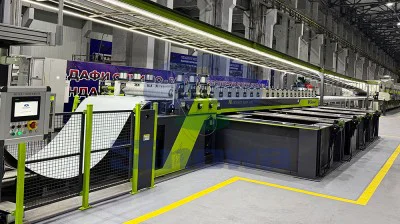
Sinowa is a composite sandwich panel production line supplier from china, customized high-quality & high efficiency composite sandwich panel production line at low price, the adoption of system integration technology and bus control technology accomplishes the full automatization of integrated and coordinated control of the composite sandwich panel production line with accessible remote interactive communication. Ranking the first-class level in the world, it is currently the composite sandwich panel production line in the market taking a comprehensive lead in high performance.
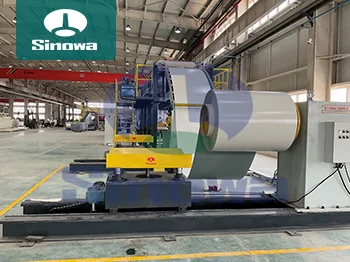
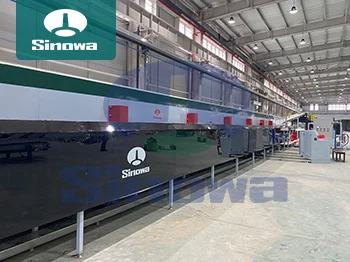
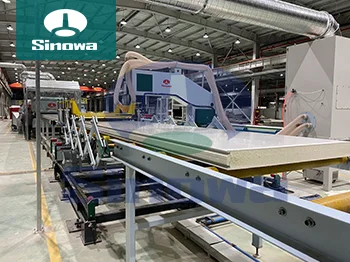
The high-tech composite sandwich panel production line can meet a variety of production needs of customers, the whole composite sandwich panel production line design concept of modularization enables all our components to be integrated and combined at will. Our high efficiency composite sandwich panel production line can easily automate the production of roof sandwich panel, wall sandwich panel, cold storage sandwich panel and other products by different combination and configuration selection and siple switching. The inner core layer can be polyrethane or rock wool, glass wool, an so on.


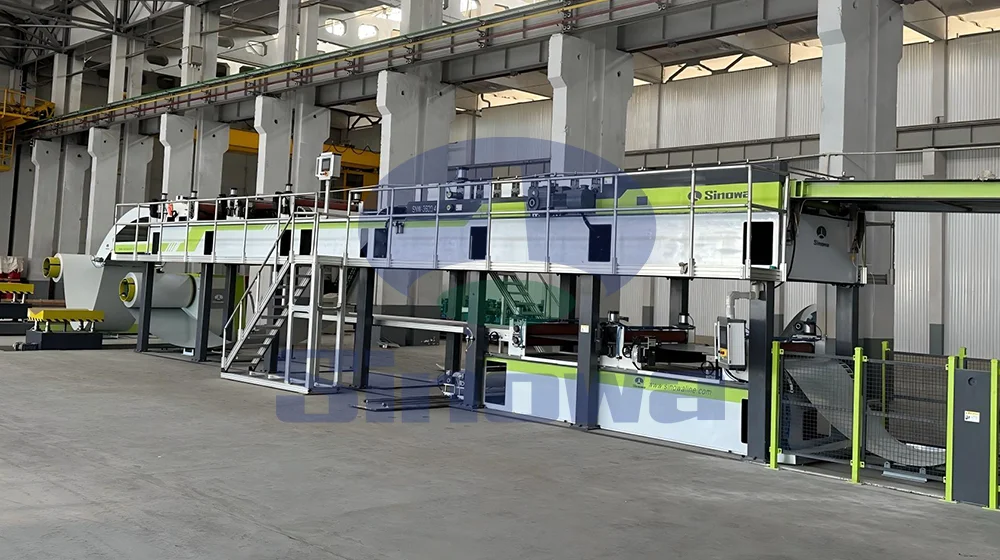
The high precision composite sandwich panel production line has high adaptability, which may produce various sandwich panel of the PU, PIR and rock wool systems. We may design various products according to the customer’s requirements, including various configurations, so as to meet their demands with flexible price system. Highly integrated and linked control system centralizes all control points at the main central center, achieving parameter linkage, fault self-diagnosis controlled by the whole line and shipping distance control. High-level automatic control system also saves the manpower and reduces the manpower loss for customers.


The precision servo hoisting mechanism employed by the main engine without hydraulic system makes the board thickness control flexible and the customer may conveniently change or adjust the board thickness. There will be not such troubles as hydraulic system adjustment, leakage, maintenance, etc.


High-level energy saving and protection design makes the whole composite sandwich panel production line possible to produce around the clock throughout the year and the customer will save huge budget. In addition, the isolated heat preservation room is constructed for warming the environment. The energy saving and protection design of our manufacturing line may guarantee that the customer’s production line may be freely heated and produce in the main time to save more costs for customers.


The high-power low-consumption design quickens the reaction of the cheap composite sandwich panel production line while energy consumption is kept low. With the brand-new, fully sealed inner insulation design, the energy consumption is controlled at the minimum level to achieve the design objective of less than an hour for the insulation system to be activated from the room temperature above 5℃ to the production process temperature. The energy consumption is only 40% that of those similar products.
Composite sandwich panels represent one of the most versatile and high-performance engineered building and industrial materials in modern manufacturing, with their production lines designed to transform raw materials into finished panels that combine exceptional structural efficiency, lightweight properties, and multi-functional performance. Unlike single-layer solid panels, these composite structures follow a layered sandwich design philosophy, which is the core foundation of their superior performance and wide adaptability across diverse industries. The fundamental structure of a composite sandwich panel consists of three key components: two thin, rigid outer face sheets, a thick, lightweight core material positioned between the face sheets, and a high-strength adhesive bonding layer that securely fuses the face sheets to the core, creating a unified and load-bearing composite structure. This layered configuration is not a random assembly but a precisely engineered system that mimics the structural logic of an I-beam, where the outer face sheets act as the flanges to resist bending, tensile, and compressive loads, while the core serves as the web to withstand shear forces and maintain the structural integrity of the entire panel by preventing the face sheets from buckling or deforming under external pressure. The production line is engineered to execute this assembly with precision, controlling material alignment, adhesive application, pressure, temperature, and curing time to ensure consistent structural uniformity across every panel produced, eliminating gaps, delamination, or uneven bonding that could compromise performance.
The structural performance of composite sandwich panels is directly derived from this optimized layered design, and it stands out sharply from traditional solid materials such as steel, aluminum, or wood in multiple key performance metrics. First and foremost is the exceptional strength-to-weight ratio, which is the most prominent advantage of these panels. The thick, low-density core adds significant overall thickness to the panel without excessive weight gain, while the thin but high-strength face sheets provide the necessary rigidity and load-bearing capacity. This means composite sandwich panels can achieve the same or even higher bending stiffness and structural strength as solid metal panels, while reducing overall weight by 50% to 80% depending on the core and face sheet materials used. This lightweight characteristic drastically lowers transportation costs, simplifies on-site installation, reduces the load-bearing pressure on supporting structures, and improves fuel efficiency in transportation applications, making them ideal for projects where weight reduction and structural efficiency are critical priorities. Beyond mechanical strength, these panels offer outstanding thermal insulation performance, a property that is highly valued in construction, cold chain logistics, and industrial temperature control. The core material, which is typically a porous or closed-cell low-conductivity material, acts as a natural thermal barrier, minimizing heat transfer between the interior and exterior environments. This thermal efficiency reduces energy consumption for heating and cooling in buildings, maintains stable temperature conditions for temperature-sensitive goods in transit, and meets the strict thermal management requirements of industrial facilities and clean rooms.
Additional performance attributes further expand the practical value of composite sandwich panels, making them suitable for harsh and demanding operating environments. Most panels exhibit excellent sound insulation capabilities, as the multi-layer structure and porous core absorb and dampen sound waves, reducing noise transmission between spaces and creating quieter indoor environments in residential, commercial, and industrial buildings. They also possess strong weather resistance, with face sheets that are resistant to UV radiation, moisture, corrosion, and temperature fluctuations, preventing warping, fading, or material degradation over long-term outdoor use. Many variants offer reliable fire resistance, with non-combustible or flame-retardant core materials that slow the spread of fire, limit smoke generation, and maintain structural stability for a certain period under high temperatures, enhancing safety in public buildings, industrial workshops, and residential structures. Impact resistance is another key performance feature; the core material absorbs impact energy and distributes external force across the entire panel surface, preventing localized cracking or breakage, while the rigid face sheets resist puncture and surface damage. Additionally, these panels are dimensionally stable, meaning they do not shrink, expand, or deform significantly with changes in temperature and humidity, ensuring long-term structural integrity and consistent performance throughout their service life. The production line plays a vital role in maintaining these performance standards, as automated processes ensure uniform material distribution, consistent core density, and perfect bonding between layers, which are essential for replicating the same high performance in every batch of panels.
Composite sandwich panels are available in a wide range of varieties, categorized primarily by the type of core material and face sheet material used, each tailored to specific performance needs and application scenarios, with the production line equipped to handle different material combinations and processing requirements. The most common classification is based on core materials, which include foam cores, mineral wool cores, honeycomb cores, and corrugated cores, each with distinct structural and functional properties. Foam core panels, typically made from polyurethane (PU), polystyrene (EPS), polyisocyanurate (PIR), or polyethylene foams, are lightweight, cost-effective, and offer exceptional thermal insulation, making them the most widely used type for general construction, cold storage, and residential building envelopes. These foam cores have closed-cell structures that prevent moisture penetration and enhance thermal efficiency, and the production line processes them with continuous lamination and foaming technology to ensure uniform density and consistent thickness. Mineral wool core panels, made from rock wool or glass wool, are non-combustible, fire-resistant, and sound-absorbent, with high temperature resistance and good structural stability. They are ideal for applications requiring strict fire safety standards, such as industrial workshops, public buildings, fire-rated partitions, and high-temperature industrial equipment enclosures. The production line for mineral wool core panels involves precise cutting and positioning of the dense mineral wool core, along with high-pressure bonding to ensure the face sheets adhere firmly without compressing the core unevenly.
Honeycomb core panels feature a hexagonal honeycomb structure made from aluminum, aramid fiber, or plastic, offering extremely high specific stiffness and strength, along with low weight and excellent vibration resistance. These panels are used in high-performance applications where lightweight and structural rigidity are non-negotiable, such as aerospace components, marine vessels, high-speed rail interiors, and precision industrial equipment. The production process for honeycomb core panels is more specialized, requiring precise expansion of the honeycomb core, flat surface treatment, and controlled adhesive bonding to maintain the integrity of the honeycomb cells. Corrugated core panels, usually with metal or plastic corrugated inserts, combine high compressive strength with good impact resistance, suitable for load-bearing wall panels, roofing systems, and packaging materials that require heavy-duty structural support. Beyond core materials, panels are also classified by face sheet types, including metal face sheets (steel, aluminum, stainless steel), fiber-reinforced polymer (FRP) face sheets, and non-metallic face sheets such as gypsum or fiber cement. Metal-faced panels are durable, impact-resistant, and weatherproof, widely used in industrial and commercial construction; aluminum-faced panels are lightweight and corrosion-resistant, perfect for marine and coastal applications; stainless steel-faced panels are hygienic, easy to clean, and resistant to chemicals, ideal for food processing plants, pharmaceutical clean rooms, and medical facilities. FRP-faced panels are corrosion-resistant, non-conductive, and lightweight, suitable for chemical plants, wastewater treatment facilities, and electrical insulation applications. Each variety requires specific adjustments in the production line, from material feeding and surface treatment to bonding pressure and curing parameters, to ensure the final panel meets the targeted performance specifications.
The versatility of composite sandwich panels, enabled by their diverse structures and performance profiles, has led to their extensive adoption across nearly every major industry, with applications spanning construction, transportation, industrial manufacturing, renewable energy, marine engineering, and special-purpose facilities. In the construction industry, they are the preferred material for modern building envelopes, including exterior wall cladding, roofing systems, partition walls, and ceiling panels, used in industrial warehouses, commercial complexes, residential buildings, cold storage facilities, and clean rooms. Their lightweight nature speeds up construction timelines, reduces labor costs, and improves building energy efficiency, while their customizable appearance allows for a variety of surface finishes and colors to meet architectural design requirements. Cold storage and refrigeration facilities rely heavily on thermal insulation foam core panels to maintain low temperatures for food preservation, pharmaceutical storage, and chemical logistics, as the panels create an airtight and thermally stable environment that minimizes energy loss and ensures product quality. In the transportation sector, composite sandwich panels are widely used in refrigerated trucks, shipping containers, railway carriages, bus interiors, and recreational vehicles, where their lightweight property increases payload capacity and fuel efficiency, while their thermal insulation and impact resistance protect goods and passengers during transit. The panels are also used in vehicle body structures to reduce overall weight and improve structural safety, with the production line able to produce custom-sized panels to fit different vehicle specifications.
In industrial and manufacturing settings, composite sandwich panels serve as enclosure materials for production workshops, warehouse partitions, clean rooms, and temperature-controlled processing areas, thanks to their hygiene, corrosion resistance, and easy maintenance. Food processing plants, beverage factories, and pharmaceutical manufacturing facilities use smooth, non-porous faced panels to maintain sterile environments, as they are easy to clean and disinfect, preventing bacterial growth and contamination. Industrial equipment enclosures and soundproof booths use sound-absorbent mineral wool core panels to reduce noise pollution and protect workers from excessive industrial noise. In renewable energy engineering, these panels are used in wind turbine components, solar energy equipment enclosures, and energy storage facility structures, leveraging their lightweight, weather resistance, and structural stability to withstand outdoor environmental conditions and support long-term operational reliability. Marine engineering applications include ship hull panels, cabin interiors, bulkheads, and offshore platform structures, where corrosion-resistant aluminum or FRP-faced panels withstand salt spray, moisture, and harsh marine environments, while reducing the overall weight of vessels to improve buoyancy and fuel efficiency. Aerospace and high-end engineering applications use high-performance honeycomb core panels for aircraft interior components, satellite structures, and precision equipment casings, where ultra-lightweight and high structural rigidity are critical for operational performance.
Specialized applications also extend to temporary construction, emergency shelters, exhibition booths, and sports facilities, where composite sandwich panels offer quick assembly, portability, and reusability. Their modular nature allows for easy disassembly and reassembly, making them ideal for temporary structures that require fast deployment and flexible relocation. Additionally, they are used in agricultural facilities such as greenhouse walls and roofing, providing thermal insulation to maintain stable growing temperatures for crops, while their light transmission variants allow natural light to penetrate, supporting plant growth. As manufacturing technology advances, the composite sandwich panel production line continues to evolve with higher automation, precision, and production efficiency, enabling the development of new panel varieties with enhanced performance, such as fire-resistant foam cores, ultra-lightweight honeycomb cores, and multi-functional panels that combine thermal insulation, sound absorption, and structural strength in one unit. The continuous innovation in material science and production processes further expands the potential applications of these panels, solidifying their position as a core engineered material in modern industry and construction.
In summary, the composite sandwich panel production line is a sophisticated manufacturing system that translates advanced structural design into high-performance finished panels, with the layered sandwich structure being the cornerstone of their exceptional mechanical, thermal, and practical performance. The wide range of core and face sheet material combinations creates a diverse product portfolio that can be customized to meet the unique requirements of different industries, from lightweight transportation components to fire-resistant building envelopes and hygienic industrial enclosures. Unlike traditional materials, composite sandwich panels strike an optimal balance between weight, strength, insulation, and durability, addressing key challenges in modern engineering such as energy conservation, structural efficiency, and environmental adaptability. As global demand for sustainable, high-performance building materials and industrial components continues to rise, the relevance and application scope of composite sandwich panels will only expand, driven by ongoing improvements in production line technology and material innovation. Their ability to deliver consistent, reliable performance across harsh and varied environments makes them an indispensable solution for current and future industrial and construction projects, offering long-term value, cost efficiency, and functional versatility that few other materials can match.
« Composite Sandwich Panel Production Line » Update Date: 2026/3/24
URL: https://www.sinowamachine.com/tags/composite-sandwich-panel-production-line.html
![Composite Sandwich Panel Production Line Manufacturer]()
Composite Sandwich Panel Production Line Manufacturer
2026-05-08In the evolving landscape of modern industrial manufacturing, the demand for high-performance building and industrial materials continues to expand steadily, which drives the continuous upgrading and iteration of composite sandwich panel production equipment. Manufacturers dedicated to composite sand…
- Links:
- Sandwich Panel Continuous Production Line
- Automatic and Continuous Sandwich Panel Production Line
- Cheap and Low Price Sandwich Panel Production Line
- China Sandwich Panel Production Line Factory
- Color Steel Sandwich Panel Production Line For Cold Storage
- Continuous Composite Foam Sandwich Panel Production Line
- Continuous Production Line For Rockwool and Mineral Wool Sandwich Panels
- Continuous PU Phenolic Insulation Panel Production Line
- Continuous PU PIR Sandwich Panel Production Line
- Continuous PUF PUR Sandwich Panel Production Line
- Continuous Sandwich Panel Production Line For Roof and Wall
- Customized and Design Sandwich Panel Production Line
- Decorative Sandwich Panel Production Line For Glass Wool Boards
- High Quality Sandwich Panel Production Line For Sale
- Polyurethane(PU) Sandwich Panel Production Line
- Sandwich Panel Production Line Manufacturer and Supplier
- Sandwich Panel Production Machinery and Equipment