
PUF Panel Machine
Sinowa is a puf panel machine supplier from china, customized high-quality & high efficiency puf panel machine at low price, the adoption of system integration technology and bus control technology accomplishes the full automatization of integrated and coordinated control of the puf panel machine with accessible remote interactive communication. Ranking the first-class level in the world, it is currently the puf panel machine in the market taking a comprehensive lead in high performance.
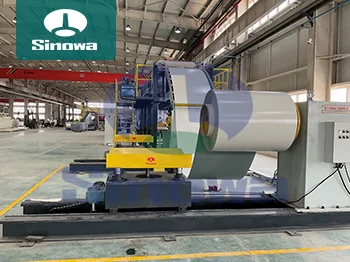
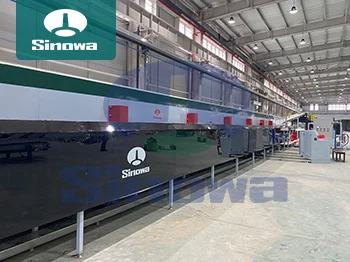
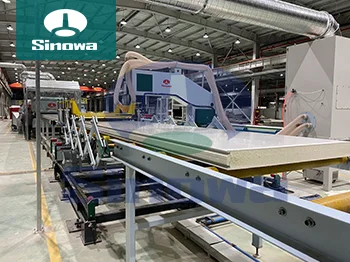
The high-tech puf panel machine can meet a variety of production needs of customers, the whole puf panel machine design concept of modularization enables all our components to be integrated and combined at will. Our high efficiency puf panel machine can easily automate the production of roof sandwich panel, wall sandwich panel, cold storage sandwich panel and other products by different combination and configuration selection and siple switching. The inner core layer can be polyrethane or rock wool, glass wool, an so on.


The high precision puf panel machine has high adaptability, which may produce various sandwich panel of the PU, PIR and rock wool systems. We may design various products according to the customer’s requirements, including various configurations, so as to meet their demands with flexible price system. Highly integrated and linked control system centralizes all control points at the main central center, achieving parameter linkage, fault self-diagnosis controlled by the whole line and shipping distance control. High-level automatic control system also saves the manpower and reduces the manpower loss for customers.


The precision servo hoisting mechanism employed by the main engine without hydraulic system makes the board thickness control flexible and the customer may conveniently change or adjust the board thickness. There will be not such troubles as hydraulic system adjustment, leakage, maintenance, etc.


High-level energy saving and protection design makes the whole puf panel machine possible to produce around the clock throughout the year and the customer will save huge budget. In addition, the isolated heat preservation room is constructed for warming the environment. The energy saving and protection design of our manufacturing line may guarantee that the customer’s production line may be freely heated and produce in the main time to save more costs for customers.


The high-power low-consumption design quickens the reaction of the cheap puf panel machine while energy consumption is kept low. With the brand-new, fully sealed inner insulation design, the energy consumption is controlled at the minimum level to achieve the design objective of less than an hour for the insulation system to be activated from the room temperature above 5℃ to the production process temperature. The energy consumption is only 40% that of those similar products.
PUF panel machine, a key piece of equipment in the production of polyurethane foam (PUF) panels, plays an indispensable role in various industrial and construction fields by integrating mechanical, electrical, hydraulic and chemical technologies to realize the continuous or discontinuous production of high-quality insulation and composite panels. These machines are designed to process raw materials into PUF panels with specific structures and properties, which are widely recognized for their excellent thermal insulation, soundproofing, and structural stability.
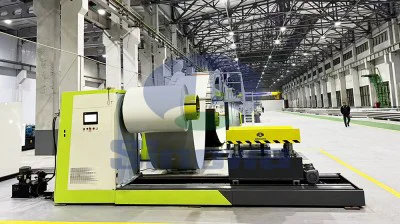
The structure of a PUF panel machine is a sophisticated combination of multiple functional units, each responsible for a specific link in the production process, ensuring the smooth and efficient operation of the entire line. At the heart of the machine is the unwinding unit, which is mainly composed of a steel frame welded with section steel, a passive unwinding mechanism, and a tension control device. The frame provides stable support for the entire unit, while the passive unwinding method, equipped with a pneumatic brake, effectively controls the tension of the coiled base material—such as color steel plates, aluminum plates, non-woven fabrics, or aluminum foil—to prevent deviation during transportation. The tension control device adopts air expansion control, which is simple to operate and ensures that the base material remains flat and stable when entering the next processing link. Connected to the unwinding unit is the preheating roller table, a non-powered conveying structure with a welded frame, non-powered rollers, and a protective heating device with temperature control functions. Its main role is to heat the base material, especially metal coils and non-woven fabrics, to an appropriate temperature, which helps improve the adhesion between the base material and the PUF core, ensuring the structural integrity of the final panel.
The foaming and distributing unit is another core component of the PUF panel machine, directly determining the quality and performance of the PUF core. The foaming machine, which can be either low-pressure continuous or high-pressure type, is equipped with two material tanks for resin (A component) and curing agent (B component) respectively. Each tank is matched with an independent metering pump driven by a frequency conversion motor, which can precisely control the output flow by adjusting the motor speed, ensuring that the two components are mixed in the required proportion. After uniform mixing in the high-speed mixing head, the foaming material is continuously coated on the upper and lower base materials through the reciprocating movement of the distributing machine. The distributing machine is installed on a base with adjustable height and distance from the double belt machine, allowing for flexible adjustment according to the thickness and width of the panels being produced, ensuring uniform distribution of the foaming material and consistent density of the PUF core. For metal base materials that require shaping, a roll forming machine is also included in the structure, which processes the coiled metal into various shapes according to production needs, expanding the scope of panel products that can be manufactured.
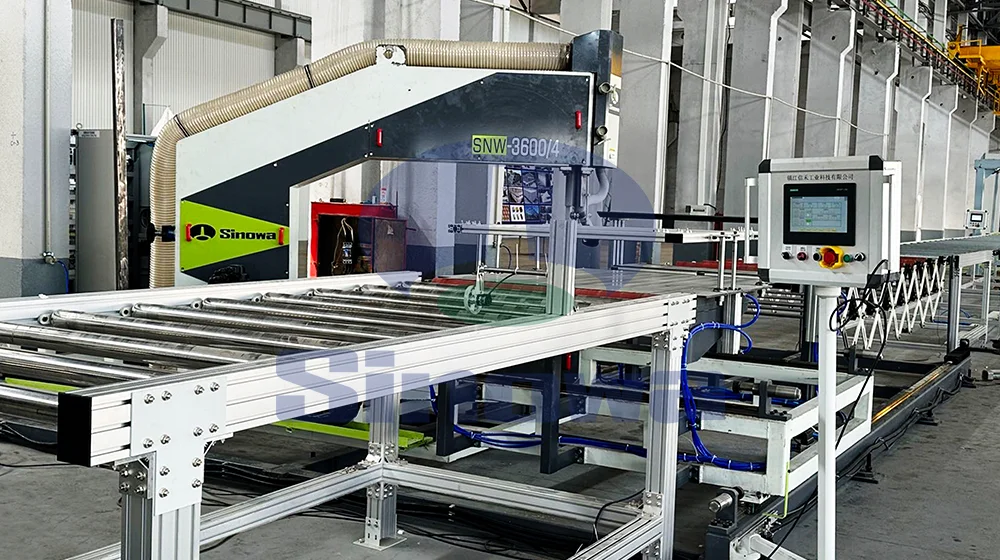
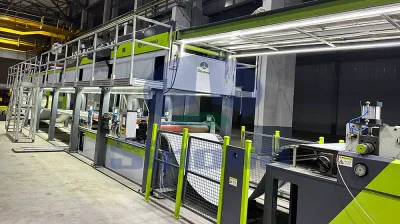
The double belt machine is the key unit for the foaming and shaping of PUF panels, responsible for completing the on-line foaming and curing of polyurethane. Its frame and machine head are made of H-section steel and plates through welding, and processed by CNC equipment in one clamping and positioning to ensure the accuracy of various key dimensions and installation. The guide rail plate is made of Cr12 plate, which is quenched and ground to improve dimensional accuracy and surface finish, ensuring the stable and reliable operation of the chain plate unit. The chain plate unit, composed of a drive motor, sprocket, track plate, chain block, pin shaft and rolling bearing, uses a high-precision hard tooth surface reduction motor for stable operation; the track plate is made of section steel and plates through welding, stress relief treatment and CNC processing to ensure dimensional and shape accuracy. The lifting unit of the double belt machine adopts a precision hydraulic elevator to drive the upper machine body to move, which not only plays a guiding and supporting role but also can precisely adjust the thickness of the panel. The insulation unit, which adopts a frame structure filled with glass fiber cotton, uses electric heating tubes combined with oil-fired furnaces for heating, enabling rapid heating of the double belt machine to the temperature required for foaming (usually around 60 ℃) and maintaining a stable temperature environment, ensuring the consistency of core foaming. After the panels are formed in the double belt machine, they enter the non-powered roller table for cooling and shaping, preparing for the subsequent cutting process.
The cutting unit, mainly composed of a fixed-length follow-up tracking saw, is responsible for cutting the formed PUF panels into the set length. Its base, machine body and upper moving frame are connected by linear guide rails, and the guide rail installation surface is precision processed to ensure installation accuracy. The sawing motor is installed on the upper moving frame, which is driven by a reduction motor to move horizontally; the clamping device, composed of an air cylinder and a pressing block, clamps the panel when cutting to prevent displacement. When the panel reaches the set length, the clamping cylinder pushes the pressing block down to fix the panel, the reset cylinder drives the machine body to move with the panel, and the sawing motor starts to complete the horizontal cutting of the panel. After cutting, the clamping device is lifted, and the reset cylinder drives the machine body back to the original position for the next cutting operation. The cutting accuracy of this unit is high, usually within ±5mm, which can meet the production needs of different length specifications. In addition, the PUF panel machine is also equipped with an electrical control system, which integrates the control of the unwinding area, double belt forming area and cooling sawing area. Composed of programmable controllers, touch screens, detection switches and frequency converters, the system realizes automatic production through parameter input and button operation, with reliable performance and simple operation, greatly reducing manual intervention and improving production efficiency.
The performance of PUF panel machines is reflected in multiple aspects, including production efficiency, processing accuracy, stability, flexibility, and energy efficiency, which together determine the machine’s production capacity and the quality of finished panels. Production efficiency is one of the core performance indicators, usually measured by production speed and annual output. The production speed of most PUF panel machines ranges from 3 to 6 meters per minute, and the annual output can reach about 100 square meters, depending on the type of machine and the specifications of the panels. High-efficiency machines can even achieve a production speed of 15 meters per minute, significantly improving production capacity for large-scale projects. Processing accuracy is another key performance, which directly affects the quality and application effect of PUF panels. The thickness adjustment range of the machine is usually 20 to 100 mm, and some machines can reach up to 300 mm, allowing for the production of panels with different insulation requirements. The width of the panels can be adjusted between 400 and 1200 mm, and the length can be customized according to customer needs, with a minimum cutting length of 2 meters. The density of the PUF core, which is controlled by the metering pump of the foaming machine, usually ranges from 45 to 60 kg/m³, ensuring excellent thermal insulation performance of the panels.
Stability and reliability are essential for the long-term operation of PUF panel machines, as they directly affect production continuity and maintenance costs. The key components of the machine, such as the reduction motor, hydraulic system, and electrical control components, are designed to have high durability and wear resistance, reducing the frequency of failures. The frame and key structural parts are subjected to stress relief treatment to prevent deformation during long-term operation, ensuring the stability of processing accuracy. The insulation unit of the double belt machine can maintain a stable temperature environment, avoiding uneven foaming caused by temperature fluctuations, and ensuring the consistency of panel quality. Flexibility is another important performance indicator, reflecting the machine’s ability to adapt to different production needs. Modern PUF panel machines adopt a modular design, allowing for the flexible combination and configuration of various units. For example, by adding cooling, stacking, packaging and other units, the machine can realize fully automatic production of various types of sandwich panels, including double-sided color steel sandwich panels, color steel and soft surface sandwich panels, etc. The machine can also be adjusted according to different base materials and core material formulas, expanding the scope of product production.
Energy efficiency is an increasingly important performance indicator in the context of global energy conservation and environmental protection. PUF panel machines are designed with energy-saving concepts in mind, optimizing the power configuration of each unit to reduce energy consumption. The total power of a typical machine is about 120 kW, of which the heating platform accounts for about 50 kW. The insulation unit of the double belt machine adopts high-efficiency insulation materials, reducing heat loss and saving energy. The frequency conversion motor used in the metering pump and drive system can adjust the speed according to production needs, avoiding energy waste caused by idling. In addition, the machine can operate continuously around the clock, improving energy utilization efficiency and reducing unit energy consumption. The environmental performance of the machine is also worthy of attention. The foaming process is sealed to avoid the leakage of harmful gases, and the waste generated during production can be recycled, reducing environmental pollution.
PUF panel machines can be divided into different types according to their production mode, structural characteristics, and application scope, each with its own characteristics and applicable scenarios. According to the production mode, they can be mainly divided into continuous PUF panel machines and discontinuous (batch) PUF panel machines. Continuous PUF panel machines are suitable for large-scale, mass production of PUF panels, with high production efficiency and stable product quality. The entire production process, from unwinding, preheating, foaming, shaping to cutting, is completed continuously, with a production speed of 3 to 15 meters per minute, which is suitable for large construction projects and industrial production that require a large number of panels. This type of machine usually adopts an integrated design, with high automation and low manual intervention, and can produce panels of various specifications by adjusting parameters. The continuous production mode also ensures the consistency of panel performance, reducing the error caused by manual operation.
Discontinuous PUF panel machines, on the other hand, are suitable for small-batch production, special specification panels, or occasions where the base material has special characteristics. This type of machine does not require continuous operation, and can complete the production of a batch of panels according to needs, with high flexibility. It is particularly suitable for producing panels that require the integration of special mechanical fasteners or panels with special sizes, such as panels used in cold storage, refrigerated trailers, and ski resorts. In addition, discontinuous machines are also suitable for small and medium-sized enterprises with limited production scale, as they have lower investment costs and can adapt to the production needs of multiple varieties and small batches. The production process of discontinuous machines is relatively flexible, and can be adjusted according to the characteristics of raw materials and product requirements, but the production efficiency is relatively lower than that of continuous machines.
According to the type of core material that can be processed, PUF panel machines can also be divided into single-core PUF panel machines and multi-core composite panel machines. Single-core PUF panel machines are mainly used for producing panels with polyurethane foam as the only core material, focusing on the production of insulation panels with excellent thermal insulation performance, which are widely used in ordinary building insulation and cold storage insulation. Multi-core composite panel machines, on the other hand, can process multiple core materials, such as polyurethane foam, rock wool, glass wool, etc., and can produce composite panels with different core materials according to customer needs by switching configurations. This type of machine has strong expandability, and can meet the diverse needs of different industries for panel performance, such as panels that require both thermal insulation and fire resistance (using rock wool and PUF composite core materials) or panels that require lightweight and high strength (using glass wool and PUF composite core materials).
In addition, according to the degree of automation, PUF panel machines can be divided into manual, semi-automatic and fully automatic types. Manual machines require a lot of manual intervention in the production process, such as manual feeding, manual adjustment of parameters, and manual cutting, which have low production efficiency and high labor intensity, and are suitable for small-scale production or experimental use. Semi-automatic machines integrate automatic and manual operations, with automatic completion of key links such as foaming and shaping, and manual assistance in feeding and cutting, which balances production efficiency and investment costs, and is suitable for small and medium-sized enterprises. Fully automatic machines realize the full automation of the entire production process, from raw material feeding, parameter adjustment, foaming, shaping, cutting to stacking and packaging, all completed by the machine without manual intervention. This type of machine has high production efficiency, stable product quality, and low labor intensity, and is suitable for large-scale industrial production, especially for projects that require a large number of PUF panels in a short period of time.
The wide range of applications of PUF panel machines is closely related to the excellent performance of PUF panels, and these machines play an important role in construction, cold chain logistics, industrial production, and other fields. In the construction industry, PUF panels produced by PUF panel machines are widely used in external wall insulation, internal wall partition, roof insulation, and other parts of buildings. Due to their excellent thermal insulation performance, PUF panels can effectively reduce the energy consumption of buildings, improve the indoor thermal comfort, and meet the requirements of energy conservation and emission reduction in the construction industry. In addition, PUF panels have the advantages of light weight, high strength, and good sound insulation, which can reduce the self-weight of the building structure, simplify the construction process, and shorten the construction period. They are suitable for various types of buildings, including residential buildings, commercial buildings, industrial workshops, and temporary buildings such as prefabricated houses. For example, in the construction of steel structure buildings, PUF sandwich panels produced by PUF panel machines are often used as wall and roof panels, which not only have good thermal insulation and sound insulation effects but also can be quickly installed, improving construction efficiency.
The cold chain logistics industry is another important application field of PUF panel machines. The PUF panels produced by these machines have excellent thermal insulation and moisture-proof performance, which are ideal materials for the construction of cold storage, refrigerated warehouses, refrigerated trucks, and refrigerated containers. In cold storage construction, PUF panels are used as wall, roof, and floor materials to form a closed thermal insulation system, which can effectively maintain the low-temperature environment inside the cold storage, reduce energy consumption of refrigeration equipment, and ensure the quality of stored goods (such as food, medicine, and chemical products). Discontinuous PUF panel machines are particularly suitable for producing cold storage panels, as they can meet the requirements of special sizes and closed systems in cold storage construction, ensuring the tightness and thermal insulation effect of the cold storage. In addition, PUF panels used in refrigerated trucks and containers are light in weight, which can reduce the fuel consumption of transportation vehicles while ensuring thermal insulation performance, improving the economic efficiency of cold chain transportation.
In industrial production, PUF panel machines are widely used in the production of insulation panels for industrial equipment and pipelines. Many industrial equipment and pipelines (such as boilers, heat exchangers, and chemical pipelines) need to be insulated to reduce heat loss, protect equipment, and ensure production safety. PUF panels produced by PUF panel machines have good thermal insulation performance and corrosion resistance, which can adapt to the harsh working environment in industrial production and provide effective insulation protection for equipment and pipelines. In addition, PUF panels can also be used in the production of sound insulation panels for industrial workshops, which can reduce noise pollution in the workshop and improve the working environment of employees. For example, in the manufacturing industry, power plants, and chemical plants, PUF sound insulation panels are widely used to reduce the noise generated by equipment operation.
PUF panel machines also have a wide range of applications in other special fields. In the field of transportation, except for refrigerated trucks, PUF panels are also used in the interior insulation and sound insulation of trains, ships, and aircraft, improving the comfort of transportation tools. In the field of environmental protection, PUF panels can be used in the construction of sewage treatment facilities and waste treatment plants, as they have good corrosion resistance and moisture-proof performance, which can extend the service life of the facilities. In the field of sports and entertainment, PUF panels are used in the construction of ski resorts, skating rinks, and other facilities, as they can maintain low-temperature stability and provide good thermal insulation effect. In addition, with the continuous development of technology, the application scope of PUF panel machines is still expanding, and they are gradually being used in more emerging fields, such as new energy, aerospace, and medical equipment, providing high-quality PUF panel products for these fields.
In summary, PUF panel machines are sophisticated industrial equipment with a reasonable structure, excellent performance, diverse types, and extensive applications. Their structure is composed of multiple functional units that work together to realize the efficient production of PUF panels; their performance in production efficiency, processing accuracy, stability, and flexibility ensures the quality and adaptability of the machines; their diverse types, divided according to production mode, core material type, and automation degree, can meet the production needs of different scales and fields; their wide applications in construction, cold chain logistics, industrial production, and other fields reflect their important role in promoting industrial development and energy conservation and emission reduction. With the continuous progress of industrial technology and the increasing demand for energy conservation and environmental protection, PUF panel machines will continue to develop towards higher automation, higher efficiency, more energy conservation, and more diversification, continuously improving production capacity and product quality, and making greater contributions to the development of various related industries. The continuous innovation of PUF panel machine technology will also drive the upgrading of PUF panel products, expanding their application scope and bringing more economic and social benefits.
« PUF Panel Machine » Update Date: 2026/2/24
URL: https://www.sinowamachine.com/tags/puf-panel-machine.html
![PUF Panel Machine For Sale]()
PUF Panel Machine For Sale
2026-08-28PUF panel machines have emerged as core automated manufacturing equipment for producing high-performance polyurethane foam sandwich panels, widely favored in the modern construction and industrial material industries. This professional production equipment integrates automatic raw material feeding, p…![PUF Panel Machine Supplier]()
PUF Panel Machine Supplier
2026-08-13PUF panel machines have emerged as core automated production equipment for the modern energy-saving building material industry, specializing in the integrated manufacturing of polyurethane foam sandwich panels that integrate thermal insulation, structural stability and environmental protection perfor…
- Links:
- Sandwich Panel Continuous Production Line
- Automatic and Continuous Sandwich Panel Production Line
- Cheap and Low Price Sandwich Panel Production Line
- China Sandwich Panel Production Line Factory
- Color Steel Sandwich Panel Production Line For Cold Storage
- Continuous Composite Foam Sandwich Panel Production Line
- Continuous Production Line For Rockwool and Mineral Wool Sandwich Panels
- Continuous PU Phenolic Insulation Panel Production Line
- Continuous PU PIR Sandwich Panel Production Line
- Continuous PUF PUR Sandwich Panel Production Line
- Continuous Sandwich Panel Production Line For Roof and Wall
- Customized and Design Sandwich Panel Production Line
- Decorative Sandwich Panel Production Line For Glass Wool Boards
- High Quality Sandwich Panel Production Line For Sale
- Polyurethane(PU) Sandwich Panel Production Line
- Sandwich Panel Production Line Manufacturer and Supplier
- Sandwich Panel Production Machinery and Equipment