
Rockwool Sandwich Panel Line
Sinowa is a rockwool sandwich panel line supplier from china, customized high-quality & high efficiency rockwool sandwich panel line at low price, the adoption of system integration technology and bus control technology accomplishes the full automatization of integrated and coordinated control of the rockwool sandwich panel line with accessible remote interactive communication. Ranking the first-class level in the world, it is currently the rockwool sandwich panel line in the market taking a comprehensive lead in high performance.
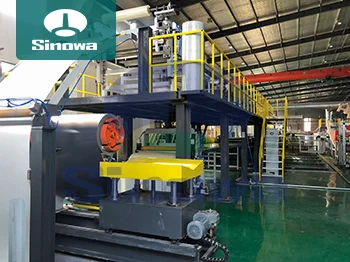
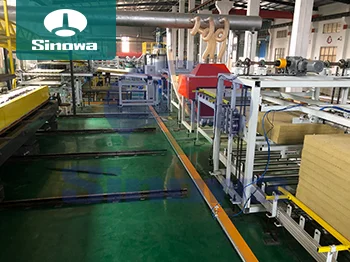
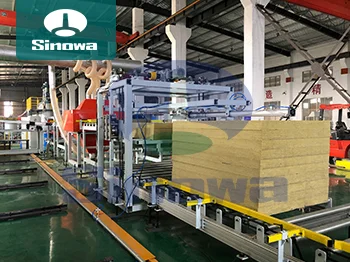
The high-tech rockwool sandwich panel line can meet a variety of production needs of customers, the whole rockwool sandwich panel line design concept of modularization enables all our components to be integrated and combined at will. Our high efficiency rockwool sandwich panel line can easily automate the production of roof sandwich panel, wall sandwich panel, cold storage sandwich panel and other products by different combination and configuration selection and siple switching. The inner core layer can be polyrethane or rock wool, glass wool, an so on. The precision servo hoisting mechanism employed by the main engine without hydraulic system makes the board thickness control flexible and the customer may conveniently change or adjust the board thickness. There will be not such troubles as hydraulic system adjustment, leakage, maintenance, etc.
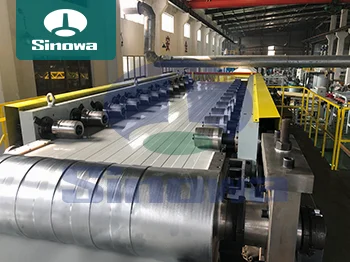
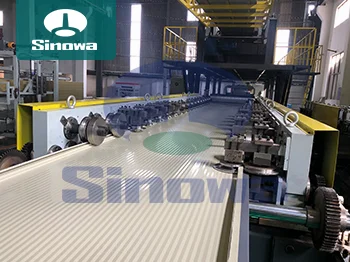
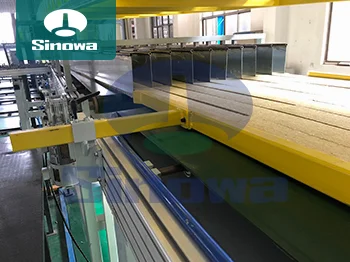
The high precision rockwool sandwich panel line has high adaptability, which may produce various sandwich panel of the PU, PIR and rock wool systems. We may design various products according to the customer’s requirements, including various configurations, so as to meet their demands with flexible price system. Highly integrated and linked control system centralizes all control points at the main central center, achieving parameter linkage, fault self-diagnosis controlled by the whole line and shipping distance control. High-level automatic control system also saves the manpower and reduces the manpower loss for customers. High-level energy saving and protection design makes the whole rockwool sandwich panel line possible to produce around the clock throughout the year and the customer will save huge budget. In addition, the isolated heat preservation room is constructed for warming the environment. The energy saving and protection design of our manufacturing line may guarantee that the customer’s production line may be freely heated and produce in the main time to save more costs for customers.
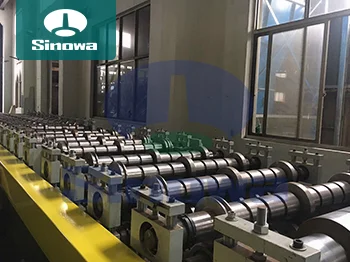
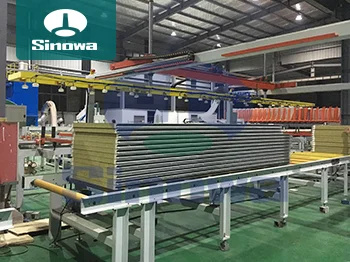
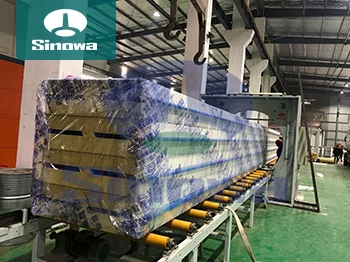
The high-power low-consumption design quickens the reaction of the cheap rockwool sandwich panel line while energy consumption is kept low. With the brand-new, fully sealed inner insulation design, the energy consumption is controlled at the minimum level to achieve the design objective of less than an hour for the insulation system to be activated from the room temperature above 5℃ to the production process temperature. The energy consumption is only 40% that of those similar products.
A rockwool sandwich panel line is an integrated and automated production system designed to manufacture high-quality rockwool sandwich panels, which are widely used in various industrial and construction fields due to their excellent comprehensive performance. This production line combines advanced mechanical technology, electrical control, hydraulic drive, and precision processing technology, realizing the continuous and efficient production of rockwool sandwich panels from raw material processing to finished product forming. Unlike traditional intermittent production equipment, the rockwool sandwich panel line integrates multiple processes into a seamless workflow, ensuring stable product quality, high production efficiency, and strong adaptability to diverse production needs. The structure of the rockwool sandwich panel line is modular and integrated, consisting of multiple functional units that work closely together to complete each link of the production process, from the uncoiling of surface materials to the stacking of finished products. Each functional unit is designed with high precision and rationality, ensuring the smooth operation of the entire production line and the consistency of product specifications.
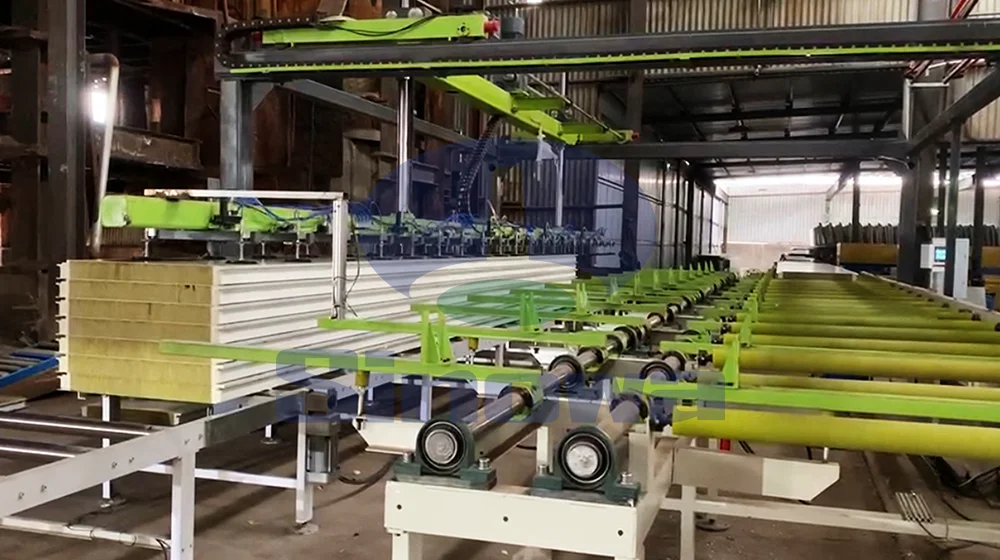
The core structure of a rockwool sandwich panel line mainly includes uncoiling units, roll forming units, rockwool core processing units, glue spraying units, composite laminating units, automatic cutting units, conveying units, stacking units, and electrical control units. Each unit undertakes specific functions and is closely connected to form a complete production chain. The uncoiling unit is the starting point of the production line, responsible for stably unwinding the surface materials, which are usually metal coils such as color-coated steel plates or aluminum alloy plates. This unit is equipped with hydraulic control and automatic centering functions to ensure that the metal coils are fed uniformly without deviation, which is crucial for maintaining the flatness and dimensional accuracy of the surface materials. The uncoiling unit is also equipped with a tension control device to adjust the tension of the metal coils according to different material thicknesses, preventing the surface materials from being stretched or wrinkled during the uncoiling process. Some advanced uncoiling units are also equipped with feeding trolleys and auxiliary support structures to facilitate the loading and unloading of heavy metal coils, improving the convenience of operation.
The roll forming unit is a key part of the rockwool sandwich panel line, responsible for shaping the surface materials into the required cross-sectional profiles. This unit uses a series of sequentially arranged rollers with precise contours to gradually bend the flat metal sheets into shapes such as corrugated, trapezoidal, or flat panels. The rollers are made of high-quality steel that has undergone quenching treatment and precision machining, ensuring high wear resistance and dimensional stability. The forming speed of the roll forming unit is adjustable, which can be adjusted according to the thickness of the surface materials and the complexity of the profile, ensuring the forming quality and production efficiency. Some advanced roll forming units adopt a cassette-type or rail-wheel design, allowing for quick replacement of roller sets to produce different types of panels, thereby enhancing the production flexibility of the line. After forming, the surface materials are conveyed to the next process through a guiding device, ensuring smooth connection between processes.
The rockwool core processing unit is another important component of the rockwool sandwich panel line, responsible for processing the rockwool raw materials into core layers that meet the production requirements. Rockwool raw materials are usually made of natural volcanic rock, such as basalt, which is crushed into uniform particles and then melted at high temperatures exceeding 1500℃ to form molten magma. The molten magma is then sent to a high-speed rotating centrifuge, where it is stretched and shredded into extremely fine fibers under the action of strong centrifugal force. During this process, a certain amount of binder, mainly phenolic resin, and dust-proof oil are uniformly sprayed on the fibers to enhance their cohesion and prevent dust generation. The fibers coated with binder fall onto a collection belt in a settling chamber, forming a loose and uniform rockwool blanket, which is then conveyed to the shaping device. In the shaping device, the rockwool blanket is adjusted to the required thickness and density, and the fiber direction is optimized—usually arranged vertically to enhance the mechanical strength and thermal insulation performance of the final panel. The shaped rockwool core is then accurately conveyed between the upper and lower surface materials that have been sprayed with adhesive, forming a three-layer structure of upper surface material, rockwool core, and lower surface material.
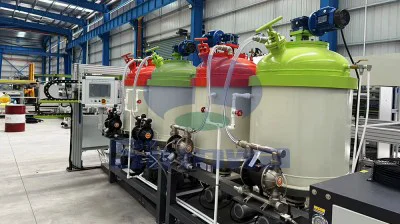
The glue spraying unit is responsible for applying adhesive to the inner surface of the surface materials to ensure a firm bond between the surface materials and the rockwool core. The adhesive used is usually a two-component polyurethane system, which has strong bonding strength, good weather resistance, and excellent aging resistance, ensuring that the sandwich panels do not delaminate or fall off during long-term use. The glue spraying unit adopts high-pressure spray guns to evenly spray the adhesive on the surface materials, and the spray amount and spray speed can be adjusted according to the production needs to ensure uniform glue application and avoid waste. Some advanced glue spraying units are equipped with automatic glue mixing and feeding systems, which can automatically mix the two-component adhesive in a certain proportion and continuously supply glue to the spray guns, improving the stability and uniformity of glue application. After glue spraying, the surface materials are conveyed to the composite laminating unit to complete the combination with the rockwool core.
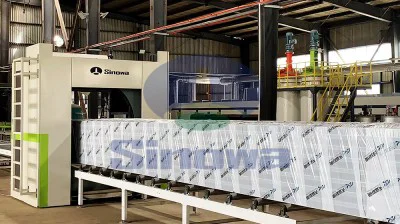
The composite laminating unit is responsible for pressing the upper surface material, rockwool core, and lower surface material into an integrated sandwich panel. This unit adopts a double-belt pressing structure, which uses two parallel conveyor belts to apply uniform pressure to the three-layer structure, ensuring that the adhesive is fully cured and the three layers are firmly bonded. The conveyor belts are made of high-temperature resistant and wear-resistant materials, and the pressing pressure and temperature can be adjusted according to the production needs to adapt to different types of surface materials and rockwool cores. The composite laminating unit is also equipped with a heating system, which uses hot air circulation heating to maintain the appropriate temperature for adhesive curing, accelerating the curing speed and improving the bonding quality. After laminating, the composite panel is conveyed to the automatic cutting unit for cutting.
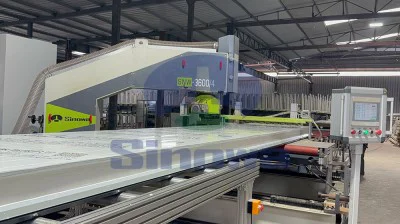
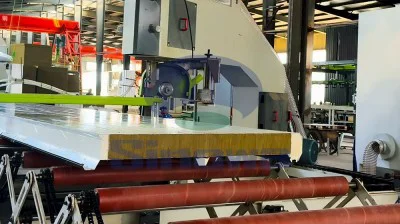
The automatic cutting unit is used to cut the continuous composite panel into finished products of the required length. This unit adopts a non-stop cutting design, which can cut the panel while the production line is running, ensuring continuous production and improving production efficiency. The cutting tool is usually a band saw or a circular saw with high sharpness and wear resistance, which can ensure smooth cutting edges and accurate dimensional accuracy. The cutting length is controlled by a PLC system, which can be set according to the customer's requirements, and the cutting accuracy can reach ±1mm, meeting the strict requirements of various application scenarios. After cutting, the finished products are conveyed to the stacking unit through the conveying unit.
The conveying unit runs through the entire production line, responsible for conveying materials between each functional unit. The conveying unit is composed of conveyor belts, rollers, and guiding devices, which are designed according to the layout of the production line and the characteristics of the materials. The conveyor belts are made of high-strength and wear-resistant materials, ensuring stable operation and long service life. The speed of the conveying unit is synchronized with the production speed of other units, ensuring the smooth flow of materials and avoiding material accumulation or stagnation. The stacking unit is the end of the production line, responsible for stacking the finished rockwool sandwich panels in an orderly manner for storage and transportation. The stacking unit adopts an automatic stacking design, which can adjust the stacking height and stacking method according to the size and weight of the finished products, reducing manual operation and improving stacking efficiency. Some advanced stacking units are also equipped with packaging devices, which can wrap the stacked panels to prevent damage during transportation.
The electrical control unit is the "brain" of the rockwool sandwich panel line, responsible for controlling the operation of all functional units. This unit adopts a PLC control system and a touch screen operation interface, which can realize automatic control, manual control, and parameter setting of the production line. The PLC system has high reliability and stability, which can accurately control the production speed, pressure, temperature, cutting length, and other parameters, ensuring the stability of product quality. The touch screen operation interface is user-friendly, easy to learn and master, and operators can monitor the operation status of the production line in real time, adjust parameters, and handle faults through the touch screen. The electrical control unit is also equipped with a safety protection system, which can automatically shut down the production line in case of abnormal conditions such as overload, short circuit, or material shortage, ensuring the safety of operators and equipment.
The performance of the rockwool sandwich panel line is reflected in multiple aspects, including production efficiency, product quality, automation level, adaptability, and energy conservation. In terms of production efficiency, the rockwool sandwich panel line adopts continuous automated production, which greatly improves production efficiency compared with traditional manual or semi-automatic production methods. The production speed can be adjusted between 0-8 meters per minute, and the annual production capacity can reach 500,000 to 800,000 square meters, depending on the configuration of the production line and the production conditions. This high production efficiency can meet the large-scale production needs of enterprises and reduce production costs.
In terms of product quality, the rockwool sandwich panel line adopts precise processing technology and strict quality control measures, ensuring that the finished products have uniform dimensions, smooth surfaces, firm bonding, and excellent performance. The thickness of the finished panels can be adjusted between 50mm and 300mm, and the width can be 950mm, 1000mm, 1200mm, or other customized sizes, meeting the diverse needs of different application scenarios. The rockwool sandwich panels produced by the line have excellent fire resistance, thermal insulation, sound insulation, and waterproof performance, which are due to the precise control of the production process. For example, the vertical arrangement of rockwool fibers enhances the thermal insulation and mechanical strength of the panels, and the uniform application of adhesive ensures that the panels do not delaminate. In addition, the production line is equipped with quality inspection devices to monitor the thickness, density, bonding strength, and other indicators of the panels in real time, ensuring that each finished product meets the required standards.
The automation level of the rockwool sandwich panel line is relatively high, realizing full-process automated operation from raw material input to finished product stacking. The entire production line only needs 5-13 operators to complete the operation, which greatly reduces labor demand and labor costs. The PLC control system and touch screen operation interface make the operation of the production line more convenient and simple, reducing the difficulty of operation and the error rate caused by manual operation. Some advanced production lines also adopt remote monitoring and fault diagnosis functions, which can realize remote monitoring of the production line's operation status and timely handle faults, improving the reliability and availability of the production line.
The adaptability of the rockwool sandwich panel line is strong, which can produce different types, specifications, and performance of rockwool sandwich panels by adjusting parameters and replacing parts. For example, by replacing the roller sets of the roll forming unit, the production line can produce flat, corrugated, trapezoidal, or other customized profile panels; by adjusting the thickness and density of the rockwool core, the thermal insulation and mechanical performance of the panels can be changed to meet the needs of different application scenarios. In addition, the production line can also adapt to different types of surface materials, such as color-coated steel plates, aluminum alloy plates, and glass magnesium plates, expanding the scope of product applications.
Energy conservation and environmental protection are also important performance characteristics of the rockwool sandwich panel line. The production line adopts advanced energy-saving technologies, such as frequency conversion speed regulation, which can adjust the power consumption according to the production load, reducing energy waste. The rockwool raw materials used in the production process are natural and environmentally friendly, and the production process does not produce harmful gases or pollutants, meeting the requirements of environmental protection. In addition, the production line is equipped with dust collecting devices to collect the dust generated during the rockwool processing process, reducing environmental pollution and protecting the health of operators.
There are various types of rockwool sandwich panel lines, which can be classified according to different standards. According to the production process, they can be divided into continuous production lines and intermittent production lines. Continuous production lines are mainly used for large-scale mass production, with high production efficiency, stable product quality, and low labor costs, which are widely used in large enterprises. Intermittent production lines are suitable for small-scale production or customized production, with flexible operation and low investment costs, which are suitable for small and medium-sized enterprises. According to the type of surface materials, rockwool sandwich panel lines can be divided into color steel rockwool sandwich panel lines, aluminum alloy rockwool sandwich panel lines, glass magnesium rockwool sandwich panel lines, etc., each of which is suitable for producing panels with different surface materials and performance characteristics.
According to the application scenarios of the finished products, rockwool sandwich panel lines can be divided into building wall panel production lines, roof panel production lines, cleanroom panel production lines, cold storage panel production lines, etc. Building wall panel production lines are mainly used to produce rockwool sandwich panels for building exterior walls and interior partitions, which require good thermal insulation, fire resistance, and sound insulation performance. Roof panel production lines are used to produce rockwool sandwich panels for building roofs, which require good waterproof, windproof, and load-bearing performance. Cleanroom panel production lines are used to produce rockwool sandwich panels for cleanrooms in medicine, food, electronics, and other industries, which require high cleanliness, corrosion resistance, and airtightness. Cold storage panel production lines are used to produce rockwool sandwich panels for cold storage and refrigeration facilities, which require excellent thermal insulation performance to reduce energy consumption.
In addition, according to the degree of automation, rockwool sandwich panel lines can be divided into fully automatic production lines and semi-automatic production lines. Fully automatic production lines realize full-process automated operation, with high production efficiency and low labor demand, but the investment cost is relatively high. Semi-automatic production lines require a certain amount of manual operation, such as manual feeding of rockwool core materials, with lower investment costs and flexible operation, which are suitable for small-scale production.
The rockwool sandwich panel line has a wide range of applications, covering construction, industrial, cold chain logistics, petrochemical, and other fields. In the construction industry, rockwool sandwich panels produced by the line are widely used in the exterior walls, interior partitions, roofs, and ceilings of various buildings, such as industrial workshops, warehouses, commercial buildings, residential buildings, and public facilities. Due to their excellent thermal insulation performance, they can reduce the energy consumption of buildings, meet the requirements of energy conservation and emission reduction, and at the same time, their good fire resistance can improve the safety of buildings. In industrial fields, rockwool sandwich panels are used in the construction of industrial plants, workshops, and equipment enclosures, which can provide thermal insulation, sound insulation, and fire protection protection for industrial equipment and production workshops, ensuring the normal operation of production.
In the cold chain logistics industry, rockwool sandwich panels are used in the construction of cold storage, refrigerated warehouses, and refrigerated vehicles. Their excellent thermal insulation performance can effectively maintain the low temperature environment inside the cold storage, reduce the energy consumption of refrigeration equipment, and ensure the quality and freshness of refrigerated goods. In the petrochemical industry, rockwool sandwich panels are used in the construction of chemical plants, oil depots, and other facilities, which have good corrosion resistance and fire resistance, and can provide effective protection for petrochemical equipment and facilities, preventing safety accidents such as fires and explosions.
In addition, rockwool sandwich panels produced by the line are also used in the construction of prefabricated buildings, container buildings, and temporary buildings. Prefabricated buildings are an emerging building type in recent years, which have the advantages of fast construction speed, energy conservation, and environmental protection. Rockwool sandwich panels are important components of prefabricated buildings, which can be prefabricated in the factory and installed on site, greatly shortening the construction period. Container buildings and temporary buildings require lightweight, easy installation, and good performance of building materials, and rockwool sandwich panels just meet these requirements, so they are widely used in these fields.
With the continuous development of the construction and industrial industries, the demand for rockwool sandwich panels is increasing, and the requirements for the performance and quality of rockwool sandwich panel lines are also getting higher and higher. In the future, the rockwool sandwich panel line will develop in the direction of higher automation, intelligence, energy conservation, and environmental protection. More advanced technologies, such as artificial intelligence, Internet of Things, and big data, will be applied to the production line, realizing intelligent monitoring, intelligent adjustment, and intelligent fault diagnosis of the production process, further improving production efficiency and product quality. At the same time, the production line will be more energy-saving and environmental-friendly, adopting more environmentally friendly raw materials and production technologies, reducing energy consumption and environmental pollution, and meeting the requirements of sustainable development.
In conclusion, the rockwool sandwich panel line is an important production equipment for manufacturing high-quality rockwool sandwich panels, with a reasonable structure, excellent performance, various types, and a wide range of applications. It plays an important role in promoting the development of the construction and industrial industries, and provides strong support for the popularization and application of rockwool sandwich panels. With the continuous progress of technology, the rockwool sandwich panel line will continue to be upgraded and improved, bringing more convenience and benefits to enterprises and society.
« Rockwool Sandwich Panel Line » Update Date: 2026/4/13
URL: https://www.sinowamachine.com/tags/rockwool-sandwich-panel-line.html
![Rockwool Sandwich Panel Line From China]()
Rockwool Sandwich Panel Line From China
2026-08-31The rockwool sandwich panel production line has emerged as a core industrial equipment for modern green building material manufacturing, widely recognized for its high automation, stable operation and superior product molding performance. Designed specifically for producing high-performance rockwool …![Rockwool Sandwich Panel Line Supplier]()
Rockwool Sandwich Panel Line Supplier
2026-08-28The rockwool sandwich panel production line has emerged as a core industrial equipment for manufacturing high-performance building insulation panels, serving as a pivotal solution for modern green construction, industrial enclosure, and energy-saving architectural projects. As professional suppliers …![Rockwool Sandwich Panel Line For House]()
Rockwool Sandwich Panel Line For House
2026-08-26Modern residential construction is increasingly pursuing a balance of safety, comfort, energy efficiency and construction efficiency, and the rockwool sandwich panel production line has become a core equipment supporting high-quality house building decoration and enclosure construction. This professi…![Rockwool Sandwich Panel Line Manufacturer]()
Rockwool Sandwich Panel Line Manufacturer
2026-08-12Rockwool sandwich panel production lines represent advanced integrated manufacturing systems dedicated to the automated production of high-performance composite building panels, which integrate thermal insulation, fire resistance, and structural stability in one finished product. As core equipment fo…
- Links:
- Sandwich Panel Continuous Production Line
- Automatic and Continuous Sandwich Panel Production Line
- Cheap and Low Price Sandwich Panel Production Line
- China Sandwich Panel Production Line Factory
- Color Steel Sandwich Panel Production Line For Cold Storage
- Continuous Composite Foam Sandwich Panel Production Line
- Continuous Production Line For Rockwool and Mineral Wool Sandwich Panels
- Continuous PU Phenolic Insulation Panel Production Line
- Continuous PU PIR Sandwich Panel Production Line
- Continuous PUF PUR Sandwich Panel Production Line
- Continuous Sandwich Panel Production Line For Roof and Wall
- Customized and Design Sandwich Panel Production Line
- Decorative Sandwich Panel Production Line For Glass Wool Boards
- High Quality Sandwich Panel Production Line For Sale
- Polyurethane(PU) Sandwich Panel Production Line
- Sandwich Panel Production Line Manufacturer and Supplier
- Sandwich Panel Production Machinery and Equipment