
Automatic Sandwich Panel Production Line Supplier
Sinowa is a well-known manufacturer and technical service provider of high-end automatic sandwich panel production line, learn more about automatic sandwich panel production line supplier, please contact Sinowa's technical engineer, tell us what you need, we will contact you as soon as possible!
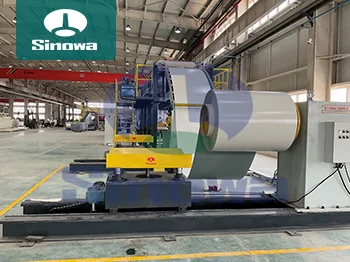
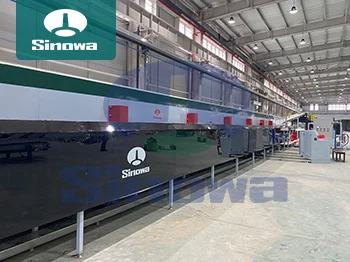
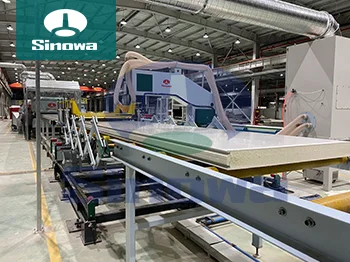
Sinowa is committed to the development and manufacturing of high-end and high-efficiency automatic sandwich panel production line. Our automatic sandwich panel production line are leading the way in efficiency, automatic control, human-computer interaction, environmental protection and energy consumption. Using system integration and bus control technology, it realizes the automatic integrated linkage control of the entire automatic sandwich panel production line, and can achieve remote interactive communication, which has the world-class level and a comprehensive leading high-performance automatic sandwich panel production line in the market.
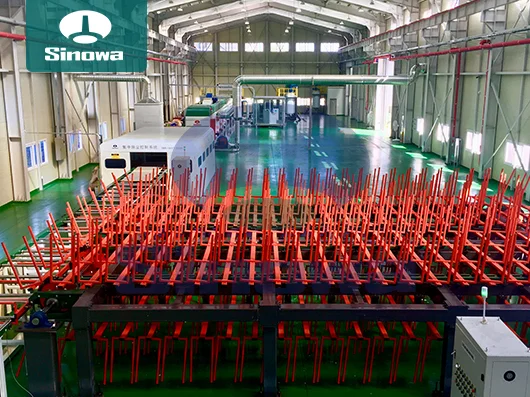
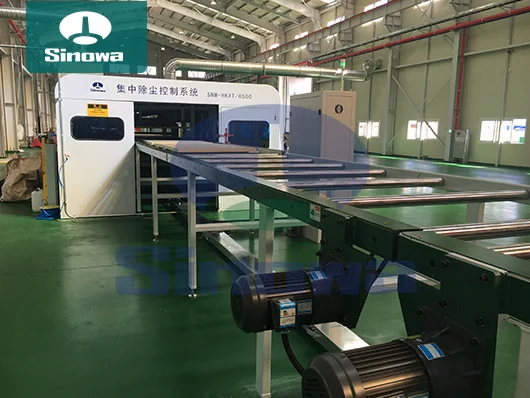
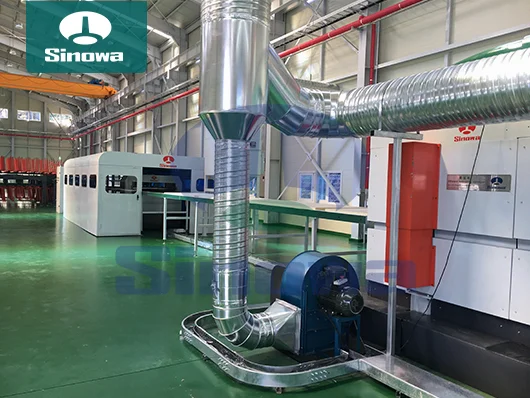
For more than ten years, relying on our innovative manufacturing concept and excellence in quality, reliable and trustworthy service to customers, we cooperate with customers all over the world, exported products to Canada, South Korea, Israel, Australia, the Middle East and other more than 20 countries and regions. contributed to building energy conservation and low-carbon production and have won widespread praise.
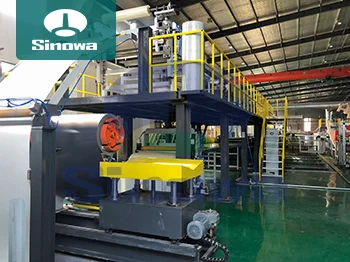
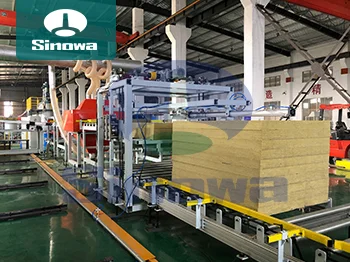
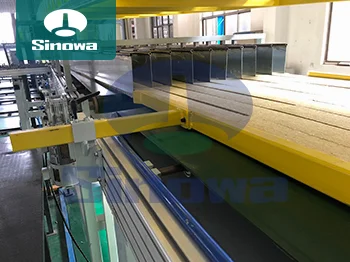
Sinowa has invested outstanding efforts in automatic sandwich panel production line, this is why our products are more efficiency, quality, automatic control technology, environmental protection, energy consumption indicators and the appearance and safety protection are comprehensively leading, some subversive design changes in many major technical points, these major innovations make our products excellent in price/performance and user experience.
In the context of global construction industry's transformation towards greenization and modularization, sandwich panels have emerged as a core building material, favored for their balanced performance of light weight, high strength, thermal insulation, and soundproofing. This growing demand for sandwich panels has inherently driven the evolution of production technologies, with automatic production lines becoming the mainstream choice for manufacturers aiming to enhance efficiency, ensure quality consistency, and adapt to diverse market needs. Unlike traditional manual or semi-automatic production methods, automatic sandwich panel production lines integrate multiple processes into a seamless workflow, from raw material feeding to finished product stacking, revolutionizing the way sandwich panels are manufactured and laying a solid foundation for the sustainable development of the construction materials industry.
The core advantage of automatic sandwich panel production lines lies in their ability to achieve high-precision and high-efficiency production through intelligent integration of key processes. A typical automatic production line consists of several interconnected systems, each performing a specific function while maintaining close coordination with others. The unwinding system, equipped with automatic deviation correction devices, ensures that the surface materials (such as color steel plates, aluminum plates, or fiber cement boards) are fed smoothly without misalignment, which is crucial for the subsequent lamination quality. The pre-heating device regulates the temperature of the surface materials to an optimal range, promoting better adhesion with the core material and improving the overall structural stability of the sandwich panels. The foaming and lamination system is the heart of the production line, where two-component raw materials for rigid foam (such as polyurethane or phenolic resin) are accurately mixed in a predetermined ratio by a high-pressure foaming machine and evenly distributed on the bottom surface material. Simultaneously, the top surface material is fed into the double-track laminating conveyor, where the foam undergoes foaming and curing between the upper and lower conveyor chains to form a solid sandwich structure. The entire process is carried out under precise temperature and pressure control, with the double-track conveyor maintaining a stable speed to ensure uniform thickness and density of the foam core.
After curing, the continuous sandwich panel is cut into specified lengths by an automatic tracking crosscut saw, which can adjust the cutting parameters in real-time according to production requirements, supporting the production of panels with lengths ranging from 2 meters to 4 meters or more. The trimming system then removes excess materials from the sides of the panels to ensure neat edges, while the conveying and stacking system automatically transports the finished products to the designated area and stacks them in an orderly manner, reducing manual handling and the risk of product damage. What distinguishes advanced automatic production lines is their centralized control system, which integrates all control points into a main control center, enabling parameter linkage, fault self-diagnosis, and even remote control. Operators can monitor the entire production process through a human-machine interface, adjust parameters as needed, and quickly respond to any abnormalities, significantly reducing the reliance on manual labor and minimizing human errors.
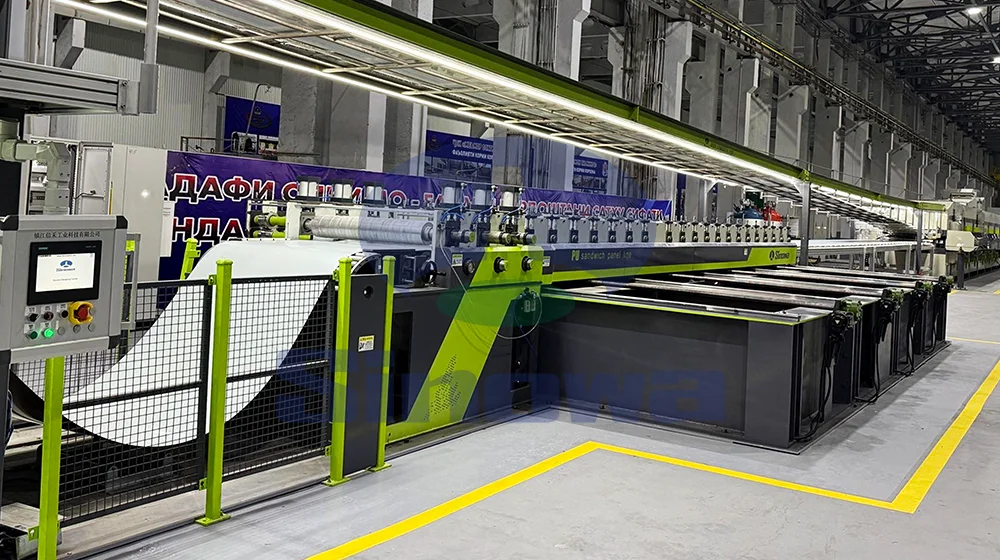
The versatility of automatic sandwich panel production lines is another key factor contributing to their widespread adoption. With modular design, these production lines can be flexibly configured to produce various types of sandwich panels by switching different components or adjusting process parameters. For example, by changing the foaming material supply system, they can produce panels with different core materials such as polyurethane (PU), expanded polystyrene (EPS), or rock wool, each catering to specific application scenarios. Polyurethane sandwich panels, known for their excellent thermal insulation and waterproof performance, are widely used in food cold storage warehouses; EPS panels, with their cost-effectiveness and stable insulation properties, are preferred for industrial plant walls and roofs; rock wool panels, featuring Class A non-combustible performance, are essential for crowded public facilities such as hospitals and schools. Additionally, the production lines can be adjusted to manufacture wall panels, roof panels, or customized panels with different thicknesses (ranging from 20mm to 200mm) and widths (commonly 1200mm), meeting the diverse needs of industrial, commercial, and civil construction projects.
The adoption of automatic sandwich panel production lines brings significant economic and environmental benefits to manufacturers. In terms of production efficiency, automatic lines can achieve a production speed of 4 to 10 meters per minute, which is far higher than manual production. This high efficiency enables manufacturers to meet large-order requirements within shorter timeframes, enhancing their market competitiveness. For instance, a modular housing project using sandwich panels produced by automatic lines can shorten the construction period from 6 months to 2 months, reducing labor costs by 35%. In terms of cost control, although the initial investment in automatic lines is relatively high, the long-term benefits are substantial. The reduction in labor costs, the minimization of raw material waste due to precise control, and the lower maintenance costs resulting from modular design all contribute to lower overall production costs. Moreover, advanced automatic production lines incorporate energy-saving designs, such as fully enclosed internal insulation and high-power low-energy consumption components, which can reduce energy consumption by a significant margin. They can maintain the required process temperature within 1 hour when the ambient temperature is above 5℃, eliminating the need for additional insulation rooms and reducing energy waste.
From a market perspective, the demand for automatic sandwich panel production lines is closely linked to the growth of the global sandwich panel market. According to market research data, the global foam sandwich panel market sales reached 8.321 billion US dollars in 2024 and are expected to grow to 13.62 billion US dollars by 2031, with a compound annual growth rate (CAGR) of 7.4% from 2025 to 2031. This steady growth is driven by several factors, including the promotion of global energy-efficient building policies, the rapid development of modular construction, and the expanding demand for industrial and cold chain logistics facilities. Governments around the world are upgrading building energy efficiency standards to achieve carbon reduction goals. For example, the European Union's Energy Performance of Buildings Directive requires all new buildings to meet zero-energy standards by 2030, driving a 9% annual growth in the European sandwich panel market. In China, under the "dual carbon" goal, the "Implementation Plan for Carbon Peaking in Urban and Rural Construction" emphasizes improving the thermal insulation performance of building envelopes, leading to a 55% utilization rate of foam sandwich panels in new buildings in 2024, an increase of 20 percentage points compared to 2019. These policy initiatives have boosted the demand for high-quality sandwich panels, thereby driving the adoption of automatic production lines that can ensure consistent product quality and meet strict performance requirements.
The rapid development of modular construction is another major driver for the automatic sandwich panel production line market. Modular construction, characterized by factory prefabrication and on-site assembly, relies heavily on sandwich panels, which account for more than 80% of the wall material usage. Automatic production lines can produce standardized sandwich panel components efficiently, supporting the large-scale development of modular construction. During the COVID-19 pandemic, emergency hospitals built with sandwich panels were completed within 72 hours to provide 1,000 isolation beds, with an installation efficiency of 500 square meters per day, demonstrating the critical role of high-quality and high-efficiency sandwich panel production in emergency scenarios. Additionally, the expansion of industrial and cold chain logistics industries has created a sustained demand for sandwich panels. The global manufacturing recovery has driven an 8% annual increase in new factory construction area, while the cold chain logistics industry is growing at an annual rate of 20%. These sectors require sandwich panels with specific properties such as corrosion resistance, moisture resistance, and long-term thermal insulation stability, which can only be reliably produced by automatic lines with precise process control.
The application of automatic sandwich panel production lines is not limited to traditional construction materials manufacturers; it also extends to emerging fields such as green buildings and smart construction. With the growing emphasis on sustainability, manufacturers are increasingly using environmentally friendly materials such as bio-based foam cores and recycled surface materials. Automatic production lines can be adapted to process these new materials, ensuring stable production quality while reducing carbon footprints. For example, plant-based polyurethane sandwich panels produced by automatic lines have a 60% lower carbon footprint compared to traditional panels and are being piloted in European green buildings. In the field of smart construction, automatic production lines can be integrated with IoT technologies to realize real-time monitoring of production processes, data collection, and process optimization. Some advanced production lines are even capable of producing sandwich panels with built-in sensors that can monitor temperature, humidity, and structural deformation, providing support for the operation and maintenance of smart buildings.
Looking ahead, the development trend of automatic sandwich panel production lines will focus on higher intelligence, greater energy efficiency, and stronger customization capabilities. Technological innovations such as AI-driven process optimization and digital twin technology will be increasingly integrated into production lines, enabling predictive maintenance, reducing downtime, and further improving production efficiency. Energy-saving technologies will continue to advance, with the goal of achieving near-zero energy consumption in the production process. Customization capabilities will be enhanced to meet the growing demand for personalized sandwich panels in special scenarios such as agricultural greenhouses, transportation hubs, and military projects. For example, automatic lines can be adjusted to produce light-transmitting sandwich panels for smart greenhouses, which have a light transmittance of 85% and can shorten the crop growth cycle by 10 days while increasing yield by 15%.
In conclusion, automatic sandwich panel production lines have become an indispensable part of the modern construction materials industry, driving the transformation of sandwich panel production from labor-intensive to technology-intensive. Their advantages in efficiency, quality, versatility, and sustainability make them well-suited to meet the evolving market demands driven by global energy conservation policies, modular construction development, and industrial expansion. As technology continues to advance, these production lines will play an even more critical role in promoting the sustainable development of the construction industry, supporting the achievement of global carbon reduction goals, and creating a more efficient, environmentally friendly, and intelligent built environment. Manufacturers that adopt and continuously upgrade automatic sandwich panel production lines will be better positioned to seize market opportunities, enhance their competitiveness, and contribute to the ongoing innovation and growth of the industry.
« Automatic Sandwich Panel Production Line Supplier » Update Date: 2026/1/9
- High-end Sandwich Panel Production Line
- High-quality Decorative Sandwich Panel Line
- Sandwich Panel Production Machinery For Sale
- Cold Room Sandwich Panel Production Line
- Cold Storage Sandwich Panel Production Line In China
- Sandwich Foam Panel Making Machine Price
- PU Sandwich Panel Making Machine Price
- Glass Wool Production Line Price
- Isolation PU Sandwich Panel Line Price
- High-tech PU Insulated Panel Production Line
- PU Insulation Board Production Line Supplier
- Cheap Glass Wool Sandwich Panel Machine
- Decorative PU Sandwich Panel Production Line For Sale
- PUF Panel Making Machine For Sale
- High Efficiency Glass Wool Sandwich Panel Line
- Cheap PUF Panel Manufacturing Machine
- Fully Automatic PU Sandwich Panel Production Line On Sales
- Customized Polyurethane Sandwich Panel Line
- High-tech Composite Panel Production Line
- PUR Sandwich Panel Production Line Manufacturer
- Links:
- Sandwich Panel Continuous Production Line
- Automatic and Continuous Sandwich Panel Production Line
- Cheap and Low Price Sandwich Panel Production Line
- China Sandwich Panel Production Line Factory
- Color Steel Sandwich Panel Production Line For Cold Storage
- Continuous Composite Foam Sandwich Panel Production Line
- Continuous Production Line For Rockwool and Mineral Wool Sandwich Panels
- Continuous PU Phenolic Insulation Panel Production Line
- Continuous PU PIR Sandwich Panel Production Line
- Continuous PUF PUR Sandwich Panel Production Line
- Continuous Sandwich Panel Production Line For Roof and Wall
- Customized and Design Sandwich Panel Production Line
- Decorative Sandwich Panel Production Line For Glass Wool Boards
- High Quality Sandwich Panel Production Line For Sale
- Polyurethane(PU) Sandwich Panel Production Line
- Sandwich Panel Production Line Manufacturer and Supplier