
Sandwich Panel Making Machine
Sinowa is a sandwich panel making machine supplier from china, customized high-quality & high efficiency sandwich panel making machine at low price, the adoption of system integration technology and bus control technology accomplishes the full automatization of integrated and coordinated control of the sandwich panel making machine with accessible remote interactive communication. Ranking the first-class level in the world, it is currently the sandwich panel making machine in the market taking a comprehensive lead in high performance.
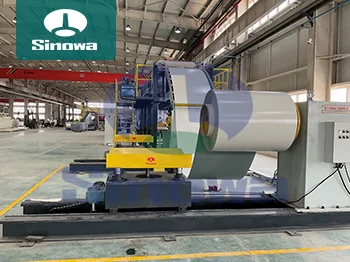
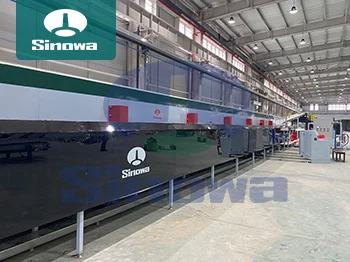
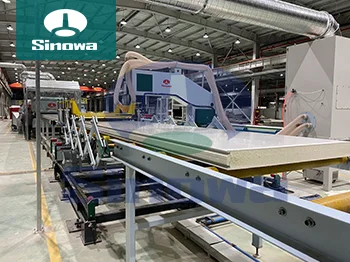
The high-tech sandwich panel making machine can meet a variety of production needs of customers, the whole sandwich panel making machine design concept of modularization enables all our components to be integrated and combined at will. Our high efficiency sandwich panel making machine can easily automate the production of roof sandwich panel, wall sandwich panel, cold storage sandwich panel and other products by different combination and configuration selection and siple switching. The inner core layer can be polyrethane or rock wool, glass wool, an so on.


The high precision sandwich panel making machine has high adaptability, which may produce various sandwich panel of the PU, PIR and rock wool systems. We may design various products according to the customer’s requirements, including various configurations, so as to meet their demands with flexible price system. Highly integrated and linked control system centralizes all control points at the main central center, achieving parameter linkage, fault self-diagnosis controlled by the whole line and shipping distance control. High-level automatic control system also saves the manpower and reduces the manpower loss for customers.


The precision servo hoisting mechanism employed by the main engine without hydraulic system makes the board thickness control flexible and the customer may conveniently change or adjust the board thickness. There will be not such troubles as hydraulic system adjustment, leakage, maintenance, etc.


High-level energy saving and protection design makes the whole sandwich panel making machine possible to produce around the clock throughout the year and the customer will save huge budget. In addition, the isolated heat preservation room is constructed for warming the environment. The energy saving and protection design of our manufacturing line may guarantee that the customer’s production line may be freely heated and produce in the main time to save more costs for customers.


The high-power low-consumption design quickens the reaction of the cheap sandwich panel making machine while energy consumption is kept low. With the brand-new, fully sealed inner insulation design, the energy consumption is controlled at the minimum level to achieve the design objective of less than an hour for the insulation system to be activated from the room temperature above 5℃ to the production process temperature. The energy consumption is only 40% that of those similar products.
Sandwich panel making machines are specialized equipment designed to produce sandwich panels, a kind of composite material composed of two outer facing layers and a middle core layer. These machines play a crucial role in modern manufacturing industries, as sandwich panels have become increasingly popular due to their excellent comprehensive performance, wide range of applications, and environmental protection features. The rational structure design, stable performance, diverse types and extensive application fields of sandwich panel making machines have promoted the mass production and high-quality development of sandwich panels, meeting the growing needs of various industries for efficient and high-performance composite materials.
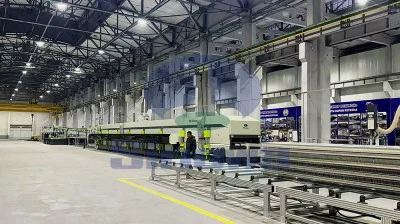
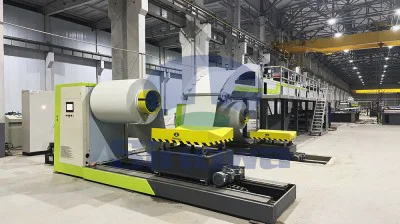
The structure of a sandwich panel making machine is a complex system composed of multiple functional components, each of which undertakes specific tasks to ensure the smooth progress of the entire production process. Generally speaking, the basic structure of a sandwich panel making machine mainly includes an uncoiling unit, a roll forming unit, a core material feeding unit, a laminating unit, a cutting unit, a conveying unit and an electrical control unit. These components are closely connected and coordinated with each other, forming a complete production line that can realize the continuous and automated production of sandwich panels. The uncoiling unit is the starting part of the production line, which is mainly used to uncoil the coiled facing materials (such as steel plates, aluminum plates, fiberboards, etc.) stably and evenly. It is usually equipped with two uncoilers to meet the needs of feeding two outer facing layers at the same time. The uncoiling unit is also equipped with a deviation correction device to prevent the facing materials from deviating during the uncoiling process, which ensures the accuracy of the subsequent lamination process. In addition, some advanced uncoiling units are also equipped with a coil car and a lifting device, which facilitates the loading and unloading of coiled materials and improves the production efficiency.
The roll forming unit is a key component that determines the shape and dimensional accuracy of the outer facing layers of sandwich panels. This unit mainly consists of a series of forming rollers arranged in a certain order, and the shape of each forming roller is designed according to the cross-sectional shape of the target facing layer. When the facing material passes through the forming rollers at a constant speed, it is gradually bent and formed under the pressure of the rollers, and finally forms the required cross-sectional shape (such as corrugated, flat, etc.). The roll forming unit is usually equipped with a preheating device, which can preheat the facing material to an appropriate temperature before forming, so as to improve the plasticity of the material, reduce the forming resistance, and avoid cracks or deformations during the forming process. The forming rollers are made of high-quality alloy steel, which has high hardness and wear resistance, and can ensure long-term stable operation under high-pressure working conditions. At the same time, the distance between the forming rollers can be adjusted according to the thickness of the facing material, which enhances the adaptability of the machine.
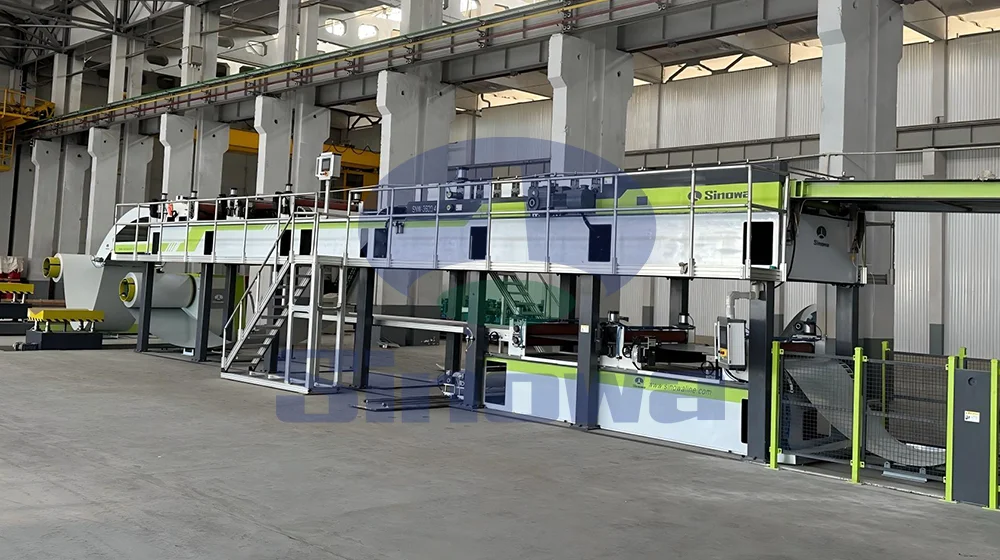
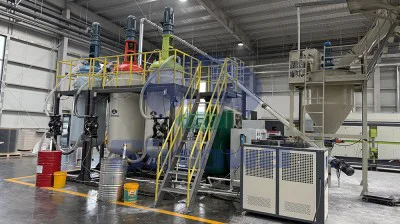
The core material feeding unit is responsible for conveying the core material to the middle of the two outer facing layers, and ensuring that the core material is evenly distributed and closely combined with the facing layers. The structure of this unit varies according to the type of core material. For loose core materials such as rock wool and glass wool, the feeding unit is usually composed of a feeding hopper, a conveying belt and a spreading device. The core material is put into the feeding hopper first, then conveyed to the spreading device by the conveying belt, and evenly spread between the two facing layers by the spreading device. For foaming core materials such as polyurethane (PU) and polyisocyanurate (PIR), the feeding unit is mainly a high-pressure foaming system, which can mix the two-component raw materials of the core material in a certain proportion and inject them evenly between the two facing layers. The foaming system is equipped with a metering pump and a mixing head, which can accurately control the ratio and injection amount of the raw materials, ensuring the uniformity and density of the foamed core material. In addition, some core material feeding units are also equipped with a compaction device, which can compact the core material appropriately to improve the bonding strength between the core material and the facing layers and enhance the overall performance of the sandwich panels.
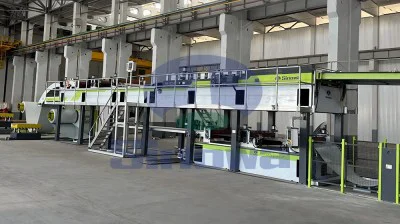
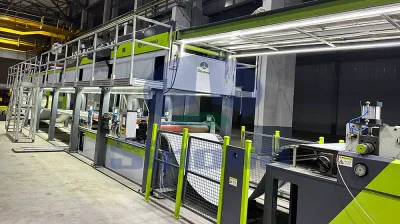
The laminating unit is used to bond the two outer facing layers and the middle core layer tightly together to form an integral sandwich panel. This unit mainly consists of a double-belt conveyor, a heating system and a pressure system. The double-belt conveyor is composed of an upper and a lower conveyor belt, which can clamp the composite material (two facing layers and core material) and convey it forward at a constant speed. The heating system is installed inside the double-belt conveyor, which can heat the composite material to the curing temperature required for bonding, so as to promote the bonding between the facing layers and the core material. The heating method can be electric heating, hot air heating or steam heating, and the heating temperature can be adjusted according to the type of bonding agent and core material. The pressure system is used to apply a certain pressure to the composite material during the conveying process, which ensures that the facing layers and the core material are closely bonded without gaps, and improves the flatness and strength of the sandwich panels. The pressure of the pressure system can be adjusted according to the thickness and type of the sandwich panels, so as to meet the production requirements of different products.
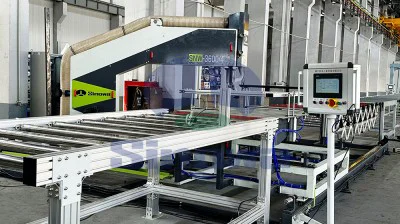
The cutting unit is used to cut the continuous sandwich panel produced by the laminating unit into finished products of the required length. This unit mainly consists of a cutting machine, a positioning device and a dust removal device. The cutting machine can be a circular saw, a band saw or a hydraulic shear, and its cutting speed and cutting accuracy are important indicators affecting the quality of the finished products. The positioning device can accurately control the cutting length of the sandwich panel, ensuring that the length error of the finished products is within the allowable range. The dust removal device is used to collect the dust and debris generated during the cutting process, which not only keeps the production environment clean, but also protects the health of the operators. Some advanced cutting units are equipped with an automatic tracking cutting function, which can realize non-stop cutting during the production process, greatly improving the production efficiency.
The conveying unit is responsible for conveying the materials between each functional unit and conveying the finished sandwich panels to the stacking area. This unit mainly consists of a series of conveying rollers and conveying belts, which are arranged according to the layout of the production line. The conveying speed of the conveying unit is consistent with the production speed of other units, ensuring the continuity and stability of the production process. The conveying rollers and conveying belts are made of wear-resistant materials, which have a long service life. In addition, the conveying unit is also equipped with a guiding device, which can prevent the materials from deviating during the conveying process.
The electrical control unit is the "brain" of the sandwich panel making machine, which is used to control the operation of all functional units and ensure the coordinated work of the entire production line. This unit mainly consists of a programmable logic controller (PLC), a human-machine interface (HMI), a frequency converter, a sensor and other electrical components. The PLC is the core of the control system, which can receive signals from various sensors, process them according to the preset program, and send control signals to each functional unit to realize the automatic control of the production process. The HMI is a man-machine interaction interface, through which operators can set production parameters (such as production speed, cutting length, heating temperature, etc.), monitor the operation status of the machine, and handle faults in a timely manner. The frequency converter is used to adjust the speed of the motor, so as to realize the stepless adjustment of the production speed, which enhances the flexibility of the machine. The sensor is used to detect various parameters during the production process (such as the thickness of the sandwich panel, the temperature of the heating system, the position of the material, etc.), and feed back the detection results to the PLC, so that the PLC can make real-time adjustments to ensure the stability of the production process and the quality of the products.
The performance of a sandwich panel making machine directly affects the quality of the sandwich panels and the efficiency of the production process. Therefore, excellent performance is an important guarantee for the wide application of these machines. The main performance indicators of sandwich panel making machines include production efficiency, product quality stability, adaptability, energy saving and environmental protection, and operation reliability.
Production efficiency is one of the most important performance indicators of sandwich panel making machines, which is usually expressed by the hourly output of the machine. The production efficiency of modern sandwich panel making machines has been greatly improved due to the adoption of advanced automation technology and continuous production mode. The hourly output can reach tens to hundreds of square meters, which can meet the needs of large-scale mass production. The production efficiency of the machine is closely related to its structure design, automation level and production speed. For example, the adoption of non-stop cutting technology and automatic coil changing technology can effectively reduce the downtime of the machine and improve the production efficiency. In addition, the optimization of the production process (such as the integration of forming, laminating and cutting processes) can also shorten the production cycle and improve the production efficiency.
Product quality stability is another important performance indicator of sandwich panel making machines. It refers to the ability of the machine to produce sandwich panels that meet the preset quality standards stably for a long time. The quality of sandwich panels mainly includes dimensional accuracy (such as length, width, thickness, flatness, etc.), bonding strength, core material density, surface quality and other indicators. Excellent sandwich panel making machines can ensure that these indicators are within the allowable error range through precise control of the production process. For example, the use of high-precision forming rollers and positioning devices can ensure the dimensional accuracy of the sandwich panels; the use of a high-precision metering pump and mixing head can ensure the uniformity and density of the foamed core material; the use of a stable heating system and pressure system can ensure the bonding strength between the facing layers and the core material. In addition, the machine is equipped with a variety of detection devices, which can detect the quality of the products in real time during the production process, and automatically adjust or stop the machine when unqualified products are found, so as to ensure the stability of the product quality.
Adaptability refers to the ability of the sandwich panel making machine to produce different types, specifications and sizes of sandwich panels by adjusting relevant parameters. With the increasing diversification of market demand for sandwich panels, the adaptability of the machine has become more and more important. Modern sandwich panel making machines have strong adaptability, which can produce sandwich panels with different facing materials (such as steel plates, aluminum plates, fiberboards, etc.), different core materials (such as rock wool, glass wool, PU, PIR, EPS, etc.), different thicknesses (usually 20mm to 300mm) and different widths (usually 1200mm to 1500mm). Operators only need to adjust the parameters of the relevant units (such as the distance between the forming rollers, the injection amount of the core material, the cutting length, etc.) through the HMI to produce sandwich panels that meet the customer's requirements. This not only reduces the investment cost of enterprises in equipment, but also improves the market competitiveness of enterprises.
Energy saving and environmental protection is an important development trend of modern mechanical equipment, and sandwich panel making machines are no exception. Excellent sandwich panel making machines adopt a variety of energy-saving technologies to reduce energy consumption during the operation process. For example, the use of frequency conversion speed regulation technology can adjust the motor speed according to the production load, avoiding the waste of energy caused by the motor running at a constant speed; the use of efficient insulation materials in the heating system can reduce heat loss, improve heating efficiency, and save energy. In addition, the machine is also equipped with environmental protection devices (such as dust removal devices, waste gas treatment devices, etc.) to reduce the impact on the environment during the production process. For example, the dust removal device can collect the dust generated during the cutting process, preventing it from polluting the air; the waste gas treatment device can treat the harmful gases generated during the foaming process, making them meet the national environmental protection standards before emission. These energy-saving and environmental protection measures not only reduce the production cost of enterprises, but also conform to the concept of sustainable development.
Operation reliability refers to the ability of the sandwich panel making machine to operate stably for a long time without failure under normal working conditions. The operation reliability of the machine is closely related to its structure design, the quality of components and the level of maintenance. Modern sandwich panel making machines adopt a reasonable structure design, which reduces the stress concentration of components and improves the stability of the machine. At the same time, the machine uses high-quality components (such as high-quality motors, bearings, sensors, etc.), which have a long service life and high reliability. In addition, the machine is equipped with a complete fault diagnosis system, which can detect the faults of the machine in real time during the operation process, and display the fault information on the HMI, so that operators can find and handle the faults in a timely manner, reducing the downtime of the machine. The operation reliability of the machine is an important guarantee for the continuous and stable production of enterprises, which can reduce the maintenance cost of enterprises and improve the economic benefits.
Due to the different market demands and production conditions, sandwich panel making machines have a variety of types, which can be divided into different categories according to different classification standards. The common classification standards include the type of core material, the degree of automation, the production mode, the type of facing material and the application field.
According to the type of core material, sandwich panel making machines can be divided into rock wool sandwich panel making machines, glass wool sandwich panel making machines, PU sandwich panel making machines, PIR sandwich panel making machines, EPS sandwich panel making machines and other types. Rock wool sandwich panel making machines are mainly used to produce sandwich panels with rock wool as the core material. This type of machine is equipped with a special rock wool feeding unit, which can evenly spread the rock wool between the two facing layers and compact it appropriately. Rock wool sandwich panels have excellent fire resistance, heat insulation and sound insulation performance, and are widely used in building exterior walls, roofs and other fields. Glass wool sandwich panel making machines are similar to rock wool sandwich panel making machines, but they are mainly used to produce sandwich panels with glass wool as the core material. Glass wool has the advantages of light weight, good heat insulation and sound absorption performance, and is suitable for the production of sandwich panels used in interior decoration and industrial pipelines. PU sandwich panel making machines are equipped with a high-pressure foaming system, which can mix the two-component raw materials of PU and inject them between the two facing layers to form a foamed core material. PU sandwich panels have excellent heat insulation, waterproof and shock absorption performance, and are widely used in cold storage, vehicles, ships and other fields. PIR sandwich panel making machines are an improved type of PU sandwich panel making machines. PIR core material has better fire resistance and heat insulation performance than PU core material, so PIR sandwich panels are more suitable for high-temperature and fire-proof occasions. EPS sandwich panel making machines are used to produce sandwich panels with EPS (expanded polystyrene) as the core material. EPS core material has the advantages of light weight, low thermal conductivity and low cost, and is widely used in building walls, roofs and other fields.
According to the degree of automation, sandwich panel making machines can be divided into manual sandwich panel making machines, semi-automatic sandwich panel making machines and fully automatic sandwich panel making machines. Manual sandwich panel making machines have a simple structure, low cost, but low production efficiency, and most of the production processes need to be completed manually. This type of machine is suitable for small-scale production or small enterprises with limited funds. Semi-automatic sandwich panel making machines realize the automation of some production processes (such as uncoiling, forming, laminating, etc.), but some processes (such as feeding core material, cutting, stacking, etc.) still need manual operation. This type of machine has moderate production efficiency and cost, and is suitable for medium-scale production enterprises. Fully automatic sandwich panel making machines realize the automation of the entire production process from uncoiling, forming, core material feeding, laminating, cutting to stacking. The machine is controlled by PLC and HMI, and operators only need to set production parameters and monitor the operation status of the machine. This type of machine has high production efficiency, stable product quality and low labor intensity, and is suitable for large-scale mass production enterprises. Fully automatic sandwich panel making machines are usually equipped with advanced technologies such as automatic coil changing, non-stop cutting and automatic stacking, which further improve the production efficiency and automation level.
According to the production mode, sandwich panel making machines can be divided into continuous sandwich panel making machines and intermittent sandwich panel making machines. Continuous sandwich panel making machines adopt a continuous production mode, which can produce sandwich panels continuously without stopping the machine. This type of machine has high production efficiency, stable product quality and is suitable for large-scale mass production. Continuous sandwich panel making machines are usually used to produce sandwich panels with foaming core materials (such as PU, PIR) and some loose core materials (such as rock wool, glass wool) that can be continuously fed. Intermittent sandwich panel making machines adopt an intermittent production mode, which needs to stop the machine after completing a batch of production, and then start the machine again to produce the next batch. This type of machine has low production efficiency, but strong flexibility, and is suitable for small-batch, multi-variety production. Intermittent sandwich panel making machines are usually used to produce special-shaped sandwich panels or sandwich panels with special core materials.
According to the type of facing material, sandwich panel making machines can be divided into metal facing sandwich panel making machines, non-metal facing sandwich panel making machines and composite facing sandwich panel making machines. Metal facing sandwich panel making machines are mainly used to produce sandwich panels with metal materials (such as steel plates, aluminum plates, zinc-aluminum alloy plates, etc.) as the outer facing layers. This type of machine is equipped with a special roll forming unit for metal materials, which can form the metal facing layers into the required shape. Metal facing sandwich panels have the advantages of high strength, good durability and beautiful appearance, and are widely used in building exterior walls, roofs, workshops and other fields. Non-metal facing sandwich panel making machines are used to produce sandwich panels with non-metal materials (such as fiberboards, cement boards, plastic boards, etc.) as the outer facing layers. This type of machine has a relatively simple structure, and the forming process of the facing layers is relatively easy. Non-metal facing sandwich panels have the advantages of light weight, good corrosion resistance and low cost, and are suitable for interior decoration, light-weight buildings and other fields. Composite facing sandwich panel making machines are used to produce sandwich panels with composite materials (such as metal and non-metal composite materials) as the outer facing layers. This type of machine can realize the combination of different facing materials, making the sandwich panels have the advantages of multiple materials at the same time, and expanding the application range of the sandwich panels.
According to the application field, sandwich panel making machines can be divided into building-oriented sandwich panel making machines, transportation-oriented sandwich panel making machines, industrial-oriented sandwich panel making machines and other types. Building-oriented sandwich panel making machines are the most widely used type of sandwich panel making machines, which are mainly used to produce sandwich panels for building exterior walls, roofs, interior partitions, floors and other parts. These sandwich panels usually have good heat insulation, sound insulation, fire resistance and waterproof performance, and can meet the requirements of building energy saving and safety. Transportation-oriented sandwich panel making machines are used to produce sandwich panels for vehicles (such as cars, trains, ships, etc.). These sandwich panels usually have the advantages of light weight, high strength, shock absorption and sound insulation, which can reduce the weight of the vehicle, improve the fuel efficiency and comfort of the vehicle. Industrial-oriented sandwich panel making machines are used to produce sandwich panels for industrial workshops, warehouses, cold storage, pipelines and other industrial facilities. These sandwich panels usually have good corrosion resistance, high temperature resistance, low temperature resistance and other performance, and can adapt to the harsh industrial environment.
Sandwich panel making machines have a wide range of applications, which are closely related to the excellent performance of sandwich panels produced by them. With the continuous development of various industries, the application fields of sandwich panel making machines are constantly expanding, and they have become an important part of modern manufacturing industry.
The construction industry is the largest application field of sandwich panel making machines. In the construction industry, sandwich panels produced by these machines are widely used in building exterior walls, roofs, interior partitions, floors, prefabricated houses and other parts. In building exterior walls, sandwich panels have excellent heat insulation and sound insulation performance, which can reduce the energy consumption of buildings and improve the living comfort. At the same time, sandwich panels have the advantages of light weight, high strength and fast construction speed, which can shorten the construction period and reduce the construction cost. In building roofs, sandwich panels have good waterproof and anti-wind performance, which can ensure the durability of the roof. In interior partitions, sandwich panels have the advantages of light weight, good sound insulation and easy installation, which can improve the space utilization rate and living comfort. Prefabricated houses made of sandwich panels have the advantages of fast assembly, easy disassembly and reusability, and are widely used in temporary buildings (such as construction site dormitories, temporary offices), disaster relief houses and mobile houses. With the promotion of building energy saving policies and the development of prefabricated buildings, the demand for sandwich panel making machines in the construction industry is increasing day by day.
The transportation industry is another important application field of sandwich panel making machines. In the transportation industry, sandwich panels are widely used in the manufacturing of cars, trains, ships, aircraft and other vehicles. In the automobile manufacturing industry, sandwich panels are used to produce automobile bodies, doors, roofs and other components. Due to the light weight and high strength of sandwich panels, they can reduce the weight of the automobile, improve the fuel efficiency and reduce exhaust emissions. At the same time, sandwich panels have good shock absorption and sound insulation performance, which can improve the comfort of the automobile. In the train manufacturing industry, sandwich panels are used to produce train carriages, interior decorations and other components. Sandwich panels have good fire resistance and sound insulation performance, which can ensure the safety and comfort of passengers. In the ship manufacturing industry, sandwich panels are used to produce ship hulls, cabins, interior decorations and other components. Sandwich panels have good corrosion resistance and waterproof performance, which can adapt to the marine environment. In the aircraft manufacturing industry, sandwich panels are used to produce aircraft interiors and other components. Sandwich panels have the advantages of light weight and high strength, which can reduce the weight of the aircraft and improve the flight efficiency. With the development of the transportation industry towards lightweight, energy-saving and environmental protection, the demand for sandwich panel making machines in this industry is also increasing.
The industrial field is also an important application field of sandwich panel making machines. In the industrial field, sandwich panels are widely used in industrial workshops, warehouses, cold storage, pipelines, electronic clean rooms and other industrial facilities. In industrial workshops and warehouses, sandwich panels have good corrosion resistance, high temperature resistance and fire resistance, which can adapt to the harsh industrial environment and protect the equipment and goods in the workshop and warehouse. In cold storage, sandwich panels have excellent heat insulation and low temperature resistance, which can maintain the low temperature environment in the cold storage and reduce the energy consumption of the cold storage. In pipelines, sandwich panels are used as thermal insulation layers, which can reduce heat loss and improve the efficiency of pipeline transportation. In electronic clean rooms, sandwich panels have good dustproof, antibacterial and sound insulation performance, which can ensure the cleanliness and stability of the clean room environment, meeting the production requirements of electronic products. With the development of the industrial economy, the demand for sandwich panel making machines in the industrial field is also growing.
In addition to the above fields, sandwich panel making machines also have a wide range of applications in other fields, such as the decoration industry, the agricultural industry and the medical industry. In the decoration industry, sandwich panels are used for interior decoration, ceiling decoration, wall decoration and other parts. Sandwich panels have the advantages of beautiful appearance, easy processing and diverse styles, which can meet the personalized decoration needs of customers. In the agricultural industry, sandwich panels are used to build greenhouses, livestock houses and other agricultural facilities. Sandwich panels have good heat insulation and waterproof performance, which can provide a suitable growth environment for crops and livestock. In the medical industry, sandwich panels are used to build medical clean rooms, operating rooms and other medical facilities. Sandwich panels have good dustproof, antibacterial and corrosion resistance, which can ensure the cleanliness and safety of the medical environment. With the continuous progress of science and technology and the continuous expansion of market demand, the application fields of sandwich panel making machines will be further expanded.
In conclusion, sandwich panel making machines are important specialized equipment in modern manufacturing industry, with a reasonable structure, excellent performance, diverse types and extensive applications. The structure of these machines is composed of multiple functional components that coordinate with each other to realize the continuous and automated production of sandwich panels. The excellent performance of the machines (such as high production efficiency, stable product quality, strong adaptability, energy saving and environmental protection, and high operation reliability) ensures the quality and efficiency of sandwich panel production. The diverse types of machines can meet the production needs of different core materials, facing materials, production scales and application fields. The extensive applications of the machines in the construction, transportation, industrial and other fields have promoted the development of these industries and brought considerable economic and social benefits. With the continuous progress of science and technology and the continuous change of market demand, sandwich panel making machines will develop towards higher automation, intelligence, energy saving and environmental protection, and their application fields will be further expanded, making greater contributions to the development of modern manufacturing industry.
« Sandwich Panel Making Machine » Update Date: 2026/2/24
URL: https://www.sinowamachine.com/tags/sandwich-panel-making-machine.html
![Sandwich Panel Making Machine Supplier]()
Sandwich Panel Making Machine Supplier
2026-09-03Sandwich panel making machines have emerged as core automated production equipment in the modern building material manufacturing industry, serving as the key equipment for producing high-performance composite sandwich panels widely used in construction, insulation, and industrial enclosure fields. Th…![Fully Automatic Sandwich Panel Making Machine Manufacturer]()
Fully Automatic Sandwich Panel Making Machine Manufacturer
2026-09-01Fully automatic sandwich panel making machines have emerged as core intelligent production equipment for the modern composite building material industry, driving the standardized, efficient, and streamlined manufacturing of insulated sandwich panels. This integrated production system combines mechani…![Sandwich Panel Making Machine Manufacturer]()
Sandwich Panel Making Machine Manufacturer
2026-08-31Sandwich panel making machines are advanced integrated industrial production systems tailored for the automated manufacturing of composite sandwich panels, which have become core building materials for modern lightweight, energy-efficient, and modular construction projects. This multifunctional equip…![Sandwich Panel Making Machine For Sale]()
Sandwich Panel Making Machine For Sale
2026-08-26Sandwich panel making machines have emerged as essential automated production equipment in the modern composite building material industry, dedicated to the continuous and efficient manufacturing of high-performance sandwich panels. These integrated production systems combine mechanical transmission,…![PU Sandwich Panel Making Machine Manufacturer]()
PU Sandwich Panel Making Machine Manufacturer
2026-08-21PU sandwich panel making machines are core integrated production equipment dedicated to the manufacturing of polyurethane composite sandwich panels, serving as a foundational technological pillar for the modern building insulation and industrial composite material industries. This automated productio…![PU Sandwich Panel Making Machine For Cold Storage]()
PU Sandwich Panel Making Machine For Cold Storage
2026-08-17PU sandwich panel making machines are specialized automated production systems designed exclusively for manufacturing high-performance insulation panels tailored to cold storage infrastructure. As the core production equipment for cold storage thermal insulation materials, this integrated machinery s…![PU Sandwich Panel Making Machine Supplier]()
PU Sandwich Panel Making Machine Supplier
2026-08-13PU sandwich panel making machines have emerged as core automated production equipment in the modern building material manufacturing industry, dedicated to the continuous and efficient production of polyurethane composite sandwich panels that integrate thermal insulation, waterproofing, and structural…![High-tech Fully Automatic Sandwich Panel Making Machine]()
High-tech Fully Automatic Sandwich Panel Making Machine
2026-08-12The high-tech fully automatic sandwich panel making machine stands as a cutting-edge integrated production solution tailored for the efficient manufacturing of composite sandwich panels, widely applied in construction insulation, industrial plant enclosure, cold chain storage, and lightweight buildin…![Fully Automatic Sandwich Panel Making Machine]()
Fully Automatic Sandwich Panel Making Machine
2026-04-13A fully automatic sandwich panel making machine is an advanced piece of equipment designed for the mass production of sandwich panels, which are widely used in various industries due to their excellent combination of structural strength, thermal insulation, soundproofing, and lightweight properties. …![PU Sandwich Panel Making Machine]()
PU Sandwich Panel Making Machine
2026-01-24Polyurethane (PU) sandwich panel making machines are sophisticated pieces of equipment designed for the mass production of composite panels consisting of a PU foam core bonded between two facing materials, typically metal sheets such as steel or aluminum. These machines integrate multiple mechanical,…![High-end PU Sandwich Panel Making Machine]()
High-end PU Sandwich Panel Making Machine
2026-01-12In the evolving landscape of modern construction and industrial manufacturing, the demand for efficient, high-performance building materials has driven significant advancements in production technology. Among these innovations, the high-end PU sandwich panel making machine stands out as a cornerstone…
- Links:
- Sandwich Panel Continuous Production Line
- Automatic and Continuous Sandwich Panel Production Line
- Cheap and Low Price Sandwich Panel Production Line
- China Sandwich Panel Production Line Factory
- Color Steel Sandwich Panel Production Line For Cold Storage
- Continuous Composite Foam Sandwich Panel Production Line
- Continuous Production Line For Rockwool and Mineral Wool Sandwich Panels
- Continuous PU Phenolic Insulation Panel Production Line
- Continuous PU PIR Sandwich Panel Production Line
- Continuous PUF PUR Sandwich Panel Production Line
- Continuous Sandwich Panel Production Line For Roof and Wall
- Customized and Design Sandwich Panel Production Line
- Decorative Sandwich Panel Production Line For Glass Wool Boards
- High Quality Sandwich Panel Production Line For Sale
- Polyurethane(PU) Sandwich Panel Production Line
- Sandwich Panel Production Line Manufacturer and Supplier
- Sandwich Panel Production Machinery and Equipment