
Mineral Wool External Wall Insulation Panel Production Line
Sinowa is a mineral wool external wall insulation panel production line supplier from china, customized high-quality & high efficiency mineral wool external wall insulation panel production line at low price, the adoption of system integration technology and bus control technology accomplishes the full automatization of integrated and coordinated control of the mineral wool external wall insulation panel production line with accessible remote interactive communication. Ranking the first-class level in the world, it is currently the mineral wool external wall insulation panel production line in the market taking a comprehensive lead in high performance.
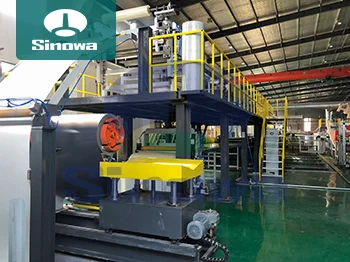
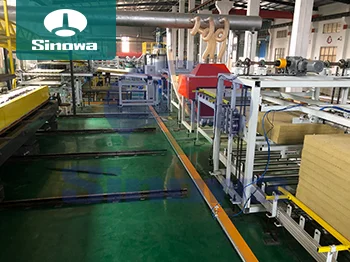
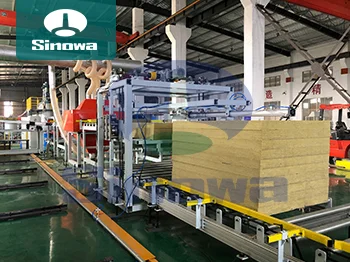
The high-tech mineral wool external wall insulation panel production line can meet a variety of production needs of customers, the whole mineral wool external wall insulation panel production line design concept of modularization enables all our components to be integrated and combined at will. Our high efficiency mineral wool external wall insulation panel production line can easily automate the production of roof sandwich panel, wall sandwich panel, cold storage sandwich panel and other products by different combination and configuration selection and siple switching. The inner core layer can be polyrethane or rock wool, glass wool, an so on. The precision servo hoisting mechanism employed by the main engine without hydraulic system makes the board thickness control flexible and the customer may conveniently change or adjust the board thickness. There will be not such troubles as hydraulic system adjustment, leakage, maintenance, etc.
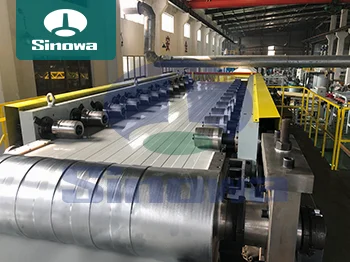
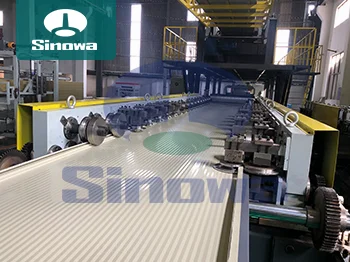
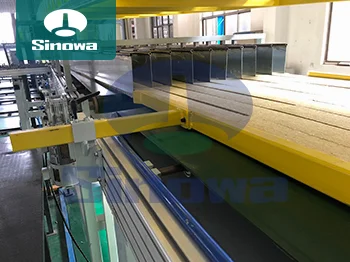
The high precision mineral wool external wall insulation panel production line has high adaptability, which may produce various sandwich panel of the PU, PIR and rock wool systems. We may design various products according to the customer’s requirements, including various configurations, so as to meet their demands with flexible price system. Highly integrated and linked control system centralizes all control points at the main central center, achieving parameter linkage, fault self-diagnosis controlled by the whole line and shipping distance control. High-level automatic control system also saves the manpower and reduces the manpower loss for customers. High-level energy saving and protection design makes the whole mineral wool external wall insulation panel production line possible to produce around the clock throughout the year and the customer will save huge budget. In addition, the isolated heat preservation room is constructed for warming the environment. The energy saving and protection design of our manufacturing line may guarantee that the customer’s production line may be freely heated and produce in the main time to save more costs for customers.
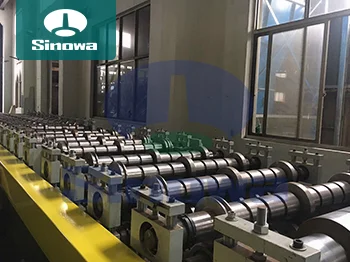
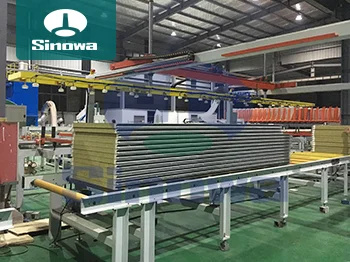
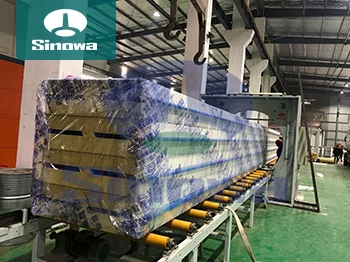
The high-power low-consumption design quickens the reaction of the cheap mineral wool external wall insulation panel production line while energy consumption is kept low. With the brand-new, fully sealed inner insulation design, the energy consumption is controlled at the minimum level to achieve the design objective of less than an hour for the insulation system to be activated from the room temperature above 5℃ to the production process temperature. The energy consumption is only 40% that of those similar products.
The advancement of modern architectural construction has continuously raised demands for building envelope materials, especially for external wall components that undertake thermal regulation, structural protection, and environmental adaptation tasks. Mineral wool external wall insulation panels have gradually become one of the most widely applied building materials in the construction industry due to their stable physical properties, excellent thermal resistance, and adaptable structural composition. The production line dedicated to manufacturing these panels integrates raw material processing, high-temperature treatment, fiber forming, structural shaping, and post-processing procedures, forming a continuous and systematic manufacturing system that balances production efficiency and product performance. Every operational link in the production line is designed to optimize the internal structure of mineral wool materials, ensuring that finished panels can steadily adapt to complex external wall service environments and meet the long-term usage requirements of modern buildings.
Raw material preparation constitutes the initial and foundational stage of the entire production workflow, determining the basic texture and intrinsic performance of finished mineral wool panels. The primary raw materials adopted in the production process are natural igneous rocks and industrial mineral by-products, which are selected based on their stable chemical composition and inorganic inherent properties. Before entering the melting procedure, these bulk raw materials undergo rigorous screening and crushing treatment to eliminate impurity particles with inconsistent particle sizes and foreign substances that may affect material stability. The processed raw materials are transported through automated conveying equipment to storage silos, where constant humidity and dry environment are maintained to prevent moisture from interfering with subsequent high-temperature melting reactions. Auxiliary raw materials, including inorganic bonding additives and functional conditioning agents, are proportioned quantitatively according to fixed material ratios. These auxiliary substances do not contain organic components that are prone to aging or decomposition, effectively enhancing the internal cohesion of mineral fibers and improving the overall structural compactness of panels without weakening the inherent environmental adaptability of mineral wool.
High-temperature melting is a core procedure that converts solid raw materials into flowable molten materials, laying the structural foundation for fiber formation. The uniformly mixed raw materials are continuously fed into melting equipment, where the internal temperature is controlled within a stable high-temperature range to achieve thorough melting of mineral raw materials. During the melting process, the internal stirring structure of the equipment maintains a constant circulating motion to ensure uniform heat distribution in the molten liquid, avoiding local solidification or inconsistent viscosity caused by uneven temperature. The molten mineral liquid flows out through specially designed flow channels, and the flow rate is precisely regulated by mechanical control structures to maintain stable liquid output pressure. This controlled outflow mode prevents turbulence and impurity mixing in the molten liquid, ensuring that the subsequent formed fibers have uniform thickness and consistent material characteristics. The entire melting process operates in an isolated closed space, which not only reduces heat loss and improves energy utilization efficiency but also avoids external dust and air pollutants from contaminating the molten materials.
Fiberization treatment transforms the high-temperature molten liquid into fine mineral fibers, which is the key step to endow panels with thermal insulation performance. The molten liquid drops fall evenly on high-speed rotating roller sets inside the fiberization equipment. Under the action of powerful centrifugal force generated by the rotating rollers, the viscous molten liquid is stretched and split into ultra-fine fibrous structures with uniform diameter. Surrounding the roller sets, annular air blowing components continuously output stable airflow, which rapidly cools the newly formed high-temperature fibers and fixes the slender fibrous shape. The airflow speed and direction are precisely adjusted to avoid fiber entanglement and breakage, ensuring that individual fibers maintain an independent and smooth structural state. In this process, the internal molecular structure of mineral materials undergoes stable reorganization, forming inorganic fibers with low thermal conductivity and high tensile resistance. These disorderly distributed fibers lay the porous internal structure foundation of mineral wool panels, enabling the finished products to trap static air inside the gaps and thus achieve efficient thermal insulation effect.
Fiber collection and paving procedures gather scattered mineral fibers into continuous fiber blankets to complete preliminary structural molding. The cooled mineral fibers are driven by airflow to enter the collection area, where layered mesh conveyor belts operate at a stable constant speed to capture dispersed fibers. The stacking density and thickness of fiber layers are regulated by adjusting the operating speed of conveyor belts and fiber feeding volume, realizing flexible setting of panel specifications. During the paving process, mechanical swinging structures distribute fibers in a cross-staggered manner, breaking the directional consistency of single-layer fibers and forming a three-dimensional interwoven fiber network. This interwoven structure effectively enhances the overall structural toughness of fiber blankets, preventing layered peeling and deformation in subsequent processing and usage. Fine dust generated during fiber collection is filtered and recycled by circulating air purification structures, which not only optimizes the production environment but also improves the comprehensive utilization rate of raw materials.
Curing and thermoforming are critical links to stabilize the internal structure of fiber blankets and shape finished panels. The loose fiber blankets are sent to constant-temperature curing equipment, where moderate temperature and pressure act on the blankets simultaneously. The auxiliary bonding components added in the early stage undergo mild chemical reaction under constant temperature, producing stable adhesive force to bond interlaced mineral fibers tightly into an integrated structure. The internal temperature gradient of the curing equipment is scientifically distributed, forming a gradual temperature change from the surface to the core of the fiber blanket. This temperature distribution mode enables rapid compacting molding on the panel surface while avoiding micro-cracks inside the panel caused by sudden moisture evaporation. The pressure system maintains uniform vertical pressure to ensure consistent density of each part of the panel, eliminating hollow areas and uneven thickness. After curing, the preliminary molded panels have fixed external shapes and stable internal structures, with significantly improved compression resistance and structural firmness.
Precision cutting and surface finishing process molded semi-finished products into standard external wall insulation panels. Continuous conveying equipment transports cured panels to the cutting area, where intelligent positioning systems accurately identify panel dimensions and automatically correct feeding deviations. Multi-group cutting tools conduct fixed-length cutting and edge trimming according to preset dimensional parameters, removing irregular edges and excess raw material parts. The cutting speed matches the continuous conveying speed of the production line to ensure flat and smooth cutting sections without burrs or fiber shedding. In the surface finishing stage, rolling and polishing structures perform gentle smoothing treatment on the panel surface to eliminate protruding fibers and uneven areas. For external wall use, some panels undergo surface anti-seepage treatment, where inorganic protective coatings are evenly covered on the panel surface through rolling coating technology. This treatment enhances the weather resistance of panels, effectively resisting moisture erosion and dust accumulation in external environments.
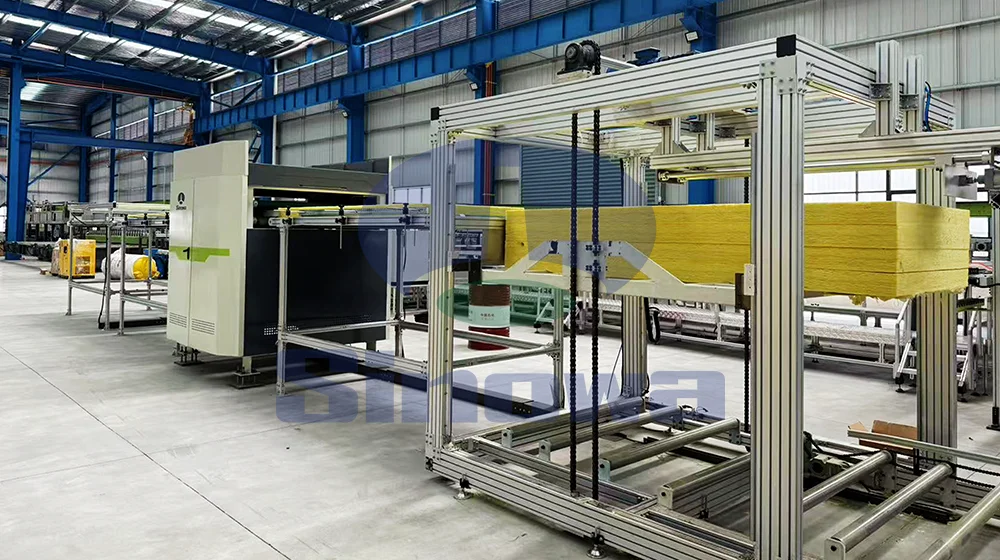
Inspection and stacking constitute the final stage of the production line, ensuring that all delivered panels meet usage standards. Automated detection devices are installed at the end of the production line to conduct non-destructive testing on finished panels, covering dimensional accuracy, surface flatness, internal density uniformity, and structural integrity. The detection system automatically screens out defective products with cracks, depressions, and uneven thickness, and independently collects unqualified products for subsequent reprocessing. Qualified panels are transported to the stacking area by mechanical arms, which arrange panels in an orderly manner according to standardized stacking modes. The stacking height and spacing are scientifically controlled to avoid extrusion deformation of panels. Meanwhile, breathable isolation structures are placed between stacked panels to prevent moisture accumulation during storage. The entire inspection and stacking process realizes automated operation, reducing manual detection errors and improving the consistency of finished product quality.
The overall structural design of the mineral wool external wall insulation panel production line takes continuous and intelligent production as the core concept. All processing units are connected by automated conveying systems to form an integrated closed-loop production chain, minimizing manual intervention links. The power consumption of each equipment unit is dynamically adjusted according to production load, realizing reasonable energy distribution and reducing ineffective energy consumption. The production line is equipped with independent dust removal and waste material recycling systems, which collect fiber dust and leftover materials generated during the production process. The recycled raw materials are re-crushed and sent back to the raw material processing link to complete cyclic utilization, reducing raw material waste and lowering resource consumption. In terms of operational control, a centralized intelligent control platform monitors the operating parameters of each equipment in real time, including melting temperature, conveying speed, curing pressure, and cutting dimensions. Once abnormal data fluctuations occur, the system automatically triggers adjustment instructions to ensure stable and consistent production conditions throughout the entire process.
The unique production technology of the production line endows mineral wool external wall insulation panels with superior comprehensive performance. The inorganic mineral raw materials and high-temperature fiberization process make the panels have excellent temperature resistance, maintaining stable structural performance in long-term high-temperature and low-temperature alternating environments. The porous interwoven fiber structure forms a large number of static air gaps inside the panels, effectively blocking heat conduction and reducing the heat exchange efficiency between the building interior and the external environment. After curing and compacting treatment, the panels have high structural density and compression resistance, which can resist external extrusion and vibration during building construction and long-term use. In addition, the panels have good moisture resistance and breathability, which can avoid internal moisture accumulation and mildew growth while preventing external rainwater from penetrating into the wall. These performance characteristics make mineral wool panels suitable for various climatic environments and different types of building external walls.
In practical architectural application scenarios, mineral wool external wall insulation panels produced by this production line adapt to diverse construction requirements. They can be applied to the external wall thermal insulation transformation of residential buildings, effectively reducing the energy consumption of building heating and cooling systems and improving indoor living comfort. In commercial public buildings with large wall areas, the stable structural performance of the panels can cope with long-term wind and rain erosion in outdoor environments, extending the service life of building exterior decoration. For industrial buildings with special environmental requirements, the inorganic material characteristics of the panels can avoid structural aging and performance degradation caused by chemical corrosion. With the continuous improvement of building energy-saving standards, the market demand for high-performance external wall insulation materials keeps increasing, which promotes the continuous optimization and upgrading of production line technology.
The optimization direction of mineral wool external wall insulation panel production lines mainly focuses on production efficiency, product performance, and environmental protection level. In terms of production efficiency, the upgrading of transmission structures and intelligent control systems further shortens the processing cycle of a single panel, realizing high-speed continuous production while ensuring product stability. In terms of product performance, by adjusting raw material blending ratios and curing process parameters, the thermal insulation efficiency and tensile strength of panels are continuously improved to adapt to harsher external service environments. In terms of environmental protection optimization, the production line strengthens waste gas and waste residue treatment technology, reduces pollutant emissions in the production process, and realizes cleaner production. In the future, with the deepening of building energy conservation concepts and the innovation of industrial manufacturing technology, this type of production line will develop towards higher intelligence, lower energy consumption, and stronger customization capability, providing more reliable material support for the sustainable development of the construction industry.
« Mineral Wool External Wall Insulation Panel Production Line » Update Date: 2026/5/8
URL: https://www.sinowamachine.com/tags/mineral-wool-external-wall-insulation-panel-production-line.html
- Links:
- Sandwich Panel Continuous Production Line
- Automatic and Continuous Sandwich Panel Production Line
- Cheap and Low Price Sandwich Panel Production Line
- China Sandwich Panel Production Line Factory
- Color Steel Sandwich Panel Production Line For Cold Storage
- Continuous Composite Foam Sandwich Panel Production Line
- Continuous Production Line For Rockwool and Mineral Wool Sandwich Panels
- Continuous PU Phenolic Insulation Panel Production Line
- Continuous PU PIR Sandwich Panel Production Line
- Continuous PUF PUR Sandwich Panel Production Line
- Continuous Sandwich Panel Production Line For Roof and Wall
- Customized and Design Sandwich Panel Production Line
- Decorative Sandwich Panel Production Line For Glass Wool Boards
- High Quality Sandwich Panel Production Line For Sale
- Polyurethane(PU) Sandwich Panel Production Line
- Sandwich Panel Production Line Manufacturer and Supplier
- Sandwich Panel Production Machinery and Equipment