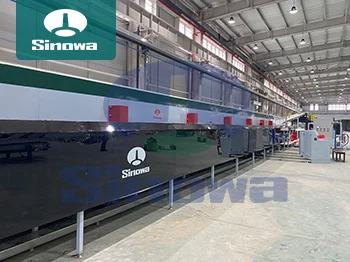
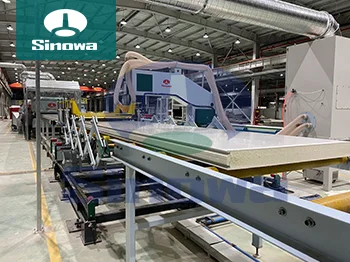
Sinowa is a decorative pu sandwich panel production line supplier from china, customized high-quality & high efficiency decorative pu sandwich panel production line at low price, the adoption of system integration technology and bus control technology accomplishes the full automatization of integrated and coordinated control of the decorative pu sandwich panel production line with accessible remote interactive communication. Ranking the first-class level in the world, it is currently the decorative pu sandwich panel production line in the market taking a comprehensive lead in high performance.
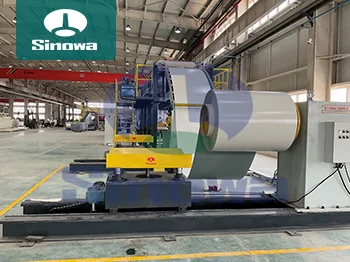
The high-tech decorative pu sandwich panel production line can meet a variety of production needs of customers, the whole decorative pu sandwich panel production line design concept of modularization enables all our components to be integrated and combined at will. Our high efficiency decorative pu sandwich panel production line can easily automate the production of roof sandwich panel, wall sandwich panel, cold storage sandwich panel and other products by different combination and configuration selection and siple switching. The inner core layer can be polyrethane or rock wool, glass wool, an so on.
The high precision decorative pu sandwich panel production line has high adaptability, which may produce various sandwich panel of the PU, PIR and rock wool systems. We may design various products according to the customer’s requirements, including various configurations, so as to meet their demands with flexible price system. Highly integrated and linked control system centralizes all control points at the main central center, achieving parameter linkage, fault self-diagnosis controlled by the whole line and shipping distance control. High-level automatic control system also saves the manpower and reduces the manpower loss for customers.
The precision servo hoisting mechanism employed by the main engine without hydraulic system makes the board thickness control flexible and the customer may conveniently change or adjust the board thickness. There will be not such troubles as hydraulic system adjustment, leakage, maintenance, etc.
High-level energy saving and protection design makes the whole decorative pu sandwich panel production line possible to produce around the clock throughout the year and the customer will save huge budget. In addition, the isolated heat preservation room is constructed for warming the environment. The energy saving and protection design of our manufacturing line may guarantee that the customer’s production line may be freely heated and produce in the main time to save more costs for customers.
The high-power low-consumption design quickens the reaction of the cheap decorative pu sandwich panel production line while energy consumption is kept low. With the brand-new, fully sealed inner insulation design, the energy consumption is controlled at the minimum level to achieve the design objective of less than an hour for the insulation system to be activated from the room temperature above 5℃ to the production process temperature. The energy consumption is only 40% that of those similar products.
The decorative PU sandwich panel production line stands as a highly integrated, automated manufacturing system designed to produce composite building panels that combine structural stability, thermal efficiency, and aesthetic versatility, catering to the evolving demands of modern construction, industrial insulation, and decorative engineering. Unlike traditional building material production setups, this line is engineered to streamline the entire manufacturing process from raw material handling to finished panel packaging, eliminating manual labor gaps and ensuring consistent product quality across large-scale output. At its core, the production line operates on a continuous forming principle, synchronizing multiple processing stations to create a three-layer composite panel structure: a rigid polyurethane (PU) foam core bonded firmly between two outer decorative facing layers, with each component processed and assembled in a sequential, precision-controlled manner. The overall structure of the production line is modular, allowing for flexible configuration based on production capacity, panel thickness requirements, and decorative finish specifications, making it adaptable for both large-scale industrial manufacturing and medium-volume customized production runs. Every segment of the line is calibrated to maintain tight tolerances, as even minor deviations in material alignment, foam expansion, or bonding pressure can compromise the final panel’s performance and decorative integrity, highlighting the line’s emphasis on mechanical precision and automated process control.
Breaking down the structural components of the decorative PU sandwich panel production line reveals a interconnected network of specialized workstations, each serving a distinct role in the panel manufacturing workflow. The line begins with raw material preparation and unrolling stations, where the outer facing materials—typically metal sheets, fiberglass, or other durable decorative substrates—are unwound from large coils, leveled to remove surface imperfections, and cleaned to ensure optimal adhesion with the PU foam core. These facing materials are pre-treated with surface finishing processes inline, such as texturing, color coating, or embossing, to achieve the desired decorative appearance without disrupting production continuity, a key feature that distinguishes decorative panel lines from standard insulation panel production lines. Following the pre-treatment stage, the facing materials move into a precision positioning and gap-setting module, where the distance between the top and bottom facings is adjusted to match the target panel thickness, ranging from thin decorative wall panels to thick industrial insulation panels. Adjacent to this module is the PU foam mixing and injection system, a high-pressure, closed-loop unit that blends polyol and isocyanate raw materials in exact ratios to form rigid PU foam, which is then injected evenly into the cavity between the two facing layers. The foam injection process is timed to align with the line’s continuous movement, ensuring uniform distribution across the entire panel width and length, preventing voids or uneven density that would weaken structural performance.
Next in the production line is the continuous pressing and foaming station, arguably the most critical structural component for defining panel performance. This station uses a double-belt press system with controlled temperature and pressure, where the injected foam expands and cures rapidly while being compressed to maintain consistent thickness and smooth surface flatness. The press belts are heated to accelerate the PU foam cross-linking reaction, locking in the core’s cellular structure and creating a strong, permanent bond between the foam core and outer facings; this bonding process eliminates delamination risks, a common issue in low-quality composite panels, and enhances the overall structural rigidity of the finished product. After curing, the panels move through a cooling section to stabilize the material structure and prevent warping, followed by a precision cutting station that trims panels to custom lengths and widths based on project requirements, with clean, straight cuts that preserve the decorative finish and edge integrity. The final stages of the production line include edge sealing, surface inspection, and packaging stations: edge sealing protects the foam core from moisture penetration and dust accumulation, while automated inspection systems check for surface defects, thickness variations, and bonding consistency before panels are stacked and packaged for shipping. The entire line is controlled by a centralized digital control system, which monitors speed, temperature, pressure, and material flow in real time, adjusting parameters automatically to maintain production efficiency and product uniformity, reducing waste and ensuring that every panel meets pre-set performance and decorative standards.
The performance characteristics of decorative PU sandwich panels, shaped directly by the design and precision of the production line, are what set these panels apart from conventional building materials, spanning structural, thermal, acoustic, and decorative performance metrics. Structurally, the panels exhibit exceptional strength-to-weight ratio, a result of the rigid PU foam core’s high compressive strength and the synergistic effect of the three-layer sandwich design. Despite being lightweight, which simplifies transportation, handling, and installation on construction sites, the panels can withstand significant vertical and horizontal loads, including wind pressure, snow load, and minor impact, making them suitable for both load-bearing and non-load-bearing applications. The closed-cell structure of the PU foam core, formed during the controlled curing process in the production line, delivers outstanding thermal insulation performance, with low thermal conductivity that minimizes heat transfer between indoor and outdoor environments. This thermal efficiency reduces energy consumption for heating and cooling in buildings, creating a more stable indoor climate and lowering long-term operational costs, a key advantage in both residential and commercial construction. Additionally, the dense foam core and bonded facing layers provide effective acoustic insulation, absorbing and blocking airborne noise transmission, making the panels ideal for spaces that require quiet environments, such as offices, residential interiors, and industrial facilities located near high-noise areas.
Beyond structural and insulation performance, decorative PU sandwich panels offer durable and versatile decorative performance, enhanced by the inline finishing processes integrated into the production line. The outer facing materials are resistant to fading, scratching, staining, and weathering, maintaining their visual appeal for extended periods even in harsh environmental conditions, including exposure to sunlight, humidity, and temperature fluctuations. The panels are non-porous and easy to clean, requiring minimal maintenance to preserve their decorative finish, unlike traditional wall materials that may need frequent repainting or refinishing. The production line’s flexibility allows for a wide range of surface textures, colors, and patterns, from smooth matte finishes to textured wood grain, stone mimicry, or metallic effects, enabling seamless integration with diverse architectural styles, from modern minimalist commercial buildings to rustic residential spaces. Furthermore, the panels exhibit good moisture resistance and dimensional stability, meaning they do not expand, contract, or warp significantly with changes in temperature or humidity, preserving both their structural shape and decorative appearance over time. They also resist mold, mildew, and pest infestation, as the closed PU foam core does not absorb moisture or provide a habitat for biological growth, adding to their long-term durability and functional performance in various climates and environments.
Decorative PU sandwich panels are available in a wide range of varieties, each tailored to specific performance needs and decorative preferences, with the production line’s modular design enabling seamless switching between different panel types without extensive reconfiguration. The primary classification of these panels is based on core density, facing material, thickness, and decorative finish, each variant serving distinct application scenarios. Panels are categorized by core density first, with low-density cores optimized for lightweight decorative interior applications, medium-density cores balancing insulation and structural strength for general exterior and interior use, and high-density cores designed for heavy-duty industrial applications that require maximum load-bearing capacity and thermal insulation. In terms of facing materials, the most common varieties include metal-faced panels (using coated steel or aluminum), fiberglass-faced panels for corrosion-resistant environments, and composite-faced panels with specialized decorative coatings for high-end architectural projects; each facing material is processed inline to achieve unique decorative effects, such as color matching, embossing, or custom printing, to align with specific design visions.
Panel thickness is another key differentiator, with thin panels (typically 30mm to 75mm) used primarily for interior wall decoration, partition walls, and ceiling panels, where space efficiency and decorative appeal are prioritized, and thick panels (80mm to 200mm) used for exterior wall cladding, roof insulation, and industrial cold storage applications, where thermal insulation and structural performance are critical. Decorative finish varieties further diversify the product range, including solid color panels, textured panels, patterned panels, and imitation material panels (such as wood, stone, or brick), all produced directly on the production line through pre-treatment and surface finishing processes, eliminating the need for secondary on-site decoration. Additionally, there are specialized varieties designed for specific functional needs, such as moisture-resistant panels for humid environments like bathrooms and kitchens, fire-retardant panels for public and commercial spaces with strict safety requirements, and anti-static panels for industrial facilities with sensitive equipment. Each variety is manufactured with consistent core performance standards, ensuring that regardless of decorative finish or thickness, the panels retain the core benefits of thermal insulation, structural stability, and durability that define PU sandwich panels.
The combination of robust performance, versatile design, and efficient production makes decorative PU sandwich panels widely applicable across countless residential, commercial, industrial, and agricultural scenarios, with their use expanding steadily as modern construction shifts toward prefabricated, energy-efficient, and aesthetically pleasing building solutions. In the residential sector, these panels are commonly used for interior wall partitions, ceiling decoration, exterior wall cladding, garage doors, and sunroom enclosures, offering homeowners a cost-effective way to enhance both the visual appeal and energy efficiency of their homes. The lightweight nature of the panels reduces construction time and labor costs for residential renovations and new builds, while the thermal insulation performance improves indoor comfort and reduces energy bills year-round. In commercial construction, the panels are a popular choice for office buildings, shopping malls, hotels, restaurants, and exhibition halls, where their sleek, customizable decorative finishes align with modern architectural design trends, and their acoustic insulation properties create comfortable, functional indoor spaces for customers and employees. They are also used for temporary commercial structures, such as pop-up shops and event booths, due to their easy installation and disassembly, as well as their ability to maintain a polished, professional appearance.
Industrial applications represent one of the largest segments for decorative PU sandwich panels, leveraging their exceptional thermal insulation, structural strength, and durability. They are extensively used in factory buildings, warehouses, logistics centers, and cold storage facilities, where they regulate indoor temperatures, protect stored goods from temperature fluctuations, and withstand the rigors of industrial operations. The panels’ moisture resistance and easy-to-clean surface make them suitable for food processing plants, pharmaceutical facilities, and cleanrooms, where hygiene and environmental control are essential. In agricultural construction, decorative PU sandwich panels are used for barns, greenhouses, livestock shelters, and agricultural storage facilities, providing stable temperature control to protect crops, livestock, and agricultural supplies, while their durable finish withstands the harsh conditions of farm environments. Beyond traditional construction, the panels are used in transportation and modular construction applications, including trailer and truck body cladding, portable cabins, emergency shelters, and prefabricated buildings, where their lightweight design and structural performance are critical for mobility and quick deployment.
The decorative PU sandwich panel production line not only enables the mass production of high-quality composite panels but also drives innovation in sustainable and efficient building practices, aligning with global trends toward green construction and energy conservation. By integrating decorative finishing into the manufacturing process, the line eliminates the need for on-site painting, plastering, or cladding, reducing construction waste, shortening project timelines, and minimizing environmental impact on construction sites. The panels themselves are environmentally friendly, with the PU foam core offering long-term energy savings that reduce carbon emissions from building heating and cooling systems, and the facing materials being recyclable at the end of the panel’s service life. As construction standards continue to evolve to prioritize energy efficiency, durability, and aesthetic flexibility, the demand for decorative PU sandwich panels and advanced production lines continues to grow, with ongoing refinements to production line technology further enhancing product performance, decorative variety, and manufacturing efficiency. The seamless integration of structural functionality, thermal performance, and decorative appeal in these panels, made possible by the precision-engineered production line, solidifies their position as a versatile, future-proof building material for a wide range of global construction and design needs.
« Decorative PU Sandwich Panel Production Line » Update Date: 2026/3/24
URL: https://www.sinowamachine.com/tags/decorative-pu-sandwich-panel-production-line.html