
Decorative Sandwich Panel Line
Sinowa is a decorative sandwich panel line supplier from china, customized high-quality & high efficiency decorative sandwich panel line at low price, the adoption of system integration technology and bus control technology accomplishes the full automatization of integrated and coordinated control of the decorative sandwich panel line with accessible remote interactive communication. Ranking the first-class level in the world, it is currently the decorative sandwich panel line in the market taking a comprehensive lead in high performance.
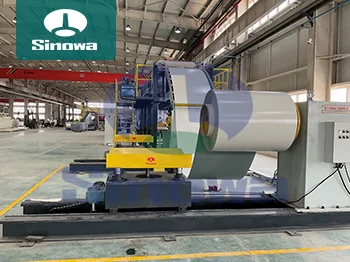
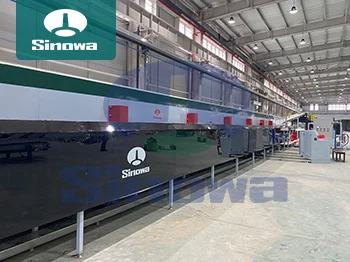
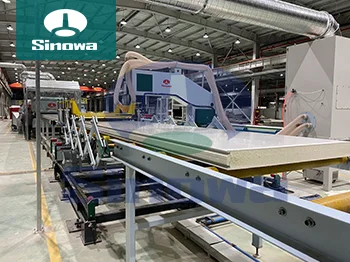
The high-tech decorative sandwich panel line can meet a variety of production needs of customers, the whole decorative sandwich panel line design concept of modularization enables all our components to be integrated and combined at will. Our high efficiency decorative sandwich panel line can easily automate the production of roof sandwich panel, wall sandwich panel, cold storage sandwich panel and other products by different combination and configuration selection and siple switching. The inner core layer can be polyrethane or rock wool, glass wool, an so on.


The high precision decorative sandwich panel line has high adaptability, which may produce various sandwich panel of the PU, PIR and rock wool systems. We may design various products according to the customer’s requirements, including various configurations, so as to meet their demands with flexible price system. Highly integrated and linked control system centralizes all control points at the main central center, achieving parameter linkage, fault self-diagnosis controlled by the whole line and shipping distance control. High-level automatic control system also saves the manpower and reduces the manpower loss for customers.


The precision servo hoisting mechanism employed by the main engine without hydraulic system makes the board thickness control flexible and the customer may conveniently change or adjust the board thickness. There will be not such troubles as hydraulic system adjustment, leakage, maintenance, etc.


High-level energy saving and protection design makes the whole decorative sandwich panel line possible to produce around the clock throughout the year and the customer will save huge budget. In addition, the isolated heat preservation room is constructed for warming the environment. The energy saving and protection design of our manufacturing line may guarantee that the customer’s production line may be freely heated and produce in the main time to save more costs for customers.


The high-power low-consumption design quickens the reaction of the cheap decorative sandwich panel line while energy consumption is kept low. With the brand-new, fully sealed inner insulation design, the energy consumption is controlled at the minimum level to achieve the design objective of less than an hour for the insulation system to be activated from the room temperature above 5℃ to the production process temperature. The energy consumption is only 40% that of those similar products.
A decorative sandwich panel line is a set of integrated industrial equipment designed for the continuous and automated production of decorative sandwich panels, which are widely used in modern construction and other fields due to their combination of aesthetic appeal and functional performance. This production system integrates multiple mechanical, electrical, and control components to complete the entire manufacturing process from raw material feeding to finished product output, ensuring stable quality, high efficiency, and consistent performance of the produced panels. Unlike traditional single-process equipment, a decorative sandwich panel line realizes the seamless connection of various production links, reducing manual intervention and improving production efficiency while ensuring the uniformity of product specifications and performance. The structure of a decorative sandwich panel line is designed based on the production process of decorative sandwich panels, which usually consists of core functional modules that work together to achieve the precise processing of each component of the sandwich panel and their effective combination. Each module has a specific function, and the coordination between them directly determines the production efficiency, product quality, and overall performance of the entire line.
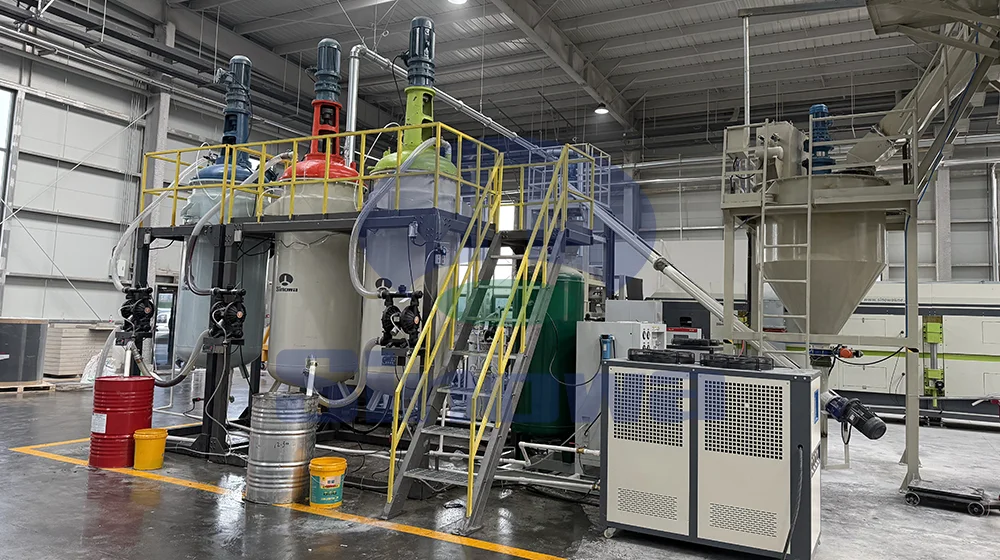
The basic structure of a decorative sandwich panel line mainly includes raw material handling modules, forming modules, bonding and compounding modules, cutting modules, and auxiliary modules, each of which plays an indispensable role in the production process. The raw material handling module is responsible for the storage, uncoiling, and leveling of surface materials and core materials, laying the foundation for subsequent processing. For surface materials such as metal coils, the uncoiler in this module ensures stable and continuous feeding, avoiding material jams or uneven feeding that may affect the subsequent forming quality. The leveling device corrects the deformation of the metal coils caused by storage or transportation, ensuring that the surface materials are flat and smooth before entering the forming process. For core materials such as rock wool, polyurethane foam, or polystyrene, the raw material handling module also includes feeding mechanisms that can accurately control the feeding amount and speed, ensuring that the core material is evenly distributed between the two surface layers. The forming module is the core part of the decorative sandwich panel line, responsible for shaping the surface materials into the required profile and decorative patterns. This module usually includes roll forming machines and embossing machines, which can process metal surface materials into various shapes and patterns according to design requirements. The roll forming machine uses continuous rolling to shape the metal sheet into the desired cross-sectional profile with high dimensional accuracy, while the embossing machine creates decorative patterns on the surface of the metal sheet, such as wood grain, stone grain, or geometric patterns, enhancing the aesthetic appeal of the finished panel and improving its structural rigidity at the same time.
The bonding and compounding module is another key component of the decorative sandwich panel line, which is responsible for combining the surface layers and the core material into an integrated sandwich structure. This module usually includes gluing devices, foam injection systems (for foam core materials), and composite pressing mechanisms. The gluing device evenly applies adhesive to the surface of the core material or the inner side of the surface layers, ensuring firm bonding between the layers. For polyurethane (PU) or polyisocyanurate (PIR) core materials, the foam injection system injects the foaming material into the gap between the two surface layers, where it undergoes a chemical reaction to expand and fill the entire space, forming a dense and uniform core layer. The composite pressing mechanism applies appropriate pressure and temperature to the bonded materials, promoting the curing of the adhesive or foam and ensuring that the three layers are tightly combined without delamination. The pressure and temperature parameters in this process are precisely controlled to avoid problems such as insufficient bonding strength or deformation of the panel. The cutting module is used to cut the continuous composite panel into finished products of specified lengths, which usually includes a fixed-length cutting machine and a trimming device. The fixed-length cutting machine uses high-precision cutting tools to ensure that the length of each panel meets the design requirements, with small cutting errors and smooth cutting edges. The trimming device trims the excess material on both sides of the panel, ensuring the width accuracy and appearance quality of the finished product. In addition, the decorative sandwich panel line is also equipped with auxiliary modules such as a control system, a cooling system, and a stacking system. The control system, usually based on PLC (Programmable Logic Controller) and servo control technology, realizes the automatic control of the entire production line, including parameter setting, process monitoring, and fault alarm, ensuring the stable operation of the line. The cooling system cools the finished panels after compounding and cutting to avoid deformation caused by high temperature, while the stacking system automatically stacks the finished panels in an orderly manner, facilitating storage and transportation.
The performance of a decorative sandwich panel line is reflected in multiple aspects, including production efficiency, processing accuracy, stability, adaptability, and energy conservation, which directly affect the quality of the finished panels and the economic benefits of production. Production efficiency is one of the core performance indicators of the line, which is usually measured by the production speed and annual output. A high-performance decorative sandwich panel line can achieve continuous and automated production, with a production speed of 5 to 15 meters per minute, and an annual output of hundreds of thousands of square meters, which is much higher than traditional manual or semi-automatic production methods. This high efficiency not only shortens the production cycle but also reduces labor costs, making it suitable for large-scale industrial production. Processing accuracy is another important performance indicator, which determines the dimensional consistency and appearance quality of the finished panels. The line’s precise control system and advanced processing equipment ensure that the thickness, width, length, and pattern accuracy of the panels meet the design requirements. For example, the thickness of the produced panels can be controlled within a range of 20 mm to 50 mm with small errors, and the cutting length error can be controlled within a few millimeters. The surface patterns formed by the embossing machine are clear and consistent, without defects such as blurring or deformation.
Stability is crucial for the long-term operation of the decorative sandwich panel line. A high-stability line can operate continuously for a long time without frequent failures, reducing downtime and maintenance costs. This stability is ensured by the rational design of the equipment structure, the use of high-quality components, and the advanced control system. The control system can monitor the operation status of each module in real-time, detect potential faults in advance, and issue alarm signals, allowing operators to take measures in a timely manner. In addition, the line’s components are designed to be wear-resistant and corrosion-resistant, ensuring a long service life and stable performance. Adaptability is another important performance of the decorative sandwich panel line, which refers to the line’s ability to produce different types, specifications, and styles of decorative sandwich panels to meet diverse market demands. A flexible line can adjust parameters such as production speed, panel thickness, and pattern type according to customer requirements without major modifications to the equipment. For example, it can switch between different core materials (such as rock wool, PU, and EPS) by adjusting the feeding mechanism and process parameters, and can produce panels with different surface patterns by replacing the embossing molds. This adaptability makes the line suitable for a variety of application scenarios and improves its market competitiveness.
Energy conservation and environmental protection are also important performance indicators of modern decorative sandwich panel lines. With the increasing emphasis on environmental protection and energy conservation, the line adopts a series of energy-saving technologies and processes to reduce energy consumption and waste emissions. For example, the control system optimizes the operation parameters of each module to avoid unnecessary energy consumption; the foam injection system uses environmentally friendly foaming agents that do not damage the ozone layer; the cutting process adopts precise cutting technology to reduce material waste. In addition, the finished decorative sandwich panels produced by the line also have good energy-saving performance, such as excellent thermal insulation and sound insulation effects, which help reduce the energy consumption of buildings, conforming to the concept of green and sustainable development. The durability of the line is also an important performance factor, which is reflected in the service life of the equipment and the stability of its performance over time. High-quality components and reasonable maintenance design ensure that the line can operate stably for many years, reducing the cost of equipment replacement and maintenance.
Decorative sandwich panel lines can be classified into different types according to various standards, such as the type of core material, the degree of automation, and the type of surface material, each of which has its own characteristics and applicable scenarios. According to the type of core material used in the production of sandwich panels, the line can be divided into polyurethane (PU) sandwich panel lines, rock wool sandwich panel lines, polystyrene (EPS) sandwich panel lines, and honeycomb sandwich panel lines. PU sandwich panel lines are mainly used to produce sandwich panels with PU foam as the core material. PU foam has excellent thermal insulation performance, with a thermal conductivity of 0.022 to 0.025 W/(m·K), and good overall strength, making the produced panels suitable for applications that require high thermal insulation performance, such as cold storage, residential buildings, and commercial buildings. The PU sandwich panel line is equipped with a high-pressure foam injection system, which can ensure the uniform density and stable performance of the foam core layer. Rock wool sandwich panel lines are designed to produce sandwich panels with rock wool as the core material. Rock wool has excellent fire resistance, reaching Class A non-combustible grade, and good sound insulation performance, with a sound insulation effect of up to 35 dB, making it suitable for applications with strict fire safety requirements, such as industrial factories, public buildings, and high-rise buildings. The rock wool sandwich panel line is equipped with a vertical cotton laying device, which ensures the uniform distribution of rock wool and improves the structural strength of the panel.
EPS sandwich panel lines produce sandwich panels with expanded polystyrene (EPS) as the core material. EPS has the advantages of low cost, light weight, and good thermal insulation performance (thermal conductivity of 0.033 to 0.038 W/(m·K)), making it suitable for applications with low fire safety requirements and limited budget, such as storage buildings, mobile board rooms, and temporary structures. Honeycomb sandwich panel lines are used to produce sandwich panels with honeycomb core materials, which have high strength, light weight, and good shear resistance, but are afraid of moisture. The honeycomb core material has a thermal conductivity of 0.05 to 0.08 W/(m·K) and a fire rating of Class A, making it suitable for applications that require high structural strength and fire resistance, such as bridges, tunnels, and high-end buildings. According to the degree of automation, decorative sandwich panel lines can be divided into fully automated lines and semi-automatic lines. Fully automated lines integrate all production links from raw material feeding to finished product stacking into an automated system, requiring little manual intervention. They have high production efficiency, stable product quality, and are suitable for large-scale industrial production. Semi-automatic lines require manual operation in some links, such as raw material feeding and finished product stacking, with lower production efficiency and investment, making them suitable for small and medium-sized enterprises or start-up projects.
According to the type of surface material, decorative sandwich panel lines can be divided into metal surface sandwich panel lines and non-metal surface sandwich panel lines. Metal surface sandwich panel lines use metal materials such as galvanized steel, galvalume steel, aluminum, and stainless steel as the surface layers, which have high strength, good weather resistance, and can be processed into various decorative patterns. These lines are widely used in the production of exterior wall panels, roof panels, and partition panels for industrial and commercial buildings. Non-metal surface sandwich panel lines use non-metal materials such as fiberglass reinforced plastic (FRP) and cement fiberboard as the surface layers, which have good corrosion resistance, light transmittance, and insulation performance, suitable for special environments such as chemical plants and coastal areas. In addition, there are also special decorative sandwich panel lines, such as metal carved sandwich panel lines, which are designed to produce metal composite sandwich panels with three-dimensional decorative patterns on the surface. These lines are equipped with special stamping and carving equipment, which can press various three-dimensional patterns on the metal surface, enhancing the aesthetic appeal of the panels and making them suitable for exterior wall decoration of high-end buildings and residential complexes.
The applications of decorative sandwich panel lines are closely related to the characteristics of the decorative sandwich panels they produce, covering a wide range of fields such as construction, industrial production, infrastructure, and temporary structures, and playing an important role in promoting the modernization and green development of the construction industry. In the field of construction, decorative sandwich panels produced by the line are widely used in exterior wall cladding, roof decoration, indoor partitions, and suspended ceilings of various buildings. For commercial buildings such as retail stores, offices, hotels, and restaurants, the customizable decorative surface layers of the panels can help create a unique brand image, while their excellent thermal insulation performance helps maintain a comfortable indoor temperature and reduce energy consumption. For residential buildings, from single-family homes to multi-story apartments, the panels enhance the curb appeal of the residential complex while improving the energy efficiency and comfort of the houses. The lightweight characteristics of the panels also reduce the structural load of the building, reducing the cost of the building structure.
In the field of industrial production, decorative sandwich panels are widely used in the construction of industrial facilities such as factories, warehouses, and workshops. These panels have good durability, corrosion resistance, and fire resistance, which can adapt to the harsh environment of industrial production. For example, in factories with high temperature, humidity, or corrosive gas, the panels can maintain stable performance for a long time, reducing maintenance costs. The thermal insulation and sound insulation performance of the panels also helps improve the working environment of the workshop, reducing noise pollution and energy loss. In addition, the fast installation speed of the panels can shorten the construction period of industrial facilities, enabling enterprises to put into production faster. In the field of infrastructure projects, such as bridges, tunnels, and toll stations, decorative sandwich panels are used as auxiliary materials for wall cladding and roof decoration. Their lightweight and high-strength characteristics make them easy to install and transport, while their decorative effect enhances the overall appearance of the infrastructure. For example, in tunnel construction, the panels can be used as interior wall cladding, providing good fire resistance and sound insulation, and improving the safety and comfort of the tunnel.
Temporary structures are another important application field of decorative sandwich panels produced by the line. These include mobile houses, temporary offices, construction site dormitories, and emergency shelters. The panels are lightweight, easy to assemble and disassemble, and can be reused, making them suitable for temporary use. For example, in construction sites, mobile houses made of decorative sandwich panels can provide a comfortable living and working environment for construction workers, and can be quickly moved and assembled according to the needs of the construction site. In areas affected by natural disasters, emergency shelters made of these panels can be quickly built to provide temporary housing for disaster victims. In addition, decorative sandwich panels are also used in some special fields, such as cold storage, clean rooms, and exhibition halls. Cold storage requires panels with excellent thermal insulation performance to maintain a low temperature environment, and PU or rock wool sandwich panels produced by the line are ideal choices. Clean rooms, such as those in the pharmaceutical and electronic industries, require panels with good airtightness and corrosion resistance, and non-metal surface sandwich panels can meet these requirements. Exhibition halls require panels with beautiful appearance and easy installation, and decorative sandwich panels with various patterns and colors can meet the design needs of the exhibition space.
With the continuous development of the construction industry and the increasing demand for green and energy-saving building materials, the application scope of decorative sandwich panel lines is constantly expanding, and their performance and types are also constantly improving. The future development of decorative sandwich panel lines will tend to be more intelligent, energy-saving, and environmentally friendly. Intelligent control systems will be more widely used, realizing real-time monitoring, remote control, and fault diagnosis of the production line, further improving production efficiency and stability. Energy-saving technologies will be continuously optimized, reducing energy consumption and carbon emissions during the production process. Environmentally friendly materials and processes will be promoted, making the production process more environmentally friendly and the finished panels more in line with the concept of sustainable development. In addition, with the continuous enrichment of market demand, decorative sandwich panel lines will develop more types and specifications to meet the personalized needs of different customers, such as panels with better fire resistance, higher thermal insulation performance, or more diverse decorative patterns. The integration of modular design will also make the line more flexible and easy to maintain, reducing the cost of equipment modification and upgrading.
In conclusion, a decorative sandwich panel line is a highly integrated industrial equipment system that combines multiple functions such as raw material handling, forming, bonding, compounding, and cutting. Its reasonable structure ensures the smooth progress of the production process, while its excellent performance guarantees the quality and efficiency of production. The various types of decorative sandwich panel lines meet the diverse needs of different application scenarios, and their wide range of applications covers construction, industrial production, infrastructure, and other fields, making important contributions to the development of the modern construction industry. As technology continues to advance, decorative sandwich panel lines will continue to innovate and develop, providing more high-quality, energy-saving, and environmentally friendly building materials for the market, and promoting the sustainable development of the construction industry.
« Decorative Sandwich Panel Line » Update Date: 2026/4/16
URL: https://www.sinowamachine.com/tags/decorative-sandwich-panel-line.html
- Links:
- Sandwich Panel Continuous Production Line
- Automatic and Continuous Sandwich Panel Production Line
- Cheap and Low Price Sandwich Panel Production Line
- China Sandwich Panel Production Line Factory
- Color Steel Sandwich Panel Production Line For Cold Storage
- Continuous Composite Foam Sandwich Panel Production Line
- Continuous Production Line For Rockwool and Mineral Wool Sandwich Panels
- Continuous PU Phenolic Insulation Panel Production Line
- Continuous PU PIR Sandwich Panel Production Line
- Continuous PUF PUR Sandwich Panel Production Line
- Continuous Sandwich Panel Production Line For Roof and Wall
- Customized and Design Sandwich Panel Production Line
- Decorative Sandwich Panel Production Line For Glass Wool Boards
- High Quality Sandwich Panel Production Line For Sale
- Polyurethane(PU) Sandwich Panel Production Line
- Sandwich Panel Production Line Manufacturer and Supplier
- Sandwich Panel Production Machinery and Equipment