
Automatic Rock Wool Production Line
Sinowa is a automatic rock wool production line supplier from china, customized high-quality & high efficiency automatic rock wool production line at low price, the adoption of system integration technology and bus control technology accomplishes the full automatization of integrated and coordinated control of the automatic rock wool production line with accessible remote interactive communication. Ranking the first-class level in the world, it is currently the automatic rock wool production line in the market taking a comprehensive lead in high performance.
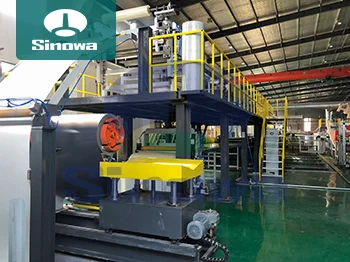
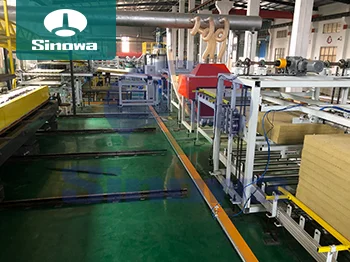
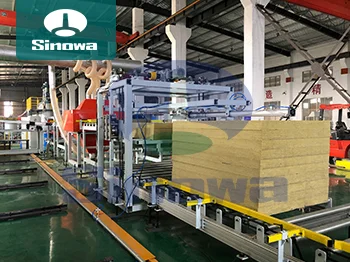
The high-tech automatic rock wool production line can meet a variety of production needs of customers, the whole automatic rock wool production line design concept of modularization enables all our components to be integrated and combined at will. Our high efficiency automatic rock wool production line can easily automate the production of roof sandwich panel, wall sandwich panel, cold storage sandwich panel and other products by different combination and configuration selection and siple switching. The inner core layer can be polyrethane or rock wool, glass wool, an so on. The precision servo hoisting mechanism employed by the main engine without hydraulic system makes the board thickness control flexible and the customer may conveniently change or adjust the board thickness. There will be not such troubles as hydraulic system adjustment, leakage, maintenance, etc.
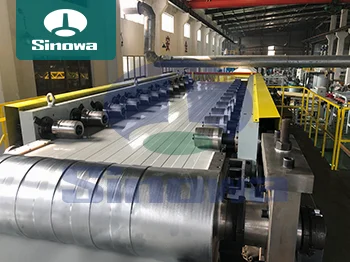
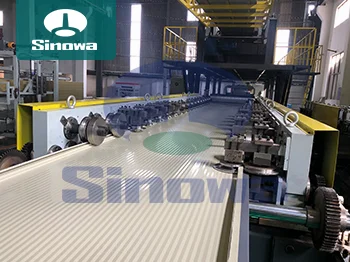
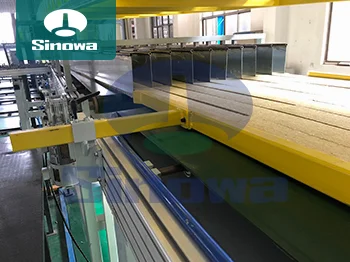
The high precision automatic rock wool production line has high adaptability, which may produce various sandwich panel of the PU, PIR and rock wool systems. We may design various products according to the customer’s requirements, including various configurations, so as to meet their demands with flexible price system. Highly integrated and linked control system centralizes all control points at the main central center, achieving parameter linkage, fault self-diagnosis controlled by the whole line and shipping distance control. High-level automatic control system also saves the manpower and reduces the manpower loss for customers. High-level energy saving and protection design makes the whole automatic rock wool production line possible to produce around the clock throughout the year and the customer will save huge budget. In addition, the isolated heat preservation room is constructed for warming the environment. The energy saving and protection design of our manufacturing line may guarantee that the customer’s production line may be freely heated and produce in the main time to save more costs for customers.
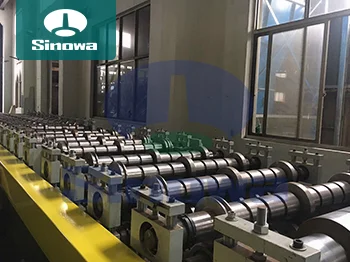
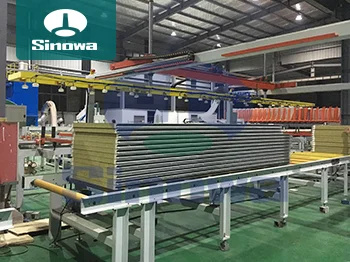
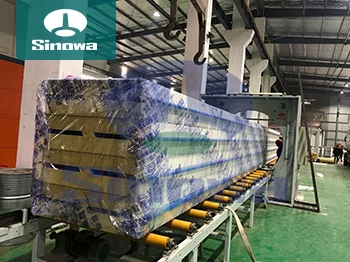
The high-power low-consumption design quickens the reaction of the cheap automatic rock wool production line while energy consumption is kept low. With the brand-new, fully sealed inner insulation design, the energy consumption is controlled at the minimum level to achieve the design objective of less than an hour for the insulation system to be activated from the room temperature above 5℃ to the production process temperature. The energy consumption is only 40% that of those similar products.
Automatic rock wool production lines are integrated systems designed to realize the continuous, efficient and standardized production of rock wool products, which are widely used in various fields due to their excellent thermal insulation, fire resistance and sound absorption properties. Unlike traditional manual or semi-automatic production methods, automatic rock wool production lines integrate mechanical, electrical, hydraulic and control technologies to complete the entire production process from raw material processing to finished product packaging with minimal manual intervention, ensuring stable product quality and high production efficiency. To fully understand the value and application potential of these production lines, it is necessary to conduct in-depth exploration of their structure, performance, types and practical applications, which can provide effective reference for relevant industries to select and use production equipment rationally.
The structure of an automatic rock wool production line is a complex and coordinated system composed of multiple functional units, each of which undertakes specific production tasks and cooperates closely to ensure the smooth operation of the entire production process. The core structure usually starts with the raw material processing unit, which is mainly used to pretreat the raw materials required for rock wool production. The main raw materials of rock wool include natural rocks such as basalt and dolomite, as well as auxiliary materials such as blast furnace slag. The raw material processing unit is equipped with screening, crushing and drying equipment. First, the raw materials are screened to remove impurities and particles that do not meet the specifications, then crushed into uniform powder or small pieces by crushing equipment, and finally dried by drying equipment to reduce the moisture content in the raw materials. This pretreatment process is crucial because the moisture content and impurity content of raw materials will directly affect the melting effect and fiber quality in the subsequent production links. After pretreatment, the raw materials are transported to the storage silo through the automatic conveying device, and then quantitatively and evenly sent to the melting furnace through the weighing and feeding system, laying a foundation for stable production.
The melting unit is the key part of the automatic rock wool production line, responsible for melting the pretreated raw materials into a molten state. The melting furnace adopted in the automatic production line is usually a closed energy-saving structure, which can effectively prevent heat loss and waste gas leakage, and at the same time facilitate the treatment of waste gas. The melting furnace uses natural gas, electricity or other energy sources to heat the raw materials to a high temperature of 1400 to 1600 degrees Celsius, so that the raw materials are completely melted into a uniform molten liquid. In order to ensure the stability of the melting temperature, the melting unit is equipped with an automatic temperature control system, which can real-time monitor the temperature inside the furnace and adjust the energy supply according to the set parameters, avoiding the influence of temperature fluctuation on the quality of molten liquid. In addition, the slag balls and waste slag generated during the melting process can be recycled and reused after simple treatment, which not only reduces resource waste but also conforms to the concept of environmental protection production.
After melting, the molten liquid enters the fiberization unit, which is the core link to form rock wool fibers. The fiberization unit is mainly composed of a centrifuge, a wind ring and other equipment. The molten liquid is guided into the high-speed four-roller centrifuge through the flow channel. Under the action of high centrifugal force, the molten liquid is thrown out through the small holes on the centrifuge roller and initially formed into primary fibers. At the same time, the high-speed airflow blown by the wind ring acts on the primary fibers, further stretching and refining them into fine rock wool fibers with uniform thickness. The diameter of the rock wool fibers formed by this method is usually between 3 and 7 microns, which has good flexibility and toughness. In the fiberization process, the automatic control system will adjust the rotation speed of the centrifuge and the wind speed of the wind ring in real time according to the quality of the fibers, ensuring the stability and uniformity of the fiber quality. After fiberization, the rock wool fibers are blown to the cotton collector by the airflow, and adsorbed on the cotton collector belt under the action of negative pressure to form a primary cotton felt.
The primary cotton felt needs to go through the forming and curing unit to form a rock wool product with a certain strength and shape. The forming and curing unit includes a pendulum machine, a pleating machine, a pressing machine and a curing furnace. First, the primary cotton felt is sent to the pendulum machine through the transition conveyor, and the pendulum machine evenly spreads the cotton felt to ensure the uniform thickness of the cotton felt. Then, the pleating machine and the pressing machine longitudinally compress the cotton felt to improve the density and strength of the cotton felt, and at the same time form a certain pleated structure to enhance the tensile performance of the product. After forming, the cotton felt is sent to the curing furnace for heat treatment. The curing furnace adopts a continuous conveying structure, and the temperature and humidity inside the furnace are strictly controlled by the automatic system. Under the action of high temperature, the binder added in the fiberization process (usually a phenolic resin binder) undergoes a curing reaction, so that the rock wool fibers are firmly bonded together to form a stable honeycomb structure. The curing time and temperature are determined according to the type and specification of the product, which usually takes 3 to 10 minutes. After curing, the rock wool felt has sufficient strength and hardness, and can maintain a stable shape.
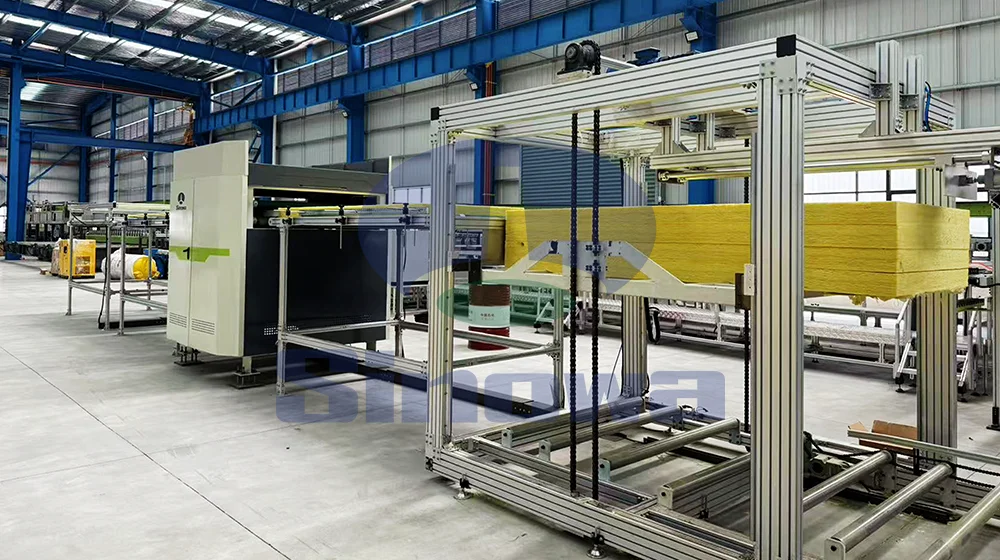
The post-processing unit is the last link of the automatic rock wool production line, mainly responsible for cutting, trimming, packaging and other processing of the cured rock wool felt to form finished products that meet the market demand. The post-processing unit is equipped with longitudinal cutting machines, transverse cutting machines, edge crushing machines, stacking robots and other equipment. First, the cured rock wool felt is longitudinally cut into strips of a certain width by the longitudinal cutting machine, then transversely cut into sheets of a certain length and thickness by the transverse cutting machine, and the edge crushing machine trims the irregular edges of the cut products to ensure the neatness of the product size. Finally, the stacking robot automatically stacks the finished products, and the packaging equipment wraps the products with heat-shrinkable film to prevent moisture and damage during transportation and storage. The entire post-processing process is fully automated, which not only improves production efficiency but also avoids the damage to products caused by manual operation, ensuring the appearance quality of finished products.
In addition to the above core units, the automatic rock wool production line is also equipped with a central control unit, which is the "brain" of the entire production line. The central control unit adopts a computer integrated control system, which integrates digital servo technology, frequency conversion vector technology and hydraulic control technology, realizing the integrated control and management of the entire production line. The operator can set production parameters, monitor production status and adjust production processes through the man-machine interface. The central control system can real-time collect the operating data of each unit, such as temperature, pressure, speed and other parameters, and issue adjustment instructions in time when abnormalities occur, ensuring the stable operation of the production line. At the same time, the central control system can record the production data, which is convenient for enterprises to carry out production management, quality traceability and production optimization.
The performance of automatic rock wool production lines is mainly reflected in production efficiency, product quality stability, energy conservation and environmental protection, and operability, which are the key factors to measure the level of production lines. In terms of production efficiency, automatic rock wool production lines adopt continuous production mode, which greatly improves production efficiency compared with traditional batch production mode. The production speed of the production line can be adjusted according to the product specification and production demand, usually between 2 and 40 meters per minute. For large-scale production lines, the annual output can reach hundreds of thousands or even millions of square meters, which can effectively meet the large demand of the market. At the same time, the automatic production line greatly reduces the number of operators. A complete production line only needs 5 to 8 operators to complete the entire production process, which significantly reduces labor costs and labor intensity, and avoids the influence of human factors on production efficiency.
Product quality stability is another important performance of automatic rock wool production lines. Due to the adoption of full automatic control, the production process of the production line, such as raw material feeding, melting temperature, fiberization parameters, curing conditions and cutting size, can be accurately controlled according to the set standards, avoiding the errors caused by manual operation. This ensures that the rock wool products produced have uniform thickness, density, fiber diameter and other indicators, and the product performance is stable. For example, the thermal conductivity of the produced rock wool products can be stably maintained at 0.030 to 0.040 W/(m·K), the fire resistance grade can reach A1 level, and the sound absorption coefficient is more than 0.7, which fully meets the relevant national and industrial standards. In addition, the production line is equipped with online detection equipment, which can real-time detect the quality of products during the production process, and automatically remove unqualified products, further ensuring the qualification rate of finished products.
Energy conservation and environmental protection are important performance indicators of modern automatic production lines, and automatic rock wool production lines also have obvious advantages in this regard. In terms of energy conservation, the melting furnace adopted by the production line is a closed energy-saving structure, which can effectively reduce heat loss and improve energy utilization rate. At the same time, the production line adopts frequency conversion speed regulation technology, which can adjust the energy consumption of equipment according to the production load, avoiding unnecessary energy waste. In addition, the waste slag and slag balls generated during the production process can be recycled and reused as raw materials, which not only reduces resource waste but also reduces the energy consumption required for raw material processing. In terms of environmental protection, the closed structure of the melting furnace prevents waste gas leakage, and the waste gas generated during the production process is treated by the waste gas treatment system before being discharged, which meets the national environmental protection emission standards. The production line does not produce industrial wastewater, and the solid waste generated is also recyclable, which has little impact on the environment. In addition, rock wool products themselves are environmentally friendly and non-toxic, do not contain harmful substances such as formaldehyde, and can be recycled after scrapping, which is in line with the concept of green development.
Operability is also an important part of the performance of automatic rock wool production lines. The production line adopts a man-machine conversation interface, which is simple and intuitive. Operators only need to undergo simple training to master the operation method of the production line. The central control system can real-time display the operating status of each unit, and issue an alarm prompt when an abnormality occurs, which is convenient for operators to find and solve problems in time. In addition, the production line is equipped with a complete safety protection system, such as emergency stop devices, overload protection devices and high-temperature protection devices, which can effectively avoid safety accidents and ensure the personal safety of operators. At the same time, the production line has good maintainability, and each unit is designed with a maintenance door and a maintenance platform, which is convenient for daily maintenance and repair of equipment, reducing the downtime of the production line and improving the utilization rate of the production line.
Automatic rock wool production lines can be divided into different types according to the production scale, product type and production process, so as to meet the different needs of various industries. According to the production scale, automatic rock wool production lines can be divided into small, medium and large-scale production lines. Small-scale production lines are usually suitable for small enterprises or enterprises with small production demand. The production line has a simple structure, small floor area and low investment cost. The annual output is usually less than 100,000 square meters, and the production speed is relatively slow, which is suitable for the production of small-batch and multi-specification rock wool products. Medium-scale production lines are the most widely used type, with moderate investment cost and production scale, annual output between 100,000 and 500,000 square meters, and can meet the production demand of most enterprises. Large-scale production lines are suitable for large enterprises with large market demand. The production line has a complex structure, large floor area and high investment cost, but the production efficiency is extremely high, the annual output can reach more than 500,000 square meters, and it is suitable for large-batch and standardized production of rock wool products.
According to the type of rock wool products produced, automatic rock wool production lines can be divided into rock wool board production lines, rock wool felt production lines, rock wool pipe production lines and rock wool sandwich panel production lines. Rock wool board production lines are mainly used to produce rock wool boards with a certain thickness and strength, which are widely used in building exterior walls, roofs and interior partitions. The production line is equipped with special forming and cutting equipment to ensure the flatness and size accuracy of the rock wool board. Rock wool felt production lines are used to produce soft rock wool felt, which has good flexibility and is suitable for thermal insulation and sound absorption of curved surfaces, pipelines and other parts. The production line of rock wool felt has no special pressing process, and the thickness of the product can be adjusted according to the demand. Rock wool pipe production lines are specialized in producing rock wool pipe products, which are mainly used for thermal insulation and anti-corrosion of pipelines in industrial and civil fields. The production line is equipped with a pipe forming mold, which can produce rock wool pipes of different diameters and lengths. Rock wool sandwich panel production lines integrate the production of rock wool core materials and surface materials, and can directly produce rock wool sandwich panels, which are composed of rock wool core materials and surface materials such as color steel plates. The production line adopts advanced roll forming technology and adhesive spraying technology, which ensures the firm combination of the core material and the surface material, and the product has the advantages of light weight, high strength and good thermal insulation performance, and is widely used in prefabricated buildings, workshops and other fields.
According to the fiberization process, automatic rock wool production lines can be divided into centrifugal fiberization production lines and blowing fiberization production lines. Centrifugal fiberization production lines are the most common type, which use high-speed centrifuges to form rock wool fibers, with high fiberization efficiency and good fiber quality, and are suitable for large-scale production of various rock wool products. Blowing fiberization production lines use high-speed airflow to blow the molten liquid into fibers, which has a simple structure and low investment cost, but the fiber quality is relatively poor, and is usually used for small-scale production of low-grade rock wool products. In addition, according to the type of binder used, automatic rock wool production lines can be divided into phenolic resin binder production lines and non-phenolic resin binder production lines, which are selected according to the performance requirements of rock wool products and environmental protection requirements.
The application of automatic rock wool production lines is closely related to the application fields of rock wool products. Due to the excellent performance of rock wool products, automatic rock wool production lines are widely used in building, industrial, aerospace, transportation and other fields, providing high-quality rock wool products for various industries and promoting the development of related industries. In the construction field, automatic rock wool production lines are the most widely used. Rock wool products produced by the production line, such as rock wool boards, rock wool felt and rock wool sandwich panels, are widely used in thermal insulation, fire prevention and sound absorption of buildings. In building exterior walls, rock wool boards are used as external insulation materials, which can effectively reduce building energy consumption, improve indoor thermal comfort, and at the same time have good fire resistance, which can improve the fire safety level of buildings. In building roofs, rock wool felt or rock wool boards are used as thermal insulation materials, which can prevent heat transfer between the interior and exterior of the building, reduce air conditioning and heating energy consumption. In interior partitions, rock wool products are used as sound insulation and fire prevention materials, which can effectively isolate noise and prevent the spread of fire, creating a comfortable and safe indoor environment. With the development of prefabricated buildings, rock wool sandwich panels produced by automatic production lines are more and more widely used, which can improve the construction efficiency and quality of buildings.
In the industrial field, automatic rock wool production lines also play an important role. Rock wool products are widely used in thermal insulation and anti-corrosion of industrial equipment and pipelines. For example, in power plants, chemical plants, steel plants and other enterprises, a large number of high-temperature equipment and pipelines need thermal insulation treatment to reduce heat loss and ensure the normal operation of equipment. Rock wool pipes and rock wool boards produced by automatic production lines have good high-temperature resistance and thermal insulation performance, which can effectively meet the thermal insulation needs of industrial equipment and pipelines. At the same time, rock wool products have good sound absorption performance, which can be used for noise reduction treatment of industrial workshops, reducing the impact of industrial noise on the surrounding environment and the physical and mental health of workers. In addition, rock wool products are used as fire insulation materials in industrial buildings, which can prevent the spread of fire and reduce the loss caused by fire.
In the aerospace field, the requirements for materials are extremely high, and rock wool products produced by automatic rock wool production lines also have certain applications. Due to the excellent high-temperature resistance and thermal insulation performance of rock wool fibers, they can be used as thermal insulation materials for aerospace vehicles, such as rockets, satellites and aircraft, to isolate the high temperature generated during flight and protect the normal operation of internal equipment and personnel. In addition, rock wool fibers have good light weight and high strength, which can reduce the weight of aerospace vehicles and improve the load capacity and flight performance. Although the application volume in the aerospace field is relatively small, it has high technical requirements, which also promotes the technological progress of automatic rock wool production lines.
In the transportation field, automatic rock wool production lines provide important supporting materials for automobiles, ships, trains and other transportation tools. In automobiles, rock wool products are used as thermal insulation and sound absorption materials for vehicle bodies, engines and other parts, which can reduce the noise inside the vehicle and the heat transfer between the interior and exterior of the vehicle, improving the comfort of the vehicle. In ships, rock wool products are used as fire insulation and thermal insulation materials for ship cabins and pipelines, which can meet the fire safety requirements of ships and adapt to the harsh marine environment. In trains, especially high-speed trains, rock wool products are used as thermal insulation and sound absorption materials, which can reduce the impact of external noise and temperature changes on the interior of the train, ensuring the comfort and safety of passengers. With the development of the transportation industry, the demand for high-performance rock wool products is increasing, which also promotes the development and upgrading of automatic rock wool production lines.
In addition to the above fields, automatic rock wool production lines also have applications in other fields, such as agriculture, environmental protection and national defense. In the agricultural field, rock wool products are used as thermal insulation materials for greenhouses, which can maintain the temperature inside the greenhouse, extend the growth cycle of crops and improve crop yield. In the environmental protection field, rock wool products can be used as filtering materials for industrial wastewater and waste gas, which can effectively filter impurities and harmful substances in wastewater and waste gas, purify the environment. In the national defense field, rock wool products are used as fire insulation and sound absorption materials for military facilities, which can improve the safety and concealment of military facilities. The wide application of automatic rock wool production lines not only promotes the development of the rock wool industry but also provides important support for the sustainable development of various industries.
With the continuous progress of science and technology and the increasing demand for energy conservation and environmental protection in various industries, automatic rock wool production lines are also constantly developing and upgrading. In the future, the structure of automatic rock wool production lines will be more optimized, the integration degree will be higher, and the production efficiency and product quality will be further improved. At the same time, with the development of intelligent technology, automatic rock wool production lines will gradually move towards intelligence, realizing functions such as intelligent monitoring, intelligent adjustment and intelligent maintenance, further reducing manual intervention and improving the intelligence level of production. In terms of energy conservation and environmental protection, the production line will adopt more advanced energy-saving technologies and environmental protection processes, further reducing energy consumption and environmental impact, and conforming to the concept of green development. In addition, with the expansion of the application field of rock wool products, automatic rock wool production lines will develop in a more specialized direction, producing rock wool products that meet the special needs of different fields, and promoting the continuous development of the rock wool industry.
In conclusion, automatic rock wool production lines are complex integrated systems with reasonable structure, excellent performance, various types and wide applications. Their structure is composed of multiple functional units that cooperate closely to complete the entire production process of rock wool products; their performance is reflected in production efficiency, product quality stability, energy conservation and environmental protection, and operability, which can meet the production needs of different enterprises; their types are divided according to production scale, product type and production process, providing a variety of choices for enterprises; their applications cover building, industrial, aerospace, transportation and other fields, providing important support for the development of various industries. With the continuous development of technology, automatic rock wool production lines will play a more important role in the future, promoting the sustainable development of the rock wool industry and making greater contributions to energy conservation, environmental protection and social development.
« Automatic Rock Wool Production Line » Update Date: 2026/2/24
URL: https://www.sinowamachine.com/tags/automatic-rock-wool-production-line.html
- Links:
- Sandwich Panel Continuous Production Line
- Automatic and Continuous Sandwich Panel Production Line
- Cheap and Low Price Sandwich Panel Production Line
- China Sandwich Panel Production Line Factory
- Color Steel Sandwich Panel Production Line For Cold Storage
- Continuous Composite Foam Sandwich Panel Production Line
- Continuous Production Line For Rockwool and Mineral Wool Sandwich Panels
- Continuous PU Phenolic Insulation Panel Production Line
- Continuous PU PIR Sandwich Panel Production Line
- Continuous PUF PUR Sandwich Panel Production Line
- Continuous Sandwich Panel Production Line For Roof and Wall
- Customized and Design Sandwich Panel Production Line
- Decorative Sandwich Panel Production Line For Glass Wool Boards
- High Quality Sandwich Panel Production Line For Sale
- Polyurethane(PU) Sandwich Panel Production Line
- Sandwich Panel Production Line Manufacturer and Supplier
- Sandwich Panel Production Machinery and Equipment