
Insulated Sandwich Panel Line
Sinowa is a insulated sandwich panel line supplier from china, customized high-quality & high efficiency insulated sandwich panel line at low price, the adoption of system integration technology and bus control technology accomplishes the full automatization of integrated and coordinated control of the insulated sandwich panel line with accessible remote interactive communication. Ranking the first-class level in the world, it is currently the insulated sandwich panel line in the market taking a comprehensive lead in high performance.
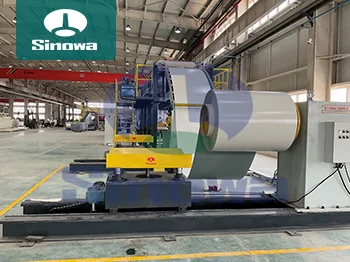
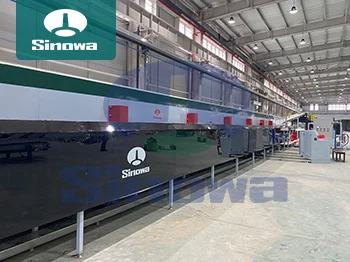
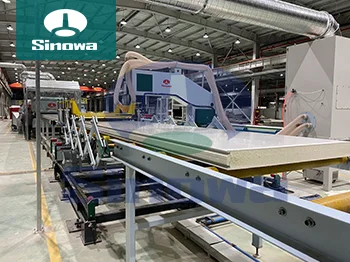
The high-tech insulated sandwich panel line can meet a variety of production needs of customers, the whole insulated sandwich panel line design concept of modularization enables all our components to be integrated and combined at will. Our high efficiency insulated sandwich panel line can easily automate the production of roof sandwich panel, wall sandwich panel, cold storage sandwich panel and other products by different combination and configuration selection and siple switching. The inner core layer can be polyrethane or rock wool, glass wool, an so on.


The high precision insulated sandwich panel line has high adaptability, which may produce various sandwich panel of the PU, PIR and rock wool systems. We may design various products according to the customer’s requirements, including various configurations, so as to meet their demands with flexible price system. Highly integrated and linked control system centralizes all control points at the main central center, achieving parameter linkage, fault self-diagnosis controlled by the whole line and shipping distance control. High-level automatic control system also saves the manpower and reduces the manpower loss for customers.


The precision servo hoisting mechanism employed by the main engine without hydraulic system makes the board thickness control flexible and the customer may conveniently change or adjust the board thickness. There will be not such troubles as hydraulic system adjustment, leakage, maintenance, etc.


High-level energy saving and protection design makes the whole insulated sandwich panel line possible to produce around the clock throughout the year and the customer will save huge budget. In addition, the isolated heat preservation room is constructed for warming the environment. The energy saving and protection design of our manufacturing line may guarantee that the customer’s production line may be freely heated and produce in the main time to save more costs for customers.


The high-power low-consumption design quickens the reaction of the cheap insulated sandwich panel line while energy consumption is kept low. With the brand-new, fully sealed inner insulation design, the energy consumption is controlled at the minimum level to achieve the design objective of less than an hour for the insulation system to be activated from the room temperature above 5℃ to the production process temperature. The energy consumption is only 40% that of those similar products.
An insulated sandwich panel line is a set of integrated industrial equipment designed for continuously manufacturing insulated sandwich panels, which are widely applied in construction, logistics, industrial facilities and other fields. This production line combines multiple functional systems to realize automated and efficient production, reducing manual intervention and ensuring consistent product quality. It usually consists of feeding, forming, bonding, curing, cutting and packaging systems, each playing a vital role in the whole production process. The production starts with feeding raw materials, including outer facing materials and insulation core materials such as rock wool, polyurethane or glass wool, which are then processed and transported to the forming system. In the bonding process, the core material is firmly attached to the outer layers under controlled temperature and pressure, ensuring strong adhesion and structural stability. After forming, the panels go through a curing process to enhance their performance, followed by precise cutting according to required specifications. The final step is packaging to protect the finished panels during transportation and storage. This production line features high efficiency, energy saving and environmental friendliness, as it adopts automated technology to reduce energy consumption and can utilize recyclable raw materials. The insulated sandwich panels produced have excellent thermal insulation, sound insulation, fire resistance and lightweight properties, meeting the diverse needs of modern construction and industrial development. With the increasing emphasis on energy conservation and environmental protection, the insulated sandwich panel line is becoming more and more important in promoting sustainable development in related industries.
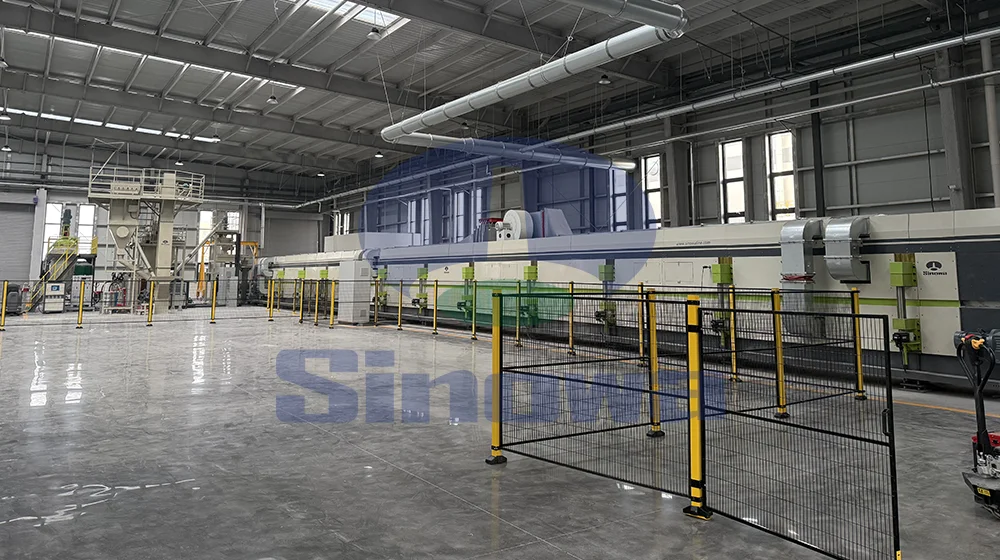
The Insulated Sandwich Panel Line stands as a cornerstone in modern manufacturing, enabling the mass production of composite panels that have revolutionized the construction and industrial sectors with their exceptional thermal efficiency, structural integrity, and versatility. These production lines are engineered to transform raw materials into finished panels through a series of precision coordinated processes, ensuring consistency, quality, and efficiency that meet the evolving demands of diverse applications. From industrial warehouses and cold storage facilities to commercial buildings and modular constructions, the panels produced by these lines have become indispensable, driven by the global emphasis on energy conservation, sustainable building practices, and rapid construction timelines.
At the core of the Insulated Sandwich Panel Line is a sequence of integrated stages, each designed to refine and assemble the key components of the sandwich panel: the outer facing materials, the insulating core, and the bonding agents that ensure structural cohesion. The process typically commences with the preparation of the facing materials, which are most commonly metal coils—such as galvanized or color-coated steel—due to their durability, corrosion resistance, and structural strength. These coils are loaded onto decoilers, which unwind the material at a controlled speed to feed the subsequent stages. The unwound metal sheets then pass through profiling equipment, where they are shaped into specific profiles or textures tailored to the intended application. This profiling not only enhances the aesthetic appeal of the final panels but also improves their mechanical performance, such as resistance to wind loads or structural rigidity.
Prior to the introduction of the insulating core, the profiled facing materials undergo a preheating process, a critical step that ensures optimal adhesion between the facing and the core. The preheating tunnel, equipped with modular infrared heating units, carefully regulates the temperature of the upper and lower metal sheets—typically between 40 to 60 degrees Celsius—depending on the type of core material and adhesive used. Sensors positioned just before the foaming area monitor the temperature of each sheet, ensuring consistency and preventing issues such as poor foam adhesion or uneven curing. This preheating stage is particularly important for maintaining the longevity of the panels, as inadequate adhesion can lead to delamination over time, compromising both thermal performance and structural safety.
The next stage in the production line is the formulation and application of the insulating core, a component that defines the panel’s thermal, acoustic, and fire-resistant properties. The choice of core material varies based on application requirements, with common options including polyurethane (PU), polyisocyanurate (PIR), expanded polystyrene (EPS), and mineral wool. Each material offers distinct advantages: PU and PIR cores excel in thermal insulation and are lightweight, making them ideal for cold storage and energy-efficient buildings; mineral wool cores provide superior fire resistance and acoustic insulation, suitable for high-risk environments such as industrial facilities or public buildings; while EPS cores offer cost-effectiveness and good thermal performance for general construction applications.
The production of foam-based cores (PU, PIR, EPS) involves a precise mixing process carried out by high-pressure metering machines. These machines consist of tanks, pumps, and measuring equipment that deliver a perfect combination of chemical components—such as isocyanate, polyol, foaming agents, catalysts, and flame retardants—to a high-pressure mixing head. Operating at pressures between 120 to 200 bar, the mixing head ensures thorough blending of the components, resulting in a foam with a uniform cell structure that enhances thermal insulation and structural stability. Unlike low-pressure foaming equipment, which can produce uneven foam and require environmentally harmful solvents for cleaning, high-pressure systems feature automatic circulation cleaning devices that use high-pressure airflow to eliminate residue, making the process more efficient, safe, and eco-friendly. For mineral wool cores, the production line incorporates equipment for cutting, preparing, and gluing the mineral wool sheets to the facing materials, ensuring a secure bond and consistent core thickness.
Once the core material is formulated, it is precisely poured or placed between the two preheated facing sheets, which then move into the double belt laminator—the heart of the production line. This continuous press consists of two parallel belts that apply uniform pressure to the assembled panel, ensuring proper bonding between the facing materials and the core. The double belt laminator is engineered for durability and precision, with thick plates or slats that maintain flatness tolerances and can be re-ground on-site to preserve production quality. The modular design of the laminator allows for adjustments in length to accommodate different production requirements and factory floor space constraints. As the panel passes through the laminator, the core material undergoes a curing process—facilitated by the controlled temperature and pressure—transforming from a liquid or semi-solid state into a rigid, stable structure.
Following lamination and curing, the continuous panel is fed into a cutting system, where it is trimmed to the desired length using precision cutting tools. These cutting systems are equipped with sensors and automated controls to ensure accurate dimensions, minimizing waste and ensuring that the panels meet the exact specifications of construction projects. After cutting, the finished panels are transferred to a stacking system, which organizes them into neat bundles for storage or transportation. This automated stacking process reduces manual labor, improves efficiency, and prevents damage to the panels during handling.
Quality control is an integral part of the Insulated Sandwich Panel Line, with monitoring systems integrated at every stage of production. Sensors track the temperature of the facing materials during preheating, the pressure and mixing ratio of the core components, and the thickness and flatness of the panels during lamination. Visual inspection stations, often equipped with ATEX LED lamps for clear visibility, allow operators to check for surface defects, such as cracks, delamination, or uneven coating. These quality control measures ensure that each panel meets the required standards for thermal performance, structural strength, and durability, reducing the risk of product failures and ensuring customer satisfaction.
The versatility of the Insulated Sandwich Panel Line is evident in its ability to produce panels for a wide range of applications. In the construction sector, these panels are used for exterior walls, roofs, and partition walls in industrial buildings, commercial centers, and residential structures. Their excellent thermal insulation properties help reduce energy consumption for heating and cooling, contributing to more sustainable and cost-effective buildings. In the cold chain logistics industry, panels with PU or PIR cores are essential for refrigerated warehouses, freezers, and food processing facilities, as they maintain consistent low temperatures and prevent heat transfer. For cleanroom applications—such as in pharmaceutical or electronics manufacturing—panels with smooth, non-porous surfaces and airtight seals prevent contamination, ensuring compliance with strict hygiene standards. Additionally, the lightweight and modular nature of the panels makes them ideal for prefabricated and modular construction, enabling rapid assembly and reducing construction timelines significantly.
Environmental considerations have become increasingly important in the design and operation of Insulated Sandwich Panel Lines. Manufacturers have adopted eco-friendly practices such as using pentane-based foaming agents—replacing ozone-depleting substances like Freon—and implementing energy-efficient heating and cooling systems. The high-pressure mixing equipment’s automatic cleaning process eliminates the need for harmful solvents, reducing environmental pollution. Furthermore, the panels themselves contribute to sustainability by improving the energy efficiency of buildings, reducing carbon emissions, and being recyclable at the end of their lifecycle. The shift toward prefabricated construction using these panels also minimizes construction waste, as the panels are manufactured to precise specifications in a controlled factory environment, unlike traditional on-site construction which generates significant waste.
Technological advancements continue to drive innovation in Insulated Sandwich Panel Lines, with a focus on automation, efficiency, and performance. Modern production lines incorporate advanced control systems that enable integrated linkage control of all stages, from decoiling to stacking. These systems use bus control technology and human-machine interaction interfaces, allowing operators to monitor and adjust production parameters in real-time. Remote monitoring and diagnostic capabilities have also been introduced, enabling manufacturers to troubleshoot issues and optimize production from off-site locations. Innovations in core material technology, such as the development of fire-retardant and recycled insulation materials, further enhance the performance and sustainability of the panels produced by these lines.
The global demand for insulated sandwich panels is expected to grow steadily in the coming years, driven by increasing industrialization, urbanization, and the tightening of energy efficiency and fire safety regulations. This growth will continue to fuel the development of more advanced and efficient Insulated Sandwich Panel Lines, capable of meeting the diverse and evolving needs of the construction and industrial sectors. As the focus on sustainable building practices intensifies, these production lines will play an increasingly vital role in providing high-quality, energy-efficient, and environmentally friendly building materials that contribute to a more sustainable future.
In conclusion, the Insulated Sandwich Panel Line is a sophisticated and essential manufacturing system that has transformed the way we build and construct. Through its integrated processes, precision engineering, and commitment to quality, it produces panels that offer exceptional thermal efficiency, structural strength, and versatility. From the preparation of raw materials to the final stacking of finished products, every stage of the production line is designed to ensure consistency, efficiency, and sustainability. As technology advances and global demands evolve, the Insulated Sandwich Panel Line will continue to innovate, providing solutions that meet the challenges of modern construction and contribute to a more energy-efficient and sustainable built environment. Whether for industrial warehouses, cold storage facilities, commercial buildings, or modular constructions, the panels produced by these lines have become a cornerstone of modern construction, enabling faster, safer, and more sustainable building practices worldwide.
« Insulated Sandwich Panel Line » Update Date: 2026/4/20
URL: https://www.sinowamachine.com/tags/insulated-sandwich-panel-line.html
- Links:
- Sandwich Panel Continuous Production Line
- Automatic and Continuous Sandwich Panel Production Line
- Cheap and Low Price Sandwich Panel Production Line
- China Sandwich Panel Production Line Factory
- Color Steel Sandwich Panel Production Line For Cold Storage
- Continuous Composite Foam Sandwich Panel Production Line
- Continuous Production Line For Rockwool and Mineral Wool Sandwich Panels
- Continuous PU Phenolic Insulation Panel Production Line
- Continuous PU PIR Sandwich Panel Production Line
- Continuous PUF PUR Sandwich Panel Production Line
- Continuous Sandwich Panel Production Line For Roof and Wall
- Customized and Design Sandwich Panel Production Line
- Decorative Sandwich Panel Production Line For Glass Wool Boards
- High Quality Sandwich Panel Production Line For Sale
- Polyurethane(PU) Sandwich Panel Production Line
- Sandwich Panel Production Line Manufacturer and Supplier
- Sandwich Panel Production Machinery and Equipment