
Mineral Wool Board Production Line
Sinowa is a mineral wool board production line supplier from china, customized high-quality & high efficiency mineral wool board production line at low price, the adoption of system integration technology and bus control technology accomplishes the full automatization of integrated and coordinated control of the mineral wool board production line with accessible remote interactive communication. Ranking the first-class level in the world, it is currently the mineral wool board production line in the market taking a comprehensive lead in high performance.
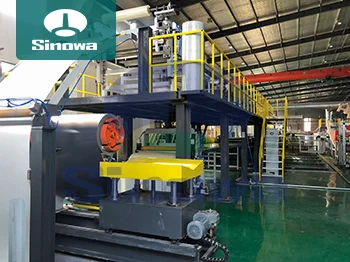
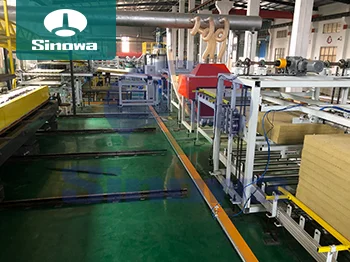
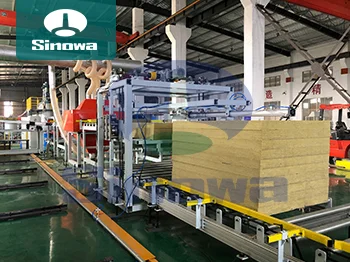
The high-tech mineral wool board production line can meet a variety of production needs of customers, the whole mineral wool board production line design concept of modularization enables all our components to be integrated and combined at will. Our high efficiency mineral wool board production line can easily automate the production of roof sandwich panel, wall sandwich panel, cold storage sandwich panel and other products by different combination and configuration selection and siple switching. The inner core layer can be polyrethane or rock wool, glass wool, an so on. The precision servo hoisting mechanism employed by the main engine without hydraulic system makes the board thickness control flexible and the customer may conveniently change or adjust the board thickness. There will be not such troubles as hydraulic system adjustment, leakage, maintenance, etc.
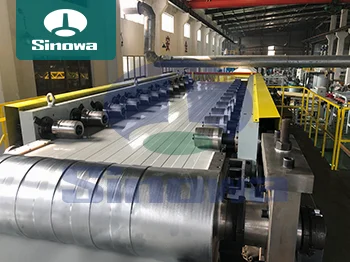
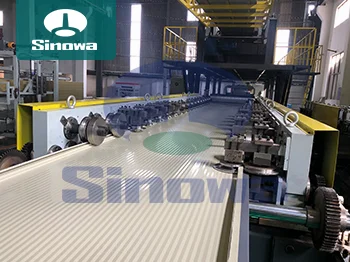
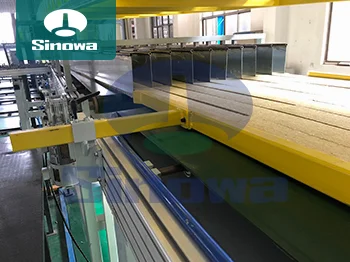
The high precision mineral wool board production line has high adaptability, which may produce various sandwich panel of the PU, PIR and rock wool systems. We may design various products according to the customer’s requirements, including various configurations, so as to meet their demands with flexible price system. Highly integrated and linked control system centralizes all control points at the main central center, achieving parameter linkage, fault self-diagnosis controlled by the whole line and shipping distance control. High-level automatic control system also saves the manpower and reduces the manpower loss for customers. High-level energy saving and protection design makes the whole mineral wool board production line possible to produce around the clock throughout the year and the customer will save huge budget. In addition, the isolated heat preservation room is constructed for warming the environment. The energy saving and protection design of our manufacturing line may guarantee that the customer’s production line may be freely heated and produce in the main time to save more costs for customers.
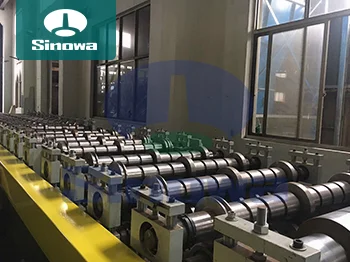
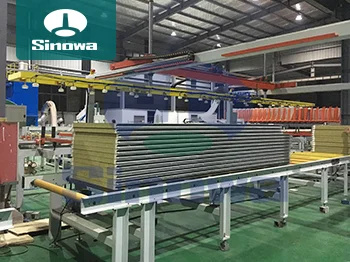
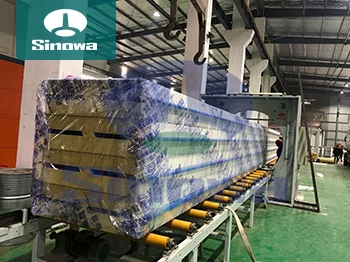
The high-power low-consumption design quickens the reaction of the cheap mineral wool board production line while energy consumption is kept low. With the brand-new, fully sealed inner insulation design, the energy consumption is controlled at the minimum level to achieve the design objective of less than an hour for the insulation system to be activated from the room temperature above 5℃ to the production process temperature. The energy consumption is only 40% that of those similar products.
A mineral wool board production line is a sophisticated and integrated set of equipment designed to transform raw materials into high-quality mineral wool boards through a series of systematic and precise processes. These production lines are engineered to ensure consistency, efficiency, and adaptability, catering to the diverse needs of various industries that rely on mineral wool boards for their exceptional properties. Unlike simple manufacturing setups, a complete mineral wool board production line consists of multiple interconnected systems, each playing a crucial role in the overall production process, from raw material preparation to the final packaging of finished products. The structure of the production line is carefully designed to optimize workflow, minimize energy consumption, and ensure the production of boards that meet strict quality standards, making it an indispensable asset in the manufacturing of mineral wool products.
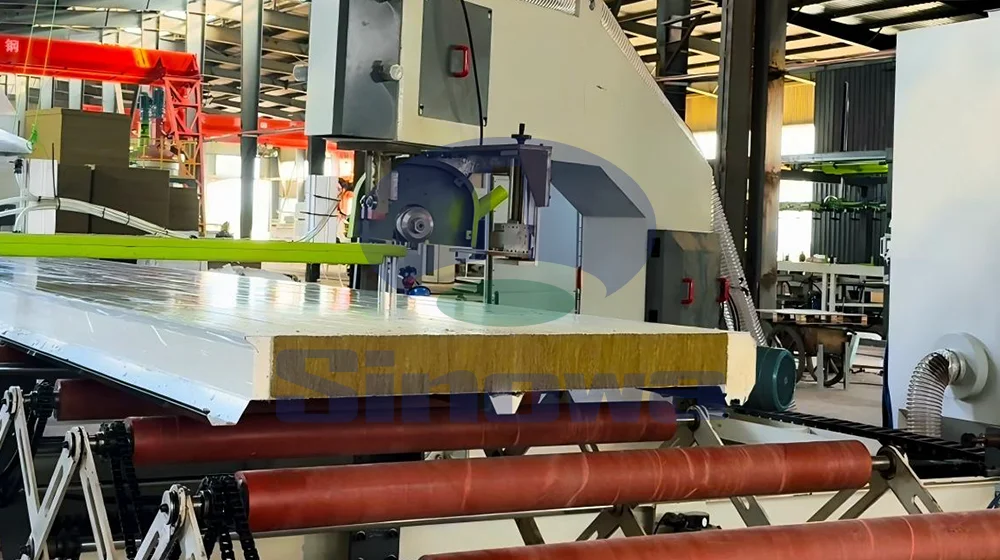
The structure of a mineral wool board production line is composed of several core systems that work in harmony to complete the entire production cycle. At the starting point of the line is the raw material preparation system, which is responsible for receiving, storing, screening, and mixing the necessary raw materials. Common raw materials used in mineral wool board production include natural minerals such as basalt, dolomite, and diabase, as well as recycled materials like slag and cullet, which not only reduce environmental impact but also lower production costs. The raw material preparation system typically includes a working platform with a side-turning vehicle walking platform, allowing side-turning vehicles to transport raw materials to designated material silos. Each material silo is designed with an inclined bottom and an automatic vibrating discharge port, ensuring a steady and controlled flow of raw materials. Below the discharge ports, weighing day silos are installed to accurately measure the proportion of each raw material, which is crucial for maintaining the consistent quality of the final product. The weighed raw materials are then transferred to a mixing hopper, where they are thoroughly mixed before being conveyed to the next stage of the production process by a horizontal belt conveyor and an elevator.
Following the raw material preparation system is the melting furnace system, which is the core of the production line as it converts solid raw materials into a molten state. The melting furnace system often includes a preheating furnace and a main melting furnace, with the preheating furnace used to preheat raw materials before they enter the main melting furnace, reducing energy consumption and improving melting efficiency. The main melting furnace is equipped with heating devices, usually made of silicon molybdenum rods and protective tubes, which heat the raw materials to extremely high temperatures, typically between 1300°C and 1500°C, until they melt into a homogeneous liquid. An overflow channel connects the melting furnace to a speed-regulating and temperature-adjusting insulation bath, which adjusts the composition uniformity and acidity of the molten material to ensure optimal fiber formation. The design of the melting furnace system is focused on energy efficiency and environmental protection, with exhaust gas filtration and flue gas cleaning systems to minimize environmental impact.
After the melting process, the molten material is transferred to the fiber forming system, which transforms the liquid into fine mineral fibers. This system typically uses a centrifuge, which rotates at high speed to spin the molten material into thin fiber filaments. During the fiber forming process, atomized adhesives are sprayed onto the fiber surface through nozzles to enhance the bonding force between fibers, which is essential for the strength and stability of the final mineral wool board. The fiber forming system is a critical component that directly affects the quality of the fibers, and thus the performance of the finished product. The speed of the centrifuge, the temperature of the molten material, and the amount of adhesive sprayed are all precisely controlled to ensure the production of fibers with consistent thickness and properties.
Once the fibers are formed, they are transferred to the cotton collection and paving system. This system includes a horn-shaped swing hopper that collects the fibers and swings left and right along the edge of the discharge port to fold the fibers and pave them evenly on the paving machine. This folding and paving process ensures that the mineral wool board has a uniform thickness and density, which is crucial for its mechanical and thermal properties. The cotton collection and paving system also includes a pre-pressing unit, which uses a sweeping roller and a pre-press to initially shape the fiber mat. The pre-press can be either a continuous roller pre-press or a continuous flat pre-press, depending on the specific production requirements, and it applies a moderate pressure to compact the fibers and prepare them for the curing process.
The curing forming system is the next stage in the production line, where the pre-pressed fiber mat is transferred to a curing furnace for further processing. The curing furnace uses electric heating to maintain a specific temperature and pressure, which promotes the curing of the adhesive and the formation of a solid mineral wool board. The temperature and pressure in the curing furnace are precisely controlled to ensure that the board achieves the desired strength, density, and thermal insulation properties. After curing, the board is transferred to a servo cross-cutting system, which cuts the board along the direction perpendicular to its movement to obtain a neat cross-section that meets the required dimensions for the next stage. The servo cross-cutting system ensures high precision cutting, minimizing waste and ensuring consistency in the size of the finished boards.
Following the cross-cutting process, the mineral wool board undergoes a hot-pressing process in the hot-pressing system. The hot-press can be either a multi-station intermittent hot-press or a continuous hot-press, and it applies high pressure and temperature to the board to further increase its density and strength. The hot-pressing temperature typically ranges from 250°C to 700°C, and the pressure ranges from 1 MPa to 100 MPa, with the duration of the hot-pressing process ranging from 3 minutes to 20 minutes, depending on the desired properties of the board. After hot-pressing, the board is cut to the final required size by the cutting system, which can be adjusted to produce boards of different lengths, widths, and thicknesses to meet the diverse needs of customers. Finally, the finished mineral wool boards are transferred to the packaging system, where they are packaged, either directly or after being laminated with other materials such as paper, aluminum foil, or glass fiber cloth, for storage and transportation.
In addition to these core systems, a modern mineral wool board production line is also equipped with intelligent control systems and remote visualization systems, which allow for seamless operation and precise control of the entire production process. The intelligent control system, often based on a programmable logic controller (PLC), integrates the control of all components of the production line into a single control console, enabling operators to monitor and adjust production parameters in real-time. The remote visualization system allows for remote monitoring and operation of the production line, reducing the need for on-site personnel and improving operational efficiency. These additional systems enhance the automation level of the production line, reduce human error, and ensure the stability and consistency of product quality.
The performance of a mineral wool board production line is determined by its efficiency, stability, adaptability, energy efficiency, and environmental friendliness. Efficiency is a key performance indicator, with modern production lines capable of achieving high hourly and annual output rates. The hourly output can range from 1.5 tons to 4.5 tons, depending on the type and configuration of the line, while the annual output can reach 15,000 tons to 30,000 tons or more. The high efficiency of the production line is achieved through the integration of automated systems, which minimize manual intervention and streamline the production process. Stability is another important performance characteristic, as the production line must operate continuously for long periods without breakdowns to ensure consistent production. The use of high-quality components and precise control systems ensures the stability of the production line, reducing downtime and maintenance costs.
Adaptability is a crucial performance feature of mineral wool board production lines, as they must be able to produce a wide range of mineral wool boards with different properties and specifications. The modular design of modern production lines allows for easy integration and combination of components, enabling the production of different types of boards by simply adjusting the configuration and parameters. For example, the production line can be adjusted to produce high-density mineral wool boards with a density of 250 kg/m³ to 1500 kg/m³, or low-density boards with a density of 40 kg/m³ to 200 kg/m³, depending on the application requirements. The production line can also be configured to produce boards of different thicknesses, ranging from 30 mm to 250 mm, and widths from 300 mm to 1200 mm, ensuring that it can meet the diverse needs of various industries.
Energy efficiency is an increasingly important performance indicator for mineral wool board production lines, as manufacturers seek to reduce energy consumption and operating costs. Modern production lines adopt a range of energy-saving technologies, such as preheating raw materials, using efficient heating devices, and recycling waste heat. The use of recycled raw materials also contributes to energy efficiency, as recycling materials requires less energy than processing raw materials from scratch. Additionally, the closed-loop water system used in the production process reduces freshwater consumption and avoids polluted water discharges, further enhancing the environmental friendliness of the production line. The environmental performance of the production line is also improved through the use of exhaust gas treatment systems and waste recycling devices, which minimize dust emissions and waste generation, ensuring compliance with environmental regulations.
The types of mineral wool board production lines can be classified based on several criteria, including production capacity, automation level, product type, and heating method. Based on production capacity, production lines can be divided into small, medium, and large-scale lines. Small-scale lines typically have an annual output of less than 15,000 tons, suitable for small manufacturers or those with limited market demand. Medium-scale lines have an annual output of 15,000 tons to 25,000 tons, balancing production capacity and investment costs. Large-scale lines have an annual output of more than 25,000 tons, designed for large manufacturers with high market demand and economies of scale.
Based on the level of automation, mineral wool board production lines can be divided into manual, semi-automatic, and fully automatic lines. Manual lines require a high level of manual intervention, with operators responsible for feeding raw materials, adjusting parameters, and handling finished products. These lines are suitable for small-scale production and have lower investment costs but higher labor costs and lower efficiency. Semi-automatic lines integrate some automated systems, such as automatic feeding and cutting, reducing manual intervention and improving efficiency. Fully automatic lines are the most advanced, with all processes from raw material preparation to packaging controlled by automated systems and intelligent control systems. These lines require minimal manual intervention, offer high efficiency, consistent product quality, and are suitable for large-scale production.
Another classification criterion is the type of product produced. Some production lines are designed specifically for producing standard mineral wool boards, which are used for general insulation and sound absorption applications. Other lines are specialized in producing high-density mineral wool boards, which have higher strength and are suitable for load-bearing applications. There are also production lines that produce mineral wool composite boards, which are laminated with other materials such as color steel plates, aluminum foil, or polyurethane foam to enhance their performance and expand their application range. Additionally, some production lines are designed to produce mineral wool boards with special properties, such as fire-resistant, waterproof, or corrosion-resistant boards, to meet the specific needs of certain industries.
Based on the heating method, mineral wool board production lines can be divided into electric heating lines and fuel heating lines. Electric heating lines use electric heating devices, such as silicon molybdenum rods, to heat the melting furnace, offering precise temperature control, low environmental impact, and easy operation. These lines are suitable for areas with abundant electricity supply and strict environmental requirements. Fuel heating lines use fuels such as natural gas, coal, or oil to heat the melting furnace, offering lower energy costs in areas with abundant fuel resources but may have higher environmental emissions, requiring additional exhaust gas treatment systems.
The applications of mineral wool board production lines are closely linked to the applications of the mineral wool boards they produce, which are widely used in various industries due to their excellent properties such as thermal insulation, sound absorption, fire resistance, and corrosion resistance. One of the main applications of mineral wool boards is in the construction industry, where they are used for external wall insulation, roof insulation, internal wall insulation, and fire partitions. In external wall insulation, mineral wool boards help to reduce energy consumption by minimizing heat transfer between the interior and exterior of buildings, improving energy efficiency and reducing heating and cooling costs. Roof insulation with mineral wool boards prevents heat loss in winter and heat gain in summer, creating a more comfortable indoor environment. Internal wall insulation and fire partitions use the fire-resistant properties of mineral wool boards to enhance the fire safety of buildings, slowing down the spread of fire and protecting the structure of the building and the safety of occupants.
Mineral wool boards produced by these production lines are also widely used in the industrial sector. In industrial plants, they are used to insulate pipes, boilers, and other equipment, reducing heat loss and improving energy efficiency. They are also used as sound absorption materials in industrial workshops, reducing noise pollution and creating a more comfortable working environment. In the automotive industry, mineral wool boards are used as insulation and sound absorption materials in vehicle interiors, improving the comfort of the vehicle and reducing noise. In the shipbuilding industry, mineral wool boards are used for thermal insulation and fire protection in ships, ensuring the safety and comfort of the ship's interior.
Another important application area is the HVAC (Heating, Ventilation, and Air Conditioning) industry. Mineral wool boards are used in the insulation of HVAC ducts, reducing heat loss and ensuring the efficiency of the heating and cooling systems. They also help to reduce noise generated by the ducts, improving the indoor environment. In addition, mineral wool boards are used in the packaging industry as protective packaging materials, thanks to their lightweight and shock-absorbing properties. They are used to package fragile items such as glass, ceramics, and electronic equipment, providing protection during transportation and storage.
Mineral wool boards are also used in the renewable energy sector, particularly in solar energy and wind energy applications. In solar energy systems, they are used to insulate solar water heaters and solar panels, improving their efficiency by reducing heat loss. In wind energy systems, they are used to insulate wind turbine nacelles, protecting the internal components from extreme temperatures and ensuring the reliable operation of the turbines. Additionally, mineral wool boards are used in the aerospace industry as insulation materials for aircraft cabins and components, providing thermal insulation and sound absorption in extreme environments.
The versatility of mineral wool board production lines allows them to cater to the needs of these diverse application areas, making them an essential part of the manufacturing industry. As the demand for energy-efficient and environmentally friendly materials continues to grow, the importance of mineral wool board production lines is expected to increase. Manufacturers are constantly innovating and improving the design and performance of these production lines, integrating new technologies such as artificial intelligence and the Internet of Things to further enhance efficiency, reduce energy consumption, and improve product quality. This continuous innovation ensures that mineral wool board production lines remain at the forefront of the manufacturing industry, providing high-quality mineral wool boards that meet the evolving needs of various industries.
In summary, a mineral wool board production line is a complex and integrated system that plays a crucial role in the manufacturing of mineral wool boards. Its structure is composed of several core systems, each contributing to the efficient and consistent production of high-quality boards. The performance of the production line is characterized by its efficiency, stability, adaptability, energy efficiency, and environmental friendliness, ensuring that it can meet the diverse needs of manufacturers and industries. The types of production lines are diverse, classified based on production capacity, automation level, product type, and heating method, allowing manufacturers to choose the most suitable line for their specific needs. The applications of these production lines are wide-ranging, covering the construction, industrial, automotive, shipbuilding, HVAC, packaging, renewable energy, and aerospace industries, making them an indispensable asset in modern manufacturing. As technology continues to advance, mineral wool board production lines will continue to evolve, providing more efficient, sustainable, and high-performance solutions for the production of mineral wool boards.
« Mineral Wool Board Production Line » Update Date: 2026/4/13
URL: https://www.sinowamachine.com/tags/mineral-wool-board-production-line.html
- Links:
- Sandwich Panel Continuous Production Line
- Automatic and Continuous Sandwich Panel Production Line
- Cheap and Low Price Sandwich Panel Production Line
- China Sandwich Panel Production Line Factory
- Color Steel Sandwich Panel Production Line For Cold Storage
- Continuous Composite Foam Sandwich Panel Production Line
- Continuous Production Line For Rockwool and Mineral Wool Sandwich Panels
- Continuous PU Phenolic Insulation Panel Production Line
- Continuous PU PIR Sandwich Panel Production Line
- Continuous PUF PUR Sandwich Panel Production Line
- Continuous Sandwich Panel Production Line For Roof and Wall
- Customized and Design Sandwich Panel Production Line
- Decorative Sandwich Panel Production Line For Glass Wool Boards
- High Quality Sandwich Panel Production Line For Sale
- Polyurethane(PU) Sandwich Panel Production Line
- Sandwich Panel Production Line Manufacturer and Supplier
- Sandwich Panel Production Machinery and Equipment