
PU Board Production Line
Sinowa is a pu board production line supplier from china, customized high-quality & high efficiency pu board production line at low price, the adoption of system integration technology and bus control technology accomplishes the full automatization of integrated and coordinated control of the pu board production line with accessible remote interactive communication. Ranking the first-class level in the world, it is currently the pu board production line in the market taking a comprehensive lead in high performance.
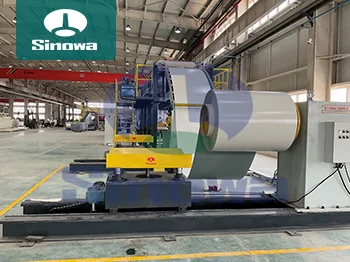
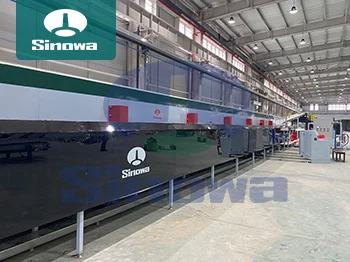
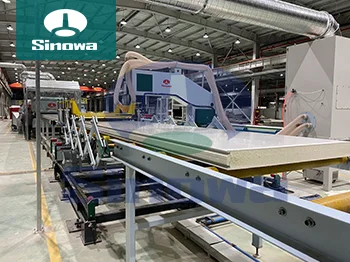
The high-tech pu board production line can meet a variety of production needs of customers, the whole pu board production line design concept of modularization enables all our components to be integrated and combined at will. Our high efficiency pu board production line can easily automate the production of roof sandwich panel, wall sandwich panel, cold storage sandwich panel and other products by different combination and configuration selection and siple switching. The inner core layer can be polyrethane or rock wool, glass wool, an so on.


The high precision pu board production line has high adaptability, which may produce various sandwich panel of the PU, PIR and rock wool systems. We may design various products according to the customer’s requirements, including various configurations, so as to meet their demands with flexible price system. Highly integrated and linked control system centralizes all control points at the main central center, achieving parameter linkage, fault self-diagnosis controlled by the whole line and shipping distance control. High-level automatic control system also saves the manpower and reduces the manpower loss for customers.


The precision servo hoisting mechanism employed by the main engine without hydraulic system makes the board thickness control flexible and the customer may conveniently change or adjust the board thickness. There will be not such troubles as hydraulic system adjustment, leakage, maintenance, etc.


High-level energy saving and protection design makes the whole pu board production line possible to produce around the clock throughout the year and the customer will save huge budget. In addition, the isolated heat preservation room is constructed for warming the environment. The energy saving and protection design of our manufacturing line may guarantee that the customer’s production line may be freely heated and produce in the main time to save more costs for customers.


The high-power low-consumption design quickens the reaction of the cheap pu board production line while energy consumption is kept low. With the brand-new, fully sealed inner insulation design, the energy consumption is controlled at the minimum level to achieve the design objective of less than an hour for the insulation system to be activated from the room temperature above 5℃ to the production process temperature. The energy consumption is only 40% that of those similar products.
Polyurethane (PU) board production lines are integrated industrial systems designed to transform raw materials into high-performance PU boards through a series of coordinated processes, combining mechanical, electrical, and chemical technologies to achieve efficient, standardized, and high-quality production. These production lines play a crucial role in various industries by providing versatile PU boards with excellent thermal insulation, structural strength, and durability, making them indispensable equipment in modern manufacturing.
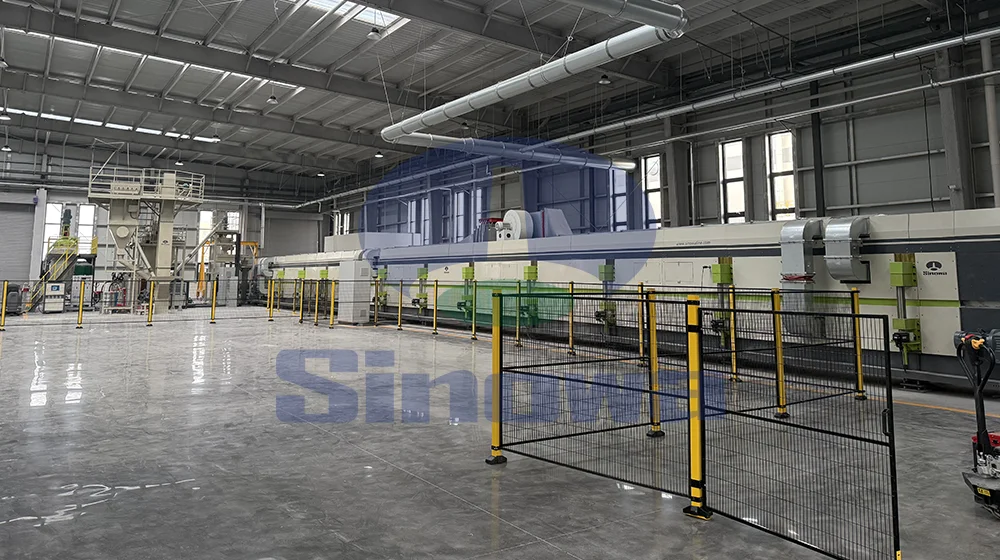
The structure of a PU board production line is a modular system composed of several core components that work in tandem to complete the entire manufacturing process from raw material preparation to finished product stacking. Each component is designed to perform specific functions, and their seamless coordination ensures the stability and efficiency of the production line. The raw material storage and temperature control system is one of the foundational components, as PU raw materials such as polyol and isocyanate are sensitive to temperature changes. This system typically includes insulated storage tanks equipped with temperature control devices to maintain the raw materials at a stable temperature, ensuring consistent reaction performance during the mixing and foaming process. The temperature control system can automatically adjust the heating or cooling equipment according to the ambient temperature and raw material requirements, preventing the raw materials from deteriorating or losing their reactivity, which directly affects the quality of the final PU boards.
Following the raw material storage system is the metering and mixing system, which is critical for ensuring the precise ratio of raw materials. This system consists of high-precision metering pumps and a high-speed mixing head. The metering pumps accurately deliver polyol, isocyanate, foaming agents, catalysts, and other additives according to the preset ratio, ensuring that each component is mixed in the optimal proportion. The high-speed mixing head is designed to achieve full and uniform mixing of the raw materials in a very short time, as the reaction between PU raw materials is rapid and requires thorough mixing to avoid uneven foaming. The mixing head often adopts a special structure with rotating blades or high-pressure injection nozzles, which can break down the raw material particles and promote the formation of a homogeneous mixture, laying the foundation for high-quality foaming.
The foaming and forming system is the core part of the PU board production line, where the mixed raw materials are transformed into PU foam and formed into boards of specific shapes and sizes. This system usually includes a foaming machine, a forming mold or double-track conveyor, and a heating and curing device. The foaming machine injects the mixed raw materials into the forming mold or between the upper and lower surface materials, and the raw materials undergo a chemical reaction to generate gas, expanding and forming a foam structure. For continuous production lines, the double-track conveyor provides a stable platform for the foaming and curing process, with the upper and lower tracks maintaining a constant temperature and pressure to ensure uniform foaming and solidification. The heating and curing device uses hot air circulation or electric heating to control the temperature of the foaming environment, accelerating the curing speed of the PU foam and improving its structural stability. During the foaming process, the pressure and temperature are strictly controlled to avoid the formation of bubbles, cracks, or uneven density in the foam, which would affect the mechanical properties of the final PU boards.
After the foaming and curing process, the cutting and trimming system processes the formed PU boards into the required specifications. This system includes trimming devices and a fixed-length cutting machine. The trimming devices remove the excess material on both sides of the board to ensure the width accuracy of the product, while the fixed-length cutting machine cuts the continuous board into sections of preset length according to the production requirements. The cutting equipment is usually equipped with high-precision saw blades or cutting wires, and the cutting speed is synchronized with the production line speed to ensure smooth and flat cuts, avoiding damage to the board surface or internal structure. Some advanced cutting systems also adopt numerical control technology, which can automatically adjust the cutting parameters according to the product specifications, improving the cutting accuracy and efficiency.
The conveying and stacking system is the final component of the PU board production line, responsible for transporting the finished boards from the cutting system to the storage area and stacking them neatly. This system includes roller conveyors, belt conveyors, and automatic stacking machines. The conveyors ensure the smooth transportation of the boards without causing scratches or deformation, while the automatic stacking machine uses mechanical arms or suction cups to stack the boards in an orderly manner, reducing manual intervention and improving production efficiency. The stacking system can also be equipped with a film wrapping device to wrap the stacked boards, preventing dust, moisture, or damage during storage and transportation.
In addition to these core components, modern PU board production lines are also equipped with an electrical control and monitoring system, which serves as the "brain" of the entire production line. This system consists of a programmable logic controller (PLC), a human-machine interface (HMI), sensors, and a fault detection system. The PLC controls the operation of each component in a coordinated manner, ensuring that the production process is carried out in an orderly and synchronized manner. The HMI allows operators to set production parameters, monitor the operation status of the production line, and adjust the process in real time. The sensors detect various parameters such as temperature, pressure, and speed during the production process, and the fault detection system can quickly identify abnormal conditions and issue alarms, helping operators troubleshoot problems in a timely manner, reducing production downtime, and ensuring the stability of the production line.
The performance of a PU board production line directly determines the quality of the PU boards and the efficiency of the production process, with key performance indicators including automation level, production efficiency, product precision, energy efficiency, and environmental friendliness. The automation level of modern PU board production lines is constantly improving, with most systems achieving full-process automation from raw material feeding to finished product stacking. This not only reduces the need for manual intervention, lowers labor costs, but also avoids human errors, ensuring consistent product quality. The integration of mechanical, electrical, and hydraulic systems enables the production line to operate continuously and stably, with minimal manual operation required, which is particularly important for large-scale mass production.
Production efficiency is another important performance indicator, which is usually measured by the output per unit time. The efficiency of PU board production lines varies according to their types and configurations, with continuous production lines having a higher output than discontinuous ones. Continuous production lines can achieve 24-hour continuous operation, with a production speed that can be adjusted according to the process requirements, usually ranging from a few meters to tens of meters per minute. The high efficiency of these production lines is attributed to their modular design, synchronized operation of each component, and advanced control systems, which minimize production interruptions and maximize the utilization of equipment and raw materials. In contrast, discontinuous production lines have a lower output, but they are more flexible and suitable for small-batch production of special-sized or complex boards.
Product precision is crucial for ensuring the quality and applicability of PU boards, and it is reflected in the dimensional accuracy, density uniformity, and surface smoothness of the products. Modern PU board production lines adopt high-precision components and advanced control technologies to ensure that the thickness, width, and length of the boards meet the preset specifications. The metering system ensures the precise ratio of raw materials, the forming system maintains stable pressure and temperature to ensure uniform foam density, and the cutting system achieves high-precision cutting to ensure the dimensional accuracy of the boards. The surface smoothness of the boards is guaranteed by the high-quality surface materials and the precise control of the forming process, which is particularly important for PU boards used in decorative or high-end applications.
Energy efficiency is an increasingly important performance indicator in modern industrial production, as it helps reduce production costs and environmental impact. PU board production lines adopt various energy-saving technologies, such as efficient heating systems, energy-saving motors, and heat recovery devices. The heating system uses insulation materials to reduce heat loss, and the energy-saving motors reduce power consumption during operation. The heat recovery device recycles the waste heat generated during the production process, such as the heat from the curing oven, and reuses it for heating raw materials or the production environment, improving energy utilization efficiency. These energy-saving measures not only reduce the operating costs of the production line but also contribute to environmental protection by reducing energy consumption and carbon emissions.
Environmental friendliness is another key performance requirement for modern PU board production lines, as the production process may generate waste gas, waste water, or noise. To meet environmental standards, production lines are equipped with waste gas treatment devices, such as activated carbon filters or catalytic combustion systems, which purify the waste gas generated during the foaming process before it is discharged into the atmosphere. Waste water treatment systems are used to treat the waste water generated during the cleaning of equipment, ensuring that the discharged water meets environmental standards. Noise reduction measures, such as sound insulation covers for motors and other equipment, are also adopted to reduce the impact of production noise on the surrounding environment and operators.
PU board production lines can be divided into different types according to their production mode, product type, and structure, each designed to meet specific production needs and application scenarios. The most common classification is based on the production mode, which includes continuous production lines and discontinuous (intermittent) production lines. Continuous production lines are designed for large-scale mass production of PU boards with consistent specifications, and they operate continuously without interruption. These production lines are equipped with a series of integrated components that work in synchronization to achieve the continuous feeding, mixing, foaming, curing, cutting, and stacking of raw materials. Continuous production lines are suitable for producing standard-sized PU boards, such as wall panels, roof panels, and cold storage panels, and they have the advantages of high production efficiency, stable product quality, and low labor costs. The length of the production line can be adjusted according to the production scale, and the production speed can be steplessly adjusted to meet different output requirements.
Discontinuous production lines, also known as intermittent production lines, are suitable for small-batch production or the production of large-sized, thick, or complex-shaped PU boards. These production lines operate in batches, with each batch of boards going through the feeding, mixing, foaming, curing, and cutting processes sequentially. The core equipment of discontinuous production lines includes a foaming machine, a laminating machine, and a cutting machine, and the production process requires more manual intervention compared to continuous production lines. Discontinuous production lines have the advantages of flexible operation, small equipment size, and low investment cost, making them suitable for small and medium-sized enterprises or manufacturers that need to produce a variety of special-shaped PU boards. The size of the boards produced by discontinuous production lines can be adjusted according to customer requirements, and they are particularly suitable for producing PU boards used in special projects, such as large-scale cold storage, industrial equipment insulation, and custom-made decorative panels.
Another classification of PU board production lines is based on the type of PU boards produced, including rigid PU board production lines, flexible PU board production lines, and composite PU board production lines. Rigid PU board production lines are designed to produce rigid PU boards with a closed-cell foam structure, which have high density, high compressive strength, and excellent thermal insulation performance. These production lines usually adopt a continuous foaming process, and the foaming and curing process is strictly controlled to ensure the closed-cell rate and density uniformity of the foam. Rigid PU boards produced by these lines are widely used in thermal insulation, sound insulation, and structural applications.
Flexible PU board production lines are used to produce flexible PU boards with an open-cell foam structure, which have good elasticity, toughness, and sound absorption performance. The production process of flexible PU boards is slightly different from that of rigid ones, with adjustments made to the raw material ratio and foaming parameters to achieve the desired flexibility. These production lines are often used to produce PU foam cushions, sound insulation panels, and packaging materials, which require good elasticity and shock absorption performance.
Composite PU board production lines are designed to produce composite boards with a PU foam core and surface layers made of other materials, such as color steel plates, aluminum plates, fiberglass-reinforced sheets, or plywood. These production lines integrate the processes of surface material forming, PU foaming, and composite bonding, ensuring that the surface layers and the PU core are firmly bonded. Composite PU boards combine the advantages of PU foam (excellent thermal insulation and lightweight) and the surface materials (high strength and corrosion resistance), making them suitable for a wide range of applications, such as building exterior walls, roofs, and industrial equipment insulation. Some composite PU board production lines can also produce multi-sided composite boards, with different surface materials on different sides to meet specific application requirements.
The applications of PU board production lines are closely related to the properties of the PU boards they produce, covering construction, cold chain, industrial, automotive, packaging, and other fields. In the construction industry, PU boards produced by these lines are widely used for thermal insulation and sound insulation of buildings, including external wall insulation, roof insulation, floor insulation, and interior wall sound insulation. Rigid PU boards have excellent thermal insulation performance, with a low thermal conductivity that can effectively reduce building energy consumption, making them an important material for energy-saving buildings. Composite PU boards with color steel or aluminum surface layers are widely used in prefabricated buildings, industrial workshops, stadiums, and modular houses, as they are lightweight, high-strength, and easy to install. These boards not only provide thermal insulation but also have good weather resistance and decorative effects, reducing the construction cycle and maintenance costs.
In the cold chain industry, PU boards are essential materials for cold storage, refrigerated trucks, and refrigerated containers, due to their excellent thermal insulation performance and low water absorption. The rigid PU boards produced by PU board production lines have a closed-cell structure that can effectively block heat transfer, maintaining a stable low temperature inside the cold storage or refrigerated equipment. These boards are also resistant to moisture and corrosion, ensuring long-term use in harsh environments. In addition, PU boards are used in the insulation of cryogenic equipment, such as liquid nitrogen storage tanks and refrigeration pipelines, due to their ability to maintain stable performance at low temperatures.
The industrial sector is another important application field for PU board production lines. PU boards are used for the insulation of industrial equipment, such as boilers, pipelines, and reactors, reducing heat loss and improving energy efficiency. In the electronics and pharmaceutical industries, PU boards with antibacterial and antistatic properties are used in clean workshops, as they can maintain a clean and stable environment while providing thermal insulation. In the automotive industry, flexible PU boards are used for interior decoration, such as seat cushions, door panels, and sound insulation mats, due to their good elasticity, sound absorption, and lightweight properties. Rigid PU boards are also used for the insulation of automotive engines and air conditioning systems, improving the energy efficiency and comfort of the vehicle.
In the packaging industry, flexible PU boards are used as shock-absorbing and protective materials for fragile products, such as electronic equipment, glass products, and precision instruments. The good elasticity and shock absorption performance of PU foam can effectively reduce the impact during transportation and storage, protecting the products from damage. Rigid PU boards are also used for packaging large-scale equipment, providing structural support and thermal insulation. In addition, PU boards are used in the furniture industry, such as sofa cushions, mattress cores, and cabinet insulation, due to their comfort and durability.
With the continuous development of technology and the increasing demand for energy conservation and environmental protection, PU board production lines are constantly being optimized and upgraded. The integration of intelligent technologies, such as Internet of Things (IoT) and artificial intelligence (AI), has enabled remote monitoring and intelligent adjustment of production lines, improving production efficiency and product quality. The development of environmentally friendly raw materials and processes has also reduced the environmental impact of PU board production, making it more sustainable. In the future, PU board production lines will continue to develop in the direction of high efficiency, intelligence, energy conservation, and environmental protection, expanding their application scope and providing more high-quality PU products for various industries.
In summary, PU board production lines are complex and integrated industrial systems with a modular structure, excellent performance, diverse types, and wide applications. The structure of these production lines includes core components such as raw material storage, metering and mixing, foaming and forming, cutting and trimming, and conveying and stacking, which work together to ensure the efficient and stable production of PU boards. The performance of the production lines is reflected in their automation level, production efficiency, product precision, energy efficiency, and environmental friendliness, which directly affect the quality and cost of PU boards. The different types of production lines, including continuous, discontinuous, rigid, flexible, and composite, meet the diverse production needs of different industries. The applications of PU board production lines cover construction, cold chain, industrial, automotive, packaging, and other fields, playing an important role in promoting the development of these industries. As technology continues to advance, PU board production lines will continue to evolve, providing more efficient, environmentally friendly, and high-quality solutions for the production of PU boards.
« PU Board Production Line » Update Date: 2026/4/20
URL: https://www.sinowamachine.com/tags/pu-board-production-line.html
- Links:
- Sandwich Panel Continuous Production Line
- Automatic and Continuous Sandwich Panel Production Line
- Cheap and Low Price Sandwich Panel Production Line
- China Sandwich Panel Production Line Factory
- Color Steel Sandwich Panel Production Line For Cold Storage
- Continuous Composite Foam Sandwich Panel Production Line
- Continuous Production Line For Rockwool and Mineral Wool Sandwich Panels
- Continuous PU Phenolic Insulation Panel Production Line
- Continuous PU PIR Sandwich Panel Production Line
- Continuous PUF PUR Sandwich Panel Production Line
- Continuous Sandwich Panel Production Line For Roof and Wall
- Customized and Design Sandwich Panel Production Line
- Decorative Sandwich Panel Production Line For Glass Wool Boards
- High Quality Sandwich Panel Production Line For Sale
- Polyurethane(PU) Sandwich Panel Production Line
- Sandwich Panel Production Line Manufacturer and Supplier
- Sandwich Panel Production Machinery and Equipment