
Rock Wool Sandwich Panel Production Line In China
Sinowa is a well-known manufacturer and technical service provider of high-end rock wool sandwich panel production line, learn more about rock wool sandwich panel production line in china, please contact Sinowa's technical engineer, tell us what you need, we will contact you as soon as possible!
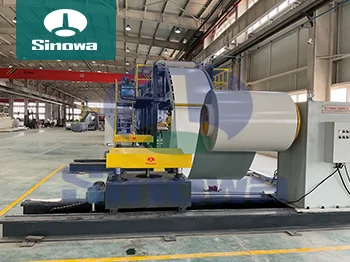
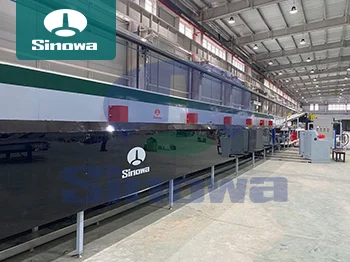
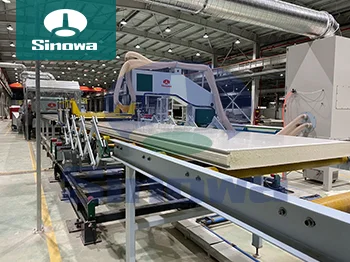
Sinowa is committed to the development and manufacturing of high-end and high-efficiency rock wool sandwich panel production line. Our rock wool sandwich panel production line are leading the way in efficiency, automatic control, human-computer interaction, environmental protection and energy consumption. Using system integration and bus control technology, it realizes the automatic integrated linkage control of the entire rock wool sandwich panel production line, and can achieve remote interactive communication, which has the world-class level and a comprehensive leading high-performance rock wool sandwich panel production line in the market.
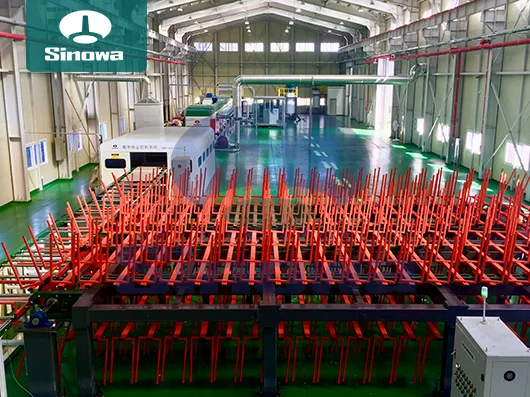
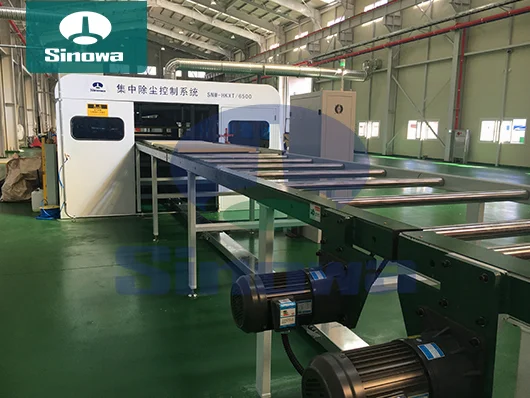
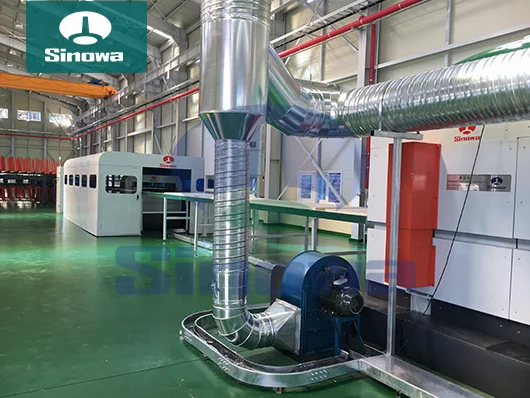
For more than ten years, relying on our innovative manufacturing concept and excellence in quality, reliable and trustworthy service to customers, we cooperate with customers all over the world, exported products to Canada, South Korea, Israel, Australia, the Middle East and other more than 20 countries and regions. contributed to building energy conservation and low-carbon production and have won widespread praise.
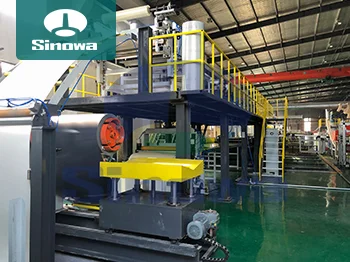
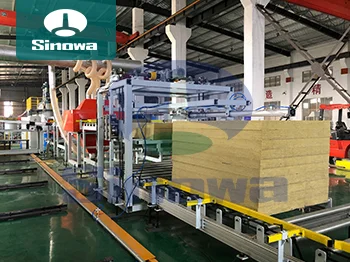
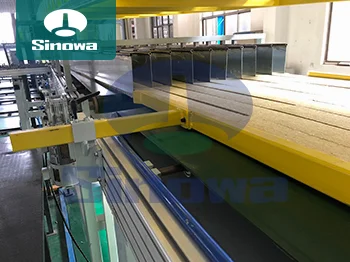
Sinowa has invested outstanding efforts in rock wool sandwich panel production line, this is why our products are more efficiency, quality, automatic control technology, environmental protection, energy consumption indicators and the appearance and safety protection are comprehensively leading, some subversive design changes in many major technical points, these major innovations make our products excellent in price/performance and user experience.
Rock wool sandwich panel production line in China represents a mature and continuously evolving industrial equipment sector that supports the booming demand for composite building materials across diverse construction scenarios. Unlike foam-core sandwich panel equipment, this type of production system is specially engineered to handle rigid fibrous rock wool cores, requiring dedicated material handling, cutting, alignment and bonding modules to maintain stable continuous operation. Decades ago, most core equipment and control logic relied heavily on overseas technical references, and domestic manufacturing capacity was limited to simple semi-automatic units with frequent manual intervention. Operators needed to adjust parameters manually at each station, which often caused inconsistent panel thickness, uneven glue distribution and low daily output. As downstream construction sectors expanded, local equipment developers began systematic research on mechanical structure optimization and automatic control. Today, the complete line integrates multiple functional modules into one interconnected system, starting from metal sheet decoiling, roll forming, rock wool core cutting, glue spraying, composite pressing, curing and continuous cutting, with most operational actions coordinated by central control systems. The development of these production lines has laid a solid foundation for the large-scale application of rock wool sandwich panels, which combine thermal retention, sound absorption and fire resistance properties for modern building envelopes. Many equipment designers keep refining mechanical details to reduce material waste and improve running stability, gradually making locally manufactured production systems competitive in global markets.
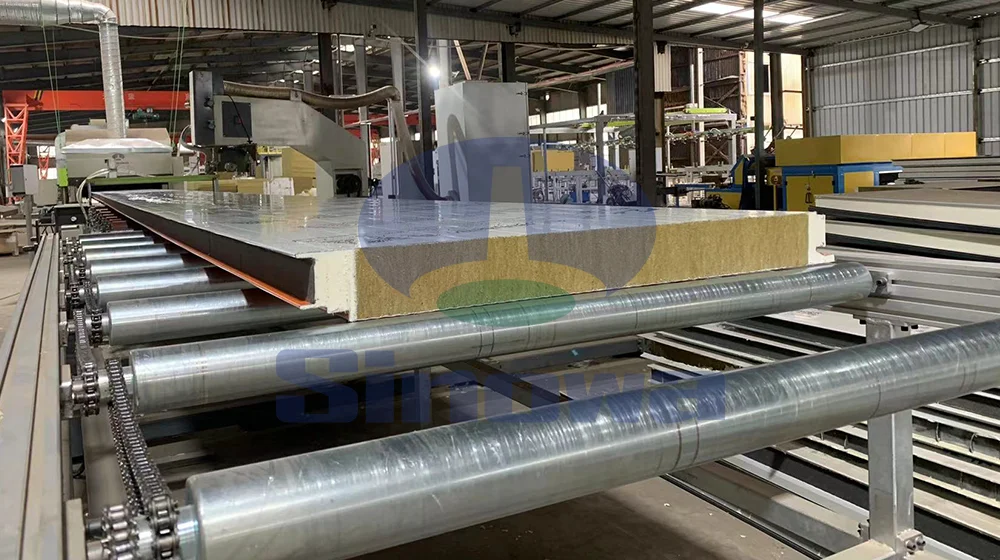
The first functional section of a rock wool sandwich panel production line focuses on metal surface sheet processing, which shapes the outer protective layer of finished panels. Large metal coils are mounted on decoiler units, which release raw metal sheets at a constant feeding speed to match the rhythm of subsequent stations. The sheet then moves into roll forming machines equipped with groups of profiling rollers, which gradually bend and shape flat metal strips into specific profiles for wall or roof panels. Profiling shapes can be adjusted by changing roller sets, enabling the same line framework to produce different panel profiles to meet varied architectural design requirements. Before entering the composite area, protective film can be automatically attached onto the metal surface to prevent scratches during transportation and installation. Sensors installed along the feeding track continuously monitor sheet tension, position and feeding speed to avoid deviation, wrinkling or stretching defects. This part of the line shares some similarities with other metal forming equipment, yet it must maintain precise speed synchronization with rock wool core feeding and glue spraying units. Any mismatch in feeding speed will lead to misalignment between metal skins and rock wool cores, resulting in defective composite panels. Operators can set profile parameters and feeding speed through the central human-machine interface, reducing repeated manual adjustment work and lowering the chance of human error during long continuous production runs.
Rock wool core preparation stands as the most distinctive part of this production line, separating it from polyurethane or foam sandwich panel manufacturing systems. Rock wool raw slabs arrive in large block forms and must be cut into strips with matched width and thickness according to target panel specifications. Special cutting units slice rock wool slabs, and some configurations rotate cut rock wool strips to adjust fiber orientation, improving the mechanical performance of finished panels. Conveyors transport processed rock wool strips to the assembly station, where positioning mechanisms arrange the core strips closely together to eliminate gaps between adjacent rock wool blocks. Gaps left unaddressed will weaken overall panel performance and create weak points on the finished composite board. Dust collection devices work alongside cutting stations to capture fine rock wool particles generated during cutting, maintaining a cleaner working environment and reducing particle accumulation on mechanical components. Feeding speed of rock wool cores is synchronously linked with metal sheet movement, so core strips can land accurately between upper and lower metal skins at the assembly position. This process requires stable conveying power and precise positioning, because rock wool is relatively brittle and easy to break under excessive squeezing or uneven impact. Continuous optimization on clamping and conveying mechanisms helps reduce breakage rate of rock wool cores and improves material utilization throughout the whole production cycle.
Adhesive application and composite lamination form the core bonding stage inside the rock wool sandwich panel production line. After metal sheets and rock wool cores are in position, automatic glue spraying systems apply uniform adhesive layers onto the inner surfaces of upper and lower metal skins. Spraying pressure, glue flow rate and moving speed of spray nozzles are precisely regulated to avoid excessive glue overflow or partial missing coating, both of which will compromise bonding strength. Once adhesive is applied, rock wool cores are sandwiched between two metal sheets, and the whole composite assembly enters the double-belt continuous pressing system. The double-belt structure applies consistent pressure on the composite panel while providing controlled heating environment to accelerate adhesive curing. Pressure and temperature must stay within stable ranges during this process to ensure full contact between rock wool core and metal skins without deforming the metal profiles. The conveyor belts carry the composite forward steadily, maintaining pressure and heat for a required period to complete adhesive curing. If temperature is insufficient, the adhesive cannot cure fully, and delamination may occur after the panel leaves the line; overheating may damage the adhesive and affect surface quality. This integrated pressing and curing module is the heart of the production line, determining the bonding reliability and flatness of rock wool sandwich panels manufactured by the equipment.
Following the continuous pressing and curing stage, the production line proceeds to fixed-length cutting and surface finishing processes. After the composite material exits the double-belt press, the continuous long panel moves forward to the flying saw cutting unit, which cuts panels to preset lengths while keeping pace with the moving material. Flying cutting technology avoids stopping the whole line during cutting operation, maintaining uninterrupted continuous production and improving overall production efficiency. After cutting, edge trimming devices handle panel edges to remove burrs and irregular sections generated during cutting, ensuring neat panel edges for convenient on-site assembly. Some lines also equip edge sealing modules to treat exposed rock wool edges, protecting fiber cores from moisture absorption in later service environments. Visual inspection stations can be arranged after cutting, where cameras and sensing devices detect surface defects, bonding gaps or dimension deviations. Products that fail inspection will be marked separately from qualified panels. All cutting length and trimming parameters can be modified through the control system when switching between different panel sizes, supporting flexible production of multiple specifications on one single line. This modular design greatly improves equipment adaptability for orders with mixed panel dimensions and profile types.
Intelligent control and operation systems built into China’s rock wool sandwich panel production lines have achieved remarkable progress over recent years. The whole production process is managed by integrated control hardware, which collects real-time data from sensors installed at decoiling, forming, glue spraying, pressing and cutting stations. Operators can monitor running status, production speed, fault alerts and output statistics on a touchscreen interface without frequent physical inspection of each machine unit. When abnormal conditions such as material jamming, pressure fluctuation or feeding deviation appear, the system triggers warning signals and can slow down or stop relevant sections automatically to prevent large quantities of defective products. Many systems support remote data access, allowing technical personnel to check operating data and diagnose faults without staying on site. This intelligent transformation reduces reliance on experienced on-site operators and shortens troubleshooting time. Compared with older mechanical control modes, modern control systems can store multiple sets of production parameter recipes. Users can call saved recipes directly when switching panel types, instead of resetting every parameter manually. Such upgrades enhance production repeatability and help factories maintain consistent product quality during long batch manufacturing cycles.
The application scenarios of panels produced by rock wool sandwich panel production lines drive the continuous upgrading of equipment design in China. Finished rock wool sandwich panels serve exterior wall cladding, roof systems, partition walls, clean space enclosures and temporary building structures. Different application scenarios raise different requirements for panel thickness, mechanical strength and surface treatment, pushing equipment manufacturers to develop customizable line configurations. For projects requiring rapid installation, production lines are adjusted to manufacture panels with specialized interlocking edge structures. Some users prioritize higher production capacity and choose extended continuous lines with stronger pressing and curing capacity, while small and medium manufacturers prefer compact layouts that occupy less workshop space. Equipment designers balance automation level, floor space requirement and investment cost to offer diversified layout solutions. Meanwhile, environmental considerations influence equipment iteration. Upgraded units reduce adhesive consumption and rock wool scrap, and dust management systems minimize fiber release during core processing. As building design concepts focus more on energy efficiency and safety performance, the market demand for rock wool sandwich panels keeps expanding, which in turn stimulates further technical refinement of related production equipment in this industry.
The global market presence of China-made rock wool sandwich panel production lines keeps expanding as manufacturing technology matures. International buyers value the flexible configuration, stable operation and comprehensive after-sales support of these equipment solutions. A complete production line is delivered as a turnkey system, including mechanical assembly, control debugging, on-site installation guidance and operator training services. Technical teams assist overseas users with workshop layout planning, equipment installation and parameter adjustment after shipment. Besides supplying full complete lines, manufacturers also provide spare parts and technical support for long-term operation. Competition in this market pushes equipment developers to keep improving mechanical durability, energy efficiency and intelligent functions. The development of rock wool sandwich panel production line manufacturing reflects the progress of China’s heavy machinery and building equipment sector. Looking ahead, research and development will continue to focus on higher automation, lower energy consumption and stronger adaptive capacity for new composite materials. As global construction markets keep seeking high-performance insulated building components, locally developed rock wool sandwich panel production systems will maintain steady improvement and continue to serve construction projects in many regions around the world.
« Rock Wool Sandwich Panel Production Line In China » Update Date: 2026/10/16
Tags: Fully Automatic Rock Wool Sandwich Panel Production Line , Rock Wool Sandwich Panel Production Line , rock wool sandwich panel production line, rock wool sandwich panel production line manufacturer, rock wool sandwich panel production line supplier, rock wool sandwich panel production line for sale, customized rock wool sandwich panel production line, china rock wool sandwich panel production line
- Sandwich Panel Rock Wool Production Line From China
- Rock Wool Line
- Rockwool Sandwich Panel Machine
- Sandwich Panel Rock Wool Production Line Price
- Highly Intelligent Rockwool Sandwich Panel Line
- Rock Wool Machine Supplier
- Highly Intelligent Rock Wool Board Production Line
- Rockwool Panel Production Line On Sales
- Rock Wool Insulation Panel Production Line In China
- Mineral Wool Sandwich Panel Production Line
- Mineral Wool Board Production Line For Cold Room
- Mineral Wool Line For Sale
- Mineral Wool Sandwich Panel Machine For Roof
- Rock Wool Sandwich Panel Machine Design
- Mineral Wool Sandwich Panel Machine For Building
- Rock Wool Line On Sales
- Mineral Wool Sandwich Panel Production Line For Cold Room
- High-tech Rockwool Machine
- Mineral Wool Sandwich Panel Line For Wall
- Customized Rockwool Sandwich Panel Machine
- Links:
- Sandwich Panel Continuous Production Line
- Automatic and Continuous Sandwich Panel Production Line
- Cheap and Low Price Sandwich Panel Production Line
- China Sandwich Panel Production Line Factory
- Color Steel Sandwich Panel Production Line For Cold Storage
- Continuous Composite Foam Sandwich Panel Production Line
- Continuous Production Line For Rockwool and Mineral Wool Sandwich Panels
- Continuous PU Phenolic Insulation Panel Production Line
- Continuous PU PIR Sandwich Panel Production Line
- Continuous PUF PUR Sandwich Panel Production Line
- Continuous Sandwich Panel Production Line For Roof and Wall
- Customized and Design Sandwich Panel Production Line
- Decorative Sandwich Panel Production Line For Glass Wool Boards
- High Quality Sandwich Panel Production Line For Sale
- Polyurethane(PU) Sandwich Panel Production Line
- Sandwich Panel Production Line Manufacturer and Supplier
- Sandwich Panel Production Machinery and Equipment