
Mineral Wool Sandwich Panel Production Line
Sinowa is a mineral wool sandwich panel production line supplier from china, customized high-quality & high efficiency mineral wool sandwich panel production line at low price, the adoption of system integration technology and bus control technology accomplishes the full automatization of integrated and coordinated control of the mineral wool sandwich panel production line with accessible remote interactive communication. Ranking the first-class level in the world, it is currently the mineral wool sandwich panel production line in the market taking a comprehensive lead in high performance.
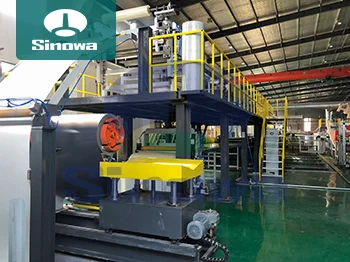
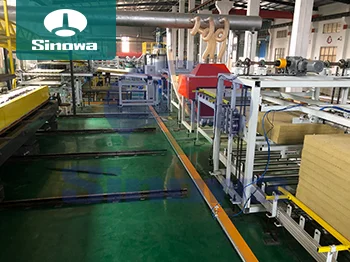
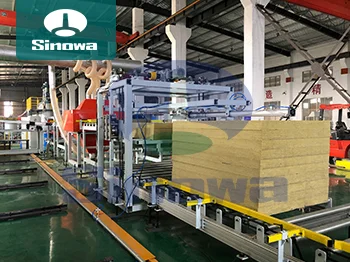
The high-tech mineral wool sandwich panel production line can meet a variety of production needs of customers, the whole mineral wool sandwich panel production line design concept of modularization enables all our components to be integrated and combined at will. Our high efficiency mineral wool sandwich panel production line can easily automate the production of roof sandwich panel, wall sandwich panel, cold storage sandwich panel and other products by different combination and configuration selection and siple switching. The inner core layer can be polyrethane or rock wool, glass wool, an so on. The precision servo hoisting mechanism employed by the main engine without hydraulic system makes the board thickness control flexible and the customer may conveniently change or adjust the board thickness. There will be not such troubles as hydraulic system adjustment, leakage, maintenance, etc.
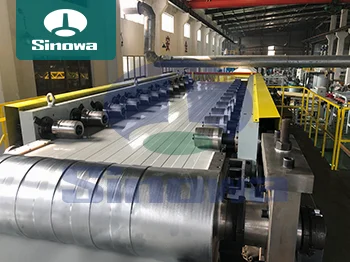
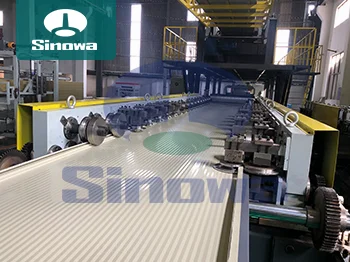
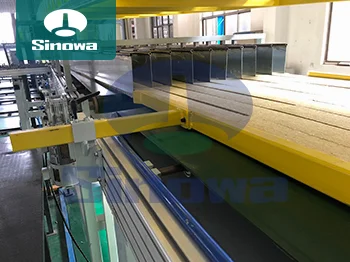
The high precision mineral wool sandwich panel production line has high adaptability, which may produce various sandwich panel of the PU, PIR and rock wool systems. We may design various products according to the customer’s requirements, including various configurations, so as to meet their demands with flexible price system. Highly integrated and linked control system centralizes all control points at the main central center, achieving parameter linkage, fault self-diagnosis controlled by the whole line and shipping distance control. High-level automatic control system also saves the manpower and reduces the manpower loss for customers. High-level energy saving and protection design makes the whole mineral wool sandwich panel production line possible to produce around the clock throughout the year and the customer will save huge budget. In addition, the isolated heat preservation room is constructed for warming the environment. The energy saving and protection design of our manufacturing line may guarantee that the customer’s production line may be freely heated and produce in the main time to save more costs for customers.
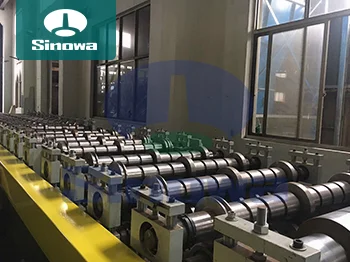
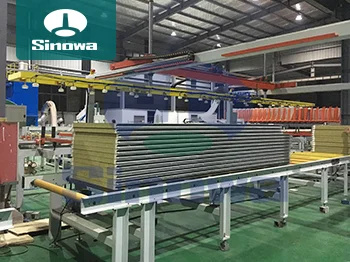
The high-power low-consumption design quickens the reaction of the cheap mineral wool sandwich panel production line while energy consumption is kept low. With the brand-new, fully sealed inner insulation design, the energy consumption is controlled at the minimum level to achieve the design objective of less than an hour for the insulation system to be activated from the room temperature above 5℃ to the production process temperature. The energy consumption is only 40% that of those similar products.
A mineral wool sandwich panel production line is an integrated automatic system designed for continuous and efficient manufacturing of composite panels with a mineral wool core and outer facing materials. It combines mechanical, electrical, and hydraulic technologies to ensure seamless coordination between each production stage, from raw material feeding to finished product stacking. The line operates with high automation, relying on intelligent control systems that allow operators to set parameters and monitor the entire process without constant manual intervention, significantly reducing labor requirements while improving consistency. The production process typically starts with the unwinding and shaping of outer facing materials, followed by the precise feeding and cutting of mineral wool core materials. Adhesive is evenly applied to ensure strong bonding between the core and facing layers, which are then pressed together under controlled temperature and pressure to form a solid structure. A non-stop cutting system trims the panels to preset sizes, ensuring dimensional accuracy and minimizing material waste. These production lines are highly adaptable, capable of adjusting to different panel thicknesses and specifications to meet diverse application needs. The mineral wool panels produced are known for excellent thermal insulation, fire resistance, and sound absorption, making them widely used in construction, industrial facilities, and cold storage. With compact process layout and energy-saving features, the production line balances high efficiency with environmental friendliness, supporting the demand for sustainable and high-performance building materials in modern industries.
The production of mineral wool sandwich panels has become an integral part of modern construction and industrial manufacturing, driven by the growing demand for materials that offer superior thermal insulation, fire resistance, and structural stability. At the heart of this production process lies the mineral wool sandwich panel production line, a sophisticated integration of mechanical, electrical, and chemical technologies designed to transform raw materials into high-performance composite panels efficiently and consistently. This continuous and automated system ensures that each panel meets the rigorous requirements of various applications, from industrial warehouses and logistic centers to commercial buildings and agricultural facilities, without compromising on quality or functionality.
The mineral wool sandwich panel production line operates on the principle of assembling three key components into a unified composite structure: two outer metal facings and a central mineral wool core, bonded together by a high-performance adhesive. This "sandwich" structure is engineered to leverage the complementary properties of each material, resulting in a final product that exhibits the strength of metal, the insulating capabilities of mineral wool, and the structural integrity provided by the bonding agent. The production line is meticulously designed to handle each stage of this assembly process with precision, from the preparation of raw materials to the final packaging of finished panels, ensuring seamless coordination between different units and minimizing any potential for defects.
The journey of a mineral wool sandwich panel begins with the preparation of the outer metal facings, which typically involve uncoiling and shaping steel coils. The uncoiling unit is the first point of contact for the metal raw materials, where large steel coils are loaded onto mandrels operated by hydraulic systems. These mandrels ensure stable and consistent feeding of the steel sheets into the subsequent processing stages. Advanced production lines often feature a 2+2 uncoiling system, which allows for the continuous feeding of steel coils without the need to stop production when replacing empty coils, thereby maintaining high throughput. Once uncoiled, the steel sheets pass through a preheating device, which adjusts the temperature of the metal to optimize the adhesion of the adhesive later in the process. This preheating step is crucial as it ensures that the bonding agent forms a strong and durable bond with the metal surface, preventing delamination over time.
Following preheating, the steel sheets enter the roll forming unit, a critical component that imparts the desired shape and profile to the outer facings. The roll forming process involves passing the steel sheets through a series of paired metal rollers, each of which gradually bends the sheet into the intended geometric pattern. These patterns can vary widely depending on the application, with common designs including trapezoidal profiles for roof panels and various corrugated or flat profiles for wall panels. The roll forming units are often designed in a cassette or railway wheel type, allowing for quick and easy changes to different profiles, which enhances the versatility of the production line. This flexibility is particularly valuable for manufacturers who need to produce a range of panel types to meet diverse customer requirements. The precision of the roll forming process ensures that the metal facings have consistent dimensions and shape, which is essential for the proper assembly of the sandwich panels and the overall structural stability of the final product.
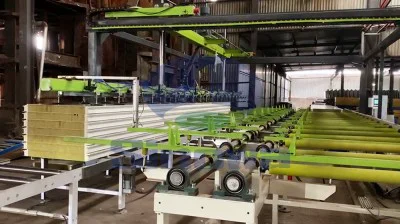
Simultaneously with the preparation of the metal facings, the mineral wool core is processed and prepared for integration into the sandwich structure. Mineral wool, derived from natural ores such as basalt, is known for its excellent thermal insulation, fire resistance, and acoustic properties. The mineral wool supplying system is responsible for cutting and shaping the mineral wool boards to the required thickness and dimensions, ensuring a precise fit between the two metal facings. This system typically consists of a lift, board cutter, turning conveyor, and side trimmer. The lift feeds the mineral wool boards into the cutter, which slices the boards according to the specified thickness of the sandwich panel. The turning conveyor then orients the cut mineral wool correctly before it enters the side trimmer, which trims the edges of the mineral wool to ensure a tight fit within the metal facings. Some advanced systems also include an auto pad supplying unit, which adds protective pads to the mineral wool core to prevent damage during processing and transportation.
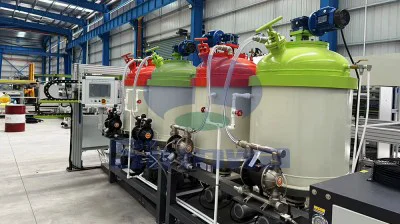
Once both the metal facings and the mineral wool core are prepared, the next stage in the production process is the application of the adhesive. The glue applying system is responsible for uniformly coating the inner surfaces of the metal facings with a high-performance bonding agent, typically a polyurethane (PU) or modified phenolic resin (PF) adhesive. These adhesives are chosen for their strong bonding strength, excellent weather resistance, and resistance to aging, ensuring that the sandwich panel remains intact even under harsh environmental conditions. The glue applying system uses precision nozzles to distribute the adhesive evenly, with the amount of adhesive carefully controlled to ensure optimal bonding without excess waste. In some production lines, the adhesive is applied to both the upper and lower metal facings, as well as to the edges of the mineral wool core, to enhance the overall bond strength and prevent moisture penetration.
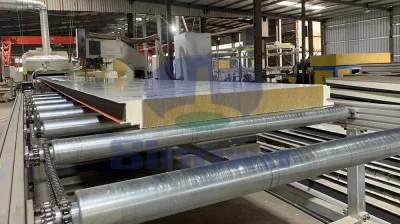
The assembly of the sandwich panel takes place in the laminating unit, where the prepared metal facings and mineral wool core are brought together and pressed into a unified structure. The mineral wool core is fed between the upper and lower metal facings, which have already been coated with adhesive. The three components then pass through a double belt conveyor system, which applies uniform pressure to the assembly. The double belt conveyor consists of two parallel belts that move synchronously, pressing the components together to ensure full contact between the adhesive and the metal facings, as well as between the adhesive and the mineral wool core. Some production lines also include a double belt heating system, which applies controlled heat to accelerate the curing of the adhesive, reducing the time required for the bond to reach full strength. This combination of pressure and heat ensures that the sandwich panel forms a rigid and stable structure, with the metal facings and mineral wool core working together synergistically.
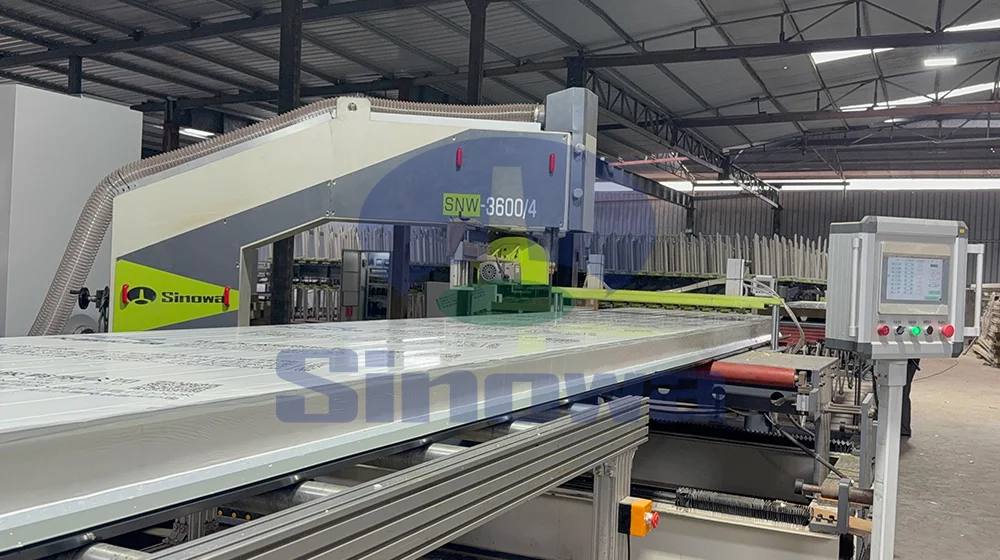
After the laminating process, the continuous sheet of sandwich panel is cut to the required length by the panel cutting unit. This unit typically uses a band saw or a circular saw, which is controlled by a computerized system to ensure precise cutting. Advanced production lines feature a "cut to length without machine stop" function, which allows for continuous cutting of the panel without interrupting the production process, thereby maintaining high efficiency. The cutting unit is programmed with the desired length parameters, and the saw moves automatically to make clean, straight cuts, ensuring that each panel meets the exact dimensional requirements. Once cut, the individual panels are inspected for quality, with any defective panels removed from the production line.
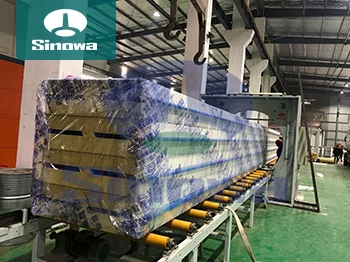
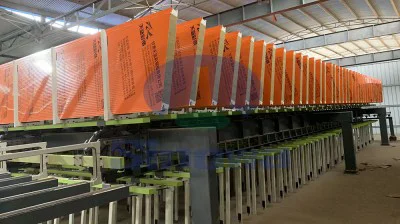
The final stages of the production process involve stacking and packaging the finished panels. The auto stacking unit uses mechanical arms or conveyor systems to lift and stack the finished panels onto pallets, ensuring that the panels are stacked neatly and securely to prevent damage during transportation. The stacking process is fully automated, with the number of panels per pallet carefully controlled to optimize storage and transportation efficiency. After stacking, the panel packing unit wraps the pallets with plastic wrap to protect the panels from dust, moisture, and damage during transportation. Some production lines also include additional packaging features, such as edge protectors and labels, to further enhance the protection and identification of the panels.
The mineral wool sandwich panel production line is characterized by its high level of automation, which is achieved through the integration of advanced control systems. The entire production line is controlled by a central computer system that uses digital servo technology, frequency conversion vector technology, and hydraulic control technology to coordinate the operation of each unit. This central control system allows for real-time monitoring of the production process, with parameters such as production speed, adhesive application rate, and cutting length easily adjustable through a man-machine interface. Operators can input the desired parameters into the system, and the production line will automatically adjust to meet these requirements, minimizing the need for manual intervention. This high level of automation not only improves production efficiency but also reduces the potential for human error, ensuring consistent quality across all produced panels.
Another key advantage of the mineral wool sandwich panel production line is its high efficiency. Modern production lines can achieve production speeds of 3 to 8 meters per minute, with an annual production capacity of up to 800,000 square meters or more, based on 250 working days per year and 10 working hours per day. This high throughput allows manufacturers to meet large-scale orders efficiently, reducing lead times and improving customer satisfaction. The efficiency of the production line is further enhanced by its low labor requirements, with most advanced lines requiring only 5 to 8 operators to oversee the entire production process. This reduces labor costs and improves overall production economics for manufacturers.
The versatility of the mineral wool sandwich panel production line is another notable feature. These production lines can be configured to produce a wide range of panel types, with varying thicknesses, dimensions, and profiles. The mineral wool core thickness can typically be adjusted from 50 mm to 200 mm, depending on the required insulation properties, while the metal facings can be made from different types of steel, such as galvanized steel or color-coated steel, to meet specific aesthetic and performance requirements. Additionally, some production lines are capable of producing panels with combined core materials, such as polyurethane and mineral wool, allowing for further customization of the panel's properties. This versatility makes the production line suitable for a wide range of applications, from industrial buildings that require high fire resistance to commercial buildings that prioritize thermal insulation and acoustic performance.
The performance of the mineral wool sandwich panels produced by these lines is directly influenced by the precision and control of the production process. The low thermal conductivity of the mineral wool core ensures excellent thermal insulation, reducing heat transfer and energy consumption in buildings. The mineral wool core is also non-combustible, with a high melting point, making the panels highly fire-resistant and capable of preventing flame spread, which is crucial for ensuring the safety of buildings and their occupants. Additionally, the porous structure of the mineral wool core provides excellent acoustic insulation, absorbing sound waves and reducing noise transmission, making the panels ideal for use in environments where noise reduction is important, such as factories, sport halls, and residential buildings. The metal facings provide structural strength and protection against external environmental factors, such as wind, rain, and corrosion, ensuring the long-term durability of the panels.
In conclusion, the mineral wool sandwich panel production line represents a sophisticated and efficient solution for the manufacturing of high-performance composite panels. Through the seamless integration of various mechanical, electrical, and chemical processes, these production lines ensure the consistent production of panels that offer superior thermal insulation, fire resistance, acoustic performance, and structural stability. The high level of automation, efficiency, and versatility of these lines make them an essential asset for manufacturers in the construction and industrial sectors, enabling them to meet the growing demand for high-quality, sustainable building materials. As the construction industry continues to evolve, with an increasing focus on energy efficiency and safety, the mineral wool sandwich panel production line will undoubtedly play a crucial role in shaping the future of building materials manufacturing, providing innovative and reliable solutions for a wide range of applications.
« Mineral Wool Sandwich Panel Production Line » Update Date: 2026/4/16
URL: https://www.sinowamachine.com/tags/mineral-wool-sandwich-panel-production-line.html
![Highly Intelligent Mineral Wool Sandwich Panel Production Line]()
Highly Intelligent Mineral Wool Sandwich Panel Production Line
2026-09-01The highly intelligent mineral wool sandwich panel production line represents a cutting-edge integrated manufacturing system tailored for high-performance building insulation panel production, redefining the efficiency, precision, and automation level of traditional sandwich panel manufacturing. Unli…![Mineral Wool Sandwich Panel Production Line For Wall]()
Mineral Wool Sandwich Panel Production Line For Wall
2026-09-01Mineral wool sandwich panel production lines dedicated to wall panel manufacturing are advanced integrated production systems designed to produce high-performance composite building panels for modern architectural wall applications. These automated production setups integrate multiple functional unit…![High-end Mineral Wool Sandwich Panel Production Line]()
High-end Mineral Wool Sandwich Panel Production Line
2026-08-28The high-end mineral wool sandwich panel production line represents a sophisticated, fully integrated manufacturing system dedicated to the continuous and automated production of high-performance composite building panels. Optimized for modern construction industry demands for safe, energy-saving, an…![Cheap Mineral Wool Sandwich Panel Production Line]()
Cheap Mineral Wool Sandwich Panel Production Line
2026-08-27The cheap mineral wool sandwich panel production line is a cost-effective, streamlined manufacturing system designed to produce high-performance composite panels with mineral wool as the core insulation material and metal sheets as the outer protective layers. Tailored for small and medium-scale manu…![Mineral Wool Sandwich Panel Production Line Manufacturer]()
Mineral Wool Sandwich Panel Production Line Manufacturer
2026-08-18The mineral wool sandwich panel production line stands as a sophisticated, fully automated industrial system tailored for the continuous manufacturing of high-performance building composite panels. Integrating precision mechanical transmission, intelligent material control, and constant-temperature c…![Mineral Wool Sandwich Panel Production Line For Building]()
Mineral Wool Sandwich Panel Production Line For Building
2026-08-14The mineral wool sandwich panel production line is a specialized automated manufacturing system designed to produce high-performance building composite panels tailored for modern construction projects. Integrating mechanical processing, automatic material distribution, adhesive bonding, and constant-…![Mineral Wool Sandwich Panel Production Line Supplier]()
Mineral Wool Sandwich Panel Production Line Supplier
2026-08-14Mineral wool sandwich panel production lines stand as sophisticated integrated manufacturing systems designed for the continuous and automated fabrication of high-performance building insulation panels, widely adopted in modern construction, industrial enclosure, and cleanroom engineering sectors. Th…![High Efficiency Mineral Wool Sandwich Panel Production Line]()
High Efficiency Mineral Wool Sandwich Panel Production Line
2026-08-12The high efficiency mineral wool sandwich panel production line represents an advanced integrated manufacturing system tailored for large-scale, continuous production of high-performance composite building panels. Differing greatly from traditional segmented and manual-assisted production equipment, …![High-tech Mineral Wool Sandwich Panel Production Line]()
High-tech Mineral Wool Sandwich Panel Production Line
2026-07-10The high-tech mineral wool sandwich panel production line represents a sophisticated, fully integrated manufacturing system designed for the continuous and efficient production of high-performance composite building panels. Engineered to merge precise mechanical automation, intelligent process contro…
- Links:
- Sandwich Panel Continuous Production Line
- Automatic and Continuous Sandwich Panel Production Line
- Cheap and Low Price Sandwich Panel Production Line
- China Sandwich Panel Production Line Factory
- Color Steel Sandwich Panel Production Line For Cold Storage
- Continuous Composite Foam Sandwich Panel Production Line
- Continuous Production Line For Rockwool and Mineral Wool Sandwich Panels
- Continuous PU Phenolic Insulation Panel Production Line
- Continuous PU PIR Sandwich Panel Production Line
- Continuous PUF PUR Sandwich Panel Production Line
- Continuous Sandwich Panel Production Line For Roof and Wall
- Customized and Design Sandwich Panel Production Line
- Decorative Sandwich Panel Production Line For Glass Wool Boards
- High Quality Sandwich Panel Production Line For Sale
- Polyurethane(PU) Sandwich Panel Production Line
- Sandwich Panel Production Line Manufacturer and Supplier
- Sandwich Panel Production Machinery and Equipment