
Insulated Sandwich Panel Production Line
Sinowa is a insulated sandwich panel production line supplier from china, customized high-quality & high efficiency insulated sandwich panel production line at low price, the adoption of system integration technology and bus control technology accomplishes the full automatization of integrated and coordinated control of the insulated sandwich panel production line with accessible remote interactive communication. Ranking the first-class level in the world, it is currently the insulated sandwich panel production line in the market taking a comprehensive lead in high performance.
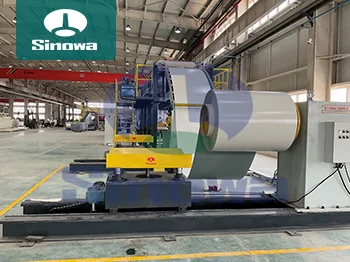
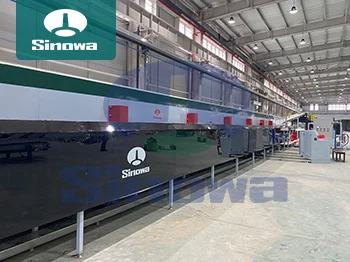
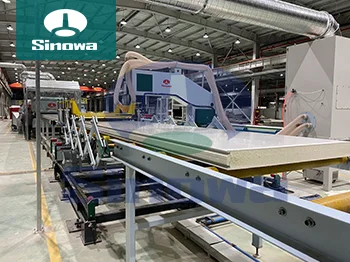
The high-tech insulated sandwich panel production line can meet a variety of production needs of customers, the whole insulated sandwich panel production line design concept of modularization enables all our components to be integrated and combined at will. Our high efficiency insulated sandwich panel production line can easily automate the production of roof sandwich panel, wall sandwich panel, cold storage sandwich panel and other products by different combination and configuration selection and siple switching. The inner core layer can be polyrethane or rock wool, glass wool, an so on.


The high precision insulated sandwich panel production line has high adaptability, which may produce various sandwich panel of the PU, PIR and rock wool systems. We may design various products according to the customer’s requirements, including various configurations, so as to meet their demands with flexible price system. Highly integrated and linked control system centralizes all control points at the main central center, achieving parameter linkage, fault self-diagnosis controlled by the whole line and shipping distance control. High-level automatic control system also saves the manpower and reduces the manpower loss for customers.


The precision servo hoisting mechanism employed by the main engine without hydraulic system makes the board thickness control flexible and the customer may conveniently change or adjust the board thickness. There will be not such troubles as hydraulic system adjustment, leakage, maintenance, etc.


High-level energy saving and protection design makes the whole insulated sandwich panel production line possible to produce around the clock throughout the year and the customer will save huge budget. In addition, the isolated heat preservation room is constructed for warming the environment. The energy saving and protection design of our manufacturing line may guarantee that the customer’s production line may be freely heated and produce in the main time to save more costs for customers.


The high-power low-consumption design quickens the reaction of the cheap insulated sandwich panel production line while energy consumption is kept low. With the brand-new, fully sealed inner insulation design, the energy consumption is controlled at the minimum level to achieve the design objective of less than an hour for the insulation system to be activated from the room temperature above 5℃ to the production process temperature. The energy consumption is only 40% that of those similar products.
The insulated sandwich panel production line is a highly integrated, automated manufacturing system designed for the mass production of high-performance composite insulation panels widely applied in modern construction, cold chain logistics, and industrial enclosure projects. This integrated production system combines mechanical transmission, automatic material processing, chemical foaming, constant-temperature molding, and precision cutting technologies to complete the full manufacturing process of sandwich panels in a continuous and streamlined manner. Structurally, it adopts a modular collaborative design, where each functional unit operates in precise coordination to convert raw surface sheets and thermal insulation core materials into finished panels with stable structural integrity and excellent thermal insulation properties. By eliminating intermittent manual operations and redundant material transfer links, the production line achieves standardized and efficient manufacturing, effectively improving product consistency while reducing production losses. As a core equipment for energy-saving building material production, it adapts to diverse production demands for different panel specifications and lays a solid foundation for the large-scale application of insulated sandwich panels in various engineering scenarios.
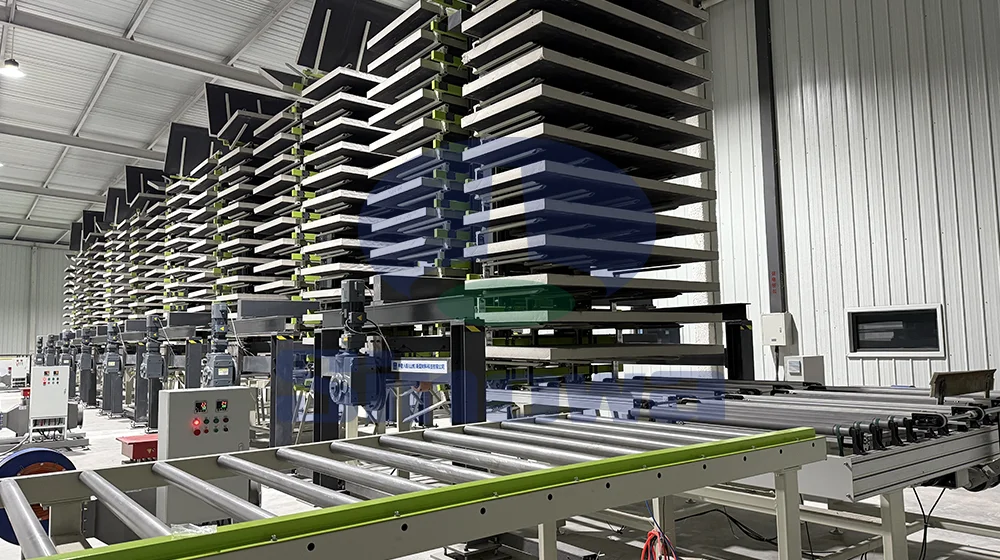
The overall operational framework of the insulated sandwich panel production line follows a scientific material flow logic, arranging all functional modules in a linear and continuous layout to ensure unobstructed raw material circulation and orderly process progression. The entire production workflow starts with raw material feeding and pretreatment, followed by surface material forming, core material proportioning and foaming, multi-layer composite bonding, constant-temperature curing, fixed-length cutting, surface finishing, and final automatic stacking. Each production link is closely connected without redundant intermediate procedures, which optimizes production efficiency and avoids quality deviations caused by repeated material handling. Different from traditional intermittent production equipment, this continuous production mode realizes synchronous operation of multiple processes, enabling seamless connection from raw material input to finished product output. The modular structure also endows the production line with strong flexibility, allowing adaptive adjustment of operating parameters to meet the production requirements of panels with different thicknesses, surface styles, and core material types, covering most conventional application scenarios of insulated sandwich panels.
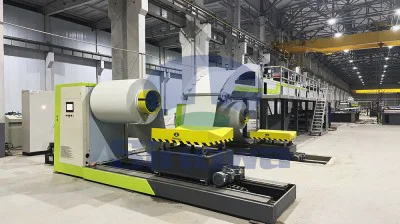
Raw material pretreatment and feeding serve as the initial and foundational stage of the entire production process, directly determining the surface quality and molding stability of finished sandwich panels. The production line is equipped with automatic uncoiling and feeding devices for metal surface sheets, which can stably release coiled sheet materials at a constant speed and maintain consistent sheet tension throughout the process to avoid wrinkles, deviations, or deformation. Meanwhile, the system is fitted with surface cleaning and pretreatment components to remove dust, oil stains, and oxide layers on the surface of raw sheets accumulated during storage and transportation. For thermal insulation core materials, the equipment adopts sealed quantitative feeding structures to transport various chemical raw materials and bulk core materials at stable and accurate flow rates. The independent feeding control of different raw materials ensures the precise proportioning of core material components, which is crucial for maintaining uniform density and stable thermal insulation performance of the panel core layer, and effectively avoids material waste caused by uneven feeding.
Surface roll forming is a key process that shapes the outer protective structure of insulated sandwich panels, responsible for converting flat metal sheets into standardized profiled surfaces that meet structural and installation requirements. The roll forming unit of the production line consists of multiple groups of precision-arranged forming rollers with optimized structural parameters. As the metal sheet passes through the roller set step by step, it undergoes gradual cold bending and shaping to form regular wave shapes, flat surfaces, or special structural edges without damaging the surface coating or metal substrate. The roller spacing and forming angle can be finely adjusted according to different panel design specifications, enabling flexible switching between wall panels, roof panels, and other different profile types. The entire forming process is fully automated with real-time deviation correction functions to ensure consistent flatness, dimensional accuracy, and structural symmetry of each sheet. High-precision roll forming not only enhances the aesthetic appearance of finished panels but also improves their overall structural rigidity and on-site assembly compatibility.
Core material metering, mixing, and foaming constitute the core functional links that determine the thermal insulation performance of sandwich panels. The production line is equipped with an intelligent metering and mixing system dedicated to thermal insulation core materials, which automatically adjusts the feeding proportion and mixing speed of raw materials according to preset production parameters. High-speed rotating stirring components in the sealed mixing chamber realize microscopic and uniform fusion of different raw materials, ensuring the stability of the foaming reaction environment. After uniform mixing, the raw material mixture is evenly sprayed and laid between the upper and lower formed metal sheets through a precise conveying nozzle. The foaming process is carried out in a closed and temperature-controlled environment, allowing the core material to expand steadily and fill the intermediate space completely. This process effectively avoids hollowing, uneven density, and local foaming defects, ensuring that the core layer of the panel has uniform thermal insulation performance, good adhesion, and stable structural compactness.
Continuous composite bonding is the key procedure to integrate surface metal sheets and thermal insulation core materials into an integral sandwich structure. After the core material is laid, the multi-layer composite materials enter the pressing and bonding unit of the production line synchronously. The unit adopts a multi-group synchronous pressing structure with adjustable pressing pressure and running speed, which can apply uniform and stable pressure on the composite materials during the continuous conveying process. This uniform pressing mode enables the foaming core material to fully bond with the inner surface of the metal sheets, forming a tight and seamless composite structure. The equipment’s adaptive pressure adjustment function can match different panel thicknesses and core material characteristics, avoiding excessive pressure leading to core layer compression deformation or insufficient pressure causing weak bonding. The continuous composite molding process eliminates the intermittent bonding gaps of traditional batch production, greatly improving the overall structural integrity and bonding firmness of finished panels.
Constant-temperature curing is an essential process to stabilize the structural performance and comprehensive quality of insulated sandwich panels. The production line is equipped with an integrated constant-temperature curing channel with adjustable internal temperature and conveying speed, creating a stable and continuous curing environment for freshly composited panels. During the curing process, the chemical reaction of the core material is fully completed under constant temperature conditions, realizing complete solidification and molding of the thermal insulation layer. Meanwhile, the bonding interface between the core material and the metal sheet undergoes steady curing to enhance the adhesive strength and durability of the composite structure. The length of the curing channel and operating parameters are scientifically matched with the production speed to ensure that each panel obtains sufficient curing time without affecting continuous production. Reasonable constant-temperature curing treatment effectively prevents subsequent panel deformation, degumming, and performance attenuation, significantly improving the long-term service stability of finished products.
Precise fixed-length cutting and edge trimming processes ensure the dimensional accuracy and neat appearance of finished insulated sandwich panels. After completing curing and preliminary shaping, the continuous long-panel blanks are transported to the cutting unit, which adopts high-precision automatic cutting systems with servo positioning and fixed-length control functions. The system can accurately identify and set the cutting length according to production requirements, realizing fixed-size cutting of continuous panels with high dimensional tolerance control. Meanwhile, the edge trimming device synchronously processes the panel edges to remove excess residual materials and smooth rough cutting sections, ensuring consistent edge flatness and neatness of each finished panel. The entire cutting and trimming process is automated and synchronized with the production rhythm, without manual secondary processing. High-precision post-processing not only standardizes the product size specifications but also improves the on-site installation efficiency and assembly tightness of sandwich panels in engineering applications.
Surface finishing and quality inspection optimization further polish the comprehensive quality of finished panels and eliminate potential product defects. After cutting and trimming, the panels enter the surface finishing unit for minor flaw repair, surface cleaning, and coating protection treatment. The equipment removes tiny dust, residual adhesives, and minor blemishes on the panel surface to restore the smooth and flat appearance of the metal coating. Equipped with online real-time monitoring components, the production line conducts continuous non-destructive inspection on the structural compactness, bonding uniformity, and surface flatness of panels during operation. The intelligent monitoring system can automatically identify abnormal quality problems such as local hollowing, uneven thickness, and surface deformation, and mark unqualified products in real time. This online quality control mode realizes real-time monitoring of the whole production process, effectively reducing the rate of defective products and ensuring that all finished panels meet consistent quality standards.
Automatic stacking and finished product output systems realize efficient collection and standardized storage of finished insulated sandwich panels. The final link of the production line is equipped with an intelligent automatic stacking machine, which can automatically grab, lift, and stack qualified finished panels according to preset stacking specifications. The stacking speed and layer spacing are precisely matched with the front-end production rhythm, realizing seamless docking with the production process and avoiding panel accumulation and blockage. The equipment adopts stable grabbing and placement mechanisms to prevent surface scratches, edge collisions, and panel tilting during the stacking process. After stacking is completed, the system automatically outputs finished product stacks, which facilitates subsequent packaging, transportation, and warehouse management. The fully automatic stacking mode replaces traditional manual handling and stacking, greatly improving production efficiency, reducing labor investment, and effectively protecting the surface quality and structural integrity of finished panels.
The intelligent control and operation management system serves as the brain of the entire insulated sandwich panel production line, realizing unified scheduling and precise control of all functional units. The system adopts integrated intelligent operation terminals, which can centrally set, adjust, and monitor all production parameters including feeding speed, mixing ratio, forming pressure, curing temperature, cutting size, and operating rhythm. It has real-time data collection and operation feedback functions, which can record production data throughout the process and automatically optimize operating parameters according to long-term production operation conditions. In addition, the system is equipped with fault self-diagnosis and early warning functions, which can timely identify abnormal equipment operation, remind maintenance and adjustment, and avoid equipment failure shutdown and batch quality problems. The humanized operation interface simplifies the operation process, enabling a small number of operators to complete the overall monitoring and management of the entire production line.
The insulated sandwich panel production line has significant advantages in production efficiency, product quality stability, and operational economy, supporting the sustainable development of energy-saving building material manufacturing. Its continuous automated production mode completely breaks through the efficiency bottleneck of traditional intermittent production, greatly improving unit-time output and production capacity while reducing manual operation errors and labor costs. The standardized and precise production process endows finished sandwich panels with uniform thickness, stable thermal insulation performance, strong structural adhesion, and excellent weather resistance, making them adaptable to various complex engineering environments. In terms of energy consumption and environmental protection, the optimized structural design and intelligent parameter adjustment reduce raw material waste and energy consumption per unit product. With strong production flexibility and product adaptability, the production line can continuously provide high-quality insulated sandwich panels for diversified engineering fields, showing broad application prospects in the modern green building industry.
« Insulated Sandwich Panel Production Line » Update Date: 2026/8/26
URL: https://www.sinowamachine.com/tags/insulated-sandwich-panel-production-line.html
![Metal Carved Insulated Sandwich Panel Production Line]()
Metal Carved Insulated Sandwich Panel Production Line
2026-05-08The metal carved insulated sandwich panel has gradually become one of the most indispensable composite materials in the modern construction industry due to its unique decorative texture, stable thermal insulation performance and excellent structural durability. As the core manufacturing carrier of th…
- Links:
- Sandwich Panel Continuous Production Line
- Automatic and Continuous Sandwich Panel Production Line
- Cheap and Low Price Sandwich Panel Production Line
- China Sandwich Panel Production Line Factory
- Color Steel Sandwich Panel Production Line For Cold Storage
- Continuous Composite Foam Sandwich Panel Production Line
- Continuous Production Line For Rockwool and Mineral Wool Sandwich Panels
- Continuous PU Phenolic Insulation Panel Production Line
- Continuous PU PIR Sandwich Panel Production Line
- Continuous PUF PUR Sandwich Panel Production Line
- Continuous Sandwich Panel Production Line For Roof and Wall
- Customized and Design Sandwich Panel Production Line
- Decorative Sandwich Panel Production Line For Glass Wool Boards
- High Quality Sandwich Panel Production Line For Sale
- Polyurethane(PU) Sandwich Panel Production Line
- Sandwich Panel Production Line Manufacturer and Supplier
- Sandwich Panel Production Machinery and Equipment