
Glass Wool Sandwich Panel Production Line Supplier
Sinowa is a well-known manufacturer and technical service provider of high-end glass wool sandwich panel production line, learn more about glass wool sandwich panel production line supplier, please contact Sinowa's technical engineer, tell us what you need, we will contact you as soon as possible!
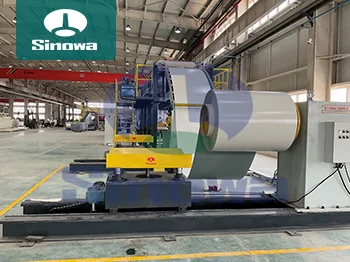
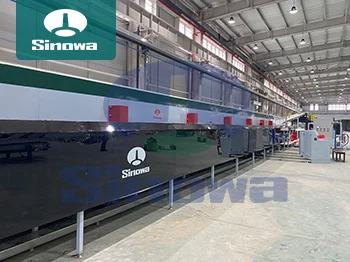
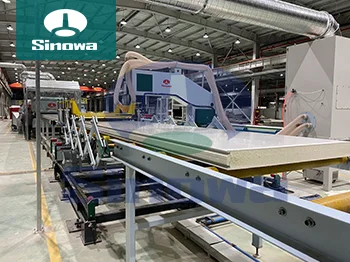
Sinowa is committed to the development and manufacturing of high-end and high-efficiency glass wool sandwich panel production line. Our glass wool sandwich panel production line are leading the way in efficiency, automatic control, human-computer interaction, environmental protection and energy consumption. Using system integration and bus control technology, it realizes the automatic integrated linkage control of the entire glass wool sandwich panel production line, and can achieve remote interactive communication, which has the world-class level and a comprehensive leading high-performance glass wool sandwich panel production line in the market.
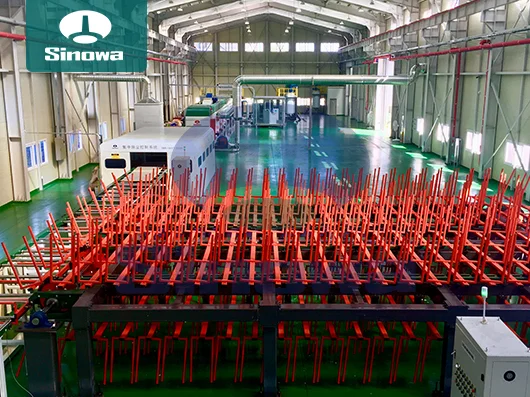
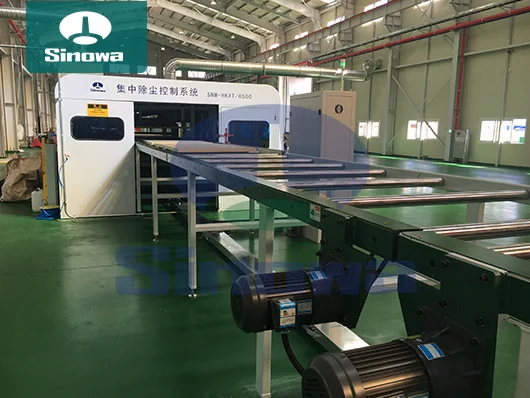
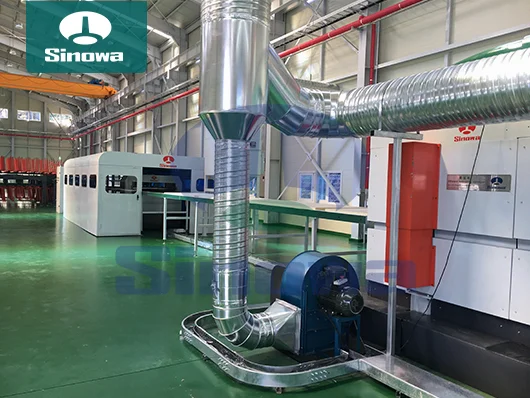
For more than ten years, relying on our innovative manufacturing concept and excellence in quality, reliable and trustworthy service to customers, we cooperate with customers all over the world, exported products to Canada, South Korea, Israel, Australia, the Middle East and other more than 20 countries and regions. contributed to building energy conservation and low-carbon production and have won widespread praise.
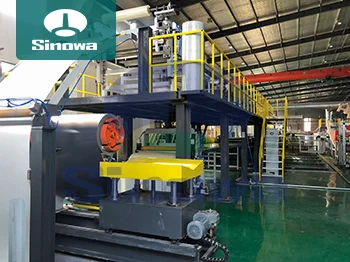
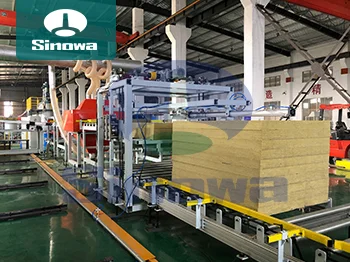
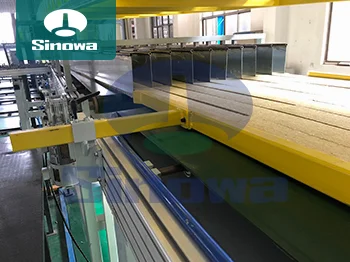
Sinowa has invested outstanding efforts in glass wool sandwich panel production line, this is why our products are more efficiency, quality, automatic control technology, environmental protection, energy consumption indicators and the appearance and safety protection are comprehensively leading, some subversive design changes in many major technical points, these major innovations make our products excellent in price/performance and user experience.
Glass wool sandwich panel production lines have become core automated manufacturing systems supporting the modern lightweight construction industry, specializing in the integrated production of high-performance composite building panels with glass wool as the core insulation layer. These automated production systems integrate material feeding, core processing, adhesive coating, composite pressing, thermal curing, precision cutting and automatic stacking into one continuous workflow, effectively solving the production pain points of low efficiency, uneven product quality and high manual error in traditional panel manufacturing. As market demand for energy-saving, sound-insulating and fire-resistant building materials continues to rise globally, professional production line suppliers focus on optimizing equipment structure and operational logic to deliver stable, high-yield and low-consumption manufacturing solutions. The entire production process is mechanically synchronized to retain the inherent physical advantages of glass wool materials, including excellent thermal insulation, sound absorption and fire resistance, while ensuring the flatness, structural firmness and dimensional uniformity of finished panels, making the equipment widely adaptable to diversified production needs of construction enclosure, industrial plant decoration and special environmental insulation projects.
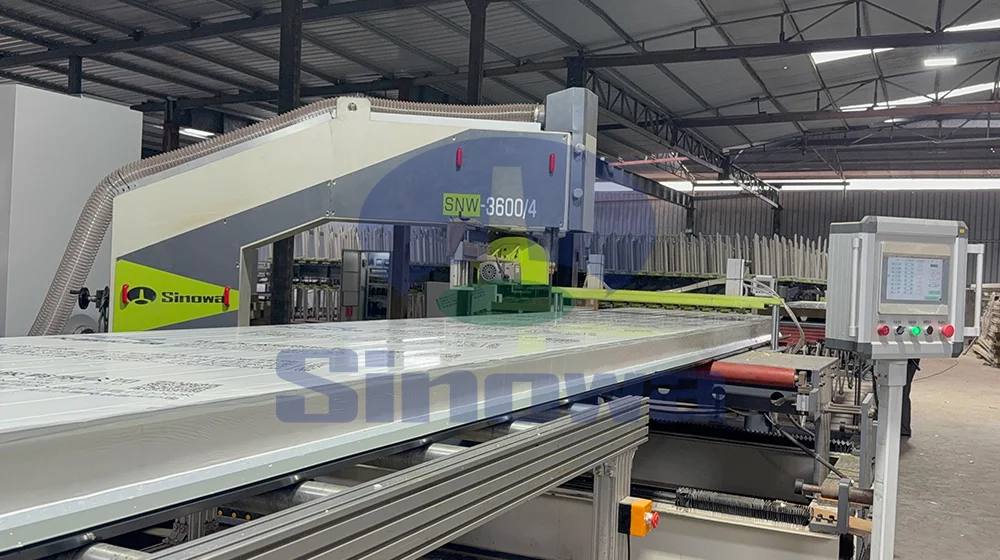
The operational foundation of a high-quality glass wool sandwich panel production line lies in its precision front-end material pretreatment and feeding system, which determines the uniformity and stability of subsequent composite molding. Different from ordinary sandwich panel production equipment, this professional line is specially optimized for the soft and porous structural characteristics of glass wool core materials to avoid fiber compression deformation and performance attenuation during production. The metal surface material unwinding unit adopts constant-tension hydraulic control and automatic deviation correction structures, which can smoothly unfold and level coiled metal sheets without scratching or wrinkling the surface materials. Meanwhile, the glass wool core material feeding and laying system uses a uniform fiber distribution mechanism to spread loose glass wool raw materials evenly according to set thickness specifications. This system features adjustable laying density and thickness parameters, which can adapt to different product customization requirements. All feeding links realize synchronous linkage operation, eliminating material dislocation and uneven thickness caused by asynchronous manual operation, and laying a solid foundation for consistent structural performance of each finished panel in batch production.
Adhesive coating and composite bonding are key intermediate processes that directly affect the structural firmness and service life of glass wool sandwich panels, and professional production lines are equipped with intelligent low-pressure adhesive application systems tailored for glass wool materials. Traditional high-pressure gluing equipment tends to penetrate excessively into glass wool fibers, causing material hardening and reducing thermal insulation and sound absorption effects, while the optimized gluing system adopts fine spray and directional coating technology to form a uniform and thin adhesive layer on the bonding surface without damaging the internal porous structure of the core material. The adhesive dosage is precisely controlled by servo drive systems according to production speed and panel specifications, avoiding excessive glue waste or insufficient bonding strength. After gluing, the upper and lower surface materials and glass wool core material enter the composite pressing unit synchronously, where multi-group balanced pressing rollers apply uniform and stable pressure. This gradual pressing mode effectively discharges internal air bubbles, achieves seamless fitting between layers, and prevents common quality problems such as degumming, bulging and layer separation of finished panels during long-term use.
Constant-temperature thermal curing is an indispensable process to stabilize the bonding performance and overall structure of glass wool sandwich panels, and advanced production lines adopt segmented constant-temperature curing tunnel structures to realize scientific and efficient curing treatment. The curing area is equipped with uniform thermal radiation devices and real-time temperature sensing modules, which maintain a stable and balanced thermal environment inside the tunnel. Unlike ordinary curing equipment with single temperature setting, the segmented temperature control design matches the chemical reaction characteristics of the adhesive, realizing gradual curing from the surface to the inner layer of the composite panel. The operating speed of the production line is intelligently linked with the curing time to ensure that each panel stays in the curing tunnel for an accurate fixed duration, completing full adhesive curing and forming a high-strength integrated composite structure. This process not only greatly improves the bonding firmness between glass wool core and metal surface materials, but also avoids structural deformation and warping caused by uneven heating, ensuring the overall flatness and dimensional stability of finished panels.
Precision cutting and edge trimming processes endow glass wool sandwich panels with accurate dimensional accuracy and neat appearance, meeting the fine installation requirements of modern construction projects. The production line is equipped with servo-driven flying cutting systems and automatic edge trimming devices, which can realize fixed-length cutting and edge finishing in a continuous operating state without stopping the production line. The flying cutting mechanism features high-response servo positioning and high-hardness cutting tools, which can complete smooth cutting of composite panels with different thicknesses, producing flat and burr-free cutting sections. The edge trimming unit automatically polishes and trims the panel edges according to preset specifications, eliminating irregular burrs and uneven edges generated in the composite process. All cutting and trimming parameters are adjustable through the central control system, supporting flexible switching of various panel length and width specifications. The entire process realizes full automation without manual intervention, effectively improving product dimensional consistency and reducing material loss caused by manual cutting errors.
The automatic finishing and stacking system of the production line realizes unmanned final-stage operation, greatly improving production efficiency and finished product management standardization. After cutting and trimming, qualified panels are automatically conveyed to the finishing platform through the synchronous conveying system, where intelligent detection modules conduct real-time inspection of panel flatness, surface integrity and bonding status to screen out unqualified products. Qualified finished panels are then transported to the automatic stacking unit, which adopts stable mechanical clamping and stacking technology to neatly stack panels layer by layer according to fixed specifications. The stacking height and interval can be flexibly adjusted to adapt to different storage and transportation requirements. This integrated finishing and stacking mode replaces traditional manual handling and stacking, effectively avoiding surface scratches, panel deformation and messy stacking caused by manual operation. It also simplifies the finished product storage and handover process, realizing seamless connection between production and subsequent packaging and transportation links.
Intelligent linkage control and operational stability optimization are the core advantages of modern high-end glass wool sandwich panel production lines, distinguishing professional supplier equipment from ordinary ordinary processing machinery. The entire production line adopts a centralized PLC intelligent control system, which integrates and synchronizes all functional units including feeding, gluing, pressing, curing, cutting and stacking. Operators can adjust all production parameters through a human-machine interactive interface, realizing one-key switching of different product specifications and real-time monitoring of equipment operating status, production speed and product yield. The equipment is designed with multi-layer safety protection and fault self-diagnosis functions, which can automatically alarm and stop operation in case of abnormal material conveying, parameter deviation or equipment failure, effectively reducing production risks and equipment failure loss. In addition, the production line is optimized for energy-saving operation, with low energy consumption per unit product and low operation noise, meeting the efficient and environmentally friendly production needs of modern processing enterprises.
Professional glass wool sandwich panel production line suppliers focus on equipment durability, maintainability and customized adaptation, providing long-term reliable manufacturing solutions for downstream production enterprises. The equipment adopts high-strength alloy steel frame and wear-resistant mechanical parts, which can maintain stable long-term operation in high-intensity continuous production scenarios and reduce frequent maintenance and replacement costs. The structural design reserves flexible adjustment space for subsequent process upgrading and product iteration, enabling the equipment to adapt to the production of new specification panels and optimized process requirements without large-scale modification. Meanwhile, suppliers support personalized equipment configuration schemes according to customers' production scale, product positioning and site conditions, realizing targeted matching of production line efficiency and product quality. With mature equipment design and perfect operational performance, these production lines help processing enterprises produce high-quality glass wool sandwich panels stably, improving market competitiveness in the energy-saving building material industry.
« Glass Wool Sandwich Panel Production Line Supplier » Update Date: 2026/8/12
- Cheap Cold Room Sandwich Panel Production Line
- PU Sandwich Panel Making Machine For Building
- Fully Automatic PU Sandwich Panel Production Line Price
- PUF Panel Manufacturing Machine Factory
- Sandwich Roof Panel Production Line Factory
- Polyurethane Foam Production Line For Roof
- Fully Automatic Sandwich Panel Making Machine In China
- High-end Cold Storage Sandwich Panel Production Line
- PIR Insulated Panel Production Line Design
- High Efficiency PU Insulation Board Production Line
- PU Sandwich Panel Production Line For Sale
- Sandwich Panel Making Equipment Supplier
- PU Board Production Line Supplier
- High-end PIR Sandwich Panel Production Line
- Low Price Foam Sandwich Panel Production Line
- PU Insulated Panel Production Line On Sales
- Continuous PU Sandwich Panel Line For House
- Sandwich Panel Production Line Manufacturer
- High-end Sandwich Panel Integrated Production Line
- PU Insulation Panel Production Line For Sale
- Links:
- Sandwich Panel Continuous Production Line
- Automatic and Continuous Sandwich Panel Production Line
- Cheap and Low Price Sandwich Panel Production Line
- China Sandwich Panel Production Line Factory
- Color Steel Sandwich Panel Production Line For Cold Storage
- Continuous Composite Foam Sandwich Panel Production Line
- Continuous Production Line For Rockwool and Mineral Wool Sandwich Panels
- Continuous PU Phenolic Insulation Panel Production Line
- Continuous PU PIR Sandwich Panel Production Line
- Continuous PUF PUR Sandwich Panel Production Line
- Continuous Sandwich Panel Production Line For Roof and Wall
- Customized and Design Sandwich Panel Production Line
- Decorative Sandwich Panel Production Line For Glass Wool Boards
- High Quality Sandwich Panel Production Line For Sale
- Polyurethane(PU) Sandwich Panel Production Line
- Sandwich Panel Production Line Manufacturer and Supplier