
Polyurethane Sandwich Panel Production Line For House
Sinowa is a well-known manufacturer and technical service provider of high-end polyurethane sandwich panel production line, learn more about polyurethane sandwich panel production line for house, please contact Sinowa's technical engineer, tell us what you need, we will contact you as soon as possible!
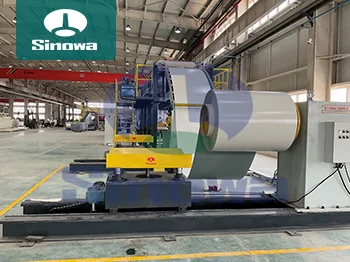
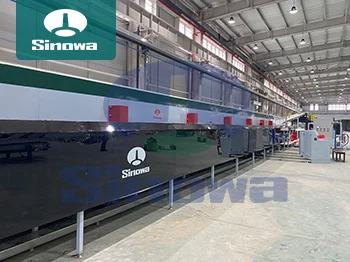
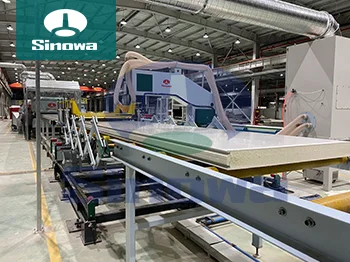
Sinowa is committed to the development and manufacturing of high-end and high-efficiency polyurethane sandwich panel production line. Our polyurethane sandwich panel production line are leading the way in efficiency, automatic control, human-computer interaction, environmental protection and energy consumption. Using system integration and bus control technology, it realizes the automatic integrated linkage control of the entire polyurethane sandwich panel production line, and can achieve remote interactive communication, which has the world-class level and a comprehensive leading high-performance polyurethane sandwich panel production line in the market.
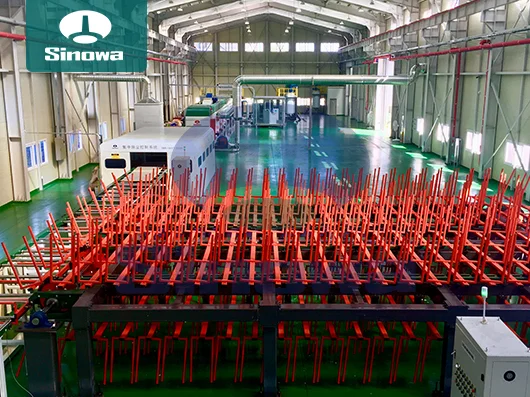
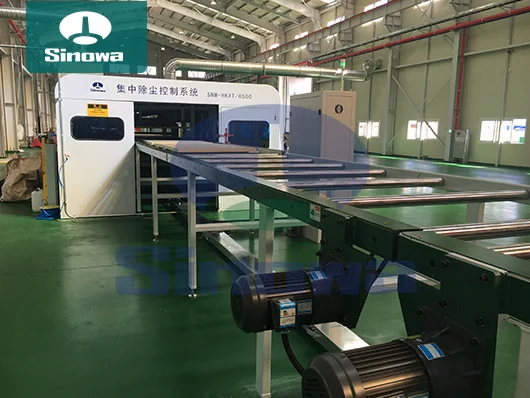
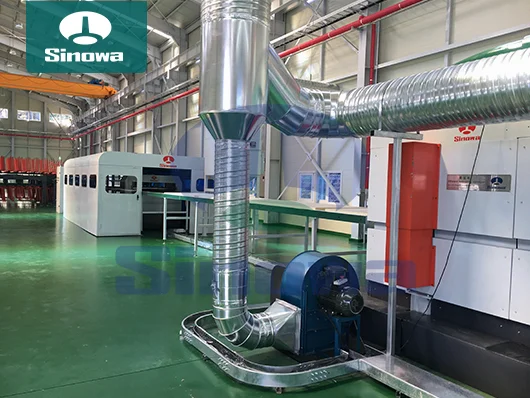
For more than ten years, relying on our innovative manufacturing concept and excellence in quality, reliable and trustworthy service to customers, we cooperate with customers all over the world, exported products to Canada, South Korea, Israel, Australia, the Middle East and other more than 20 countries and regions. contributed to building energy conservation and low-carbon production and have won widespread praise.
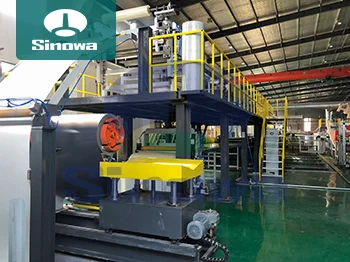
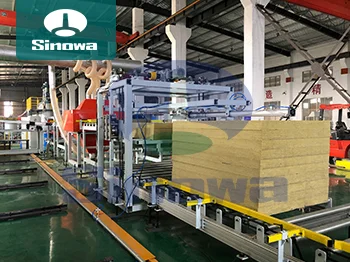
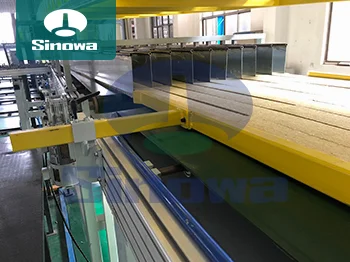
Sinowa has invested outstanding efforts in polyurethane sandwich panel production line, this is why our products are more efficiency, quality, automatic control technology, environmental protection, energy consumption indicators and the appearance and safety protection are comprehensively leading, some subversive design changes in many major technical points, these major innovations make our products excellent in price/performance and user experience.
In the modern construction industry, the pursuit of energy efficiency, durability, and construction efficiency has driven the wide application of new building materials, among which polyurethane sandwich panels have become a preferred choice for residential construction due to their excellent comprehensive performance. The polyurethane sandwich panel production line dedicated to house construction is a sophisticated and automated system that integrates multiple processes, ensuring the mass production of high-quality panels that meet the diverse needs of residential buildings. This production line not only simplifies the construction process but also promotes the transformation of the housing industry towards green, energy-saving, and modular development, bringing new possibilities to the design and construction of modern houses.
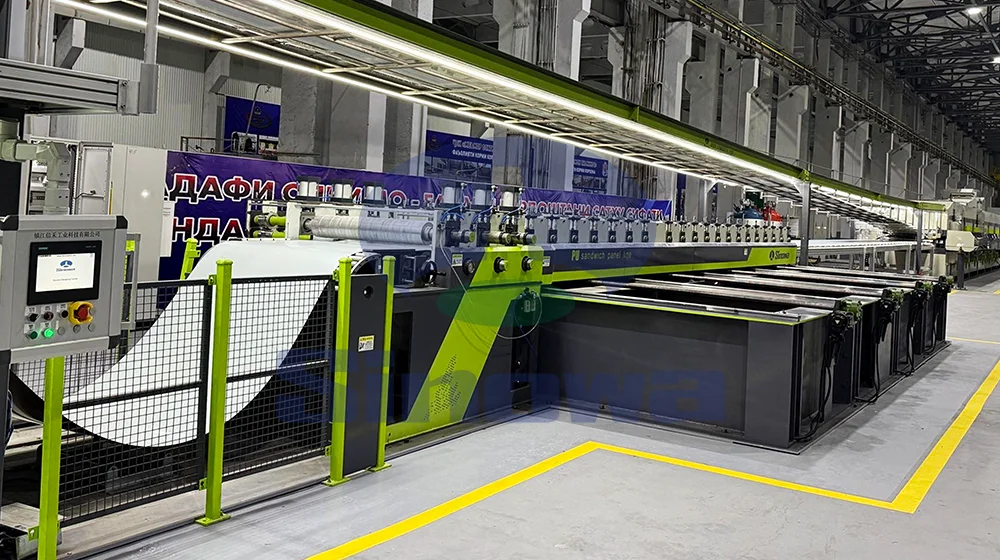
A polyurethane sandwich panel for house use is a composite material composed of two outer facing layers and a middle polyurethane foam core. The outer layers are usually made of lightweight and high-strength materials such as color-coated steel plates, aluminum sheets, or fiber-reinforced cement boards, which provide structural support and protection for the panel. The middle polyurethane core, formed by the foaming reaction of isocyanate and polyol, has a closed-cell honeycomb structure, which endows the panel with excellent thermal insulation, sound insulation, and moisture-proof performance. The production line is designed to realize the seamless combination of these three components, ensuring that each panel has uniform quality, stable performance, and meets the strict requirements of residential construction for safety and comfort.
The structure of a polyurethane sandwich panel production line for house construction is complex and systematic, consisting of several core functional units that work together to complete the entire production process from raw material input to finished product output. The main components include the unwinding system, forming system, preheating system, foaming system, composite laminating system, curing system, cutting system, cooling system, and stacking system. Each unit has a specific function, and the coordination between them directly affects the production efficiency and product quality. The unwinding system is responsible for feeding the coiled facing materials into the production line stably and evenly; the forming system shapes the facing materials into the required size and profile through rolling or pressing, which can be adjusted according to the design requirements of different houses, such as flat panels for walls, corrugated panels for roofs, or special-shaped panels for decorative parts. The preheating system heats the facing materials to an appropriate temperature, which helps to improve the adhesion between the facing and the polyurethane core, ensuring that the two are closely bonded without delamination.
The foaming system is the core part of the entire production line, as it determines the performance of the polyurethane core. In this system, the two main raw materials, isocyanate and polyol, are accurately measured and mixed in a certain proportion by a high-precision metering pump, and then injected into the gap between the two pre-formed facing layers through a mixing head. The mixing process must be uniform and rapid to ensure that the foaming reaction can proceed fully. The foaming reaction is an exothermic process, and the temperature and time of the reaction need to be strictly controlled. The production line is equipped with an intelligent temperature control system that monitors the reaction temperature in real-time and adjusts it through heating or cooling devices to ensure that the polyurethane foam forms a uniform closed-cell structure. The density of the foam core is usually controlled between 30-40kg/m³, which balances the thermal insulation performance and mechanical strength of the panel, making it suitable for the load-bearing and insulation needs of residential walls and roofs.
After the foaming is completed, the composite panel enters the composite laminating system, where it is pressed by a double-belt conveyor to ensure that the facing layers and the foam core are closely combined, and the surface of the panel is flat and smooth. The double-belt conveyor adopts a special design, with adjustable pressure and speed, which can adapt to panels of different thicknesses and specifications. The curing system is connected to the laminating system, and the composite panel is sent to a continuous curing furnace for further curing. The curing process is carried out at a constant temperature, which allows the polyurethane foam to fully cross-link and solidify, improving the structural stability and durability of the panel. The curing time is determined according to the thickness of the panel and the type of raw materials, usually ranging from several minutes to more than ten minutes. During the curing process, the panel is kept in a stable state to avoid deformation or unevenness.
After curing, the panel is transported to the cutting system, where it is cut into the required length and width by an automatic tracking cutting machine. The cutting machine is equipped with high-precision blades and a positioning system, which can ensure the cutting accuracy, and the error is controlled within a small range, meeting the installation requirements of residential construction. The cutting process is fully automated, which not only improves the cutting efficiency but also reduces the waste caused by manual operation. After cutting, the panel enters the cooling system, where it is cooled to room temperature through natural cooling or forced air cooling. Cooling is an important link to prevent the panel from deforming due to thermal expansion and contraction, ensuring that the size of the finished product is stable. Finally, the cooled panels are sent to the stacking system, where they are automatically stacked and sorted, ready for storage or transportation to the construction site.
The polyurethane sandwich panel production line for house construction has the characteristics of high automation, high efficiency, and stable quality. Compared with traditional manual or semi-automatic production methods, the automated production line can significantly improve production efficiency, reduce labor costs, and avoid the impact of human factors on product quality. The entire production process is controlled by a PLC control system, which can realize the automatic operation of each link, and the operator only needs to monitor the operation status of the equipment and adjust the parameters when necessary. The production line has strong flexibility and can produce panels of different specifications, thicknesses, and colors according to the needs of different housing projects. For example, for low-rise residential buildings, lightweight and thin panels can be produced; for high-rise residential buildings, panels with higher strength and fire resistance can be customized. This flexibility makes the production line suitable for various types of residential construction, including prefabricated houses, modular houses, traditional reinforced concrete houses, and rural self-built houses.
The polyurethane sandwich panels produced by this production line have obvious advantages in house construction, which is an important reason for their wide application. First of all, they have excellent thermal insulation performance. The closed-cell structure of the polyurethane core has a very low thermal conductivity, usually between 0.022-0.027W/(m·K), which is much lower than traditional building materials such as brick, concrete, androck wool. This means that houses built with polyurethane sandwich panels can effectively reduce heat transfer between the inside and outside, keeping the indoor temperature stable in both winter and summer. In winter, it can reduce the energy consumption of heating; in summer, it can reduce the energy consumption of air conditioning, thus achieving the effect of energy saving and environmental protection. Studies have shown that houses using polyurethane sandwich panels can reduce heating and cooling energy consumption by 30%-50% compared with traditional houses, which is of great significance for promoting green building development.
Secondly, polyurethane sandwich panels have good mechanical strength and lightweight characteristics. The outer facing layers are made of high-strength materials, and the composite structure of the panel makes it have good compressive, bending, and impact resistance, which can meet the load-bearing requirements of residential walls and roofs. At the same time, the panel is lightweight, with a weight of about 8-12kg per square meter, which is much lighter than traditional brick walls and concrete walls. This not only reduces the overall weight of the building, reduces the load on the foundation, but also simplifies the construction process, shortens the construction period. In prefabricated and modular house construction, the lightweight panels can be easily transported and installed, improving the construction efficiency by more than 50% compared with traditional construction methods.
In addition, polyurethane sandwich panels have excellent sound insulation and moisture-proof performance. The closed-cell foam core can effectively block the transmission of sound, reducing the impact of outdoor noise on the indoor environment. The sound insulation effect can reach 28-32dB, which can create a quiet and comfortable living environment for residents. At the same time, the closed-cell structure is not easy to absorb water, with a water absorption rate of less than 1%, which can effectively prevent moisture from entering the panel, avoiding mold and deformation of the panel, and improving the durability of the building. This is particularly important for houses in humid areas, as it can extend the service life of the building and reduce maintenance costs.
The application of polyurethane sandwich panel production lines in house construction also promotes the development of prefabricated housing. Prefabricated housing is a new type of construction method that prefabricates building components in the factory and then assembles them on the construction site. This method has the advantages of high construction efficiency, low environmental pollution, and high quality. Polyurethane sandwich panels, as a key prefabricated component, can be mass-produced by the production line, ensuring the consistency and quality of the components. The panels can be pre-installed with doors, windows, and pipelines in the factory, further simplifying the on-site assembly process. In modular houses, the entire wall and roof can be composed of polyurethane sandwich panels, which can be assembled quickly on the site, shortening the construction period from several months to several weeks, greatly improving the efficiency of housing construction.
With the continuous improvement of people's requirements for living quality and the continuous promotion of green building policies, the demand for polyurethane sandwich panels in house construction is increasing, which also promotes the continuous upgrading and improvement of the production line. In the future, the polyurethane sandwich panel production line for house construction will develop towards more intelligent, energy-saving, and environmentally friendly directions. The intelligent upgrading of the production line will realize the full automation of the production process, including intelligent monitoring, intelligent adjustment, and intelligent maintenance, which can further improve production efficiency and product quality, and reduce the labor intensity of operators. The energy-saving transformation of the production line will focus on reducing energy consumption in the foaming and curing links, adopting more environmentally friendly raw materials and energy-saving equipment, such as using cyclopentane instead of traditional foaming agents, which is more environmentally friendly and in line with the requirements of green development.
At the same time, the production line will also develop towards multi-functional integration, not only producing traditional polyurethane sandwich panels but also developing panels with additional functions, such as fire-resistant panels, anti-corrosion panels, and decorative panels. These panels can meet the diverse needs of different residential environments and architectural styles, expanding the application scope of polyurethane sandwich panels in house construction. For example, fire-resistant polyurethane sandwich panels can be used in high-rise residential buildings to improve the fire safety of the building; decorative panels with various colors and textures can be used for the exterior walls of houses, enhancing the aesthetic performance of the building.
It should be noted that although the polyurethane sandwich panel production line has many advantages, strict quality control is still required in the production process to ensure the safety and reliability of the products. The selection of raw materials is crucial. High-quality isocyanate, polyol, and facing materials must be used to avoid the impact of inferior raw materials on the performance of the panels. In the production process, the parameters such as the proportion of raw materials, foaming temperature, curing time, and cutting accuracy must be strictly controlled to ensure that each panel meets the relevant standards. In addition, the maintenance of the production line is also very important. Regular inspection and maintenance of the equipment can ensure the stable operation of the production line, extend the service life of the equipment, and reduce the occurrence of production failures.
In conclusion, the polyurethane sandwich panel production line for house construction is an important equipment in the modern housing industry, which provides high-quality, efficient, and energy-saving building materials for residential construction. The production line integrates multiple advanced technologies, realizes the automated and mass production of polyurethane sandwich panels, and the produced panels have excellent thermal insulation, sound insulation, moisture-proof, and mechanical performance, which can meet the diverse needs of modern house construction. With the continuous development of the construction industry and the continuous upgrading of technology, the polyurethane sandwich panel production line will play a more important role in the future housing industry, promoting the development of the housing industry towards green, energy-saving, intelligent, and modular directions, and bringing a more comfortable, safe, and environmentally friendly living environment to people.
« Polyurethane Sandwich Panel Production Line For House » Update Date: 2026/4/17
- High Efficiency Cold Room Sandwich Panel Production Line
- Low Price Corrugated Sandwich Panel Production Line
- Isolation Sandwich Panel Production Line
- Highly Intelligent Polyurethane Sandwich Panel Manufacturing Line
- Continuous PU Sandwich Panel Production Line Factory
- Metal Sandwich Panel Production Line Supplier
- Intelligent Insulation Panel Production Line
- Glass Wool Sandwich Panel Line Design
- High-end Polyurethane Sandwich Panel Line
- High-end Corrugated Sandwich Panel Production Line
- Good Quality PU Sandwich Roofing Foaming Line
- PU Insulated Panel Production Line For Sale
- Fully Automatic PU Sandwich Panel Line Design
- Highly Intelligent Continuous PU Sandwich Panel Production Line
- Good Price And Quality PU Foam Production Line
- Glass Wool Sandwich Panel Line Supplier
- Customized PUF Panel Making Machine
- Exterior Wall Insulation Panel Production Line On Sales
- Glass Wool Sandwich Panel Line
- PUR Sandwich Panel Production Line On Sales
- Links:
- Sandwich Panel Continuous Production Line
- Automatic and Continuous Sandwich Panel Production Line
- Cheap and Low Price Sandwich Panel Production Line
- China Sandwich Panel Production Line Factory
- Color Steel Sandwich Panel Production Line For Cold Storage
- Continuous Composite Foam Sandwich Panel Production Line
- Continuous Production Line For Rockwool and Mineral Wool Sandwich Panels
- Continuous PU Phenolic Insulation Panel Production Line
- Continuous PU PIR Sandwich Panel Production Line
- Continuous PUF PUR Sandwich Panel Production Line
- Continuous Sandwich Panel Production Line For Roof and Wall
- Customized and Design Sandwich Panel Production Line
- Decorative Sandwich Panel Production Line For Glass Wool Boards
- High Quality Sandwich Panel Production Line For Sale
- Polyurethane(PU) Sandwich Panel Production Line
- Sandwich Panel Production Line Manufacturer and Supplier