
Fully Automatic Sandwich Panel Line
Sinowa is a fully automatic sandwich panel line supplier from china, customized high-quality & high efficiency fully automatic sandwich panel line at low price, the adoption of system integration technology and bus control technology accomplishes the full automatization of integrated and coordinated control of the fully automatic sandwich panel line with accessible remote interactive communication. Ranking the first-class level in the world, it is currently the fully automatic sandwich panel line in the market taking a comprehensive lead in high performance.
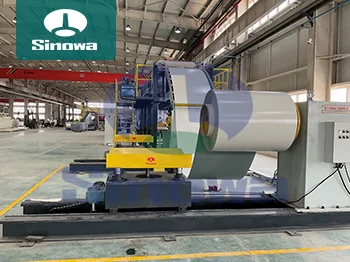
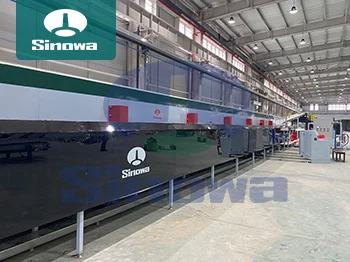
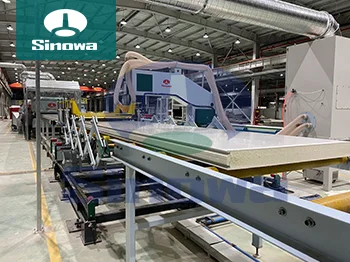
The high-tech fully automatic sandwich panel line can meet a variety of production needs of customers, the whole fully automatic sandwich panel line design concept of modularization enables all our components to be integrated and combined at will. Our high efficiency fully automatic sandwich panel line can easily automate the production of roof sandwich panel, wall sandwich panel, cold storage sandwich panel and other products by different combination and configuration selection and siple switching. The inner core layer can be polyrethane or rock wool, glass wool, an so on.


The high precision fully automatic sandwich panel line has high adaptability, which may produce various sandwich panel of the PU, PIR and rock wool systems. We may design various products according to the customer’s requirements, including various configurations, so as to meet their demands with flexible price system. Highly integrated and linked control system centralizes all control points at the main central center, achieving parameter linkage, fault self-diagnosis controlled by the whole line and shipping distance control. High-level automatic control system also saves the manpower and reduces the manpower loss for customers.


The precision servo hoisting mechanism employed by the main engine without hydraulic system makes the board thickness control flexible and the customer may conveniently change or adjust the board thickness. There will be not such troubles as hydraulic system adjustment, leakage, maintenance, etc.


High-level energy saving and protection design makes the whole fully automatic sandwich panel line possible to produce around the clock throughout the year and the customer will save huge budget. In addition, the isolated heat preservation room is constructed for warming the environment. The energy saving and protection design of our manufacturing line may guarantee that the customer’s production line may be freely heated and produce in the main time to save more costs for customers.


The high-power low-consumption design quickens the reaction of the cheap fully automatic sandwich panel line while energy consumption is kept low. With the brand-new, fully sealed inner insulation design, the energy consumption is controlled at the minimum level to achieve the design objective of less than an hour for the insulation system to be activated from the room temperature above 5℃ to the production process temperature. The energy consumption is only 40% that of those similar products.
The fully automatic sandwich panel line represents a highly integrated and streamlined manufacturing solution designed for the mass production of high-performance composite sandwich panels. This advanced production system integrates all core production procedures into a single continuous operational flow, completely replacing the fragmented and manual-dependent processing modes of traditional semi-automatic equipment. Covering raw material feeding, surface material forming, core material distribution, adhesive compounding, constant-temperature curing, precision cutting, and finished product stacking, the line realizes full-process automated operation with minimal human intervention. Its intelligent centralized control system coordinates every functional module synchronously to ensure consistent production rhythm, stable product quality, and optimized production efficiency. Widely adaptable to diverse core materials and surface plate specifications, the production line meets the manufacturing demands of architectural insulation, industrial enclosure, and lightweight structural panels. By eliminating intermediate manual handling, repeated positioning errors, and material waste, it delivers superior production uniformity, operational reliability, and cost-effectiveness, becoming the core equipment for modern standardized sandwich panel manufacturing.
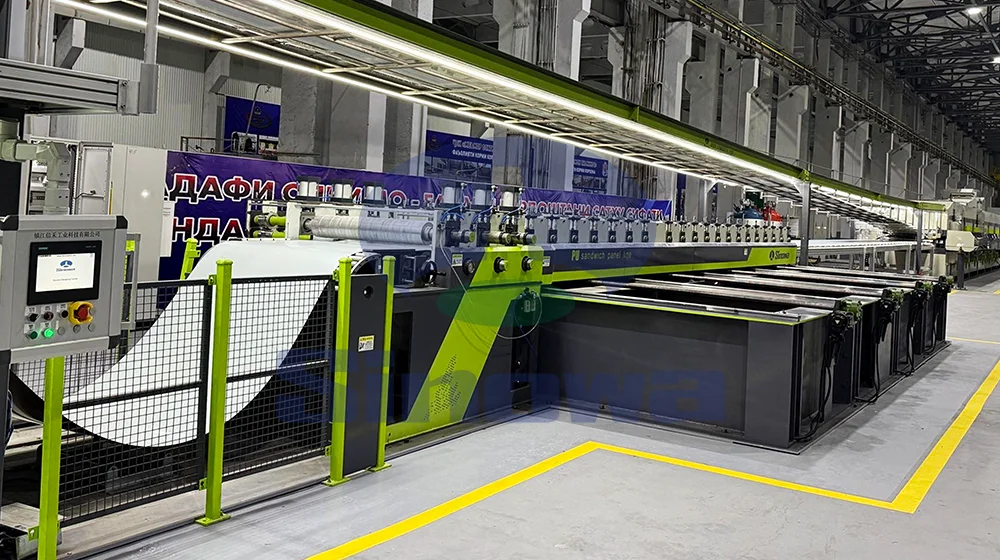
The overall structural layout of the fully automatic sandwich panel line is scientifically designed based on the linear material flow principle, forming a closed-loop continuous production system with precise functional partitioning and seamless module docking. Every functional unit is arranged in strict accordance with the production sequence, avoiding redundant material transportation and cross-operation interference that are common in traditional discrete production equipment. The whole line can be divided into multiple core functional areas including raw material unwinding and pretreatment, roll forming, core material feeding and foaming, composite lamination, constant-temperature pressure curing, fixed-length cutting, cooling shaping, and automatic stacking. Each independent module is equipped with adaptive transmission and adjustment mechanisms, maintaining synchronous operating speeds and coordinated working rhythms throughout the production process. The integrated frame structure enhances the overall stability of the equipment, effectively reducing vibration and displacement during long-term high-speed operation. This systematic layout not only simplifies the production workflow and shortens the production cycle of single-panel processing but also greatly reduces equipment failure rates and daily maintenance costs, laying a solid foundation for long-term stable and continuous industrial production.
Raw material pretreatment and unwinding serve as the initial foundational links of the entire production line, directly determining the surface quality and subsequent composite performance of finished sandwich panels. The line is equipped with fully automatic hydraulic unwinding units that adapt to various coil raw materials used for panel surface layers, featuring stable tension control systems to avoid material deviation, wrinkling, and stretching during the unwinding process. Different from manual auxiliary unwinding in traditional equipment, this automatic unit realizes continuous and uniform material release without frequent manual adjustment, ensuring consistent flatness of surface materials. Meanwhile, the built-in pretreatment mechanism completes surface cleaning and preliminary shaping of coiled materials, removing surface dust and subtle impurities that may affect adhesive bonding effects. The tension feedback system monitors material operating status in real time and automatically fine-tunes tension parameters according to material thickness and operating speed, maintaining stable material conveying tension at all times. Standardized raw material pretreatment eliminates quality differences caused by uneven manual processing, unifies the initial processing standards of raw materials, and provides qualified raw material conditions for subsequent forming, gluing, and composite processing procedures.
The roll forming system is a key functional module responsible for shaping surface materials, which endows flat coiled materials with standardized structural profiles required for sandwich panels. This high-precision forming unit consists of multiple groups of synchronous rolling rollers arranged in gradient specifications, completing gradual bending, pressing, and shaping of surface materials through multi-stage rolling processing. Each rolling group adopts precision positioning and synchronous transmission technology to ensure consistent forming accuracy of each material section, avoiding local deformation or dimensional deviation. The system supports flexible adjustment of forming parameters, which can adapt to different surface material thicknesses and panel profile requirements, realizing rapid switching of various product specifications without complicated manual mold replacement. During the forming process, the real-time monitoring module tracks material forming status, automatically correcting minor dimensional errors and ensuring the flatness and structural consistency of formed plates. Compared with traditional single-stage forming equipment, the multi-stage continuous roll forming mode improves forming efficiency while avoiding secondary damage to materials caused by repeated processing, effectively enhancing the overall structural rigidity and surface finish of finished sandwich panels.
Core material feeding and foaming mixing systems are core components that determine the thermal insulation and structural performance of sandwich panels, achieving precise proportioning and uniform laying of core layer raw materials. For foam core materials, the fully automatic metering system accurately controls the proportion of various raw material components, realizing scientific matching of raw materials through intelligent parameter setting and completely avoiding proportion deviation caused by manual batching. The high-speed mixing unit ensures full and uniform fusion of raw materials, forming stable foam slurry with consistent density and fluidity. The automatic injection and laying device evenly distributes foam materials between upper and lower surface plates at a constant speed and fixed quantity, effectively preventing hollow areas, uneven thickness, and local agglomeration of the core layer. For rigid core materials, the precision feeding system realizes fixed-thickness continuous feeding and flat laying, ensuring uniform core layer thickness of each panel. This automated core material processing mode greatly improves the uniformity of core layer structure, stabilizes the thermal insulation, shock resistance and structural bearing performance of finished panels, and avoids product performance differences caused by uneven manual material laying.
The composite lamination system undertakes the key task of bonding upper and lower surface plates with the core layer into an integrated structure, which directly affects the overall bonding strength and structural stability of sandwich panels. Equipped with high-precision synchronous pressing roller groups, the system adopts a double-track closed pressing structure to provide uniform and stable pressing force for composite panels. All pressing rollers maintain synchronous operating speed and consistent pressure output, ensuring that the composite interface of each panel section is closely fitted without gaps or dislocation. The adaptive pressure adjustment function can automatically match different pressing pressures according to material hardness, panel thickness and production speed, avoiding excessive pressure leading to material deformation or insufficient pressure causing weak bonding. Meanwhile, the automatic gluing unit realizes quantitative and uniform adhesive coating on the bonding surface, solving the problems of uneven glue layer, excessive glue consumption and local glue shortage in traditional manual gluing processes. Precise gluing and synchronous pressing work together to enhance the bonding tightness between layers, improving the overall structural integrity and service durability of sandwich panels.
Constant-temperature curing and pressure molding is an indispensable post-composite processing link that solidifies the bonding structure and stabilizes the finished panel shape. After preliminary composite lamination, the semi-finished panel enters the sealed constant-temperature curing channel, where the internal temperature and pressure environment are precisely controlled by the intelligent system to maintain a stable curing state. The uniform temperature field inside the curing equipment ensures that the adhesive on each part of the panel undergoes full and consistent curing reactions, eliminating incomplete curing or inconsistent curing degree caused by uneven temperature distribution in traditional open processing modes. The continuous low-pressure holding mode fixes the composite structure during the curing process, effectively preventing panel warping, bending and layer separation during cooling and shaping. The system can adjust curing temperature, holding time and pressure parameters according to different adhesive types and panel specifications, adapting to the curing requirements of various composite materials. Standardized constant-temperature curing significantly improves the bonding firmness between panel layers, stabilizes the overall dimensional accuracy of products, and greatly reduces the defective rate of semi-finished products.
The fixed-length cutting system realizes precise sizing and cutting of continuously produced composite panels, ensuring unified dimensional specifications of finished products. This high-precision cutting unit adopts servo-driven automatic cutting technology, which can flexibly set cutting length and spacing parameters through the central control system to meet customized sizing requirements of different products. The cutting tool is made of high-hardness wear-resistant materials, maintaining smooth and burr-free cutting sections and avoiding edge deformation and material damage during cutting. The system is equipped with automatic positioning and tracking functions, synchronously operating with the production line conveying speed to complete dynamic cutting without stopping the production line, realizing truly uninterrupted continuous production. The real-time dimensional detection module automatically verifies the cutting size of each panel, feeding back error data to the control system for real-time parameter correction to ensure that the dimensional error of finished panels is controlled within a tiny range. Compared with traditional fixed-size cutting equipment, the automatic dynamic cutting mode improves cutting efficiency and dimensional accuracy, while greatly reducing material loss caused by cutting errors.
Cooling shaping and edge trimming processes further optimize the appearance quality and structural regularity of finished sandwich panels. After fixed-length cutting, the panels are automatically conveyed to the cooling conveyor system, which adopts layered circulating air cooling technology to realize uniform and slow cooling of panels. This scientific cooling mode avoids panel deformation, shrinkage and internal stress concentration caused by rapid and uneven cooling, fully stabilizing the internal structure and overall flatness of panels. The subsequent automatic edge trimming unit precisely trims the edges and corners of panels, removing residual burrs, uneven edges and excess composite materials generated in the production process. The trimming mechanism operates synchronously with panel conveying, completing edge finishing efficiently without affecting production rhythm. The system supports adaptive trimming width adjustment according to panel specifications, ensuring neat and consistent edges of all finished products. These two post-processing links further polish product quality, standardize product appearance and structural dimensions, and improve the overall grade and applicability of sandwich panels for various engineering scenarios.
The automatic stacking and discharging system realizes unmanned collection and arrangement of finished panels, completing the final link of the full production cycle. After cooling and trimming, qualified panels are automatically transported to the stacking platform through the conveying system, and the intelligent stacking mechanism completes orderly stacking and arrangement according to set specifications. The system can adjust stacking height, spacing and arrangement mode according to product types and packaging requirements, realizing standardized and neat stacking of finished products. Equipped with anti-collision and anti-pressure protection functions, the stacking mechanism effectively avoids surface scratches, corner damage and panel extrusion deformation during the stacking process. Different from manual stacking which is inefficient and prone to irregular arrangement, the automatic stacking mode realizes continuous and stable finished product output, greatly improving packaging and warehousing efficiency. The entire discharging and stacking process requires no manual intervention, realizing seamless docking with subsequent packaging and warehousing links, and further improving the full-process automation level of the production line.
The intelligent central control system serves as the brain of the fully automatic sandwich panel line, realizing unified scheduling, parameter adjustment and operational monitoring of all functional modules. The system adopts a human-machine interactive operation interface, allowing operators to set production parameters such as panel thickness, length, production speed and material proportions in a simple and intuitive manner. It supports real-time synchronous monitoring of the operating status, operating speed and working parameters of each equipment module, automatically identifying abnormal operating conditions such as parameter deviation, equipment stalling and material blockage. Once a fault is detected, the system will issue an early warning prompt and automatically perform emergency protection actions to avoid equipment damage and mass defective product output. In addition, the control system has data recording and self-optimization functions, which can accumulate production data for a long time, analyze optimal production parameters according to different production conditions, and automatically adjust operating parameters to maintain the best production state. This intelligent control mode simplifies equipment operation difficulty, reduces reliance on experienced operators, and ensures long-term stable and high-quality operation of the production line.
The fully automatic sandwich panel line has significant comprehensive advantages in production efficiency, product quality stability and production cost control compared with traditional production equipment. In terms of production efficiency, the full continuous automated production mode eliminates intermediate waiting, manual handling and repeated debugging links, realizing uninterrupted cyclic production and greatly improving unit-time output. In terms of product quality, full-process standardized parameter control avoids manual operation errors, ensuring consistent dimensional accuracy, structural uniformity and bonding performance of each batch of products, with extremely low product defective rate. In terms of cost control, the precise material metering and feeding system reduces raw material waste, and the high degree of automation reduces on-site labor demand, effectively cutting labor and management costs. Meanwhile, the modular integrated structure reduces equipment failure rates and maintenance expenses, extending the service life of production equipment. With strong production flexibility and product adaptability, the equipment can meet the diversified production needs of multiple types of sandwich panels, providing efficient, stable and economical manufacturing solutions for modern composite panel production.
« Fully Automatic Sandwich Panel Line » Update Date: 2026/8/26
URL: https://www.sinowamachine.com/tags/fully-automatic-sandwich-panel-line.html
- Links:
- Sandwich Panel Continuous Production Line
- Automatic and Continuous Sandwich Panel Production Line
- Cheap and Low Price Sandwich Panel Production Line
- China Sandwich Panel Production Line Factory
- Color Steel Sandwich Panel Production Line For Cold Storage
- Continuous Composite Foam Sandwich Panel Production Line
- Continuous Production Line For Rockwool and Mineral Wool Sandwich Panels
- Continuous PU Phenolic Insulation Panel Production Line
- Continuous PU PIR Sandwich Panel Production Line
- Continuous PUF PUR Sandwich Panel Production Line
- Continuous Sandwich Panel Production Line For Roof and Wall
- Customized and Design Sandwich Panel Production Line
- Decorative Sandwich Panel Production Line For Glass Wool Boards
- High Quality Sandwich Panel Production Line For Sale
- Polyurethane(PU) Sandwich Panel Production Line
- Sandwich Panel Production Line Manufacturer and Supplier
- Sandwich Panel Production Machinery and Equipment