
Continuous PU Sandwich Panel Line Factory
Sinowa is a well-known manufacturer and technical service provider of high-end continuous pu sandwich panel line, learn more about continuous pu sandwich panel line factory, please contact Sinowa's technical engineer, tell us what you need, we will contact you as soon as possible!
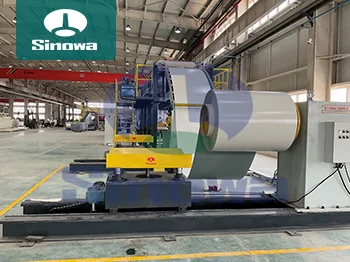
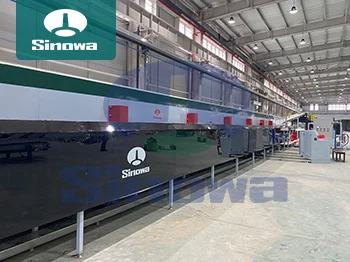
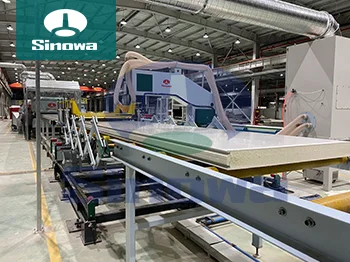
Sinowa is committed to the development and manufacturing of high-end and high-efficiency continuous pu sandwich panel line. Our continuous pu sandwich panel line are leading the way in efficiency, automatic control, human-computer interaction, environmental protection and energy consumption. Using system integration and bus control technology, it realizes the automatic integrated linkage control of the entire continuous pu sandwich panel line, and can achieve remote interactive communication, which has the world-class level and a comprehensive leading high-performance continuous pu sandwich panel line in the market.
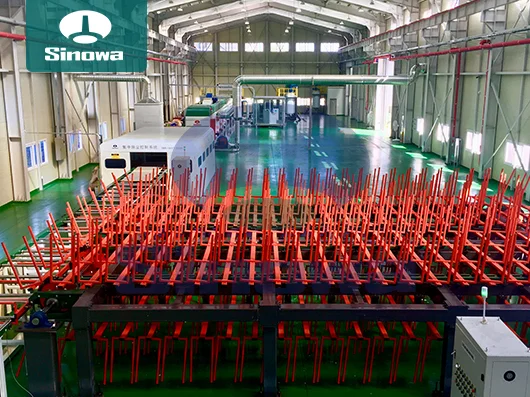
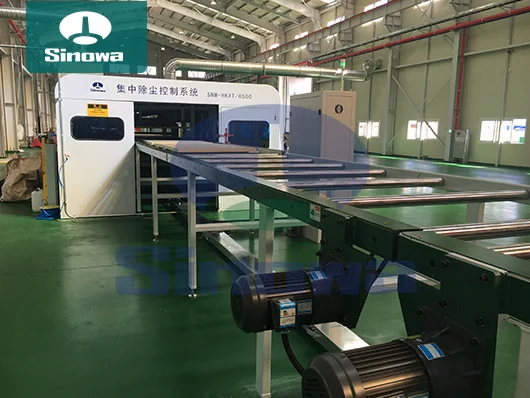
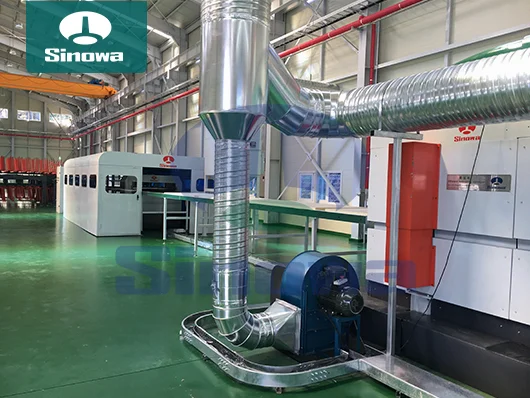
For more than ten years, relying on our innovative manufacturing concept and excellence in quality, reliable and trustworthy service to customers, we cooperate with customers all over the world, exported products to Canada, South Korea, Israel, Australia, the Middle East and other more than 20 countries and regions. contributed to building energy conservation and low-carbon production and have won widespread praise.
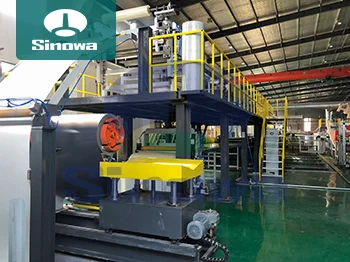
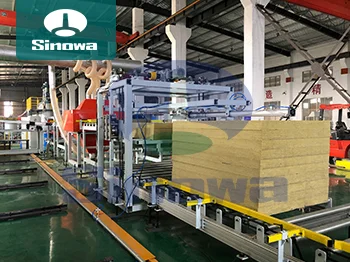
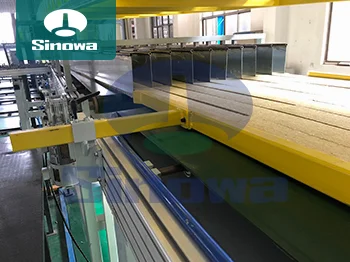
Sinowa has invested outstanding efforts in continuous pu sandwich panel line, this is why our products are more efficiency, quality, automatic control technology, environmental protection, energy consumption indicators and the appearance and safety protection are comprehensively leading, some subversive design changes in many major technical points, these major innovations make our products excellent in price/performance and user experience.
The continuous PU sandwich panel line factory stands as a hallmark of modern industrial manufacturing, blending advanced automation technology, precise chemical engineering, and efficient production management to meet the growing global demand for high-performance insulation and construction materials. Polyurethane (PU) sandwich panels, with their unique three-layer structure consisting of two outer facings and a PU foam core, have become indispensable in various sectors due to their exceptional thermal insulation, structural strength, and lightweight properties. The continuous production line, as the core of such factories, represents a significant leap from traditional discontinuous manufacturing, enabling mass production with consistent quality, reduced labor input, and enhanced operational efficiency.
At the heart of a continuous PU sandwich panel line factory lies a sophisticated integration of multiple processing stages, each designed to ensure seamless coordination and optimal product output. The production process typically commences with the preparation of raw materials, a critical step that lays the foundation for the quality of the final product. The outer facings, commonly made of galvanized steel, galvalume, or aluminum sheets, are supplied in large coils that require careful handling to avoid surface damage. These coils are loaded onto double uncoilers, which feature advanced servo correction systems to ensure the sheets are fed into the production line with precise alignment. Prior to entering the foaming stage, the facings undergo preheating in specialized ovens, a process that optimizes the adhesion between the facings and the PU core by adjusting the surface temperature to the ideal range for chemical bonding.
Parallel to the preparation of the outer facings is the handling and mixing of the PU foam raw materials. The core of the sandwich panel is formed by the reaction of polyol and isocyanate, combined with additives such as catalysts, foaming agents, and flame retardants to enhance specific properties. Modern factories employ high-pressure metering systems to accurately control the ratio of these components, ensuring consistent foam density and thermal performance. Environmental considerations have driven the adoption of eco-friendly foaming agents, such as pentane, which replace traditional HCFC-based agents, reducing the carbon footprint of the production process. The raw materials are stored in specialized tanks with temperature control systems to maintain their stability, and are transported to the mixing head via insulated pipelines to prevent premature reaction.
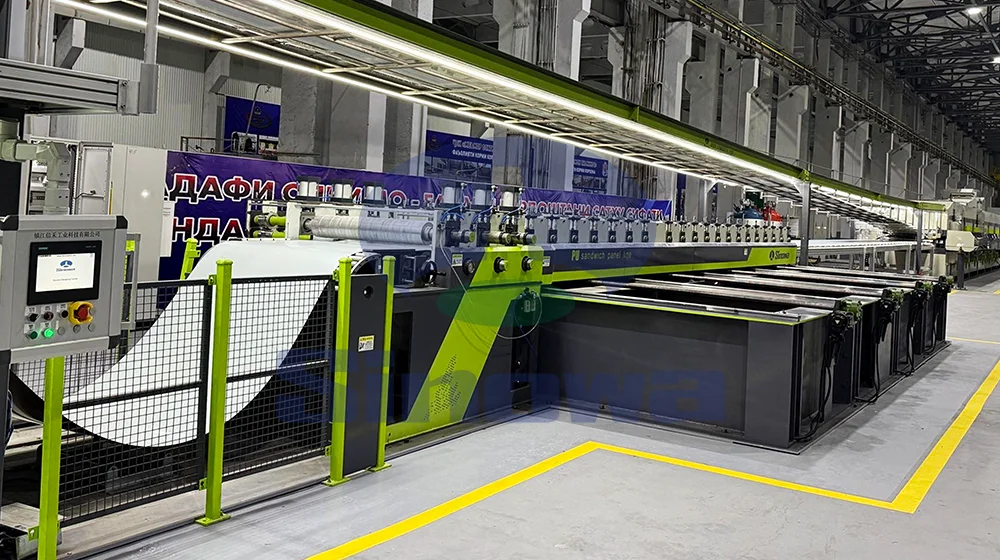
The foaming and lamination stage is the most critical part of the continuous production process, where the three layers of the sandwich panel are combined to form a unified structure. The preheated outer facings are fed into a continuous laminator, typically a dual-belt conveyor system, which maintains precise pressure and temperature conditions. Meanwhile, the mixed PU raw materials are injected between the two facings through a high-speed mixing head, which ensures uniform distribution of the foam. As the facings move through the laminator, the PU foam undergoes a rapid polymerization reaction, expanding to fill the entire space between the facings and bonding tightly to their inner surfaces. The dual-belt conveyor provides consistent pressure throughout the reaction process, ensuring the panel maintains a flat profile and uniform thickness. The length of the laminator is carefully designed to allow sufficient time for the foam to fully cure before moving to the next stage, with typical lengths ranging from 24 to 30 meters depending on the production speed and foam curing requirements.
Following the foaming and lamination process, the continuous panel undergoes post-processing to meet the required dimensions and quality standards. The first step in post-processing is edge trimming, where specialized cutting tools remove excess material from the sides of the panel to ensure precise width. This is followed by the cutting of the continuous panel into individual sheets of predetermined length using a high-precision tracking saw. The tracking saw is synchronized with the speed of the production line, allowing for cutting without stopping the conveyor, which maintains the efficiency of the continuous production process. After cutting, the panels are transferred to a cooling area to ensure complete curing and stabilization of the PU core, which enhances the structural integrity and dimensional stability of the final product.
Quality control is an integral part of every stage of production in a continuous PU sandwich panel line factory. Advanced monitoring systems are employed to track key parameters such as the temperature and pressure of the laminator, the ratio of raw materials, and the speed of the production line. These systems provide real-time data to the central control unit, allowing operators to make immediate adjustments if any parameters deviate from the set standards. In addition to automated monitoring, regular manual inspections are conducted to check the surface quality, thickness, and adhesion strength of the panels. Samples are taken at regular intervals for laboratory testing to verify thermal conductivity, fire resistance, and mechanical properties, ensuring that the products meet the requirements of various applications.
The modular design of the continuous production line is a key feature that enhances the flexibility and adaptability of the factory. Modular components allow for easy reconfiguration of the production line to accommodate different panel specifications, such as varying thicknesses (ranging from 20mm to 200mm), widths (typically up to 1200mm), and types of outer facings. This flexibility enables the factory to meet the diverse needs of customers across different sectors, from industrial warehouses and cold storage facilities to commercial buildings and agricultural structures. For example, by adjusting the foam density and adding specific flame retardants, the production line can switch between manufacturing panels for general insulation purposes and panels with high fire resistance for use in public buildings.
Automation is another defining characteristic of modern continuous PU sandwich panel line factories, significantly reducing the need for manual labor and minimizing human error. The central control system integrates all aspects of the production process, from raw material handling to packaging, allowing for centralized operation and monitoring. Operators can control the entire production line through an intuitive interface, which displays real-time data on production speed, material consumption, and quality parameters. Advanced automation features include automatic stacking and packaging systems, which handle the finished panels after cutting and cooling. These systems stack the panels according to specified quantities and wrap them in protective film to prevent damage during transportation, further enhancing the efficiency of the production process.
Energy efficiency and environmental sustainability are increasingly important considerations in the design and operation of continuous PU sandwich panel line factories. Modern production lines are equipped with energy-saving technologies such as full closed-loop insulation systems, which minimize heat loss during the preheating and lamination stages. The use of high-efficiency motors and variable frequency drives reduces electricity consumption by adjusting the speed of the conveyor and other equipment according to production needs. In addition, the adoption of eco-friendly foaming agents and the implementation of waste recycling systems further reduce the environmental impact of the factory. For example, excess foam and trimmed material can be collected and recycled, reducing waste and lowering raw material costs.
The products of continuous PU sandwich panel line factories find applications in a wide range of industries, driven by their exceptional performance characteristics. In the construction sector, PU sandwich panels are widely used for the exterior walls and roofs of industrial warehouses, logistics centers, and commercial buildings. Their excellent thermal insulation properties help reduce energy consumption for heating and cooling, making buildings more energy-efficient. In the cold storage and refrigeration industry, PU sandwich panels are the material of choice due to their low thermal conductivity and ability to maintain stable temperatures, ensuring the quality of perishable goods. Agricultural buildings, such as greenhouses and livestock facilities, also benefit from the use of PU sandwich panels, as they provide effective insulation and protection against harsh weather conditions.
The operational efficiency of continuous PU sandwich panel line factories is further enhanced by effective production management systems. These systems optimize production scheduling to minimize downtime and maximize output, ensuring that the factory can meet customer orders in a timely manner. Inventory management systems track the consumption of raw materials and the stock of finished products, reducing the risk of stockouts or overstocking. Maintenance management systems schedule regular inspections and maintenance of equipment, preventing unexpected breakdowns and extending the lifespan of the production line. By integrating these management systems with the automated production process, factories can achieve a high level of operational efficiency and profitability.
The development of continuous PU sandwich panel line factories is closely linked to the evolution of the global construction and insulation industries. As the demand for energy-efficient and sustainable building materials continues to grow, manufacturers are investing in research and development to further improve the performance of continuous production lines. Innovations such as advanced foam formulations, improved automation technologies, and enhanced quality control systems are helping to produce panels with better thermal insulation, higher structural strength, and lower environmental impact. In addition, the integration of digital technologies such as artificial intelligence and the Internet of Things (IoT) is enabling predictive maintenance and real-time optimization of the production process, further enhancing the efficiency and competitiveness of these factories.
Despite the many advantages of continuous PU sandwich panel line factories, there are also challenges that manufacturers need to address. The high initial investment required for setting up a continuous production line can be a barrier for small and medium-sized enterprises. In addition, the complexity of the production process requires skilled operators and technicians to ensure smooth operation and maintain product quality. Fluctuations in the prices of raw materials, such as polyol and isocyanate, can also affect the profitability of the factory. To overcome these challenges, manufacturers are focusing on reducing production costs through process optimization, improving the skills of their workforce through training programs, and developing long-term partnerships with raw material suppliers to stabilize prices.
In conclusion, the continuous PU sandwich panel line factory represents a high level of integration of technology, efficiency, and sustainability in modern manufacturing. Through the seamless coordination of raw material preparation, foaming and lamination, post-processing, and quality control, these factories produce high-performance PU sandwich panels that meet the diverse needs of various industries. The adoption of advanced automation, modular design, and energy-saving technologies has not only improved production efficiency and product quality but also reduced the environmental impact of the manufacturing process. As the global demand for sustainable and energy-efficient building materials continues to rise, continuous PU sandwich panel line factories are poised to play an increasingly important role in shaping the future of the construction and insulation industries. With ongoing innovations and improvements, these factories will continue to drive the development of the industry, providing high-quality products that contribute to a more sustainable and energy-efficient built environment.
« Continuous PU Sandwich Panel Line Factory » Update Date: 2026/1/12
- Sandwich Panel Line Design
- Customized Sandwich Panel Production Line
- PU Sandwich Panel Line For Wall
- Foam Sandwich Panel Production Line Factory
- Foam Sandwich Panel Machine From China
- Sandwich Panel Line Factory
- Customize Sandwich Panel Foam Production Line
- Customized PU Sandwich Panel Machine
- High-tech Wall Sandwich Panel Production Line
- Composite Panel Production Line For Sale
- Sandwich Panel Foam Production Line
- Cheap Sandwich Panel Machine
- Continuous PU Sandwich Panel Line Price
- High-quality Glass Wool Line
- Decorative PU Sandwich Panel Production Line Supplier
- Cheap Glass Wool Panel Production Line
- Sandwich Foam Panel Making Machine
- Cheap PU Sandwich Machine
- Glass Wool Sandwich Panel Production Line For Sale
- Isolation PU Sandwich Panel Line From China
- Links:
- Sandwich Panel Continuous Production Line
- Automatic and Continuous Sandwich Panel Production Line
- Cheap and Low Price Sandwich Panel Production Line
- China Sandwich Panel Production Line Factory
- Color Steel Sandwich Panel Production Line For Cold Storage
- Continuous Composite Foam Sandwich Panel Production Line
- Continuous Production Line For Rockwool and Mineral Wool Sandwich Panels
- Continuous PU Phenolic Insulation Panel Production Line
- Continuous PU PIR Sandwich Panel Production Line
- Continuous PUF PUR Sandwich Panel Production Line
- Continuous Sandwich Panel Production Line For Roof and Wall
- Customized and Design Sandwich Panel Production Line
- Decorative Sandwich Panel Production Line For Glass Wool Boards
- High Quality Sandwich Panel Production Line For Sale
- Polyurethane(PU) Sandwich Panel Production Line
- Sandwich Panel Production Line Manufacturer and Supplier