
Low Price Fully Automatic Rock Wool Sandwich Panel Production Line
Sinowa is a well-known manufacturer and technical service provider of high-end fully automatic rock wool sandwich panel production line, learn more about low price fully automatic rock wool sandwich panel production line, please contact Sinowa's technical engineer, tell us what you need, we will contact you as soon as possible!
Sinowa is committed to the development and manufacturing of high-end and high-efficiency fully automatic rock wool sandwich panel production line. Our fully automatic rock wool sandwich panel production line are leading the way in efficiency, automatic control, human-computer interaction, environmental protection and energy consumption. Using system integration and bus control technology, it realizes the automatic integrated linkage control of the entire fully automatic rock wool sandwich panel production line, and can achieve remote interactive communication, which has the world-class level and a comprehensive leading high-performance fully automatic rock wool sandwich panel production line in the market.
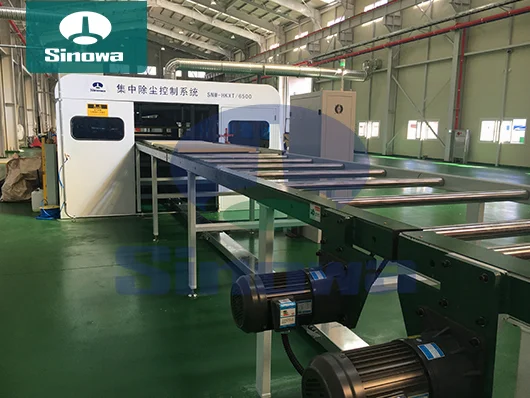
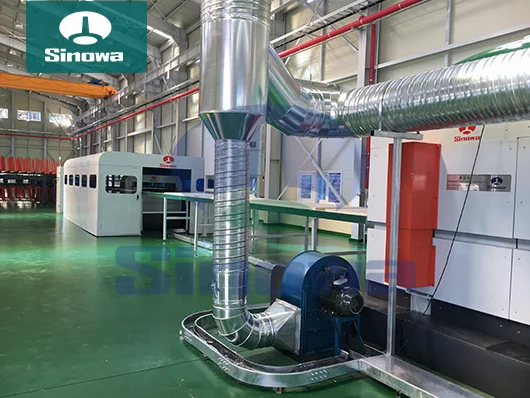
For more than ten years, relying on our innovative manufacturing concept and excellence in quality, reliable and trustworthy service to customers, we cooperate with customers all over the world, exported products to Canada, South Korea, Israel, Australia, the Middle East and other more than 20 countries and regions. contributed to building energy conservation and low-carbon production and have won widespread praise.
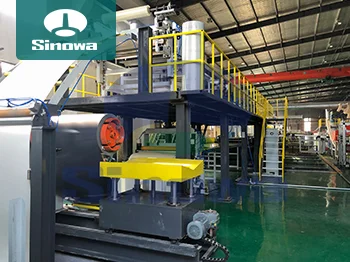
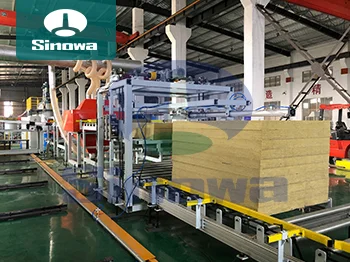
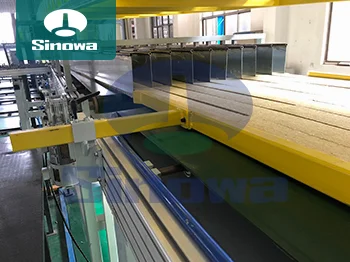
Sinowa has invested outstanding efforts in fully automatic rock wool sandwich panel production line, this is why our products are more efficiency, quality, automatic control technology, environmental protection, energy consumption indicators and the appearance and safety protection are comprehensively leading, some subversive design changes in many major technical points, these major innovations make our products excellent in price/performance and user experience.
The low price fully automatic rock wool sandwich panel production line represents a practical manufacturing solution designed for modern building material producers seeking continuous panel fabrication without excessive capital investment. Unlike older semi-automatic setups that require constant manual handling between individual processing stages, this integrated system connects every key manufacturing phase into one continuous workflow. Starting from metal coil unwinding, the line moves through roll forming, adhesive coating, rock wool core feeding, composite pressing, curing, fixed-length cutting, and finished panel stacking. Each mechanical unit communicates through a central control system to maintain consistent running speed and precise coordination. The design prioritizes simplified operation and stable running performance, which reduces the need for large teams of skilled workers on the production floor. Operators mainly monitor running status, adjust parameter settings, and replenish raw materials, rather than manually moving materials or aligning components. This reduction in labor dependence directly cuts down recurring operational expenditure, making continuous production economically viable even for small and medium manufacturing facilities. The mechanical framework is engineered to balance reliable function with reasonable construction costs, avoiding overly complex custom structures that inflate equipment budgets. It retains all essential modules required for rock wool panel production while removing redundant premium features that bring little practical benefit to standard panel manufacturing tasks. Many manufacturers find this equipment model fits well when expanding existing production capacity or entering the insulated panel market for the first time, as it lowers the barrier to launch mass production of composite building panels with fire and thermal insulation attributes.
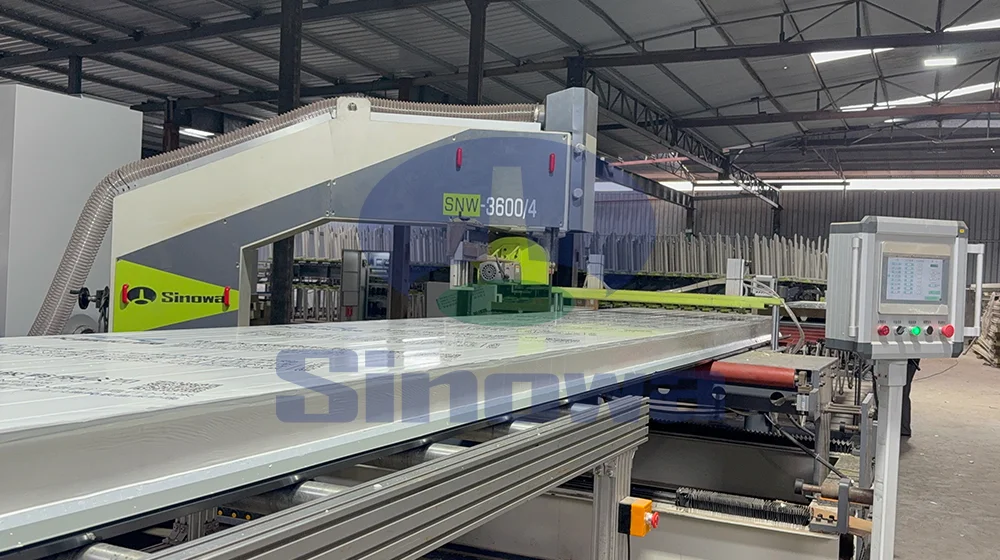
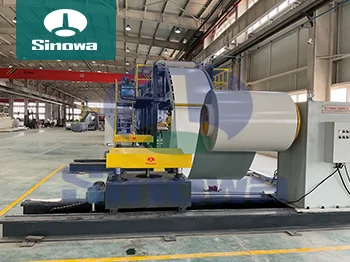
The first functional section of the production line handles metal coil unwinding and roll forming, preparing the upper and lower surface sheets that wrap the rock wool core. Metal coils are loaded onto unwinding supports, which release raw sheet material steadily and automatically as the line advances. Tension control devices keep the metal sheet flat and stable, preventing wrinkling, stretching or uneven feeding that would compromise final panel appearance and dimensional consistency. The sheet then enters the roll forming station, where a series of profiling rollers gradually bend the flat metal into the required profile for wall or roof panels. Each roller set shapes the metal incrementally to avoid material damage, and the system supports quick adjustment to switch between different profile shapes. After forming, the surface sheet moves to a surface preparation zone, where minor dust and oil residues are cleared to improve adhesive bonding strength. A protective film can also be applied on the outer metal face in this stage to prevent scratches during transportation and installation. All these actions run in synchronization with downstream processes, so the formed metal sheet arrives at the composite station at the exact matching speed of rock wool core supply. This synchronized operation eliminates waiting time between stations and avoids material accumulation or shortage. Even with the cost-effective design, the forming mechanism maintains precise dimension control, ensuring that the metal skins match the rock wool core width and shape consistently for every panel produced in long continuous runs.
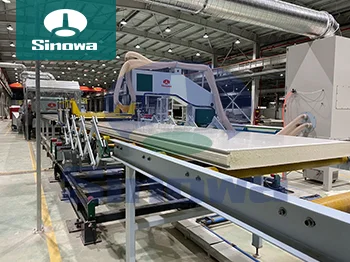
Rock wool core processing and automatic feeding form another critical segment of this fully automatic production line. Bulk rock wool blocks are delivered to the feeding station, where cutting devices trim the raw rock wool into strips with uniform thickness and width according to preset panel specifications. The system arranges these rock wool strips tightly together to eliminate gaps inside the finished sandwich panel. Poorly arranged core material often leads to hollow sections and uneven mechanical performance, so automatic alignment and arrangement functions are integrated into this module to maintain dense and consistent core filling. Some configurations include fiber orientation adjustment units to arrange rock wool fibers in directions that optimize compressive strength and sound absorption performance. After trimming and arrangement, the rock wool core is transported forward at the same linear speed as the upper and lower metal sheets. Before composite bonding, adhesive is evenly applied onto the inner surfaces of the metal skins. The glue application system controls coating volume precisely to avoid excessive adhesive waste or insufficient bonding. Uniform glue distribution guarantees reliable adhesion between rock wool and metal faces across the full panel area. This automated core handling removes heavy manual labor for lifting, cutting and placing rock wool pieces, which also lowers workplace safety risks associated with repetitive material handling tasks in traditional production workflows.
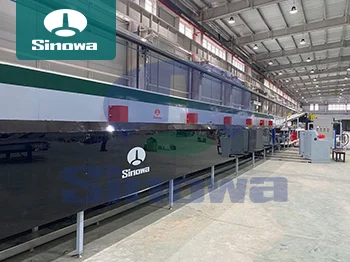
Composite pressing and curing represent the core forming stage where metal skins and rock wool cores are permanently bonded into integrated sandwich panels. Once the rock wool core is positioned between two metal sheets, the assembled assembly enters the continuous pressing section. The pressure applied is carefully calibrated to compress the layers together without crushing the porous rock wool structure. Too much pressure would damage the insulation core and reduce thermal performance, while insufficient pressure creates weak bonding that causes delamination later. The pressing platform maintains stable pressure and uniform contact across the whole panel width as the product moves forward. Inside the curing tunnel, controlled temperature conditions support adhesive solidification, forming strong bonds between rock wool and metal surfaces. Temperature parameters can be adjusted according to adhesive types and production speed to maintain stable curing effects. The entire composite and curing process proceeds continuously without stopping the production line. After curing, the bonded panel gains enough structural strength to maintain its shape through subsequent cutting and handling. This continuous composite process greatly improves output compared with batch pressing methods, where individual panels are loaded and pressed one by one. The low-cost line design retains stable pressure and temperature control, avoiding unstable thermal zones or pressure fluctuations that could create inconsistent bonding quality in mass production.
Following the curing stage, the continuous panel travels to the online cutting and edge trimming unit for final sizing. The cutting system tracks the moving panel in real time and performs fixed-length cutting automatically according to preset length parameters. It does not require stopping the main production line during cutting, preserving continuous operation and overall output capacity. Hydraulic or servo-driven cutting tools deliver clean cuts, reducing rough edges and material waste. Edge trimming devices remove excess material from panel sides to ensure consistent width and neat edges for easy assembly on construction sites. After cutting, finished single panels separate from the continuous strip and move onto the output conveyor. Sensors detect each panel and transmit position signals to downstream stacking equipment. Operators can modify target panel length through the central control interface, allowing flexible switching between different product sizes for various project requirements. The cutting unit includes safety interlock functions to halt operation when abnormal conditions appear, protecting both equipment and on-site workers. While built with cost efficiency in mind, the cutting module keeps dimensional tolerance within practical ranges for building applications, minimizing post-production rework and manual trimming. This automated sizing process reduces material loss and improves the overall yield rate of rock wool sandwich panel manufacturing.
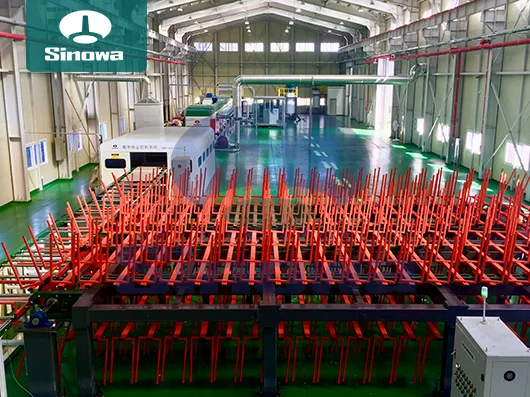
Automatic conveying and stacking systems handle finished panels after cutting, completing the full closed-loop workflow of the production line. Once individual panels exit the cutting station, conveyor belts transfer them steadily toward the stacking area. The stacking mechanism arranges finished panels neatly, separating each layer with protective measures to prevent surface scratches or edge damage during stacking. When a stack reaches the preset quantity, the system signals for forklift transfer, and a new stack begins automatically. This automated stacking eliminates heavy manual lifting and stacking work, which is physically demanding and may cause panel deformation or surface damage. The conveying speed matches upstream production speed to prevent panel piling or empty gaps on the output table. Operators only need to remove full stacks periodically and prepare space for new finished products. This stage also supports simple visual inspection access, allowing staff to spot surface defects, bonding faults or dimensional deviations quickly. Any non-conforming panels can be separated from qualified products before packaging and shipment. By automating panel handling after production, the whole line reduces the chance of human-caused damage, lowering rejection rates and improving overall production profitability. The low-priced line version keeps this stacking function practical and reliable without adding unnecessary high-end robotic accessories that raise total investment costs.
The intelligent control system serves as the command center for the entire low price fully automatic rock wool sandwich panel production line, coordinating all mechanical modules and monitoring operational status. A human-machine touch interface allows operators to set production speed, panel dimensions, temperature values, glue application rates and other key parameters. The control unit synchronizes unwinding, forming, core feeding, pressing, curing and cutting so all sections run in matched rhythm. Built-in sensor networks collect real-time data such as line speed, temperature, pressure and motor load. When abnormal conditions emerge, the system triggers alarms and can slow down or stop the line automatically to avoid equipment damage or defective product batches. Historical operation records can be stored for later review, helping technicians identify recurring issues and adjust production parameters. The control software uses straightforward logic, reducing training time for new operators. Complex programming knowledge is not required for daily running and parameter adjustment. Maintenance staff can access diagnostic information to locate faults quickly, shortening downtime. This control architecture delivers reliable automation performance while keeping the overall equipment cost within an affordable range. It avoids overly sophisticated industrial control configurations that bring limited gains for standard rock wool panel manufacturing, making the equipment a balanced choice for producers aiming at stable automated operation without premium control system expenses.
From a long-term operational perspective, the low price fully automatic rock wool sandwich panel production line brings notable economic and practical benefits for manufacturers of insulated building panels. Its continuous automated workflow raises daily output capacity compared with semi-automatic lines, helping suppliers respond to large market orders for industrial wall and roof panels. Rock wool sandwich panels produced on this line feature stable thermal insulation, sound absorption and fire-resistant characteristics, suitable for many types of industrial buildings, storage facilities and commercial construction projects. The reduced labor requirement lowers ongoing operational costs, and consistent automated processing decreases product inconsistency and waste rates. Maintenance requirements are designed to be manageable, with widely available spare parts and simple structural layout to simplify routine upkeep. Regular lubrication, cleaning and inspection can preserve stable running performance for extended service periods. The equipment also supports flexible production adjustments to manufacture panels with different thickness, length and profile options, adapting to changing market demands. For enterprises that want to enter the insulated composite panel sector or upgrade outdated manual production workflows, this production line offers a balanced option between upfront investment and long-term manufacturing capability. It proves that automated continuous rock wool panel manufacturing can be accessible to more producers, supporting the growing market demand for reliable composite insulation panels in modern construction.
« Low Price Fully Automatic Rock Wool Sandwich Panel Production Line » Update Date: 2026/10/17
Tags: Fully Automatic Rock Wool Sandwich Panel Production Line , fully automatic rock wool sandwich panel production line, fully automatic rock wool sandwich panel production line manufacturer, fully automatic rock wool sandwich panel production line supplier, fully automatic rock wool sandwich panel production line for sale, customized fully automatic rock wool sandwich panel production line, china fully automatic rock wool sandwich panel production line
- Custom Rock Wool Panel Production Line
- Fully Automatic Rock Wool Sandwich Panel Production Line On Sales
- Rock Wool Sandwich Panel Line
- Rockwool Production Line On Sales
- Highly Intelligent Rock Wool Sandwich Panel Machine
- Rockwool Production Line
- Low Price Mineral Wool Line
- Automatic Rock Wool Production Line Factory
- Rockwool Sandwich Panel Machine For Construction
- Rock Wool Sandwich Panel Machine
- Mineral Wool Sandwich Panel Line
- Rock Wool Panel Production Line For Building
- High-end Sandwich Panel Rock Wool Production Line
- Mineral Wool Board Production Line For Sale
- High Efficiency Rock Wool Line
- Mineral Wool Production Line For Cold Storage
- Rockwool Machine Supplier
- Rockwool Sandwich Panel Machine Manufacturer
- Rock Wool Sandwich Panel Production Line
- Rockwool Sandwich Panel Production Line
- Links:
- Sandwich Panel Continuous Production Line
- Automatic and Continuous Sandwich Panel Production Line
- Cheap and Low Price Sandwich Panel Production Line
- China Sandwich Panel Production Line Factory
- Color Steel Sandwich Panel Production Line For Cold Storage
- Continuous Composite Foam Sandwich Panel Production Line
- Continuous Production Line For Rockwool and Mineral Wool Sandwich Panels
- Continuous PU Phenolic Insulation Panel Production Line
- Continuous PU PIR Sandwich Panel Production Line
- Continuous PUF PUR Sandwich Panel Production Line
- Continuous Sandwich Panel Production Line For Roof and Wall
- Customized and Design Sandwich Panel Production Line
- Decorative Sandwich Panel Production Line For Glass Wool Boards
- High Quality Sandwich Panel Production Line For Sale
- Polyurethane(PU) Sandwich Panel Production Line
- Sandwich Panel Production Line Manufacturer and Supplier
- Sandwich Panel Production Machinery and Equipment