
High Efficiency Fully Automatic Rock Wool Sandwich Panel Production Line
Sinowa is a well-known manufacturer and technical service provider of high-end fully automatic rock wool sandwich panel production line, learn more about high efficiency fully automatic rock wool sandwich panel production line, please contact Sinowa's technical engineer, tell us what you need, we will contact you as soon as possible!
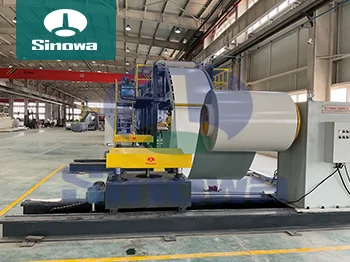
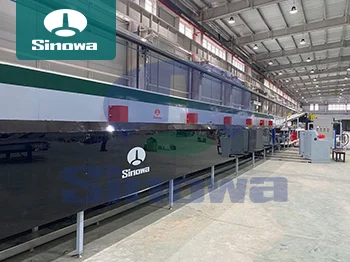
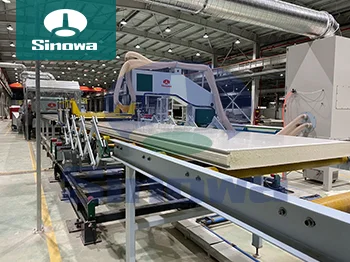
Sinowa is committed to the development and manufacturing of high-end and high-efficiency fully automatic rock wool sandwich panel production line. Our fully automatic rock wool sandwich panel production line are leading the way in efficiency, automatic control, human-computer interaction, environmental protection and energy consumption. Using system integration and bus control technology, it realizes the automatic integrated linkage control of the entire fully automatic rock wool sandwich panel production line, and can achieve remote interactive communication, which has the world-class level and a comprehensive leading high-performance fully automatic rock wool sandwich panel production line in the market.
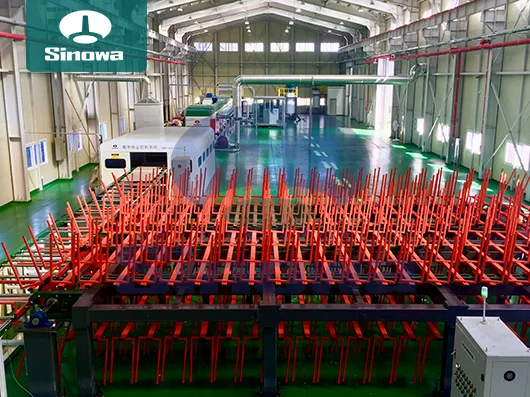
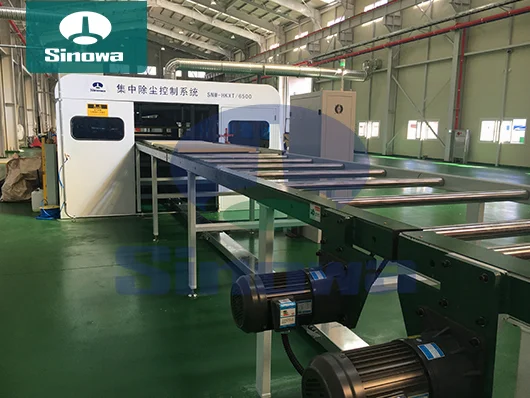
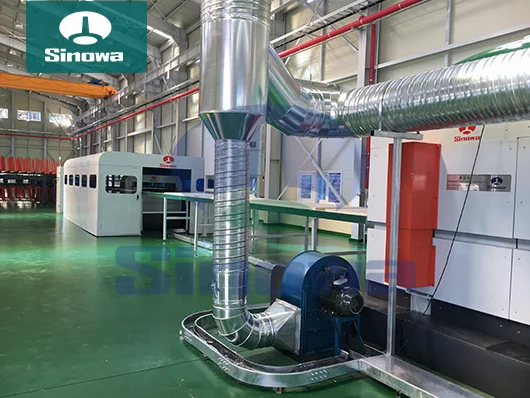
For more than ten years, relying on our innovative manufacturing concept and excellence in quality, reliable and trustworthy service to customers, we cooperate with customers all over the world, exported products to Canada, South Korea, Israel, Australia, the Middle East and other more than 20 countries and regions. contributed to building energy conservation and low-carbon production and have won widespread praise.
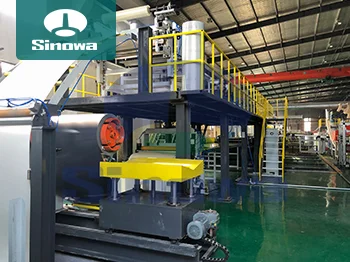
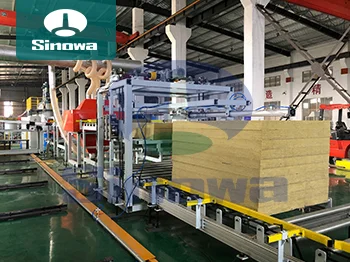
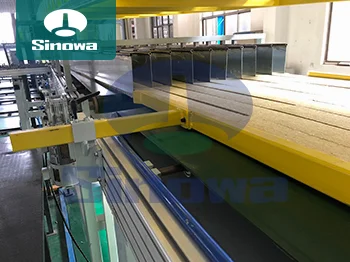
Sinowa has invested outstanding efforts in fully automatic rock wool sandwich panel production line, this is why our products are more efficiency, quality, automatic control technology, environmental protection, energy consumption indicators and the appearance and safety protection are comprehensively leading, some subversive design changes in many major technical points, these major innovations make our products excellent in price/performance and user experience.
High efficiency fully automatic rock wool sandwich panel production line stands as a sophisticated integrated manufacturing system built to streamline the fabrication of composite building panels that combine rock wool core materials with metal facing sheets. Every functional unit within the line is interconnected through synchronized drive and control modules, removing the need for frequent manual intervention that slows down traditional panel manufacturing workflows. Raw rock wool materials enter the system at the feeding section, where continuous spreading and leveling mechanisms arrange the fibrous core into a uniform thickness and consistent density, eliminating uneven spots that would compromise the finished panel’s overall performance. Metal coils are unwound simultaneously from dedicated holding racks, passing through cleaning and surface treatment stations to clear away surface dust, oil residue, and minor blemishes before they move toward the lamination zone. Sensors distributed along the conveying track constantly monitor material feed speed, position alignment, and tension of the metal sheets, making real-time tiny adjustments to prevent offset, wrinkling or tearing during continuous running. Operators only need to set basic production parameters on the central control interface at the start of a production batch, after which the system carries out sequential operations steadily for long stretches of time. This coordinated working mode greatly cuts down labor input on the shop floor and stabilizes product consistency even when the line maintains a sustained running state over multiple shifts.
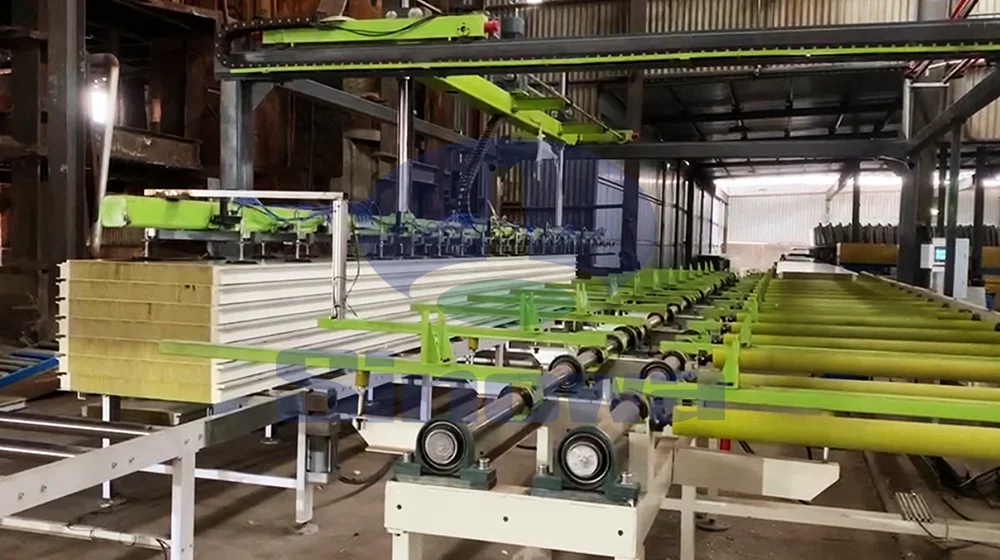
The core lamination and pressing segment of the production line defines the bonding quality between rock wool cores and outer metal layers, relying on controlled pressure, steady temperature and precise timing to form a durable composite structure. Adhesive materials are applied evenly through automatic coating devices, with flow rates matched perfectly to the linear speed of the moving substrate so there is no excess glue dripping or insufficient coverage on the contact surfaces. As the rock wool and metal facings travel together into the pressing chamber, adjustable compression force locks the three components tightly together without crushing the porous fibrous structure of the rock wool, which preserves its inherent functional properties. The pressing equipment maintains uniform force distribution across the full width of panels, avoiding localized gaps or weak bonding points that could appear in semi-automatic processes relying on manual clamping. After the pressing stage, panels move through a holding area where the adhesive gets adequate time to cure under stable environmental conditions built into the line layout. All curing related parameters are tracked automatically, and any deviation from preset ranges triggers gentle speed regulation instead of an immediate full stop, reducing material waste caused by sudden shutdowns. This balanced combination of mechanical pressure and controlled bonding creates panels with reliable structural integrity suitable for long-term service in various construction environments.
Cutting and shaping functions are embedded into the continuous workflow of the automatic line, allowing finished composite panels to be divided into required lengths without disrupting the uninterrupted material flow upstream. A flying saw cutting unit follows the moving panel synchronously during the cutting action, which means the main conveyor does not have to pause for every single cut, a key feature that lifts overall production efficiency significantly. Cutting blades are engineered to deliver clean, smooth edges on both metal skins and rock wool cores, minimizing frayed fibers and sharp burrs that would require extra trimming work later. Before each cut takes place, position detection tools verify the actual length of the panel against target values, compensating for minor stretching or slipping that may happen during conveyance. Optional notching and edge trimming attachments can run alongside the cutting station to prepare panel edges for easy interlocking assembly on construction sites, forming neat matching joints once panels are installed. All cut pieces continue forward on conveyors immediately after separation, keeping material turnover smooth and preventing backlogs at transition points. This seamless cutting design removes a separate offline cutting process from the manufacturing chain and shortens the total cycle time from raw material input to finished panel output.
Automatic conveying, flipping and stacking mechanisms handle finished panels once they pass the cutting station, replacing heavy manual lifting and sorting work that carries safety risks and limits throughput. Adjustable support rollers and belt conveyors carry individual panels steadily, with soft contact surfaces to stop scratches and indentations on the painted metal outer surfaces. Flipping devices rotate panels at set intervals so both sides can be inspected, or to arrange them in the correct orientation for stacking, with rotation speed synchronized to the pace of incoming panels. Stacking stations collect panels layer by layer, with spacing control to keep panel surfaces from rubbing against each other, and counting modules record the total number of panels in each stack automatically. Once a stack reaches the preset quantity, the system signals for it to be moved away and prepares space for a new stack without pausing upstream production. These material handling units work in harmony with the main production rhythm, so finished products accumulate in orderly stacks ready for subsequent packaging. Reducing physical handling by workers also lowers the chance of accidental panel damage and helps maintain a tidier, safer working area inside the production workshop day after day.
The intelligent control system serves as the central nervous system of the entire rock wool sandwich panel line, linking all separate mechanical sections and guaranteeing synchronized operation across every processing stage. A centralized human-machine interface gathers all running data from feeding, coating, pressing, cutting and stacking stations, displaying real-time speed, material consumption, running status and fault prompts in clear visual form. Production recipes can be saved within the control system for different panel specifications, letting operators switch between different panel thicknesses, widths and core density settings with just a few selections rather than readjusting every mechanical parameter one by one. Built-in protection logic responds to abnormal conditions such as material jams, material shortage or pressure anomalies by slowing relevant sections or issuing warning alerts before serious damage occurs. Historical production records are stored automatically, making it simple to review batch output, operating duration and abnormal events for routine production analysis. The control framework supports gradual fine-tuning during continuous operation, so minor adjustments can be made without halting the whole line for lengthy reconfiguration. This level of centralized automation simplifies daily management and helps production teams maintain stable output targets over extended operation periods.
Maintenance design of the high efficiency production line focuses on easy access to key wearing parts and predictable inspection cycles to limit downtime and extend the service life of the whole equipment set. Critical moving components, drive chains, coating nozzles and cutting blades are positioned at accessible inspection points, with protective covers that can be removed quickly for cleaning, lubrication or replacement. Lubrication points for rotating parts are arranged to support regular scheduled upkeep, and many rotating assemblies adopt sealed structures to block rock wool fiber dust from entering bearing spaces and causing premature wear. Dust collection interfaces are fitted near cutting and trimming zones to capture loose rock wool fibers at the source, stopping fine debris from building up on control panels, sensors and drive systems over time. The equipment layout reserves sufficient clearance around each functional unit for maintenance staff to carry out checks without interfering with adjacent running sections. Clear diagnostic feedback from the control system pinpoints the general area of a fault, cutting down the time spent searching for problems during breakdown events. Thoughtful maintenance planning reduces unplanned stops and helps the line retain its designed high efficiency level through long periods of regular use.
Energy consumption optimization is integrated into the mechanical and control design of the fully automatic line, balancing high production speed with reasonable resource use in daily manufacturing. Variable frequency drive units are used on conveyors, pressing motors and fans, so power output adjusts according to actual production load instead of running at a fixed high power level continuously. Heating and temperature control modules only maintain required working conditions for the bonding process, with heat insulation structures around working chambers to cut heat loss to the surrounding workshop space. Dust extraction fans and auxiliary motors activate only when related processing stations are in operation, rather than running nonstop through the entire production shift. The synchronized workflow also reduces repeated start-stop cycles that create energy spikes and extra mechanical stress on motors and transmission parts. Even with these energy saving features, the system does not sacrifice processing stability or finished panel quality, keeping consistent bonding strength and dimensional accuracy for every produced panel. Careful energy management brings steady operational cost benefits over time while supporting continuous, high-volume panel production for large scale manufacturing demands.
When deployed in a production facility, this fully automatic rock wool sandwich panel line reshapes the overall operational rhythm of composite panel manufacturing by merging separate processing steps into one continuous, self-regulating sequence. It adapts well to steady batch production of panels with varied dimensional requirements, delivering uniform finished products that meet practical application demands for enclosure systems. The reduction of repetitive manual tasks allows factory personnel to shift focus toward parameter monitoring, quality sampling, equipment inspection and production scheduling instead of constant material handling and alignment work. The compact, linked structure of the line also makes efficient use of workshop floor space, arranging all stages in a logical flow that minimizes unnecessary movement of semi-finished goods across the plant. As market demand for reliable composite building panels keeps growing, this kind of automated production setup offers a scalable way to lift manufacturing capacity while sustaining stable product performance across production batches. The combination of synchronized mechanics, responsive control and thoughtful auxiliary functions makes it a practical, high-productivity solution tailored for modern sandwich panel manufacturing operations.
« High Efficiency Fully Automatic Rock Wool Sandwich Panel Production Line » Update Date: 2026/10/21
Tags: Fully Automatic Rock Wool Sandwich Panel Production Line , fully automatic rock wool sandwich panel production line, fully automatic rock wool sandwich panel production line manufacturer, fully automatic rock wool sandwich panel production line supplier, fully automatic rock wool sandwich panel production line for sale, customized fully automatic rock wool sandwich panel production line, china fully automatic rock wool sandwich panel production line
- Low Price Rock Wool Sandwich Panel Line
- High-quality Automatic Rock Wool Production Line
- Rock Wool Board Production Line For Building
- Rockwool Sandwich Panel Production Line On Sales
- High-tech Fully Automatic Rock Wool Sandwich Panel Machine
- High-tech Rock Wool Panel Production Line
- Low Price Fully Automatic Rock Wool Sandwich Panel Production Line
- Rock Wool Sandwich Panel Machine For Construction
- Customized Rockwool Production Line
- Rock Wool Sandwich Panel Machine For House
- Rock Wool Sandwich Panel Machine For Building
- Rockwool Sandwich Panel Production Line For Cold Storage
- High-tech Mineral Wool Line
- Mineral Wool Sandwich Panel Machine For Cold Storage
- High-quality Rockwool Sandwich Panel Production Line
- Rock Wool Sandwich Panel Machine For Roof
- Rock Wool Production Line For Sale
- Rock Wool Machine Factory
- High-end Rockwool Sandwich Panel Line
- Rock Wool Sandwich Panel Production Line For Cold Room
- Links:
- Sandwich Panel Continuous Production Line
- Automatic and Continuous Sandwich Panel Production Line
- Cheap and Low Price Sandwich Panel Production Line
- China Sandwich Panel Production Line Factory
- Color Steel Sandwich Panel Production Line For Cold Storage
- Continuous Composite Foam Sandwich Panel Production Line
- Continuous Production Line For Rockwool and Mineral Wool Sandwich Panels
- Continuous PU Phenolic Insulation Panel Production Line
- Continuous PU PIR Sandwich Panel Production Line
- Continuous PUF PUR Sandwich Panel Production Line
- Continuous Sandwich Panel Production Line For Roof and Wall
- Customized and Design Sandwich Panel Production Line
- Decorative Sandwich Panel Production Line For Glass Wool Boards
- High Quality Sandwich Panel Production Line For Sale
- Polyurethane(PU) Sandwich Panel Production Line
- Sandwich Panel Production Line Manufacturer and Supplier
- Sandwich Panel Production Machinery and Equipment